

IDT Added Eight Dollars of Gross Profit in Payments for Every One Its Calling Book Lost
Hypothesis Opus 5 · Research Opus 5 · Writing Opus 5 · Prompt v1.7
A company still classified as a telecom operator now makes almost all of its profit growth selling checkout terminals and remittances to corner stores, and the market repriced it in a single session after the annual results.
IDT's fiscal 2026, ended 31 July, lifted group gross profit to $496.8m while the international-calling business it is managing down shed only a small fraction of that. NRS, its convenience-store terminal network, raised average monthly gross profit per retailer location to $383 from $315, and group adjusted EBITDA rose 17% to $154.6m.
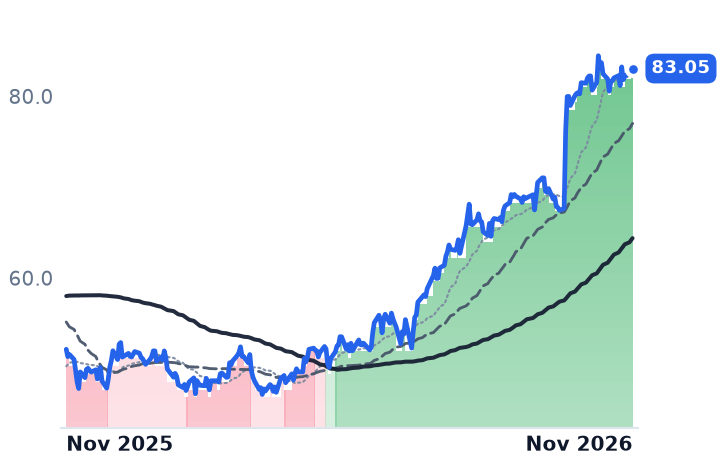
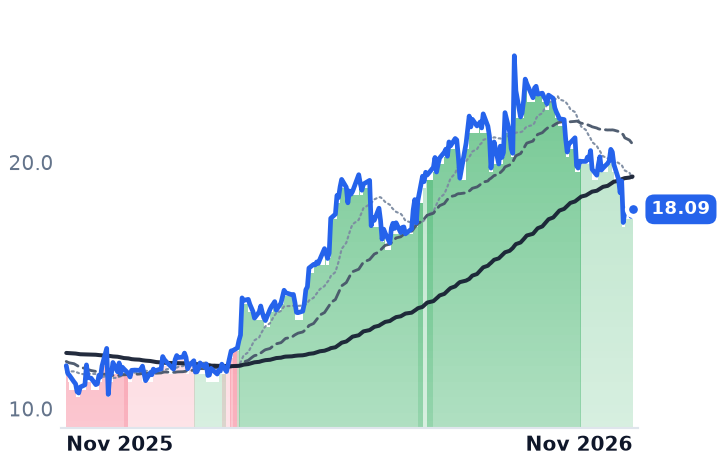
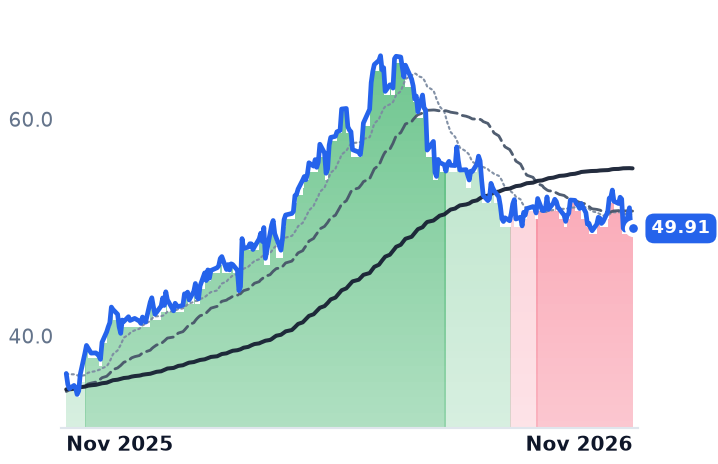
The operating record supports the story; the share price has outrun it. The trailing earnings multiple has gone from roughly 16x in May to 24.0x while trailing earnings per share rose about 6%, so most of the six-month gain is re-rating. The peers in the same industry classification do not share the mechanism: Ituran is in a downtrend and Ooma buys its growth.
| Ticker | Company | Segment | Trend · 13mo | 30D | 1Y |
|---|---|---|---|---|---|
| The subject · what this brief is about | |||||
IDT | IDT | Regional & Specialty Operators | 🟢 Cont. Bull | +1.3% | +59.2% |
| Compared against · context, not the story | |||||
OOMA | Ooma | Regional & Specialty Operators | 🟢 Cont. Bull | −10.5% | +54.0% |
ITRN | Ituran Location and Control | Regional & Specialty Operators | ⚠️ Emerging Bear | −0.8% | +36.7% |
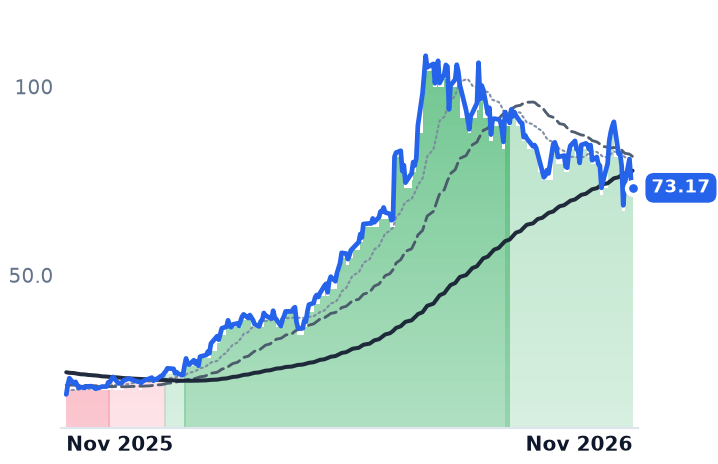
ATEX | Anterix | Regional & Specialty Operators | 🟢 Cont. Bull | −13.5% | +298.7% |
12-month price & trend
| Ticker | Mkt cap | P/E | P/E fwd | P/S | P/S fwd | P/GP | P/GP fwd | EV/EBITDA | FCF yld |
|---|---|---|---|---|---|---|---|---|---|
IDT | $2.1B | 24.0x | 19.7x | 1.6x | 1.6x | 4.2x | 4.1x | 11.9x | 3.3% |
OOMA | $505.1M | 46.4x | 13.4x | 1.6x | 1.5x | 2.7x | 2.5x | 18.6x | 6.0% |
ITRN | $987.0M | 15.4x | 13.9x | 2.5x | 2.4x | 5.0x | 4.7x | 8.4x | 8.4% |
| Ticker | Mkt cap | P/E | P/E fwd | P/S | P/S fwd | P/GP | P/GP fwd | EV/EBITDA | FCF yld |
|---|---|---|---|---|---|---|---|---|---|
ATEX | $1.5B | 190.1x | — | 201.5x | 69.3x | 201.5x | 69.3x | 204.4x | -0.5% |
Consensus projections
| Ticker | FY2026E | FY2027E | FY2028E | |
|---|---|---|---|---|
IDT | Revenue | +4.3% | +4.0% | +0.8% |
| EPS | +18.1% | +9.6% | +5.7% | |
OOMA | Revenue | +5.6% | +22.9% | +4.8% |
| EPS | +64.6% | +36.7% | +9.7% | |
ITRN | Revenue | +16.5% | +5.4% | +7.5% |
| EPS | +23.8% | +8.6% | +9.4% | |
ATEX | Revenue | −2.2% | +256.4% | −9.5% |
| EPS | −316.3% | −112.0% | +57.6% |
Forward fiscal years only. Blank means no analyst coverage for that year.
IDT Corporation closed its fiscal year on 31 July with the shrinking half of its business finally mattering less than the growing half. Group gross profit reached $496.8m, an increase of $50.6m, while the Traditional Communications segment, prepaid international calling and wholesale voice and still two-thirds of revenue, gave up about $6.8m of gross profit, a 4% decline per the annual report. The Newark, New Jersey company added roughly eight dollars of gross profit in its growth units for every dollar the legacy book lost.
That arithmetic is what the market bought on 29 September, the session after the print, when the stock gapped 12.7% to $76.20 on volume six times the prior day's. The quarter was read as proof that a melting telecom shell had become a payments and software group. It is proof of that. What it does not establish is the price: the shares have risen 59% in six months, and with trailing earnings per share up about 6% over that span, a derived split puts roughly 50 of those 59 points in multiple expansion, from near 16x trailing earnings in May to 24.0x now.
The terminal in the corner store is the whole engine
NRS sells point-of-sale terminals, card processing and in-store advertising to independent convenience, liquor, tobacco and gas-station retailers. It ended the year with 35,400 retailer locations, 2,700 more than a year earlier, and about 95% of its revenue recurring. Revenue rose 24% to $159.4m and segment gross profit was $146.6m on 12.3% of group revenue: the margin structure of a software business attached to a hardware socket.
Both axes of unit economics moved at once. Average monthly gross profit per retailer location rose 22% to $383 from $315 a year earlier, driven primarily by adoption of NRS Pay, the payment-processing product, with revenue per terminal up about 10%. Fourth-quarter merchant services rose 31% to $28.5m and segment adjusted EBITDA rose 47% to $14.0m at a 31% margin.
The advertising leg is the soft spot. It grew 49% to $10m in the fourth quarter but declined for the full year, because industry ad rates fell as streaming services launched ad-supported tiers and flooded digital inventory. The data underneath it is real: in March, NRS terminals processed $2.2bn of sales across 145m transactions.
NRS is also the smallest player in a market with giants in it. Fiserv's Clover holds roughly 20% of small-restaurant point-of-sale card processing across about 175,000 locations, with Block's Square and Lightspeed alongside. NRS's defense is the independent bodega, where it describes itself as the leading network in the United States and Canada.
Remittances got a tax break; calling got the bill
Fintech, which is 90% BOSS Money remittances, grew revenue 14% to $176.0m with gross margin up 650 basis points to 66% and digital at 88% of fourth-quarter transactions. A federal excise tax enacted in the One Big Beautiful Bill Act charges 1% on transfers funded with cash, money orders or cashier's cheques while exempting electronic funding, a rule that pushes customers toward IDT's higher-margin channel. Management expects the same shift to cost it roughly 17% of the retail PIN-less business.
"The rotation toward our high-margin growth businesses is accelerating. Our top line is growing faster, and we are entering fiscal '27 debt-free with a stronger balance sheet and a lot of momentum," chief financial officer Marcelo Fischer told investors on the 28 September earnings call.
The filing names a cause for the legacy decline. BOSS Revolution calling revenue fell 16% year on year in the April quarter as unlimited plans and free over-the-top voice and messaging cut demand for prepaid minutes. Segment adjusted EBITDA still rose 1% to $77m, because selling costs were cut 6%.
net2phone, the cloud phone unit, is the third leg and the weakest competitively: 447,000 seats, up 6%, with subscription revenue near $94.6m, up about 10%, and segment EBITDA up 33% to $16.1m. Worldwide unified-communications seats totalled roughly 114m in the first half of 2025, with Microsoft at 21.7%, so net2phone's installed base is about 0.4% of the market. Its growth is footprint, not displacement.
What the results carry and what they do not
NRS, Fintech and net2phone now produce 53% of consolidated adjusted EBITDA on about a third of revenue, against 46% a year earlier, and group adjusted EBITDA rose 17% to a record $154.6m. Gross margin widened in each of the four quarters, 36.6% to 39.8%. Buybacks are beside the point: 422,000 shares for $21m cut the diluted count 1.1%, about one point of the 15% rise in earnings per share. The gain came from operations.
The valuation is where the story stops agreeing with itself.
At 11.9x trailing enterprise value to EBITDA, IDT is no longer cheap against Ituran Location and Control, the Israeli stolen-vehicle-recovery and fleet-telematics subscriber business, at 8.4x and 15.4x trailing earnings. Ooma, the Sunnyvale small-business cloud phone provider that competes directly with net2phone, grew subscription revenue to $75.6m from $61.1m, but primarily through the December 2025 purchases of FluentStream and Phone.com; on price to gross profit it sits at 2.68x against IDT's 4.15x. IDT's forward 19.7x rests on a single analyst's estimate whose implied EBITDA is below the company's own guidance of $176-180m, against gross profit guided to $545-555m.
The companies filed under the same industry heading are not running the same business or the same chart. Ituran, which has not reported since its 12 August beat and releases third-quarter results on 24 November, has fallen 18% in six months on de-rating rather than disclosed deterioration. Anterix, in the same heading, is a spectrum-licensing asset story with $1.96m of quarterly revenue. The thirty-day weakness around them tracks the discount rate, with the 10-year Treasury yield back at 5.00% and the Russell 2000 in correction since mid-October, a channel that works through borrowing costs. IDT, debt-free with $271.9m of cash and securities, does not pay them.
The company has also retired the metric that let outsiders check its best story. NRS is shifting disclosure to retailer locations and monthly gross profit per location and dropping the terminal recurring-revenue series, so the next test of whether $383 a month keeps climbing will be a number IDT alone defines.