

Accenture Prices Two-Thirds of New Bookings in Advance and Keeps the AI Savings
Hypothesis Opus 5 · Research Opus 5 · Writing Opus 5 · Prompt v1.7
Three IT services companies tell clients the same story about AI making delivery cheaper. Only the one whose work is priced before the hours are worked gets to keep the money, and the market is paying the highest price per dollar of delivery profit for the one that has conceded it is handing the saving back.
Accenture closed fiscal 2026 with record new bookings of $84.54bn and operating income up 11.5% on revenue up 6.5%. Infosys's AI work reached 10.5% of revenue while total revenue grew 1.5% and full-year guidance was cut. Cognizant sits between them: adjusted operating margin at a four-year high, quarterly bookings down.
Accenture's order book accounts for its advance. Infosys, at 8.07x trailing gross profit against Accenture's 6.31x, is the dearest of the three per dollar of delivery profit.
| Ticker | Company | Segment | Trend · 13mo | 30D | 1Y |
|---|---|---|---|---|---|
| The subject · what this brief is about | |||||
ACN | Accenture | Consulting & Professional Services | 🌱 Emerging Bull | +17.8% | +5.0% |
CTSH | Cognizant Technology Solutions | Consulting & Professional Services | 🌱 Emerging Bull | +4.1% | −12.3% |
INFY | Infosys | Consulting & Professional Services | 🔴 Cont. Bear | +6.9% | −28.0% |
| Compared against · context, not the story | |||||
EPAM | EPAM Systems | Consulting & Professional Services | 🌱 Emerging Bull | +40.5% | −9.8% |
G | Genpact | Consulting & Professional Services | 🌱 Emerging Bull | +20.4% | −5.4% |
GLOB | Globant | Consulting & Professional Services | 🔴 Cont. Bear | +24.2% | −23.3% |
WIT | Wipro | Consulting & Professional Services | 🔴 Cont. Bear | +18.5% | −20.5% |
IT | Gartner | Research & Analytics Services | 🌱 Emerging Bull | −5.4% | −18.8% |
NVDA | NVIDIA | Processors & Accelerators | 🟢 Cont. Bull | −22.7% | −10.4% |
SPY | State Street SPDR S&P 500 ETF Trust | Asset Management | 🟢 Cont. Bull | −1.9% | +12.1% |
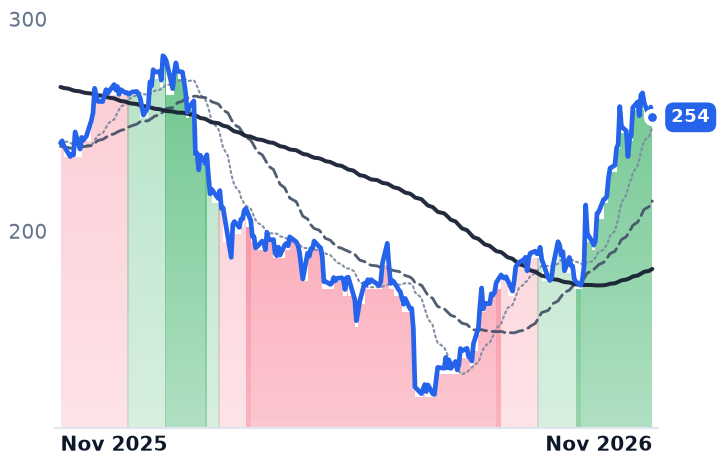
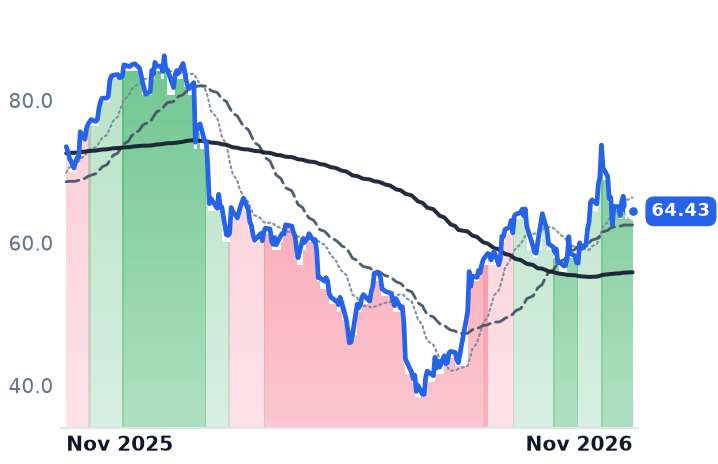
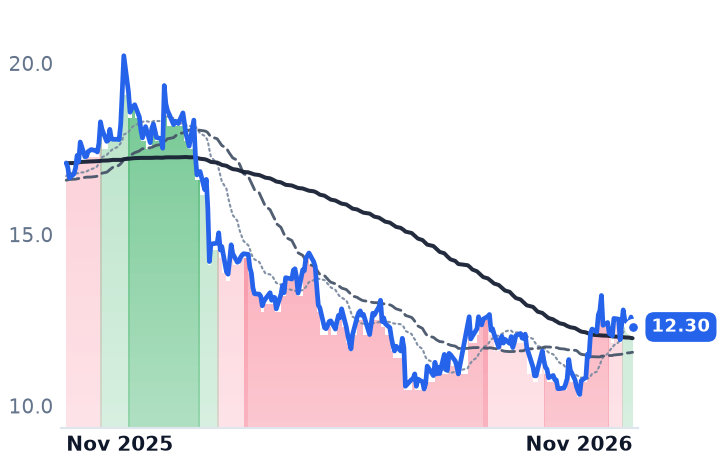
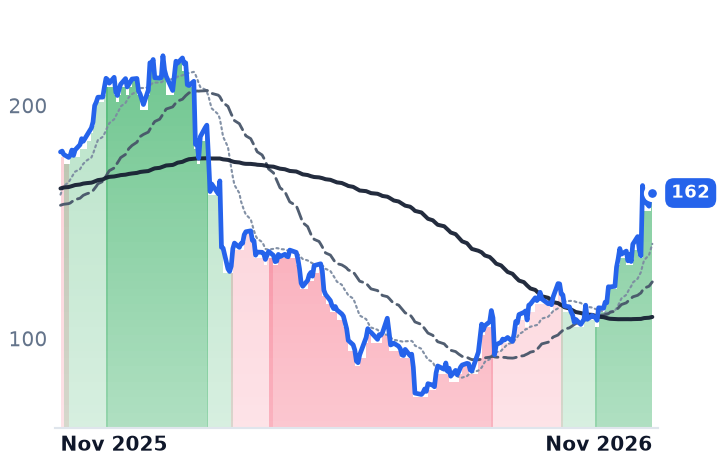
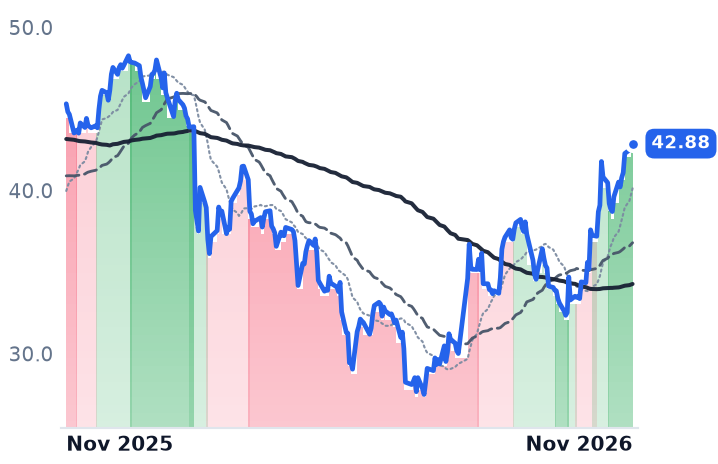
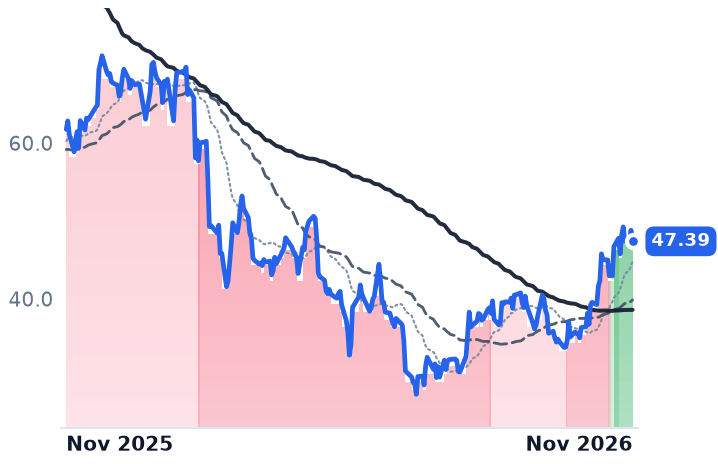
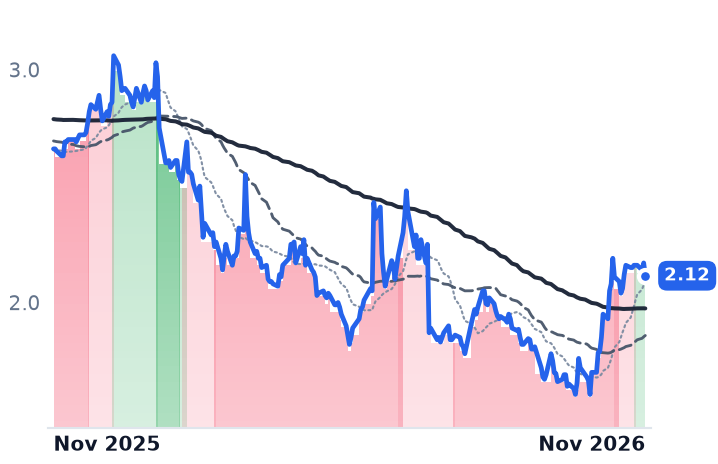
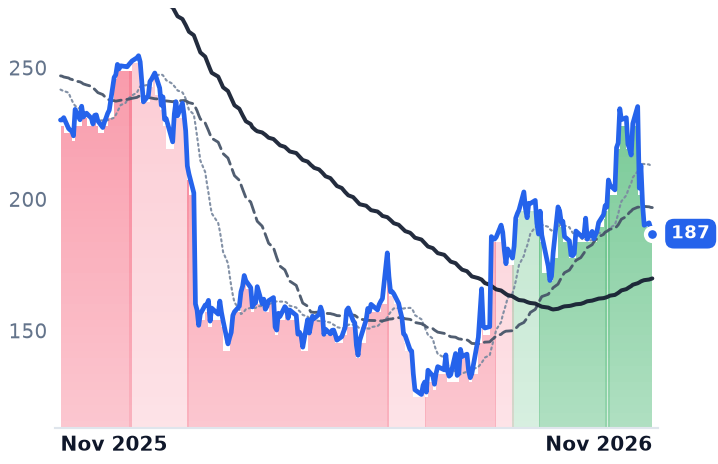
12-month price & trend
| Ticker | Mkt cap | P/E | P/E fwd | P/S | P/S fwd | P/GP | P/GP fwd | EV/EBITDA | FCF yld |
|---|---|---|---|---|---|---|---|---|---|
ACN | $149.9B | 18.6x | 17.3x | 2.0x | 1.9x | 6.3x | 6.0x | 11.3x | 7.8% |
CTSH | $28.8B | 11.7x | 11.2x | 1.3x | 1.3x | 4.1x | 4.1x | 7.2x | 8.2% |
INFY | $49.9B | 15.2x | 15.3x | 2.5x | 2.4x | 8.1x | 8.0x | 10.0x | 7.3% |
| Ticker | Mkt cap | P/E | P/E fwd | P/S | P/S fwd | P/GP | P/GP fwd | EV/EBITDA | FCF yld |
|---|---|---|---|---|---|---|---|---|---|
EPAM | $8.2B | 19.9x | 12.1x | 1.5x | 1.5x | 5.0x | 5.0x | 10.0x | 5.7% |
G | $7.0B | 11.9x | 10.0x | 1.3x | 1.3x | 3.5x | 3.5x | 7.7x | 5.1% |
GLOB | $2.0B | 18.4x | 8.0x | 0.8x | 0.8x | 2.6x | 2.6x | 7.9x | 15.6% |
| Ticker | Mkt cap | P/E | P/E fwd | P/S | P/S fwd | P/GP | P/GP fwd | EV/EBITDA | FCF yld |
|---|---|---|---|---|---|---|---|---|---|
WIT | $21.4B | 15.5x | — | 2.0x | — | 7.0x | — | 10.1x | 8.4% |
IT | $12.4B | 17.5x | 13.5x | 1.9x | 1.9x | 2.8x | 2.8x | 10.6x | 10.4% |
NVDA | $5.5T | 34.3x | 25.0x | 21.5x | 13.9x | 29.0x | 18.7x | 28.3x | 2.2% |
| Ticker | Mkt cap | P/E | P/E fwd | P/S | P/S fwd | P/GP | P/GP fwd | EV/EBITDA | FCF yld |
|---|---|---|---|---|---|---|---|---|---|
SPY | $773.0B | — | — | — | — | — | — | — | — |
Consensus projections
| Ticker | FY2026E | FY2027E | FY2028E | |
|---|---|---|---|---|
ACN | Revenue | +6.0% | +5.3% | +5.1% |
| EPS | +7.6% | +5.9% | +8.7% | |
CTSH | Revenue | +4.8% | +3.8% | +4.3% |
| EPS | +11.2% | +8.6% | +7.9% | |
INFY | Revenue | +1.6% | +5.4% | +3.2% |
| EPS | +2.4% | +5.3% | +4.5% | |
EPAM | Revenue | +3.9% | +3.4% | +4.7% |
| EPS | +15.1% | +6.9% | +7.2% | |
G | Revenue | +7.2% | +7.1% | +7.9% |
| EPS | +13.9% | +9.4% | +10.7% | |
GLOB | Revenue | −0.3% | +2.0% | +3.2% |
| EPS | −3.0% | +4.1% | +3.8% | |
WIT | Revenue | +5.4% | +7.5% | +2.8% |
| EPS | +4.6% | +5.1% | +3.6% | |
IT | Revenue | −1.2% | +4.2% | +5.1% |
| EPS | +13.2% | +13.8% | +14.8% | |
NVDA | Revenue | +65.1% | +84.2% | +43.2% |
| EPS | +59.0% | +91.7% | +42.0% |
Forward fiscal years only. Blank means no analyst coverage for that year.
Accenture closed its fiscal year on 1 October with the biggest order book in its history, and the term that matters inside it is not a growth rate but a pricing clause. Fixed-price and outcome-based work now exceeds 65% of new bookings, which means scope delivered in fewer hours than quoted leaves the saving in Accenture's own gross profit instead of in a smaller invoice.
For a year the market treated enterprise IT services as generative AI's clearest casualty: if the model writes the code, the firm that bills for the coder loses the hour. All three of the largest listed names have now reported inside five weeks. Their disclosures say the hour is not the variable that decides. Contract form is, and it splits them — Accenture keeps the productivity gain, while Infosys has told investors it is passing it through.
The half of the book where price is agreed first
Accenture's fiscal 2026 new bookings were an all-time high $84.54bn, up 5%, at a book-to-bill of 1.1. Inside the fourth quarter the mix is the finding: managed services, the outsourcing half where price is contracted in advance, took $12.77bn of bookings at a book-to-bill of 1.4, against consulting's $9.40bn at exactly 1.0. The firm signed 141 deals of $100m or more in the quarter against 129 a year earlier.
That shows up where it should. Fiscal 2026 revenue of $74.18bn rose 6.5% while operating income rose 11.5%, with gross margin at 32.05% against 31.91%. "We continue to believe the opportunities related to AI are greater than the impact of AI-related efficiencies in our business," chair and chief executive Julie Sweet told investors on 1 October.
The caution is in the guide. Accenture's fiscal 2027 outlook of 3-6% local-currency growth includes 2-2.5 points from acquisitions, leaving roughly 2-2.5% organic at the midpoint, a step down from fiscal 2026's 5%. Capability is being bought: $4.9bn spent on acquisitions in fiscal 2026, around $5bn more planned. At 17.3x forward earnings against 12.3x in mid-August, almost the whole three-month re-rating is the multiple rather than the estimates.
Cognizant's margin gain is not coming from delivery
Cognizant's adjusted operating margin reached 16.3% in the third quarter, a seventh consecutive year-on-year expansion, while GAAP operating margin of 15.4% fell 60 basis points. Below that headline, gross margin slipped to 33.77% from 33.87% and gross profit grew 4.3% against revenue's 4.6%. The engagement itself got no more profitable; the gain arrived from costs below the delivery line, where Project Leap restructuring is worth about $200m this year.
The pyramid got both busier and bigger: utilisation excluding trainees rose to 86% from 85% and headcount reached 359,900 at 30 September. Fixed-price and transaction work is now nearly 58% of revenue, up some 500 basis points since 2022. But third-quarter bookings fell 7% year on year and 2026 constant-currency guidance was cut to 4.0-4.4% from 4.0-5.5%. "The rebaselining of productivity has already happened to a large extent," chief executive Ravi Kumar said on 29 October. Cognizant is the cheapest of the three at 11.2x forward earnings and 4.11x trailing gross profit.
Infosys put a number on the giveback
Infosys disclosed AI revenue at 10.5% of the total in the September quarter, up from 8.2%. Applying those shares to reported revenue implies AI work grew by about $124m sequentially, to roughly $541m, while consolidated revenue rose only about $70m: the non-AI book shrank some $54m in the same three months. Group revenue of $5.152bn was up 1.5%.
The order intake is not the problem. "We won 19 large deals in Q2 with a TCV of $5.2 billion, which is second highest quarterly TCV in last five years. Of this, 62% was net new," chief financial officer Jayesh Sanghrajka said on 23 October. Price is. "Growth was below our expectations. Volume was softer, and price increases were lower than anticipated amidst high competitive intensity," he said the same day. Infosys cut fiscal 2027 growth guidance to 1-2% from 1.5-3%, and the company's own list of second-half margin pressures includes "continued sharing of AI driven productivity benefits." It walked away from work worth 1.8-2% of fiscal 2027 revenue rather than match the givebacks clients asked for.
Headcount rose 4,400 in the quarter and annualised revenue per employee, derived from reported revenue and disclosed staff numbers, was flat near $62,700. The growth came from heads. Infosys is also the only one of the three whose forward earnings multiple, 15.3x, sits above its trailing 15.2x, and at 8.07x trailing gross profit it is dearer per dollar of delivery profit than Accenture at 6.31x.
What the autumn bid actually bought
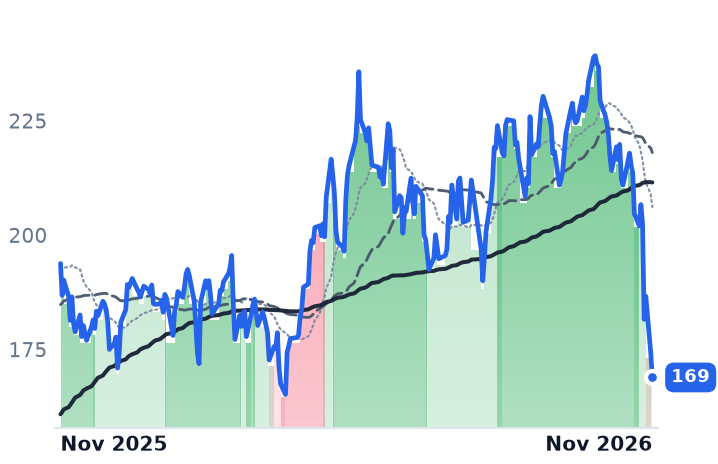
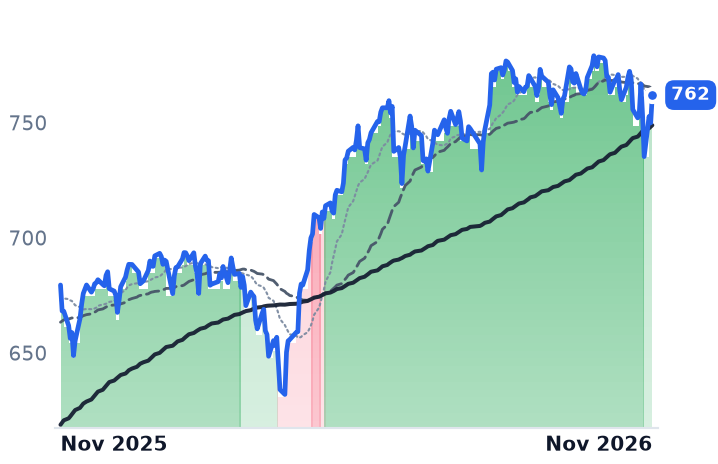
Accenture has risen 18.1% over 30 days to 11 November and 42.7% over three months, including a 15.9% session on its results, yet it is up only 4.6% on the year. Cognizant gained 8.0% over 30 days and remains 11.9% below its level a year ago. Infosys gained 13.6%, the best of the three, while sitting 27.7% below last November. The bid is shelf-wide — EPAM rose 40.5% over the same 30 days, Globant 24.2%, Genpact 20.4% — while Gartner, which sells research rather than delivery labor, fell 5.4%. On 5 November, when Nvidia fell 10.3%, all three services names closed higher, and Indian IT shares rallied the next day against an AI-linked selloff. The likelier reading for the Infosys leg is rotation out of AI hardware rather than anything Infosys disclosed.
So one of the three moves is earned on the meters that matter. Accenture's order book and its operating leverage both inflected, and the mechanism is legible: under a contract whose price was agreed before the work, fewer hours is margin. Cognizant's improvement is real but located in restructuring rather than in the engagement, with intake shrinking behind it. Infosys has the largest single deal of the quarter and no pricing power to go with it, which is why flat revenue per employee and a cut guide sit beside the shelf's best month.
Accenture reports its first quarter on 17 December and Infosys the December quarter on 13 January. Both prints answer the same question, and it is a contractual one: when a client asks for its share of the saving, which of them is able to say no.