
CoreWeave's Borrowing Got Cheaper While Banks Struggled to Sell Oracle Data-Center Debt
Hypothesis Opus 5 · Research Opus 5 · Writing Opus 5 · Prompt v1.7
The premise under this autumn's markdown of rented-compute companies was that hyperscalers pay for data centers out of operating cash flow while the renters borrow against contracted backlog. Neither half survives the September quarter. Amazon's free cash flow was an outflow of $42.4bn over the twelve months to 30 September, with long-term debt doubled to $128.9bn, and Oracle's trailing free cash flow yield of -7.4% is the most negative of the five companies examined here; banks are still trying to place $38bn of construction debt on data centers leased to Oracle.
Meanwhile CoreWeave's weighted-average cost of debt fell to 7.9% and Cipher Mining's project bonds priced tighter across three successive deals. Lenders are sorting these borrowers by credit standing and delivery record, and the sorting does not follow size: Oracle is down 46.7% over twelve months, worse than CoreWeave.
| Ticker | Company | Segment | Trend · 13mo | 30D | 1Y |
|---|---|---|---|---|---|
| The subject · what this brief is about | |||||
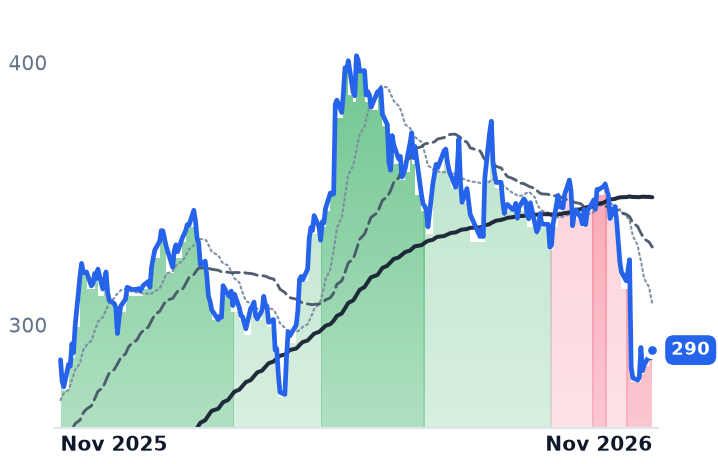
CRWV | CoreWeave | Cloud Compute & Infrastructure | 🔴 Cont. Bear | −27.4% | −33.6% |
NBIS | Nebius | Software Development & Design | 🟢 Cont. Bull | −25.3% | +63.2% |
CIFR | Cipher Mining | Cloud & Computing Infrastructure | ⚠️ Emerging Bear | −37.4% | −60.0% |
| Compared against · context, not the story | |||||
AMZN | Amazon.com | General E-commerce Platforms | 🟢 Cont. Bull | +3.2% | +10.1% |
ORCL | Oracle | Data Platforms & Databases | 🔴 Cont. Bear | −9.3% | −44.1% |
MSFT | Microsoft | Cloud Compute & Infrastructure | 🟢 Cont. Bull | −2.7% | +4.7% |
META | Meta Platforms | Social & Community Platforms | 🌱 Emerging Bull | −17.0% | +4.7% |
GOOGL | Alphabet | Search & Advertising | ⚠️ Emerging Bear | −17.9% | +1.3% |
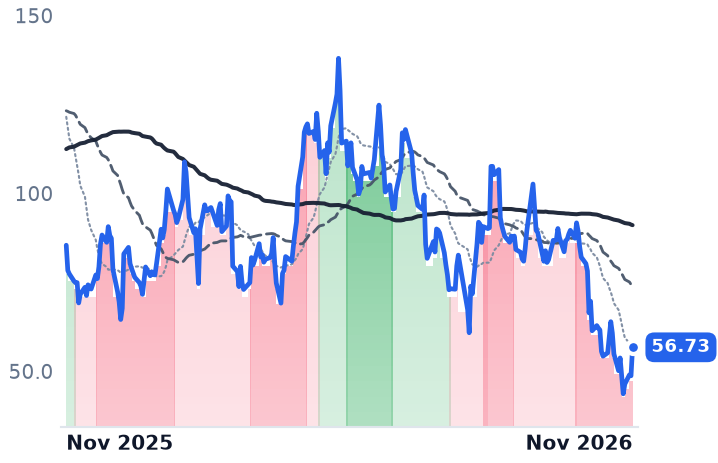
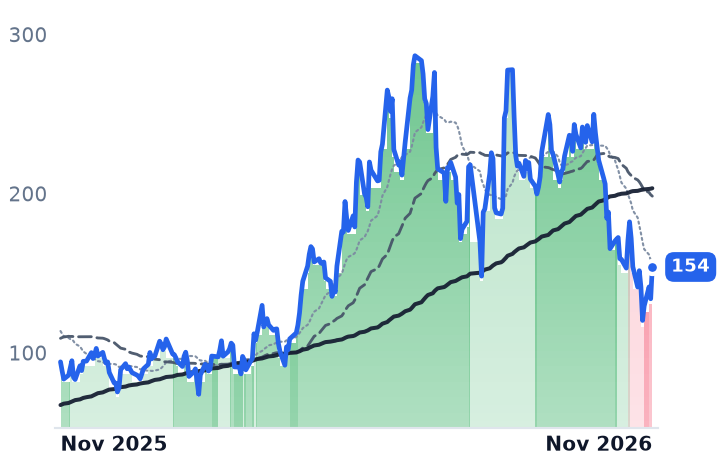
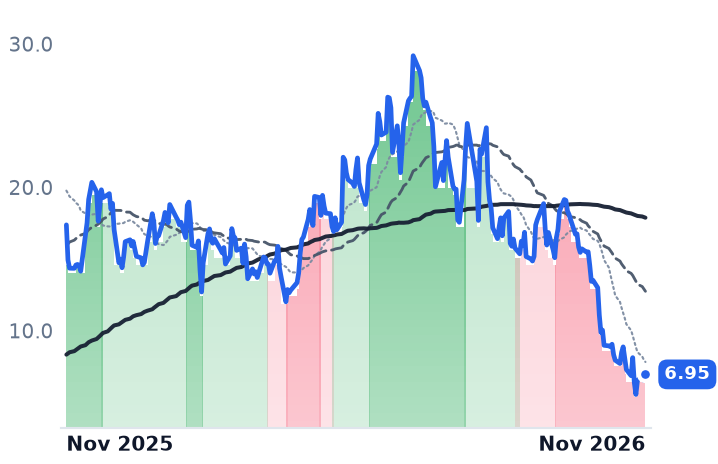
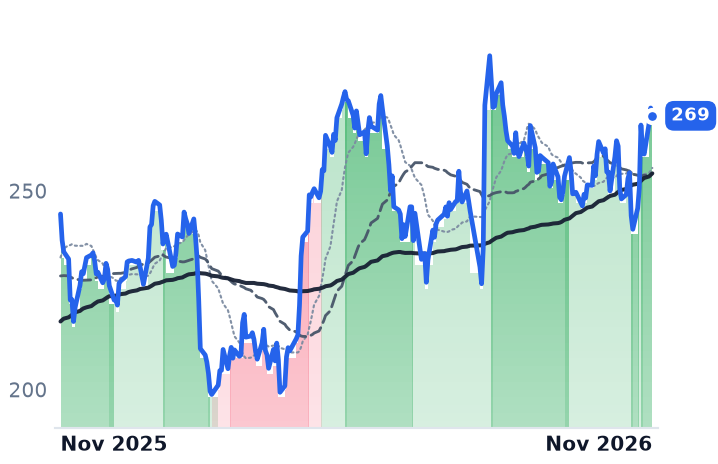
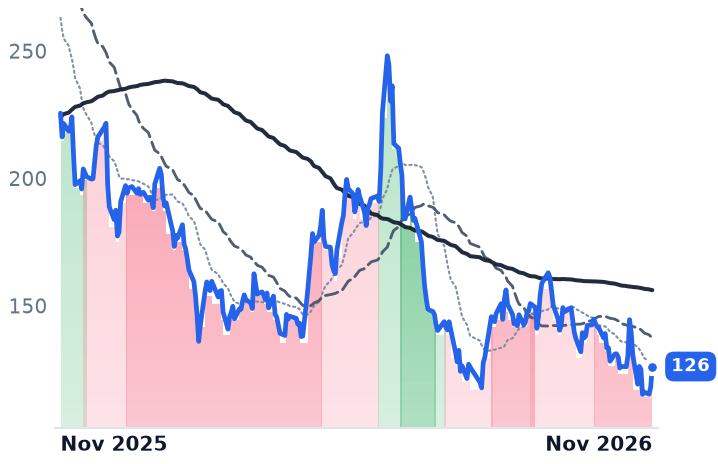
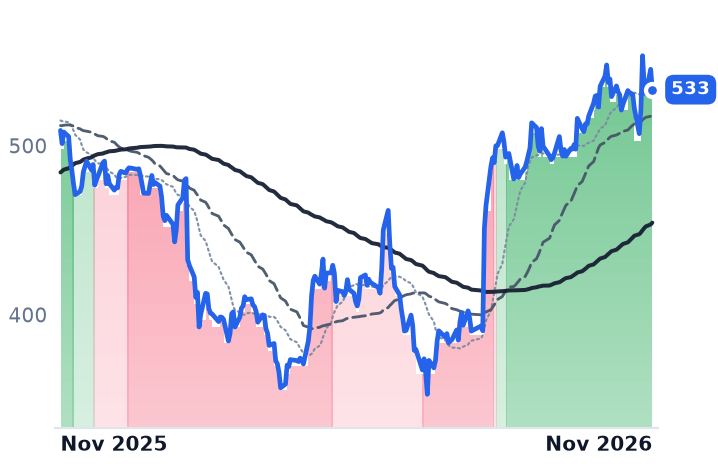
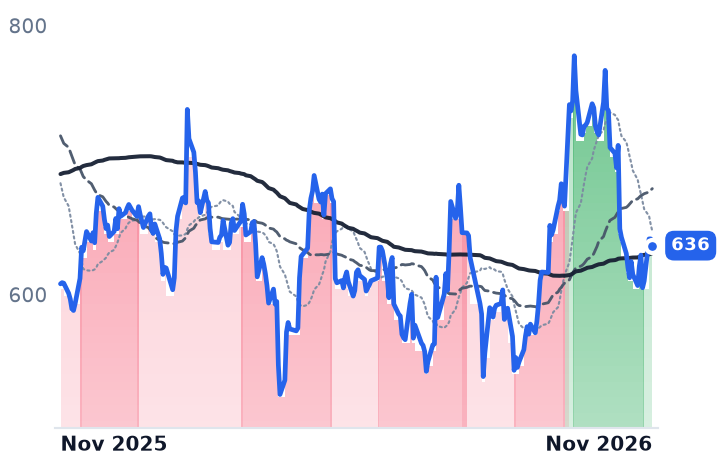
12-month price & trend
| Ticker | Mkt cap | P/E | P/E fwd | P/S | P/S fwd | P/GP | P/GP fwd | EV/EBITDA | FCF yld |
|---|---|---|---|---|---|---|---|---|---|
CRWV | $33.5B | n/m | — | 3.4x | 2.6x | 5.1x | 3.9x | 27.2x | -60.9% |
NBIS | $37.1B | 859.4x | — | 27.4x | 11.1x | 36.9x | 14.9x | 40.5x | -15.8% |
CIFR | $3.2B | n/m | — | 22.2x | 19.1x | — | — | n/m | -95.1% |
| Ticker | Mkt cap | P/E | P/E fwd | P/S | P/S fwd | P/GP | P/GP fwd | EV/EBITDA | FCF yld |
|---|---|---|---|---|---|---|---|---|---|
AMZN | $2.9T | 21.2x | 20.7x | 3.6x | 3.5x | 7.0x | 6.8x | 12.0x | -1.6% |
ORCL | $388.2B | 19.8x | 15.8x | 5.4x | 4.3x | 8.5x | 6.7x | 13.5x | -7.4% |
MSFT | $3.9T | 27.7x | 26.8x | 11.4x | 10.1x | 16.8x | 14.9x | 18.9x | 1.5% |
| Ticker | Mkt cap | P/E | P/E fwd | P/S | P/S fwd | P/GP | P/GP fwd | EV/EBITDA | FCF yld |
|---|---|---|---|---|---|---|---|---|---|
META | $1.6T | 21.6x | 22.0x | 6.8x | 6.4x | 8.4x | 7.9x | 16.3x | 1.7% |
GOOGL | $4.0T | 16.6x | 15.8x | 8.4x | 7.9x | 13.7x | 13.0x | 12.6x | 0.7% |
Consensus projections
| Ticker | FY2026E | FY2027E | FY2028E | |
|---|---|---|---|---|
CRWV | Revenue | +151.9% | +105.3% | +63.9% |
| EPS | +197.7% | −49.2% | −149.9% | |
NBIS | Revenue | +508.2% | +261.3% | +89.5% |
| EPS | +69.1% | +79.1% | −88.8% | |
CIFR | Revenue | −31.9% | +367.1% | +31.6% |
| EPS | +229.1% | −62.3% | −68.7% | |
AMZN | Revenue | +16.1% | +15.9% | +17.2% |
| EPS | +79.4% | −16.1% | +36.2% | |
ORCL | Revenue | +17.8% | +34.5% | +45.3% |
| EPS | +25.3% | +8.9% | +36.1% | |
MSFT | Revenue | +18.0% | +18.8% | +19.9% |
| EPS | +26.7% | +16.4% | +19.4% | |
META | Revenue | +28.6% | +21.8% | +19.0% |
| EPS | +27.0% | +17.4% | +17.1% | |
GOOGL | Revenue | +24.7% | +25.2% | +21.5% |
| EPS | +93.6% | −25.5% | +19.9% |
Forward fiscal years only. Blank means no analyst coverage for that year.
CoreWeave, which rents graphics-processor capacity to large enterprises and artificial-intelligence labs, told investors on 10 November that the price of its debt had come down. "At the end of Q3, our weighted average cost of debt across our entire business was 7.9%. Down 250 basis points year over year," chief financial officer Nitin Agrawal said. "Looking ahead, we will not use the unsecured debt market to fund our business at current yields. Nor do we need to." In the same week, banks including JPMorgan and MUFG were still working, after more than six months, to distribute $38bn of construction debt tied to Texas and Wisconsin data centers leased to Oracle, whose cost of default insurance hit a record.
That inversion matters because the whole case for owning the buyers of compute rather than the sellers rested on funding source: hyperscalers were said to pay for capacity out of operating cash flow, neoclouds to borrow against backlog owed by a handful of counterparties. Amazon's free cash flow turned negative for the first time since 2023 — a $42.4bn outflow for the twelve months to 30 September against a $14.8bn inflow a year earlier, with long-term debt doubling to $128.9bn — against roughly $220bn of 2026 cash capex and "meaningfully more" planned for 2027. Oracle's trailing free cash flow yield is -7.4%, more negative than Amazon's -1.6%. Everyone in this business borrows. What differs is the rate they are offered.
What a signed GPU-hour owes before it earns
CoreWeave's September quarter shows the full chain. Revenue was $3.661bn, up 168%, an acceleration from 112% in the June quarter, and operating income turned positive at $207m. The net loss still widened to $709m, because interest expense reached $846m — 23% of revenue and 4.1 times the quarter's operating income — on $46.9bn of total debt, with fourth-quarter interest guided to $1.05–1.15bn. Backlog reached about $133bn, up 138%, more than half of it on contracts where customer delivery is expected to begin by the end of 2026.
The charge against this model is that six-year depreciation on accelerators flatters the margin by assuming residual value that evaporates. CoreWeave's rebuttal is specific: 130,000 GPUs come off contract in 2027 and 170,000 in 2028, "all fully amortized," and Ampere and Hopper capacity has repriced 30–50% higher quarter on quarter at premiums to original contracts. At current pricing, management put 2027 renewals alone at roughly $4bn of incremental annualized revenue with no incremental capital. Jim Chanos, who is short the stock, counters that after stock compensation and on a ten-year asset life the business earns a 2–3% pre-tax return on invested capital. Concentration is the unsettled part: Microsoft was 45% of first-quarter revenue, and Meta committed in March to pay up to approximately $21bn through 2032.
Nebius borrows against prepayments, and costs four times as much
Nebius Group, the Amsterdam-based operator of an AI cloud platform plus data, education and autonomous-driving units, funds the same mechanism differently: it expects more than $9bn of customer prepayments in 2026, with 70% of June-quarter deals carrying prepayments covering 50–60% of the associated capital cost. Its GPU-backed debt is dated and collateralized: roughly $775m maturing 31 October 2030 at the secured overnight financing rate plus 2.5 percentage points, beside $5.0bn of convertibles. Its last reported quarter, to June, grew revenue 454% to $582m at a 77.1% gross margin and a -30.2% operating margin. Yet it is the dearest name here, at 14.9 times forward gross profit against CoreWeave's 3.9 — nearly four times the price on a smaller book, with third-quarter results due 12 November against reaffirmed full-year guidance of $3.0–3.4bn.
Cipher's tenants buy the chips
"We are not a neocloud," Cipher Mining chief executive Tyler Page said on 2 November. "Lenders and investors are placing a premium on predictable, contracted cash flows, and that is exactly what our model is designed to produce." The bitcoin miner turned data-center landlord owns no accelerators; its three contracted campuses carry 700 gross megawatts, $16.6bn of contracted revenue and about $864m of projected average annualized net operating income on a 17.3-year weighted-average lease term, against roughly $6.3bn of enterprise value. Its counterparties are investment-grade or credit-enhanced: Amazon Web Services leased about 300 gross megawatts at Black Pearl for 15 years, and the 168-megawatt Fluidstack agreement at Barber Lake is backstopped by Google. Project bonds priced 7.125%, then 6.125%, then 6.0% across three successive financings. The business itself is barely born: revenue fell 62.8% to $26.7m as mining is decommissioned, gross margin was -172%, and the quarter's $31.6m of GAAP income came from a $127m non-cash warrant revaluation. Rent starts hall by hall from the fourth quarter, and the 20-year Barber Lake tenant is disclosed only as "a leading AI lab".
The equity and the debt moved in opposite directions
All three were marked down hard before any of this reported: Cipher is off 45% over 30 days, Nebius 26% and CoreWeave 24%, with the trigger a delivery-schedule repricing rather than a demand cut — Microsoft's capex came in about $5bn under plan on 28 October because third-party capacity was late. CoreWeave then rose 24.7% on 11 November, its best session since April 2025.
The de-rating is multiple compression, not deteriorating disclosure. CoreWeave has fallen from 16.4 times trailing gross profit in early May to 9.4 in August to 5.1 now, while quarterly gross profit grew from $1.36bn to $2.48bn; at a $33.5bn market capitalization it is priced at about a quarter of its contracted book. The credit market, which has the first claim on those cash flows, repriced CoreWeave the other way. Spreads on ten-year hyperscaler debt have widened about half a percentage point this year against roughly a fifth of that for industrials with no AI exposure, and the widening was worst among the weakest borrowers — which this quarter did not mean the smallest ones.
Amazon told investors its owned and long-leased model carries roughly 35 percentage points of margin advantage over colocation and "neo" competitors, the clearest statement of why renting costs more than building. It signed a 15-year lease at Black Pearl anyway.