
Vertiv Will Stop Reporting Orders, Leaving Prepaid Customer Cash as the Demand Record
Hypothesis Opus 5 · Research Opus 5 · Writing Opus 5 · Prompt v1.7
The clearest demand signal in the AI power chain has just been withdrawn. Vertiv told investors on 28 October it will no longer publish order or book-to-bill figures, keeping backlog only in its annual report. What remains is cash already collected: current deferred revenue of $4,120.5m at 30 September against $1,814.7m at the end of 2025, equal to roughly 28% of guided 2026 sales.
The three links of the electrical path are paid at very different points. GE Vernova takes a non-refundable deposit of about 20% years before delivery and sits on $197bn of backlog; nVent carries $2.6bn, under half a year of shipments, and was the only one of the three whose gross margin fell year-on-year, to 35.8%.
All three raised 2026 guidance in late October. All three were then marked down between 17% and 35%, which reads as a repricing of orders not yet placed rather than of the contracted book.
| Ticker | Company | Segment | Trend · 13mo | 30D | 1Y |
|---|---|---|---|---|---|
| The subject · what this brief is about | |||||
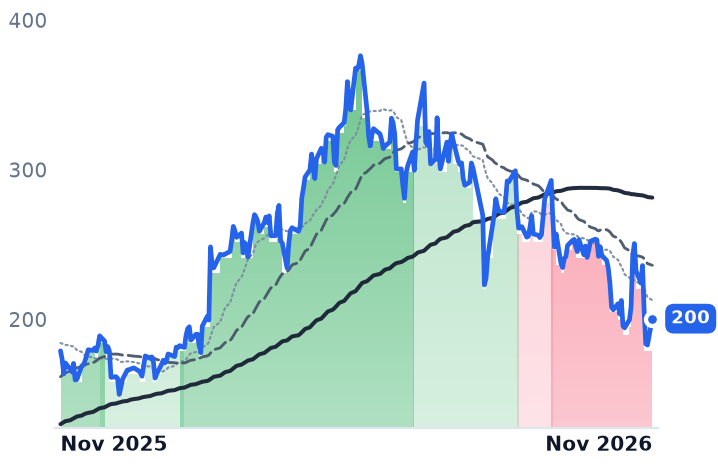
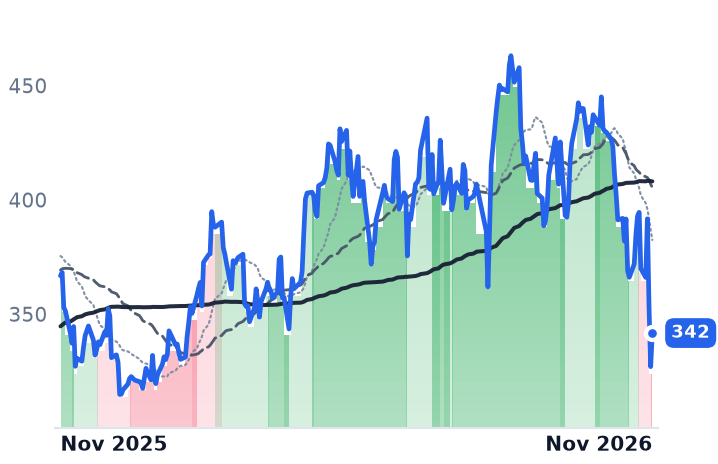
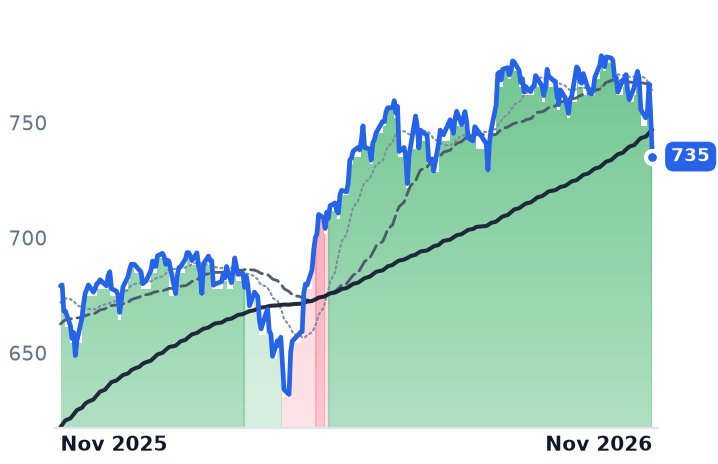
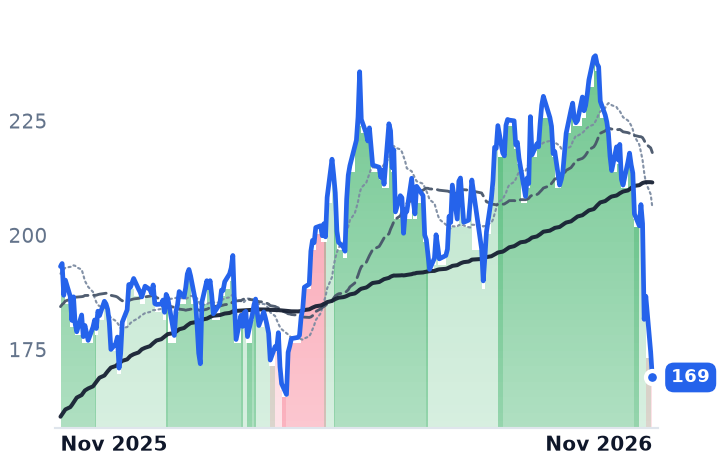
VRT | Vertiv | Advanced Power Systems | ⚠️ Emerging Bear | −16.2% | +12.0% |
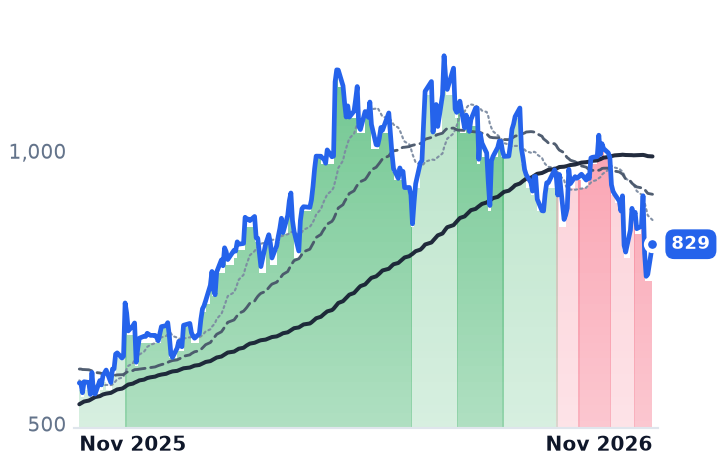
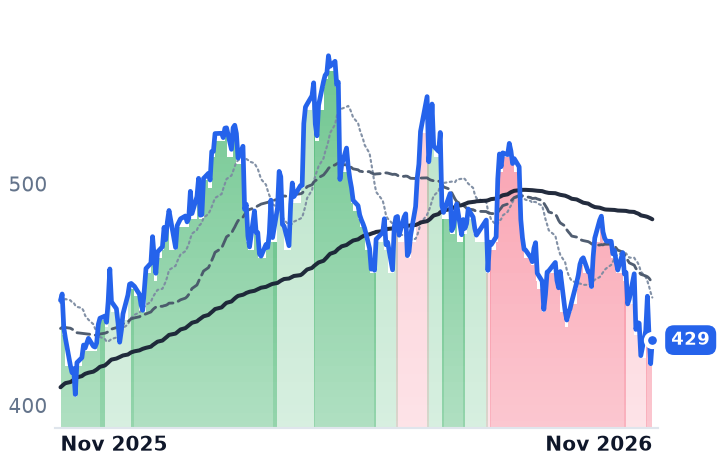
GEV | GE Vernova | Power Generation & Propulsion | ⚠️ Emerging Bear | −16.8% | +44.2% |
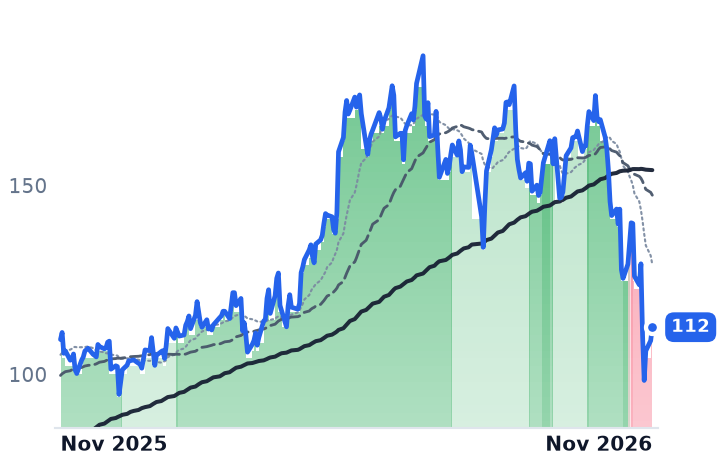
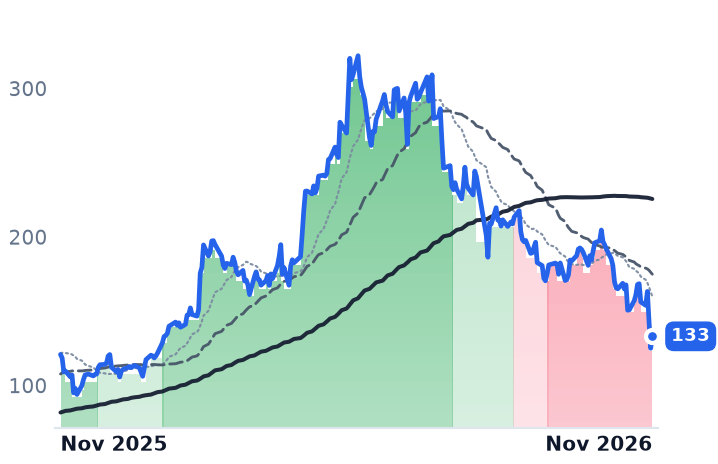
NVT | nVent Electric | Power Distribution Systems | 🟢 Cont. Bull | −30.9% | +3.0% |
| Compared against · context, not the story | |||||
ETN | Eaton | Power Distribution Systems | 🟢 Cont. Bull | −19.9% | −6.8% |
HUBB | Hubbell Incorporated | Power Distribution Systems | 🔴 Cont. Bear | −9.4% | −4.0% |
POWL | Powell Industries | Power Distribution Systems | 🔴 Cont. Bear | −28.2% | +10.1% |
MOD | Modine Manufacturing | HVAC & Refrigeration Systems | 🔴 Cont. Bear | −46.6% | −36.3% |
PWR | Quanta Services | Power Grid & Distribution | ⚠️ Emerging Bear | −16.1% | +30.0% |
EMR | Emerson Electric | Industrial Automation & Motion Control | 🟢 Cont. Bull | +3.1% | +30.4% |
AYI | Acuity Brands | Lighting & Building Controls | 🌱 Emerging Bull | +12.0% | −7.4% |
ATKR | Atkore | Power Distribution Systems | 🟢 Cont. Bull | +0.1% | +47.3% |
SPY | State Street SPDR S&P 500 ETF Trust | Asset Management | 🟢 Cont. Bull | −5.5% | +8.3% |
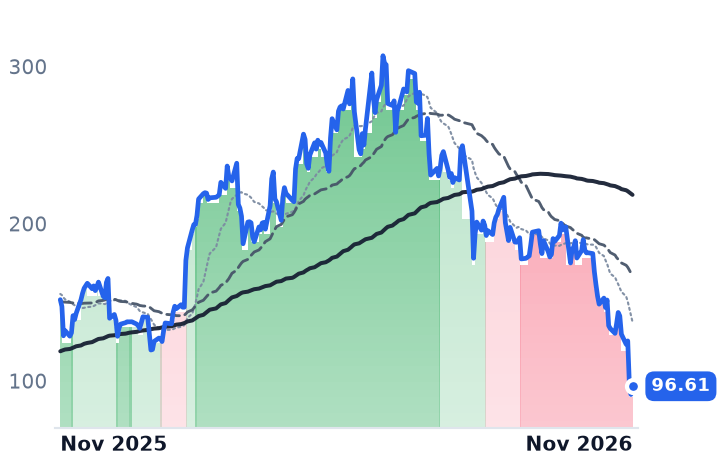
NVDA | NVIDIA | Processors & Accelerators | 🟢 Cont. Bull | −25.4% | −12.6% |
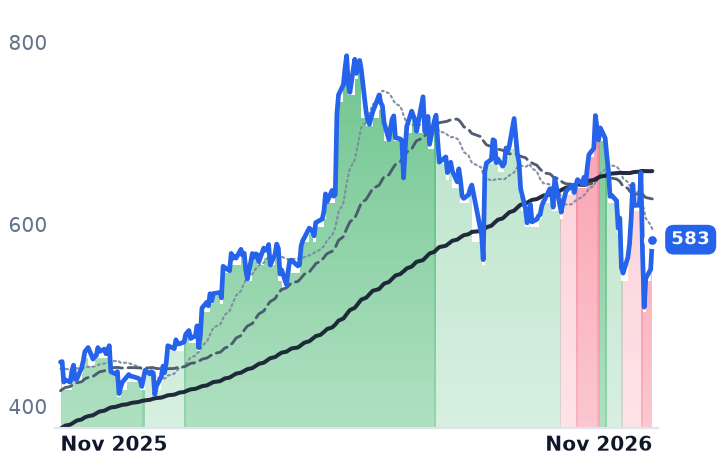
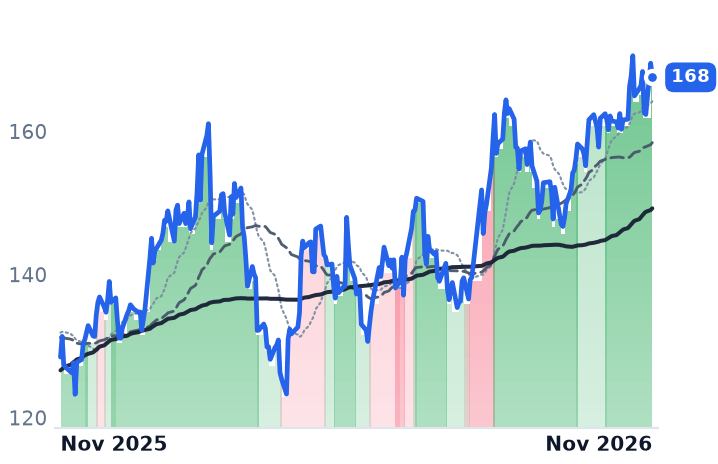
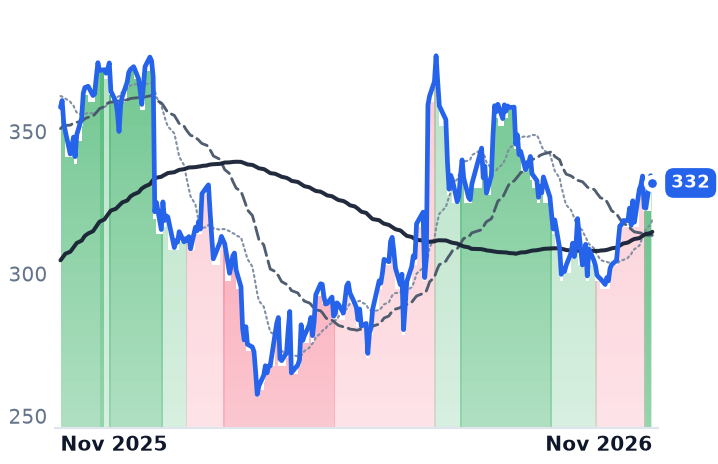
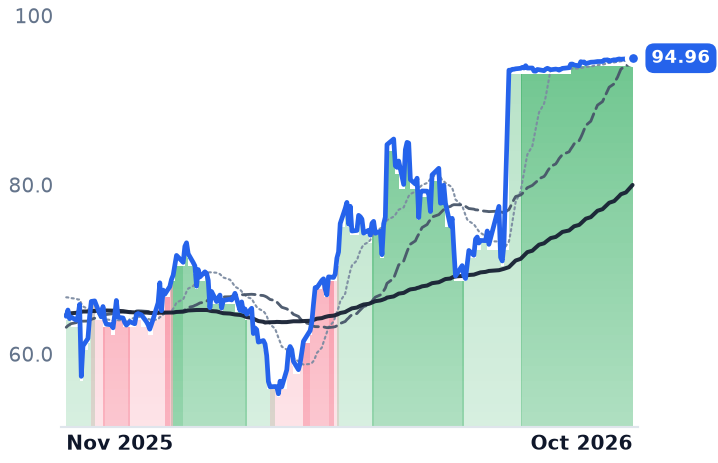
12-month price & trend
| Ticker | Mkt cap | P/E | P/E fwd | P/S | P/S fwd | P/GP | P/GP fwd | EV/EBITDA | FCF yld |
|---|---|---|---|---|---|---|---|---|---|
VRT | $74.8B | 35.5x | 27.1x | 5.7x | 5.1x | 15.0x | 13.4x | 24.6x | 4.2% |
GEV | $211.0B | 20.7x | 25.2x | 4.8x | 4.5x | 22.0x | 20.7x | 19.0x | 8.1% |
NVT | $18.2B | 26.8x | 20.9x | 3.4x | 3.1x | 9.4x | 8.6x | 16.5x | 3.5% |
| Ticker | Mkt cap | P/E | P/E fwd | P/S | P/S fwd | P/GP | P/GP fwd | EV/EBITDA | FCF yld |
|---|---|---|---|---|---|---|---|---|---|
ETN | $132.7B | 34.1x | 24.9x | 4.1x | 3.9x | 11.8x | 11.3x | 23.8x | 3.3% |
HUBB | $22.7B | 25.1x | 20.9x | 3.4x | 3.3x | 9.7x | 9.3x | 17.3x | 4.1% |
POWL | $4.8B | 25.4x | 19.3x | 4.2x | 3.2x | 13.9x | 10.7x | 16.9x | 5.0% |
| Ticker | Mkt cap | P/E | P/E fwd | P/S | P/S fwd | P/GP | P/GP fwd | EV/EBITDA | FCF yld |
|---|---|---|---|---|---|---|---|---|---|
MOD | $5.1B | 40.4x | 17.5x | 1.4x | 1.6x | 6.5x | 7.2x | 17.8x | -0.7% |
PWR | $82.2B | 61.8x | 32.6x | 2.5x | 2.1x | 17.4x | 14.4x | 28.5x | 2.9% |
EMR | $90.5B | 35.2x | 22.1x | 4.9x | 4.5x | 9.1x | 8.5x | 19.9x | 3.8% |
| Ticker | Mkt cap | P/E | P/E fwd | P/S | P/S fwd | P/GP | P/GP fwd | EV/EBITDA | FCF yld |
|---|---|---|---|---|---|---|---|---|---|
AYI | $8.9B | 17.0x | 13.9x | 1.9x | 1.8x | 3.8x | 3.6x | 10.0x | 8.4% |
ATKR | $3.2B | n/m | 15.0x | 1.1x | 1.0x | 5.6x | 5.3x | n/m | 1.8% |
SPY | $773.0B | — | — | — | — | — | — | — | — |
| Ticker | Mkt cap | P/E | P/E fwd | P/S | P/S fwd | P/GP | P/GP fwd | EV/EBITDA | FCF yld |
|---|---|---|---|---|---|---|---|---|---|
NVDA | $5.5T | 34.3x | 25.0x | 21.5x | 13.9x | 29.0x | 18.7x | 28.3x | 2.2% |
Consensus projections
| Ticker | FY2026E | FY2027E | FY2028E | |
|---|---|---|---|---|
VRT | Revenue | +43.2% | +32.8% | +21.3% |
| EPS | +73.3% | +37.7% | +26.8% | |
GEV | Revenue | +25.7% | +14.1% | +15.7% |
| EPS | +334.6% | −18.6% | +38.8% | |
NVT | Revenue | +51.0% | +30.6% | +14.3% |
| EPS | +61.3% | +30.2% | +20.4% | |
ETN | Revenue | +22.4% | +11.6% | +10.4% |
| EPS | +13.9% | +18.9% | +16.8% | |
HUBB | Revenue | +18.5% | +11.2% | +6.3% |
| EPS | +13.2% | +11.9% | +11.8% | |
POWL | Revenue | +8.8% | +25.8% | +14.4% |
| EPS | +12.1% | +27.8% | +19.8% | |
MOD | Revenue | +22.6% | +3.7% | +34.5% |
| EPS | +33.4% | +16.0% | +73.7% | |
PWR | Revenue | +41.1% | +16.3% | +14.1% |
| EPS | +57.7% | +17.9% | +18.3% | |
EMR | Revenue | +4.5% | +5.6% | +5.4% |
| EPS | +9.4% | +11.2% | +10.8% | |
AYI | Revenue | +6.4% | +3.9% | +4.9% |
| EPS | +11.7% | +8.5% | +9.1% | |
ATKR | Revenue | +5.0% | +4.7% | +6.6% |
| EPS | −13.4% | +11.5% | +13.6% | |
NVDA | Revenue | +65.1% | +84.2% | +43.2% |
| EPS | +59.0% | +91.7% | +42.0% |
Forward fiscal years only. Blank means no analyst coverage for that year.
Vertiv Holdings, which sells the uninterruptible power supplies, busway and liquid cooling installed inside data-center white space under the Liebert, Geist and Powerbar brands, told investors on 28 October that it will stop publishing how many orders it takes. Chief executive Giordano Albertazzi said the company is "not planning to share orders data going forward", arguing that lumpy large orders create "excessive volatility" unrepresentative of sustained performance. Dollar orders, book-to-bill and backlog have not been disclosed since the February call covering the fourth quarter of 2025; the annual Form 10-K backlog figure is what is left.
The timing matters because the markdown of the power-equipment shelf has been read as demand deceleration along the electrical path between the utility interconnect and the rack. The companies' own October filings say the opposite about what is already sold. What separates them is where in that path each one gets paid, and for how long its revenue is already contracted.
The line Vertiv's order book left behind
Vertiv counts backlog narrowly. Albertazzi said on the same call that the company is "very strict in what [it] calls backlog" and books only "what is squarely a purchase order" — a capacity agreement does not qualify. The last disclosed figure, $15.0bn, is about one year of the $14,650m of 2026 sales the company now guides to at the midpoint, a raise accompanied by adjusted earnings guidance of $7.15 a share. September-quarter sales of $4,313m were 61% above a year earlier, 55% of that organic, and gross margin edged up to 38.1%.
The harder number is money received. Current deferred revenue stood at $4,120.5m at 30 September against $1,814.7m at 31 December 2025, cash paid at order and at design milestones to hold manufacturing priority. Vertiv's own filings note that orders can be cancelled or rescheduled, which is why the prepayment balance now does more work than the backlog line it effectively replaces.
Paid in 2026 for turbines delivered in 2031
GE Vernova, the gas-turbine and grid-equipment maker spun out in 2023, collects earlier than anyone else in the chain. A customer converts a reservation into a production slot by posting a non-refundable deposit of typically about 20% of the turbine price, years ahead of delivery. That mechanic produced a $5.3bn working-capital benefit inside $5.4bn of third-quarter free cash flow, and total backlog of $197bn, $104bn of it equipment — against revenue guidance of $46.5bn to $47.5bn, roughly 4.2 years of cover by our arithmetic. Power equipment pricing rose more than 20% in the quarter and segment EBITDA margin reached 21.4%.
One gauge in that disclosure points down. The slot-reservation queue fell from 63 GW to 58 GW while firm gas equipment backlog climbed from 53 GW to 64 GW: the funnel ahead of the contracted book thinned as the book filled.
Five months of cover, and a $105m tariff bill
nVent Electric, the smallest of the three at about $18bn of market value, sells enclosures, cabinets and liquid-cooling hardware largely through electrical wholesalers. Its backlog is $2.6bn, under half a year of the $5.79bn of 2026 revenue consensus carries, so costs land in the same quarters as the shipments they burden. Price and productivity more than covered $60m of quarterly inflation, including about $20m of tariffs against a full-year tariff estimate lifted to roughly $105m, but gross margin still fell to 35.84% from 37.45% a year earlier. Operating margin rose anyway, to 18.6%.
nVent raised guidance hardest of the three. "At the midpoint, adjusted EPS is expected to grow 60% versus last year," chief financial officer Gary Corona said on 30 October. Its organic orders grew only low-double-digits against a 65% comparison, with management calling October orders "very strong."
What the selling is actually pricing
Over the month to 9 November, Vertiv fell 17.4%, GE Vernova 17.5% and nVent 34.9%, against 5.6% for the S&P 500 tracker and 26.3% for Nvidia. nVent is down 3.0% over twelve months, the worst of the three despite the biggest guidance raise. Gross-profit multiples compressed accordingly: Vertiv to 15.0x trailing from 29.1x in early May, GE Vernova to 22.0x from 36.6x, nVent to 9.4x from 15.1x.
Nothing in the three sets of October disclosures contains a cancellation, a pushout or a cut. What repriced sits with the buyers: CoreWeave's 2032 bond yielded above 16% in the week to 6 November with the 30-year Treasury at 5.25%, and the paper has already noted the post-election scrutiny of data-center siting in Ohio, Texas and Georgia. A higher hurdle rate changes which projects get sanctioned next year, not which turbines ship in 2029. On that reading the de-rating prices the funnel, and GE Vernova's 58 GW of reservations is the only funnel number any of the three still reports.
Albertazzi told investors on 28 October that "the demand environment remains strong heading into 2027", naming power availability, permitting and skilled construction labor as the pacing items. Having retired the quarterly order print, Vertiv has made its deferred revenue line the thing shareholders must read it by — and has left itself one scheduled chance a year to prove the book is still growing.