

Cisco Paid for Its Hyperscaler Switch Orders in Product Margin; Arista Did Not
Hypothesis Opus 5 · Research Opus 5 · Writing Opus 5 · Prompt v1.7
Ethernet has taken the back-end network inside AI clusters, and the markdown of the switch vendors rests on the idea that the port is a pass-through whose scarcity rent stays upstream with the merchant-silicon maker. Only one of the three listed vendors is actually conceding it.
Cisco's non-GAAP product gross margin fell 270 basis points in its July quarter on higher hardware mix and memory costs, as hyperscaler AI infrastructure grew to roughly 6% of revenue. Arista grew September-quarter revenue 58.5%, grew operating income faster still, and tightened its long-run gross margin range upward to 62-64%. HPE's acquired networking ran a flat operating margin and supplied close to half of group operating profit, while the AI systems it sells are the part management guided to dilute.
The de-rating has a disclosed cause at Cisco. At Arista, at 39.8x forward earnings on a full-year guide raised to $13.3bn, it does not.
| Ticker | Company | Segment | Trend · 13mo | 30D | 1Y |
|---|---|---|---|---|---|
| The subject · what this brief is about | |||||
ANET | Arista Networks | Cloud Networking | 🟢 Cont. Bull | −21.2% | +24.4% |
CSCO | Cisco Systems | Enterprise Networking & Infrastructure | ⚠️ Emerging Bear | −20.7% | +32.1% |
HPE | Hewlett Packard Enterprise | Enterprise Servers | 🟢 Cont. Bull | −39.1% | +89.8% |
EXTR | Extreme Networks | Enterprise Networking & Infrastructure | 🔴 Cont. Bear | −0.7% | +34.2% |
| Compared against · context, not the story | |||||
AVGO | Broadcom | Data Center & Networking | ⚠️ Emerging Bear | −18.8% | −17.7% |
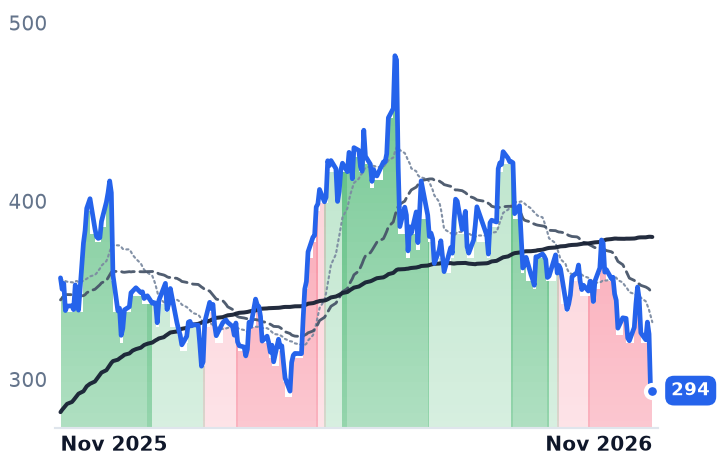
12-month price & trend
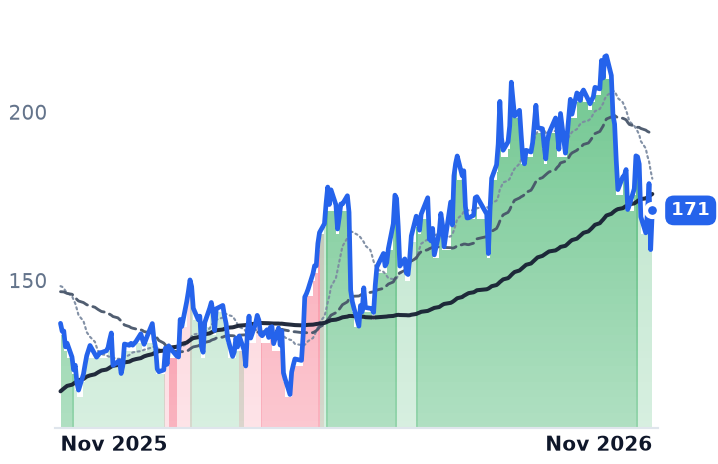
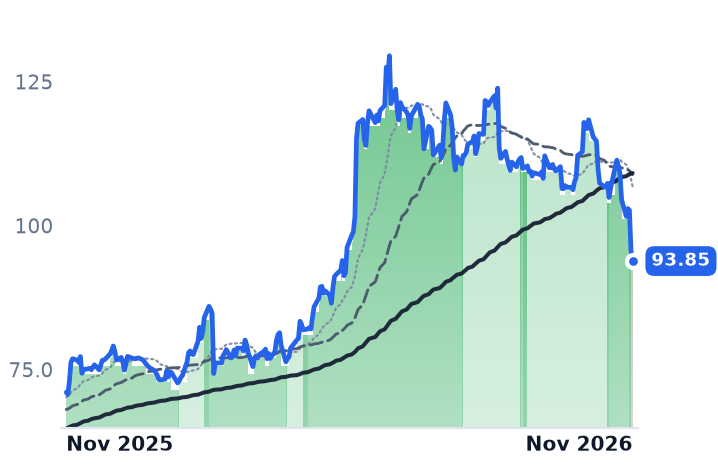
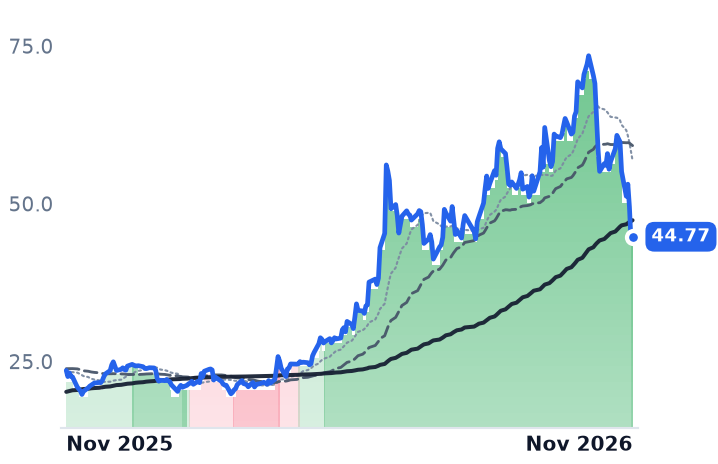
| Ticker | Mkt cap | P/E | P/E fwd | P/S | P/S fwd | P/GP | P/GP fwd | EV/EBITDA | FCF yld |
|---|---|---|---|---|---|---|---|---|---|
ANET | $215.4B | 45.3x | 39.8x | 18.1x | 16.3x | 28.8x | 26.0x | 36.0x | 2.3% |
CSCO | $370.0B | 27.9x | 18.4x | 5.8x | 5.1x | 9.1x | 7.9x | 19.6x | 3.7% |
HPE | $59.4B | 22.3x | 9.5x | 1.4x | 1.1x | 3.9x | 3.0x | 11.7x | 7.0% |
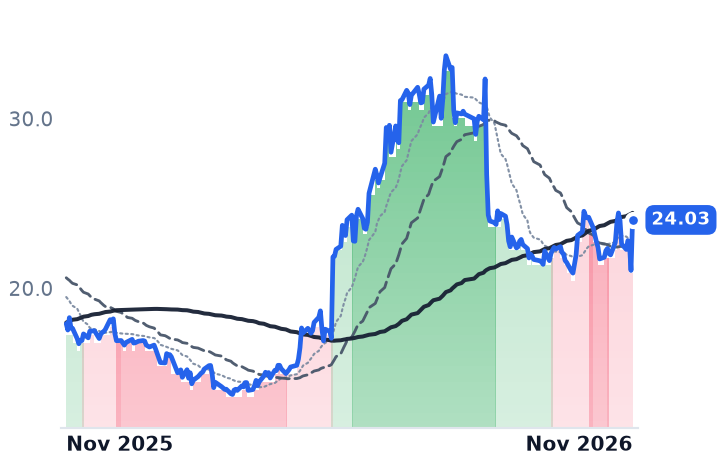
| Ticker | Mkt cap | P/E | P/E fwd | P/S | P/S fwd | P/GP | P/GP fwd | EV/EBITDA | FCF yld |
|---|---|---|---|---|---|---|---|---|---|
EXTR | $3.2B | 60.3x | 17.6x | 2.4x | 2.2x | 3.9x | 3.6x | 32.7x | 3.8% |
AVGO | $1.6T | 40.8x | 28.2x | 17.6x | 14.8x | 25.6x | 21.6x | 30.7x | 2.5% |
Consensus projections
| Ticker | FY2026E | FY2027E | FY2028E | |
|---|---|---|---|---|
ANET | Revenue | +48.1% | +37.4% | +25.3% |
| EPS | +49.0% | +36.4% | +25.8% | |
CSCO | Revenue | +11.1% | +15.9% | +6.9% |
| EPS | +12.9% | +19.3% | +8.8% | |
HPE | Revenue | +35.0% | +17.6% | +8.4% |
| EPS | +101.8% | +23.5% | +15.9% | |
EXTR | Revenue | +12.8% | +10.3% | +9.7% |
| EPS | +26.5% | +32.5% | +14.3% | |
AVGO | Revenue | +67.2% | +64.4% | +61.7% |
| EPS | +73.0% | +65.2% | +58.8% |
Forward fiscal years only. Blank means no analyst coverage for that year.
The three listed companies that sell the Ethernet fabric AI clusters run on all reported accelerating business, and all three have been marked down hard in a month. Only Cisco paid for its AI orders in margin.
The markdown rests on a specific argument: that the switch port is becoming a pass-through, that the cluster dollar gets spent but the scarcity rent stays upstream with the company that makes the silicon inside the box. The upstream half of that is not in dispute. Broadcom has guided fiscal 2026 AI semiconductor revenue to $58bn, up 186%, with AI networking revenue up more than 2.5 times year on year in its third quarter — an AI networking silicon business of roughly $19bn on those figures, larger than Arista's entire revenue guide for the year. The question is what happens downstream of it, and the three income statements disagree.
Cisco's order book came out of product margin
Cisco, which sells campus and data-center switching, routing, security and the Webex collaboration suite, booked $9.3bn of hyperscaler AI infrastructure orders in fiscal 2026, roughly 4.5 times the prior year and above the $5bn it first targeted. It recognized about $4bn of that as revenue. The cost is disclosed in its annual filing: non-GAAP product gross margin of 64.8% in the July quarter, down 270 basis points year on year on higher hardware mix and memory costs, with hyperscaler AI demand rising from under 2% of total revenue to approximately 6%. Full-year gross margin slipped to 64.5% from 64.9% while revenue growth accelerated to 11.8%. Management projects $7.5bn of hyperscaler AI revenue in fiscal 2027, which is the same mix, larger.
Arista raised the floor of its margin range
Arista, which sells high-speed Ethernet switches running its own EOS operating system to internet companies, telecom carriers and banks, did the opposite. September-quarter revenue grew 58.5% to $3.658bn, the fastest in its history as a public company, and operating income grew 67.9% — faster than revenue. Reported gross margin of 63.6% was about a point below last year but up from the 61.9% trough two quarters earlier, and management tightened the long-run range to 62-64% from 60-65%, lifting the floor. The fourth revenue raise of the year took fiscal 2026 to $13.3bn, with AI fabric revenue guided to double to roughly $7bn in 2027.
"These type of migrations are multiyear. And so we're very confident not only in our '27 guide, but a promising '28 ahead as well," chief executive Jayshree Ullal told investors on November 3.
What Arista spends to stay out of commodity territory is visible: research and development reached $408.5m in the quarter, 11.2% of revenue, against $278.1m in the prior one, on accelerator partnerships and liquid cooling. Two soft spots survive the quarter. Deferred revenue was flat sequentially at $6.8bn despite the growth, and Meta and Microsoft together are more than 40% of sales — the two customers best placed to have the same box built white-box, and the two whose accelerators Arista is co-engineering against.
Nearly half of HPE's profit is the networking it bought
Hewlett Packard Enterprise sits between the two, and the profit is not coming from the cluster. Networking revenue rose 74.9% to $2.9bn in the July quarter at a 22.0% operating margin, flat year on year — roughly $638m of segment profit on those disclosures, about 46% of group operating income on about a quarter of group revenue. Campus and branch gear is still half the segment. The AI-adjacent lines grow faster off a smaller base: data-center networking of $382m, routing of $788m, the latter up 270% behind a disclosed Oracle deployment of HPE Juniper switching and routing. Chief executive Antonio Neri said on September 2 that HPE is "at the core becoming a networking company." Meanwhile AI systems orders of $2.4bn lifted backlog to a record $6.8bn, and management guided the Cloud and AI operating margin down sequentially on AI systems mix and pricing.
The drawdown and the disclosures line up once
The three fell an average of 25% over the thirty sessions to November 6, against a twelve-month gain of 47% across the shelf they sit on. HPE's fall came in two legs, and the larger one predates the November repricing of data-center buildouts: it dropped 25.0% between October 9 and October 16, after Barclays downgraded it alongside Dell and NetApp, arguing that enterprise AI is about 5% of IT budgets with a quarter of that going to hardware, so recent hardware revenue reflects memory-cost inflation. That argument bears directly on HPE's reported gross margin expansion of nearly twelve points. Extreme Networks, which sells campus and branch Wi-Fi and switching to hospitals and schools, fell 1% over the same stretch.
None of the reported lines explains the move. Cisco's de-rating has a cause anyone can read in the filing, and the compression is modest — 7.9x forward gross profit against 9.1x trailing — because the dilution is real and continuing. Arista's does not: 39.8x forward earnings against roughly 41x in July, with the shares a touch below their May 1 level while the full-year guide went from about $10bn to $13.3bn, so a third of the multiple came off on revisions alone. HPE at 9.5x forward earnings, 11.7x trailing EV/EBITDA and a 7.0% free-cash-flow yield now sits below the bottom of a 10-13x forward anchor, with the caveat that the forward figure rests on a fiscal 2027 it has not reported against.
Cisco has not updated its AI order book since August 12. It reports again on November 12, and the open question is whether the margin it gave up was an entry fee or the new price of selling a port into an AI cluster.