

Calix Resets Fiber-Gear Prices Monthly as Memory Costs Rise; Adtran Ran Short of Parts
Hypothesis Opus 5 · Research Opus 5 · Writing Opus 5 · Prompt v1.7
A record quarter cost Calix almost nothing in extra profit. Revenue reached $302m in the September quarter, up 14%, while gross profit grew 5.8% and net income fell 34.7% — the gap is the memory bolted into access boxes sold to small and rural internet providers.
The group these shares sit in has been read as a federal-subsidy timing problem. It is not: Calix sizes its Broadband Equity, Access and Deployment opportunity at $1bn to $1.5bn and expects it in 2027, so this year's growth and its record $396m of contracted backlog are pre-subsidy. The drag comes from component prices, and it splits the shelf by who can pass them on. Calix now updates surcharges monthly and holds 53.3% gross margin; Adtran, at 38.5%, grew 0.6% and could not get supply. Gilat, selling satellite ground gear on an entirely different meter, fell hardest with nothing disclosed at all.
| Ticker | Company | Segment | Trend · 13mo | 30D | 1Y |
|---|---|---|---|---|---|
| The subject · what this brief is about | |||||
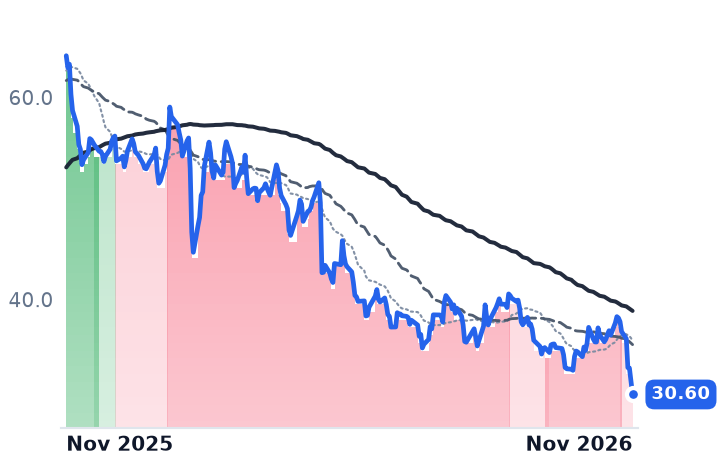
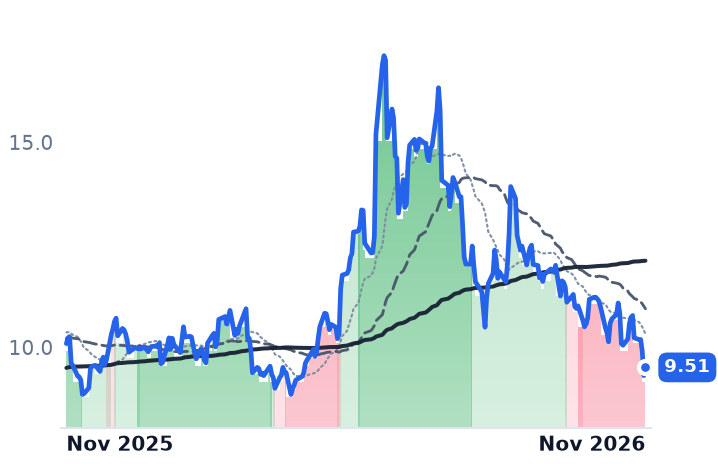
CALX | Calix | Broadband Service Provider Solutions | 🔴 Cont. Bear | −17.8% | −52.3% |
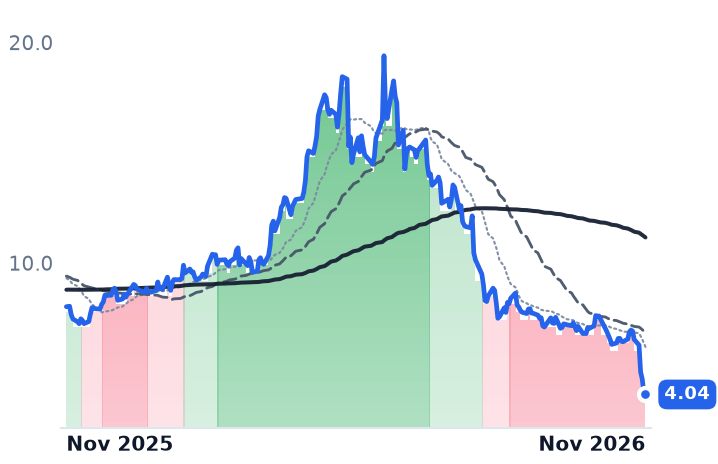
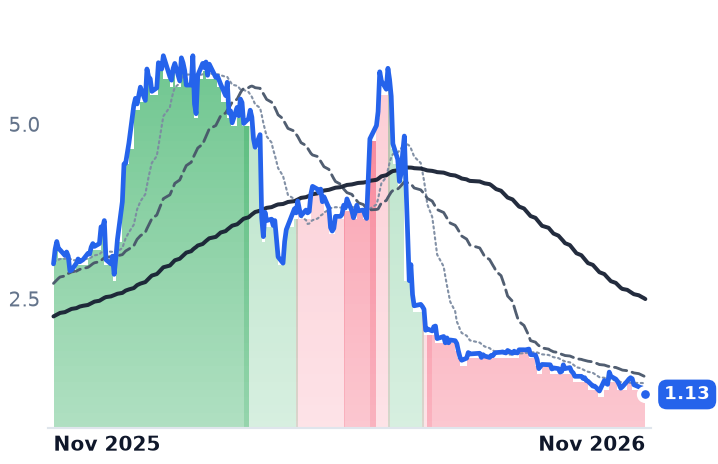
GILT | Gilat Satellite Networks | Broadband Service Provider Solutions | 🔴 Cont. Bear | −19.6% | −42.4% |
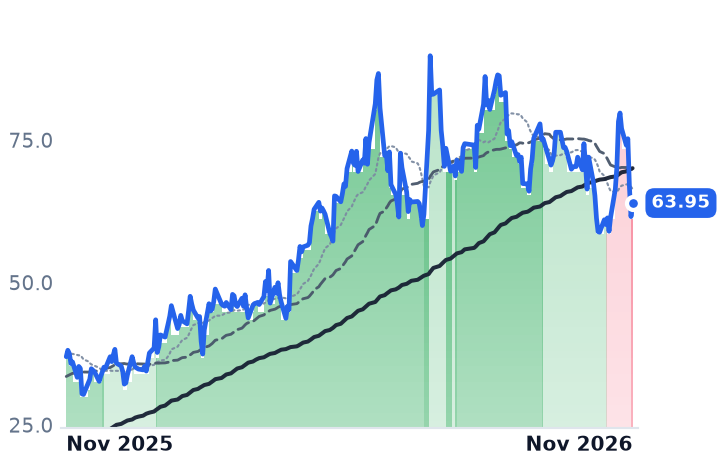
VSAT | Viasat | Broadband Service Provider Solutions | ⚠️ Emerging Bear | −11.2% | +72.9% |
| Compared against · context, not the story | |||||
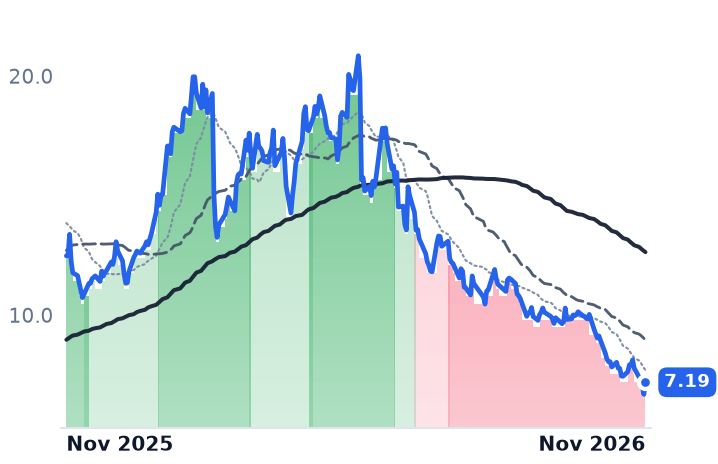
ADTN | ADTRAN | Optical Networking | 🔴 Cont. Bear | −45.8% | −49.6% |
HLIT | Harmonic | Video & Media Distribution | ⚠️ Emerging Bear | −13.5% | −5.7% |
CMTL | Comtech Telecommunications | Communication Equipment | 🔴 Cont. Bear | −4.2% | −62.3% |
12-month price & trend
| Ticker | Mkt cap | P/E | P/E fwd | P/S | P/S fwd | P/GP | P/GP fwd | EV/EBITDA | FCF yld |
|---|---|---|---|---|---|---|---|---|---|
CALX | $1.9B | 43.1x | 17.3x | 1.7x | 1.6x | 3.0x | 2.9x | 21.9x | 3.2% |
GILT | $534.3M | 15.6x | 11.7x | 1.1x | 1.1x | 3.6x | 3.5x | 7.4x | -0.6% |
ADTN | $326.3M | n/m | 13.7x | 0.3x | 0.3x | 0.7x | 0.7x | 5.1x | 6.9% |
| Ticker | Mkt cap | P/E | P/E fwd | P/S | P/S fwd | P/GP | P/GP fwd | EV/EBITDA | FCF yld |
|---|---|---|---|---|---|---|---|---|---|
VSAT | $8.8B | 304.5x | — | 1.9x | 1.8x | 5.3x | 5.1x | 9.2x | 11.5% |
HLIT | $1.4B | n/m | 19.6x | 2.7x | 2.8x | 5.4x | 5.5x | 19.4x | 4.0% |
CMTL | $116.3M | 9.5x | — | 0.2x | 0.3x | 0.8x | 0.9x | n/m | 12.5% |
Consensus projections
| Ticker | FY2026E | FY2027E | FY2028E | |
|---|---|---|---|---|
CALX | Revenue | +19.1% | +15.5% | +13.4% |
| EPS | +31.3% | +38.2% | +36.9% | |
GILT | Revenue | +13.2% | +11.7% | +10.6% |
| EPS | +6.6% | +16.3% | +13.3% | |
ADTN | Revenue | +5.5% | +6.4% | +7.7% |
| EPS | +82.1% | +60.1% | +68.4% | |
VSAT | Revenue | +3.6% | +4.1% | +4.7% |
| EPS | −66.9% | +59.4% | +6.2% | |
HLIT | Revenue | −11.6% | +15.3% | −2.1% |
| EPS | +48.8% | +19.7% | −3.6% | |
CMTL | Revenue | −8.8% | +4.6% | — |
| EPS | −67.3% | −16.7% | — |
Forward fiscal years only. Blank means no analyst coverage for that year.
Calix reported the biggest quarter in its history on 3 November, and the shares fell 8% the same day. The San Jose company sells fiber-access platforms, premises systems and a cloud subscription to small, regional and rural broadband providers; it collected $302m of revenue, up 14% from a year earlier, and carried only 5.8% more gross profit out of the quarter. Net income fell 34.7% to $10.22m. The shares kept going, to $30.60 by 6 November.
This corner of communications equipment has been read for a year as a subsidy-timing story: rural operators sitting on their capital budgets until the federal Broadband Equity, Access and Deployment program pays out, after a June 2025 restructuring delayed deployment by at least a year. Calix's own numbers refuse that reading. Chief executive Michael Weening sized the program's opportunity for Calix at $1bn to $1.5bn and said it happens "at some point in 2027", which means none of this year's growth, and none of the record $396m in remaining performance obligations, is subsidy money. The pressure arrives from the other direction, through the bill of materials.
The memory bill is bigger than the software gain
Contract prices for conventional memory chips are set to rise 10% to 15% in the fourth quarter as suppliers shift capacity toward server modules for artificial-intelligence workloads. Calix's appliance gross margin fell 220 basis points in the quarter to 50.7%, which management attributed primarily to memory. Its software and services line went the other way, to a record 67.2%, up 340 points sequentially.
That is the whole argument in two lines, and the arithmetic does not yet favor the better line. Software and services were $52m of the quarter; appliances were roughly $250m. On those bases the hardware hit costs about $5.5m of quarterly gross profit against roughly $1.8m gained on software — figures derived from the reported mix. The recurring dollar earns about 16.5 points more margin and is growing faster, 19% against 14%, but hardware is still about four-fifths of the invoice.
Calix's answer is to reprice. It is passing cost through via monthly surcharge updates, targeting gross-profit neutrality, and it guided the December quarter to $311m–$317m of revenue. "At the midpoint of guidance for the fourth quarter, our 2026 non-GAAP EPS is $1.76, which would represent an annual EPS growth of 30%, compared to revenue growth of 19%," chief financial officer Cory Sindelar told investors on 3 November. Management also called 2027 "as challenging, if not more challenging" on memory.
Adtran had the same bill and neither the margin nor the parts
Adtran Holdings, the closest listed comparable in rural and regional access gear, reported the same day and fell 19.4% in the session, ending the month down 46.7%. Its revenue grew 0.6% to $281.2m at a 38.5% gross margin, with a small operating loss. "Generally speaking, I mean, it's 80%-90% supply cost," chief executive Tom Stanton said of the margin pressure, adding that "there was tens of millions of dollars we could have shipped if we had more supply." Its constraints now run past memory into optics, lasers, semiconductors and printed circuit boards; price increases have reached 70% of customers, with the rest rolling into early 2027. Rosenblatt's Mike Genovese cut his target from $15 to $6.25.
The fourteen-point gross-margin difference is why one of these two can surcharge and the other absorbs. Measured against the gross profit each actually earns, Calix is priced at 3.02 times and Adtran at 0.74 times.
Gilat fell harder with nothing disclosed
Gilat Satellite Networks, which builds satellite ground equipment and multi-orbit terminals for operators, governments and defense customers from Petah Tikva, Israel, dropped 20.5% over the same thirty days without reporting anything. Its last call was 5 August; third-quarter results are due 10 November. The only company news inside the window was positive: more than $10m of additional platform orders on 7 October and more than $8m of US Department of War field-service and upgrade orders on 8 October.
Its problem is mix, not cost. June-quarter revenue grew 16.9% to $122.66m, but gross margin has slid from 37.1% in 2024 to 29.5% in 2025 and 30.4% in the quarter as acquired terminal hardware dilutes it, and operating income fell 30.8%. "Gilat Defense continued to expand its activity in both the United States and in Europe," chief executive Adi Sfadia said on 5 August, reaffirming $500m–$520m of 2026 revenue. Defense revenue was $22.5m, up 12%. Growth here is substantially bought, and the $157.5m purchase of Comtech's satellite and space division, agreed in June and expected to close by year-end, buys more of it.
What the quarters do and do not explain
Calix's drawdown is its own print: the decline is concentrated in the sessions after 3 November, and the cause is visible in the margin line. The shares now carry 17.3 times this year's consensus earnings and roughly 12.5 times next year's $2.44, against 43.1 times trailing — cheapness that rests entirely on surcharges holding gross profit flat through a year management has already called harder than this one. Adtran's fall is also explained, and more severely, because it lacks both the margin cushion and the parts.
Gilat's is not explained by anything it has published. It trades at 11.7 times forward earnings and 1.10 times sales, against roughly 51 times earnings and 2.8 times revenue when it sat near a one-year high in May. Nothing in the three names moves together except the direction, which is the weakest thing three companies can share. The group's gentle twelve-month decline is itself an illusion built from one member: satellite operator Viasat rose about 80% over the year while Calix fell 52.5% and Gilat 42.8%.
On 10 November Gilat says what the last three months earned. Calix has already said what the next ones cost, and set itself a monthly deadline to collect it.