

Software Metered by Filings and Assets Widened Margins; ServiceNow's Profit Fell a Third
Hypothesis Opus 5 · Research Opus 5 · Writing Opus 5 · Prompt v1.7
Three vendors of software metered by something physical — a customs filing, a warehouse order line, an engineered asset — all reported low-teens revenue growth, and only two converted it into faster profit. Descartes and Bentley Systems each added roughly six points of operating margin; Manhattan Associates' 26.5% is still below last year's, even as cloud subscription revenue grew 28% and passed its services line for the first time.
ServiceNow, growing twice as fast, saw operating income fall by a third on a reported basis and lost a quarter of its value in one session. The prints say the three vertical businesses are compounding. They do not explain the move: the October re-rating swept all 13 names on the shelf, the two biggest gainers bill by neither filing nor asset, and after its crash ServiceNow is cheaper per dollar of forward gross profit than Descartes.
| Ticker | Company | Segment | Trend · 13mo | 30D | 1Y |
|---|---|---|---|---|---|
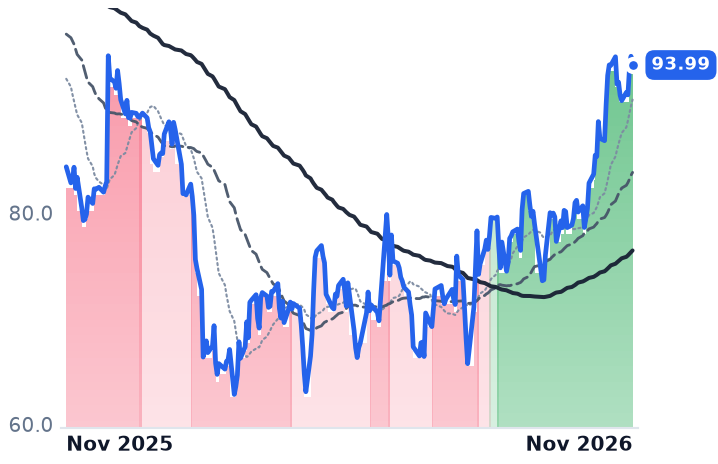
DSGX | The Descartes Systems | Industry-Specific Platforms | 🟢 Cont. Bull | +16.9% | +11.4% |
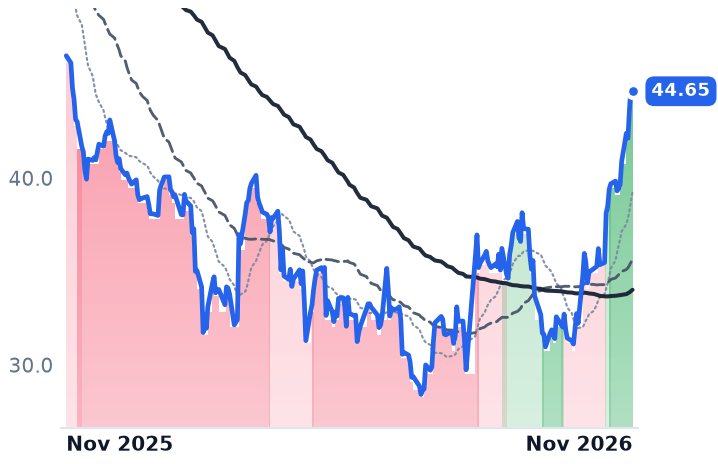
BSY | Bentley Systems, Incorporated | Software Development & Design | 🌱 Emerging Bull | +29.8% | −4.1% |
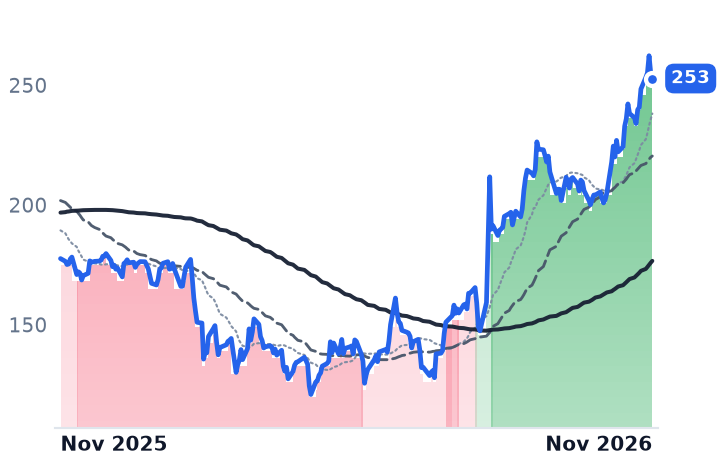
MANH | Manhattan Associates | Industry-Specific Platforms | 🟢 Cont. Bull | +25.1% | +42.3% |
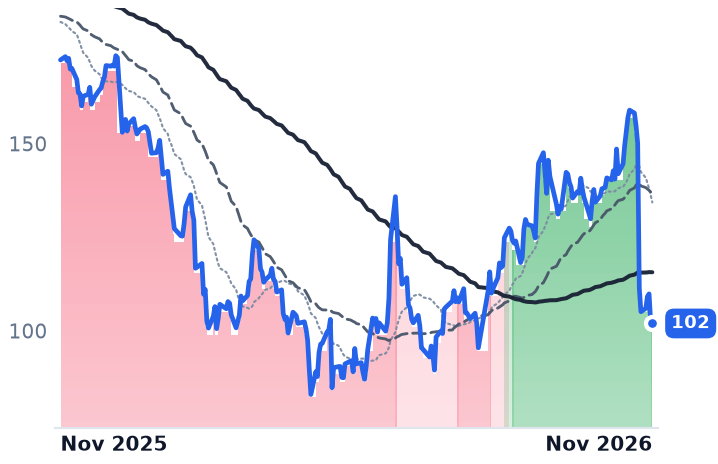
NOW | ServiceNow | Sales, Service & Customer Management | 🟢 Cont. Bull | −26.3% | −40.8% |
12-month price & trend
| Ticker | Mkt cap | P/E | P/E fwd | P/S | P/S fwd | P/GP | P/GP fwd | EV/EBITDA | FCF yld |
|---|---|---|---|---|---|---|---|---|---|
DSGX | $8.0B | 42.9x | 40.2x | 10.4x | 9.7x | 13.4x | 12.5x | 22.7x | 3.7% |
BSY | $13.0B | 43.3x | 31.8x | 7.9x | 7.7x | 9.6x | 9.3x | 27.2x | 3.8% |
MANH | $14.7B | 70.2x | 45.3x | 12.7x | 12.5x | 23.1x | 22.7x | 49.3x | 2.6% |
| Ticker | Mkt cap | P/E | P/E fwd | P/S | P/S fwd | P/GP | P/GP fwd | EV/EBITDA | FCF yld |
|---|---|---|---|---|---|---|---|---|---|
NOW | $105.8B | 72.8x | 25.8x | 6.9x | 6.5x | 9.4x | 8.9x | 32.6x | 4.5% |
Consensus projections
| Ticker | FY2026E | FY2027E | FY2028E | |
|---|---|---|---|---|
DSGX | Revenue | +15.0% | +13.1% | +12.8% |
| EPS | +15.8% | +25.2% | +15.6% | |
BSY | Revenue | +13.6% | +10.4% | +10.2% |
| EPS | +18.6% | +12.3% | +16.3% | |
MANH | Revenue | +9.4% | +8.1% | +9.0% |
| EPS | +12.0% | +10.8% | +11.4% | |
NOW | Revenue | +22.6% | +18.5% | +18.1% |
| EPS | +13.5% | +21.6% | +22.2% |
Forward fiscal years only. Blank means no analyst coverage for that year.
Three software companies that bill against something physical rather than a logged-in user reported within eight weeks of each other, and the profit each extracted from near-identical growth went three ways. Descartes Systems, which sells customs-filing, route-optimization and sanctioned-party screening software to carriers, brokers and freight forwarders, grew revenue 11.8% in its July quarter while operating income rose 38.5%. Bentley Systems, whose MicroStation and OpenRoads applications design roads, rail, bridges and power distribution, grew September-quarter revenue 12.2% and operating income 45.1%. Manhattan Associates, which runs warehouse and omni-channel execution software for retailers and third-party logistics operators, grew revenue 11.0% and operating income 6.8%.
They reported into a market that had just decided seat-priced software was the problem. ServiceNow, the workflow-automation vendor, beat on subscription revenue and raised its artificial-intelligence booking target again, then fell 25.9% from close to close on 29 October after guiding fourth-quarter contracted revenue to 18.5% constant-currency growth; commentary tied the fall to the fear that AI agents shrink demand for software sold by the seat. On a reported basis its operating income fell 32.7% to $385m on revenue up 20.5%, margin down to 9.4% from 16.8%; the company's own non-GAAP operating margin was 32.5%.
The shelf went up without checking the meter
The 13-name specialized-enterprise software group these three sit in rose as a block: the median member is up 22% over 30 days and 11 of 13 are up double digits, against a median twelve-month change of -3.8%. But the meter does not sort the winners. PAR Technology, in restaurant software, leads at 41% and Procore, which sells construction project management, at 39%. DocuSign, priced per user and per envelope, rose 13.2%. PTC, whose asset-design billing most resembles Bentley's, rose 0.8%.
The timing is worse for the mechanical story. Descartes ran from $80.43 on 8 October to $94.00 on 22 October with no company disclosure in the window; its last report was 10 September, and the discoverable events were a Loop Capital reiteration at $96 on 8 October and BMO Capital Markets lifting its target to $90 on 13 October. Manhattan gained 19% between 9 and 22 October, after a Morgan Stanley upgrade, and added about 4% after its 27 October results. Bentley's shares turned up on 19 October, two weeks before it printed.
What Descartes is paid for when volumes fall
The unit Descartes bills is the obligation, not the box. Chief executive Edward Ryan told investors on the 10 September call that overall shipment volumes fell in the quarter, with trucking down 4% year on year, and named rapidly changing tariffs, stepped-up customs and export-control enforcement and a heavier audit burden as the growth drivers. Services revenue was $188.6m, 94% of the total and up 13%, with licence revenue at $0.1m, so nothing is diluting the recurring line. Organic services growth, though, was just north of 9%: roughly four points came from about $250m of acquisitions, and revenue growth has decelerated from 16.2% two quarters ago. At 13.4x trailing gross profit, against 11.3x in mid-September, and 40.2x forward earnings, the market is paying now for leverage already delivered.
Bentley's margin, and the engineers it cannot hire
Bentley's annualized recurring revenue reached $1,582.8m, growing 13% in constant currency, with dollar-based net retention at 110% and operating margin at 29.1% against 22.5%. Executive chair Gregory Bentley called the retention figure "a historical high of 110%" on the 5 November call. It is not AI revenue: chief executive Nicholas Cumins said design-focused monetization starts in 2027 and will not be material that year, and that "Asset Analytics is already monetizing AI, Q3 was a great quarter for Asset Analytics," naming tower-inspection and road-monitoring deals with existing accounts. The demand behind it is a physical bottleneck: of 12–16 GW of data-center capacity projected for 2026 delivery, only about 5 GW is under construction, and nearly half of US engineers are 50 or older. The 13 October divestiture of Cohesive, its IBM Maximo consulting arm, lifts the mix to roughly 95% subscriptions and costs about $12m of fourth-quarter services revenue. Bentley is the cheapest of the three at 9.3x forward gross profit, and 31.8x forward earnings against 43.3x trailing.
Manhattan is buying the transition
Manhattan's cloud subscription revenue hit $134.4m, up 28%, exceeding services revenue for the first time, with contracted revenue yet to be recognized at $2.59bn, up 25%. Services grew 1%, and the maintenance annuity trailing retired perpetual licences fell 12.9% to $30.5m. New logos were only about 35% of new cloud bookings, so the growth is existing accounts buying more. Chief executive Eric Clark told investors on 27 October: "We are maintaining our 100% conversion success from AI pilot to AI subscription." What it has not yet bought back is margin — 26.5% against 27.5% a year earlier, though up from 22.2% in the June quarter. At 23.1x trailing gross profit, from 19.6x seven weeks earlier, and 45.3x forward earnings, it is the dearest of the three on the lowest gross margin, 56.9%.
Compounding, and what the re-rating actually bought
The results account for the direction and almost none of the timing. Descartes and Bentley widen margin because an extra filing or an extra consumption unit rides a platform already built; Manhattan is funding a conversion in which services revenue grows 1% while cloud capacity has to be sold, so its incremental dollar costs more. That split is a pay-structure difference inside one shelf, and the shelf rose without it. The sharpest test sits on the other side: after its crash ServiceNow trades at 8.9x forward gross profit, below Descartes at 12.5x and far below Manhattan at 22.7x. Whatever October paid for, it was not a premium for non-seat meters earned on numbers.
Descartes' own analysis of the overturned tariffs expects brokers to file more post-summary corrections, not fewer. The obligation is symmetrical: taking a duty away generates the same paperwork as putting one on, which is the one thing in this chain that no agent can delete.