

Chip Designers Want Their Own CPU Cores: Synopsys Sold Its Processor IP, Arm Now Sells Silicon
Hypothesis Opus 5 · Research Opus 5 · Writing Opus 5 · Prompt v1.7
The layer that gets paid before any silicon ships has split into two businesses with opposite economics. Arm's licensees shipped more than 10 billion chips in a single quarter for the first time and paid only 8% more in royalties, so the blended rate per chip went backwards; licence revenue hit a record, which is the pipeline being sold up front.
Arm's answer to that ceiling is to sell its own data-center processor at a guided gross margin in the high 30s to low 40s, against roughly 97% on licensing. Synopsys took the other exit, selling its processor-core business to GlobalFoundries and citing customers' preference for developing their own processor IP.
The toolchain is not in the same argument. Cadence's backlog stands at a record $8.2bn and its recurring revenue growth doubled to 18%, while the shares de-rated with everything else in the complex.
| Ticker | Company | Segment | Trend · 13mo | 30D | 1Y |
|---|---|---|---|---|---|
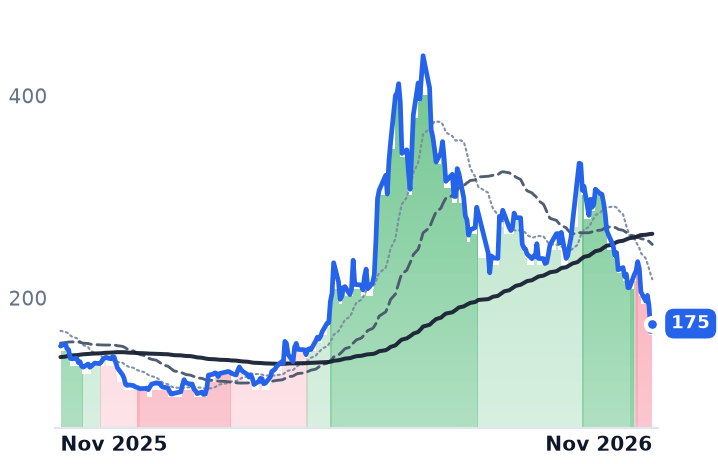
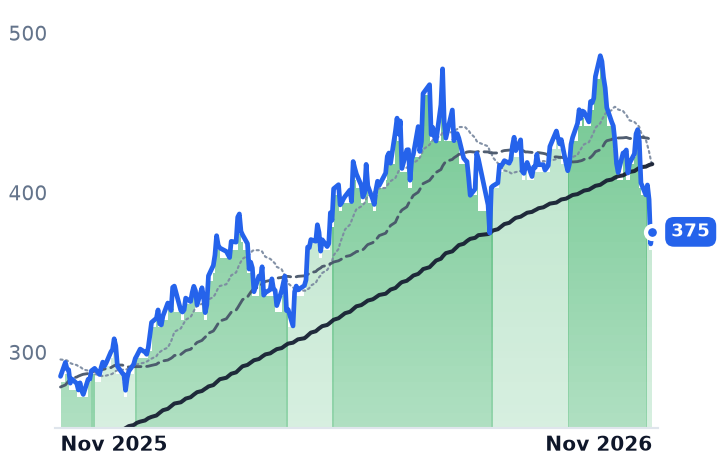
ARM | Arm Holdings plc American Depositary Shares | Processors & Accelerators | 🟢 Cont. Bull | −38.3% | +14.6% |
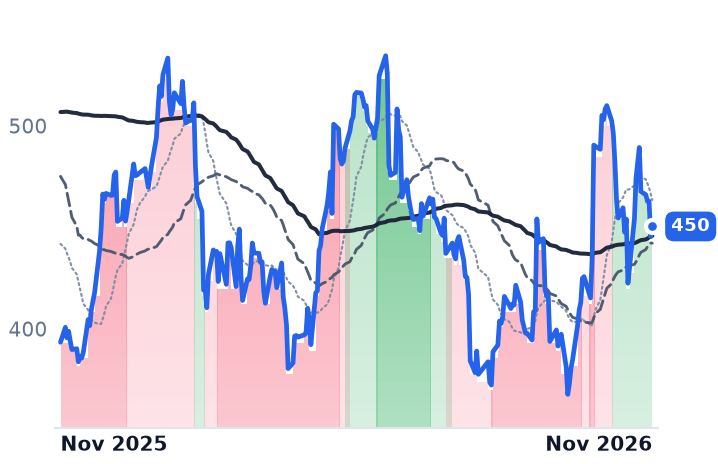
SNPS | Synopsys | Developer Platforms & APIs | 🔴 Cont. Bear | −11.4% | +14.5% |
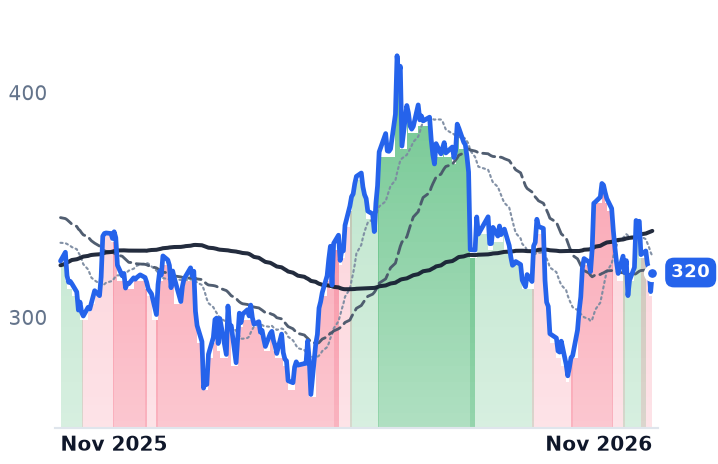
CDNS | Cadence Design Systems | Software Development & Design | 🔴 Cont. Bear | −10.0% | −1.6% |
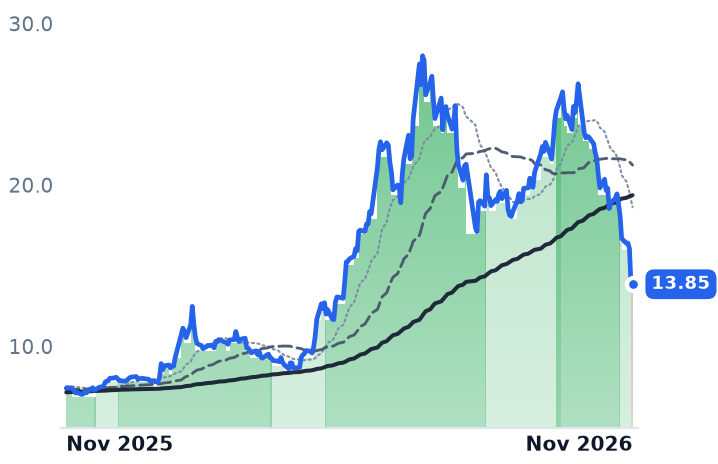
GFS | GLOBALFOUNDRIES | Foundries | 🔴 Cont. Bear | −23.6% | +13.3% |
TSM | Taiwan Semiconductor Manufacturing | Foundries | 🟢 Cont. Bull | −19.4% | +31.8% |
UMC | United Microelectronics | Foundries | 🟢 Cont. Bull | −39.8% | +86.9% |
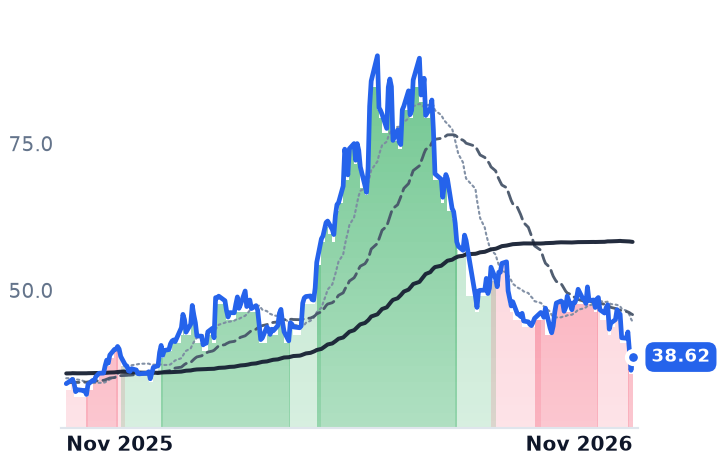
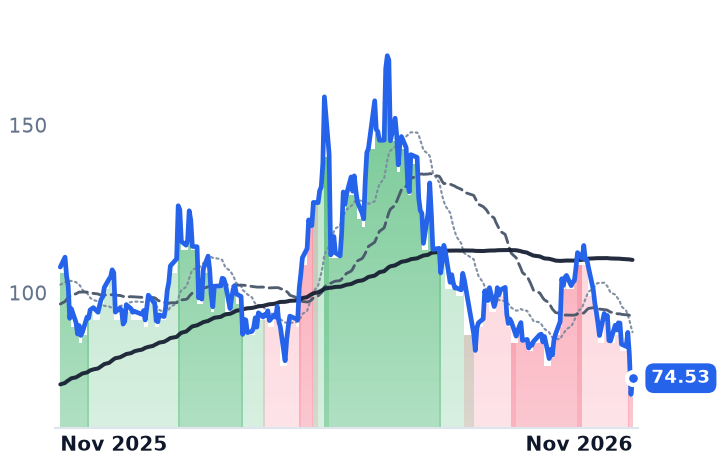
RMBS | Rambus | Memory & Storage | 🔴 Cont. Bear | −32.1% | −30.8% |
12-month price & trend
| Ticker | Mkt cap | P/E | P/E fwd | P/S | P/S fwd | P/GP | P/GP fwd | EV/EBITDA | FCF yld |
|---|---|---|---|---|---|---|---|---|---|
ARM | $186.5B | 200.7x | 78.7x | 34.1x | 30.6x | 35.8x | 32.0x | 141.6x | 0.6% |
SNPS | $86.3B | 78.2x | 24.0x | 9.2x | 7.8x | 12.7x | 10.8x | 25.1x | 3.2% |
CDNS | $87.8B | 63.2x | 38.1x | 14.3x | 13.7x | 16.7x | 16.0x | 37.8x | 2.0% |
| Ticker | Mkt cap | P/E | P/E fwd | P/S | P/S fwd | P/GP | P/GP fwd | EV/EBITDA | FCF yld |
|---|---|---|---|---|---|---|---|---|---|
GFS | $21.2B | 107.3x | 19.9x | 3.0x | 2.9x | 10.3x | 10.1x | 10.3x | 2.0% |
TSM | $1.9T | 21.7x | — | 11.2x | — | 17.0x | — | 14.4x | 2.7% |
UMC | $34.5B | 13.5x | — | 4.3x | — | 13.9x | — | 6.7x | 6.0% |
| Ticker | Mkt cap | P/E | P/E fwd | P/S | P/S fwd | P/GP | P/GP fwd | EV/EBITDA | FCF yld |
|---|---|---|---|---|---|---|---|---|---|
RMBS | $8.0B | 30.3x | 23.9x | 10.0x | 9.5x | 12.7x | 12.1x | 21.8x | 3.9% |
Consensus projections
| Ticker | FY2026E | FY2027E | FY2028E | |
|---|---|---|---|---|
ARM | Revenue | +22.5% | +24.5% | +36.8% |
| EPS | +7.9% | +26.6% | +35.9% | |
SNPS | Revenue | +38.0% | +13.5% | +13.9% |
| EPS | +18.2% | +23.8% | +23.2% | |
CDNS | Revenue | +21.3% | +14.5% | +12.5% |
| EPS | +19.1% | +17.2% | +15.7% | |
GFS | Revenue | +8.0% | +12.4% | +14.3% |
| EPS | +17.9% | +30.4% | +33.7% | |
TSM | Revenue | +43.9% | +38.6% | +26.0% |
| EPS | +68.7% | +34.6% | +27.3% | |
UMC | Revenue | +16.3% | +25.1% | +16.4% |
| EPS | +112.4% | −1.4% | +25.3% | |
RMBS | Revenue | +18.8% | +20.9% | +25.4% |
| EPS | +24.8% | +24.6% | +25.8% |
Forward fiscal years only. Blank means no analyst coverage for that year.
Arm's partners shipped more than 10 billion Arm-based chips in a single quarter for the first time, and the royalties Arm collected on them grew at the slowest rate in eight quarters. Royalty revenue rose 8% to $670m while shipments rose by 1.5 billion chips year on year. Divide one by the other and the blended rate works out near 6.5 cents a chip, down from roughly 7 cents a year earlier — a derived figure, but the direction is not in dispute, because Arm guided December-quarter royalty growth to the low single digits.
Custom accelerators, chiplets and hyperscaler in-house silicon were supposed to multiply the money collected at the design layer. What the autumn prints show is that the design layer is indeed being paid more, through the invoice for tools and verification hardware rather than through the per-chip rate — and the two companies that owned licensable CPU cores have each found a way out of selling them.
The core is the part customers now build themselves
Synopsys, which sells chip-design software and a large silicon IP catalogue, completed the sale of its Processor IP Solutions business to GlobalFoundries on 1 June 2026 for $443.3m — the ARC and ARC-V RISC-V cores, the digital-signal and neural-processing IP, and the MetaWare toolkits. Chief executive Sassine Ghazi cited "customer preference for developing their own processor IP." The divestiture is why Synopsys' backlog slipped sequentially to $10.9bn in the July quarter even as reported revenue grew 42%, most of that from the Ansys acquisition.
What Synopsys kept is the plumbing an in-house design team cannot write itself. Its Design IP segment returned to growth at $474m, up roughly 11%, on a 95% win rate in PCIe 7 interfaces and 25 design wins for the next memory standard.
GlobalFoundries, the specialty foundry that bought those cores, is using them to sell design wins rather than only wafers: it booked roughly $1bn of lifetime revenue in third-quarter wins including a RISC-V real-time control processor and a data-center board management controller, with communications infrastructure and data center reaching 17% of revenue, up 81% year on year. "We are absolutely booked out through 2027," chief executive Tim Breen told investors on 4 November.
Arm traded a 97% margin for a 40% one
Arm's response to the same ceiling was to build the chip itself. Its AGI data-center processor, launched on 24 March 2026 with Meta as debut customer, now carries a target of up to $2bn of revenue across fiscal 2027 and 2028, raised from $1bn-plus. "In the past 90 days, we have signed purchase orders from multiple customers and signed supply agreements with companies in our supply chain," chief financial officer Jason Child said on the 4 November call. The guided gross margin is high 30s to low 40s initially, against the 97.1% the licensing business earns.
The per-socket story is real where it works. Data-center royalties doubled year on year, and chief executive Rene Haas told investors that Arm-based server share at the top hyperscalers "has more than tripled from 15% in calendar 2024 to more than 50% in calendar 2025." It is not enough to lift the blend, because the incremental billion-plus units are low-rate edge silicon and because elevated memory prices inflated handset bills of materials, squeezing the smartphone royalty base. Meanwhile licence revenue jumped 50% to a record $773m: four new compute-subsystem deals that convert to royalties in 12 to 24 months, booked as cash today.
Cadence got paid for the same design starts, under contract
Cadence, which sells design software alongside its Palladium emulation and Protium prototyping machines, grew September-quarter revenue 22% and ended the quarter with record backlog of $8.2bn, $4.2bn of it due inside twelve months. Recurring revenue growth doubled to 18% from 11%. The emulation hardware line — the piece that is a capital order from the same hyperscalers whose spending is now being questioned — set another record, and full-year guidance went up to 21% growth with the earnings target lifted $0.30 to $8.40. Reported operating margin fell to 26.2% from 33.8%, which is the Hexagon design-and-engineering integration carrying about $160m of revenue at minimal operating profit this year, against a 44.1% non-GAAP margin.
Chief executive Anirudh Devgan gave the mechanism on 26 October: "TSMC showed their process road map and said in the next 5 years, the chip size will go up by 48x. 48x." Verification work scales with die area whoever owns the core.
Where the markdown was deserved and where it was not
Over thirty days Arm fell 40.7% and sits 61.4% below its 52-week high; Synopsys fell 10.5% and Cadence 10.8%, the two shallowest declines on the shelf, and over three months Synopsys is up 8.3%. Most of the late damage was one session, the 5 November selloff in which the Nasdaq fell 5.52% into correction on the midterm result's implications for the AI buildout, already the complex-wide event this paper described when analog chipmakers caught it.
Arm's de-rating is doing rational work. At $174.62 the shares still cost 78.7x consensus 2027 earnings against 200.7x trailing, while consensus models revenue up 36.8% in fiscal 2028 on a royalty line growing 8% — and the company faces a Qualcomm trial over its licensing terms expected this quarter plus a US Federal Trade Commission antitrust inquiry into its handling of licensees.
Cadence's does not. Its forward earnings multiple is 38.1x on this year's consensus and 32.5x on next year's, against 63.2x trailing and the roughly 50-55x forward it commanded in May, on a contracted book that is larger and converting faster. The split has a cause: Arm's price per chip was fixed years before tape-out and is exposed to what memory costs a handset maker today, while Cadence's is a multi-year subscription plus a machine the customer must buy before the chip exists.
Arm's data-center royalties doubled in the quarter and its blended rate per chip still went down. The licensable core keeps getting more valuable in the sockets where it survives, and fewer designers keep paying per chip for someone else's — which is why the two firms that held those cores each took a different way out, and why the companies selling the tools to build the replacements never had to choose.