

FICO Froze the Mortgage Score Price That Drove Its Growth as Loan Counts Head Down
Hypothesis Opus 5 · Research Opus 5 · Writing Opus 5 · Prompt v1.7
Fair Isaac's June quarter was read as proof that it could raise the toll on a mortgage credit score at will. Its own disclosures since 23 October say the opposite is now in force: the wholesale price is held flat for 2027 after going from $4.95 to $10.00, and the Mortgage Bankers Association's October forecast cuts next year's loan count 5.6% to 5.0 million.
Both levers of a per-pull business now point down at once, while reported results still look superb: Scores revenue grew 41% in the June quarter on price, at a 53.8% group operating margin. The forward earnings consensus of $46.77 a share for fiscal 2027 still embeds the lever the company froze.
Vertex and BlackLine rallied in the same month with no demand inflection behind them: Vertex's annual recurring revenue grew 10.5% with net retention down to 105%, BlackLine's grew 6% with 134 fewer customers.
| Ticker | Company | Segment | Trend · 13mo | 30D | 1Y |
|---|---|---|---|---|---|
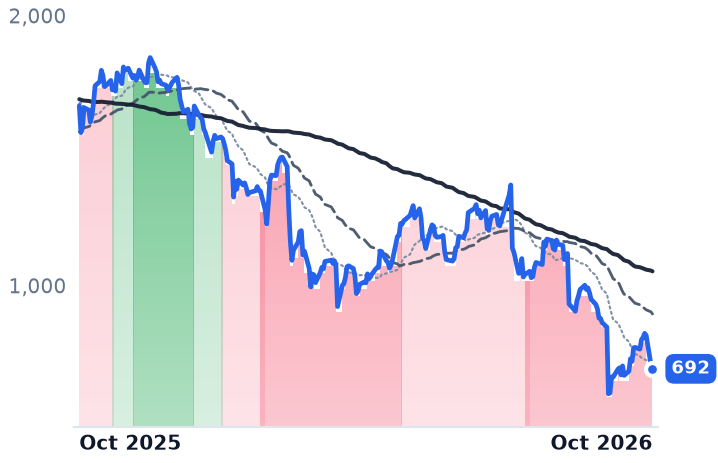
FICO | Fair Isaac | Data, Analytics & Intelligence | 🔴 Cont. Bear | −18.3% | −58.5% |
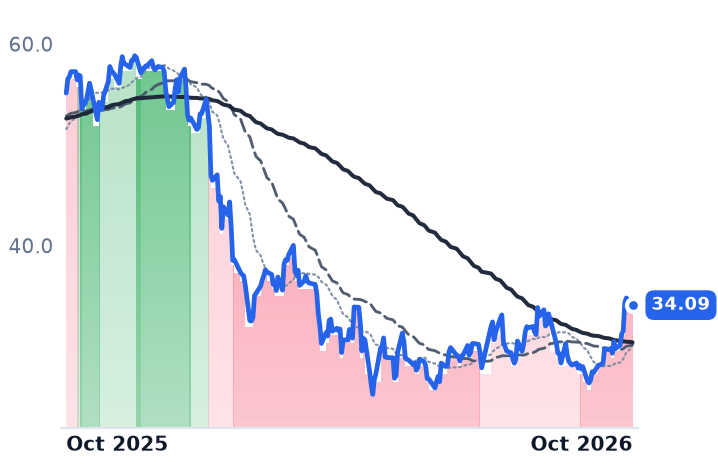
VERX | Vertex | Commerce & Digital Payments | 🔴 Cont. Bear | +33.4% | −41.1% |
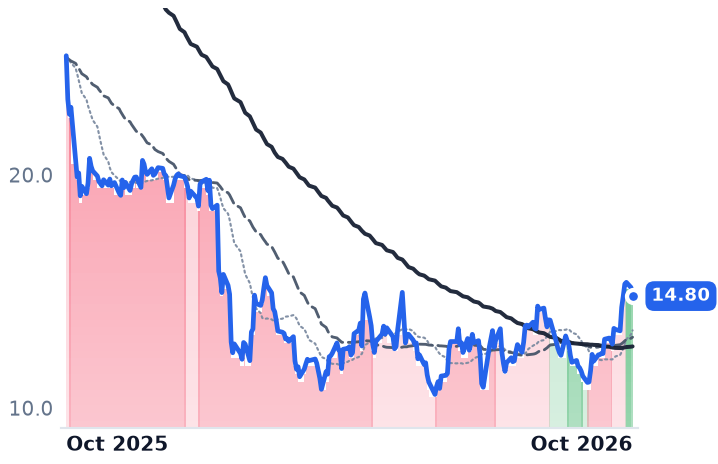
BL | BlackLine | Other | 🔴 Cont. Bear | +28.4% | −38.2% |
12-month price & trend
| Ticker | Mkt cap | P/E | P/E fwd | P/S | P/S fwd | P/GP | P/GP fwd | EV/EBITDA | FCF yld |
|---|---|---|---|---|---|---|---|---|---|
FICO | $14.9B | 19.9x | 14.8x | 6.2x | 5.6x | 7.3x | 6.5x | 16.0x | 6.7% |
VERX | $2.4B | 483.7x | 18.1x | 3.0x | 2.9x | 4.9x | 4.7x | 48.0x | 2.4% |
BL | $2.0B | 57.9x | 13.7x | 2.7x | 2.6x | 3.6x | 3.4x | 24.0x | 8.6% |
Consensus projections
| Ticker | FY2026E | FY2027E | FY2028E | |
|---|---|---|---|---|
FICO | Revenue | +27.3% | +6.3% | +7.2% |
| EPS | +44.8% | +9.6% | +12.3% | |
VERX | Revenue | +10.6% | +10.5% | +11.5% |
| EPS | +28.4% | +23.9% | +21.1% | |
BL | Revenue | +9.5% | +10.4% | +10.3% |
| EPS | +19.7% | +10.9% | +18.0% |
Forward fiscal years only. Blank means no analyst coverage for that year.
Fair Isaac has stopped raising the price of the credit score that American mortgage lenders pull on nearly every application. On 23 October the company said it would hold the wholesale price of the FICO score sold through tri-merge resellers at $10 for lenders and brokers enrolled in a new, non-exclusive Preferred Program, which bundles Classic FICO Score and FICO Score 10T for resellers committing to pull a FICO score on 100% of mortgage applications. It is the first flat year after the step up from $4.95.
That price step is what produced the growth. Scores revenue was $458.9m in the June quarter, up 41%, and the company's own release says the 49% rise in the business-to-business line was "primarily attributable to a higher mortgage origination scores unit price." The quarter was read as proof the toll could be raised at will. What the October disclosures establish is that both legs of a per-pull business, the price and the number of loans it is collected on, are now pointing down in the same year.
The first flat year after the doubling
"By holding our price at $10 for lenders in our Preferred Program and including both Classic FICO Score and FICO Score 10T, we're ensuring lenders have access to the trusted and predictive tools they need to assess risk with confidence," chief executive Will Lansing said on 23 October. Mortgage-market coverage treated the program as a defensive volume play rather than pricing strength, and as one of several 2027 options still undisclosed; the shares fell about 6% in after-hours trade.
The competitive socket explains the defense. The Federal Housing Finance Agency now lets lenders use VantageScore 4.0, owned by Equifax, Experian and TransUnion, on conventional loans bought by Fannie Mae and Freddie Mac, at a single-score price of around $0.99 against FICO's $10 tri-merge bundle. FHFA Director Bill Pulte said on 28 September that the two mortgage guarantors would merge their fee-pricing grids to cover both models, letting a lender take whichever score produces the better fee. Senator Josh Hawley has separately opened an investigation into the doubling to $10, citing FICO's use by roughly 90% of lenders.
The unit leg is forecast to shrink too
The Mortgage Bankers Association's October forecast cuts 2027 single-family origination by loan count 5.6%, to 5.0 million from 5.3 million expected this year, with rates staying above 7%. Fewer applications, each of which may now carry a dollar score instead of a ten-dollar one, is the arithmetic the price freeze sits inside.
The shares have taken it in dated steps. FICO fell 29.2% on 29 September, the session after Pulte's grid statement, and 13.2% on 26 October after he pledged "more action this week in the credit scoring industry to ensure competition is real and not fake, or manipulated." At $691.74 on 27 October the stock is down 58.9% over a year.
Against reported results, that looks like a dislocation: revenue grew 25.7% in the June quarter at a 53.8% operating margin, and the stock trades at 19.9x trailing earnings and 14.8x forward, against roughly 62x in January. The forward figure is the weak one. It rests on fiscal-2027 consensus of $46.77 a share, up 9.6% on this year, and that estimate still contains the pricing lever the company switched off on 23 October.
Eight of nine rallied without a demand inflection
Eight of nine financial-services application software names rose over the 30 days to 27 October, a median gain of 16.3%, and FICO was the only decliner. Vertex, which sells transaction-tax determination software that corporations bolt onto billing and enterprise systems, gained 30.2%, yet its annual recurring revenue of $703.4m grew 10.5% and net revenue retention fell to 105% from 108%. Its cloud line is the piece working, up 17.9% with revenue per direct customer at $142,997, helped by statutory mandates: "we won several six-figure enterprise e-invoicing deals in the second quarter, including a mid six-figure win for an existing customer driven by mandates in just two countries, France and Finland," chief executive Chris Young told investors on the second-quarter call. It is the dearer of the two bounce names at 4.68x forward gross profit.
BlackLine, whose cloud software automates the accounting close for large enterprises, rose 21.8% on an improving profit and loss statement, revenue up 9.2% and operating income up 45.7%, while its forward book did the reverse: recurring revenue up 6%, net retention 102%, and 4,260 customers at 30 June against 4,394 at December. At 3.42x forward gross profit and an 8.6% trailing free-cash-flow yield, it is cheaper than Vertex on comparable growth, and far below the 81x earnings it carried in May.
Neither bounce is explained by the meters. The Morningstar US Software Application Index rose 18% in the third quarter as fears that artificial-intelligence coding agents would wreck high-margin software models faded, and BlackLine's 9.5% jump on 22 October was attributed to that sector move rather than company news. The likelier reading of both is multiple repair off oversold lows. FICO is the inverse case: its results are the best of the three and its de-rating is the only one with a disclosed cause.
FICO reports fiscal fourth-quarter results on 4 November, against guidance of $2.53bn revenue for the year. It is the first occasion on which the company has to say, in full, what a mortgage score will cost next year and how many lenders are still pulling one.