

TAL Rebuilt the Fattest Margins in Chinese Tutoring and Is the Only One Down This Month
Hypothesis Opus 5 · Research Opus 5 · Writing Opus 5 · Prompt v1.7
The three Chinese tutoring companies climbed together over the summer on the premise that the businesses they rebuilt after academic tutoring was banned in 2021 are compounding. Their filings say the group has already split, and it split on profitability: TAL ran an 18.1% operating margin in its May quarter against 2.5% a year earlier, New Oriental 11.4% for its fiscal year, Gaotu minus 9.0% because selling expense alone eats 54.7% of revenue.
Since 9 October the company with the sharpest margin turn has lost 18.7% of its value with nothing disclosed, sliding into a 29 October print at 7.4x forward earnings. New Oriental's advance is supported by its own accounts; Gaotu's is not. And a Peking University study published 21 October put the share of Chinese students buying academic tutoring at 20.1% in 2025 against 38.1% in 2017, with the top tenth of students funding three-quarters of all spending.
| Ticker | Company | Segment | Trend · 13mo | 30D | 1Y |
|---|---|---|---|---|---|
| The subject · what this brief is about | |||||
TAL | TAL Education | China K-12 Tutoring | 🟢 Cont. Bull | −12.7% | −17.4% |
EDU | New Oriental Education & Technology | China K-12 Tutoring | 🟢 Cont. Bull | +4.6% | −1.3% |
GOTU | Gaotu Techedu | China K-12 Tutoring | 🌱 Emerging Bull | +8.6% | −20.5% |
| Compared against · context, not the story | |||||
BABA | Alibaba | General E-commerce Platforms | 🔴 Cont. Bear | −8.1% | −40.8% |
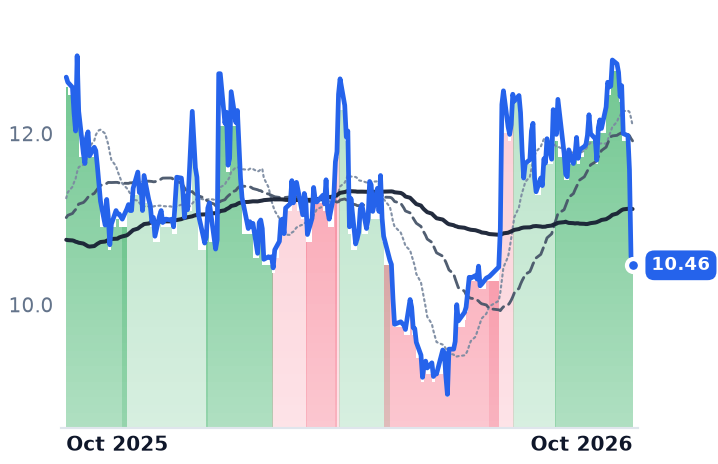
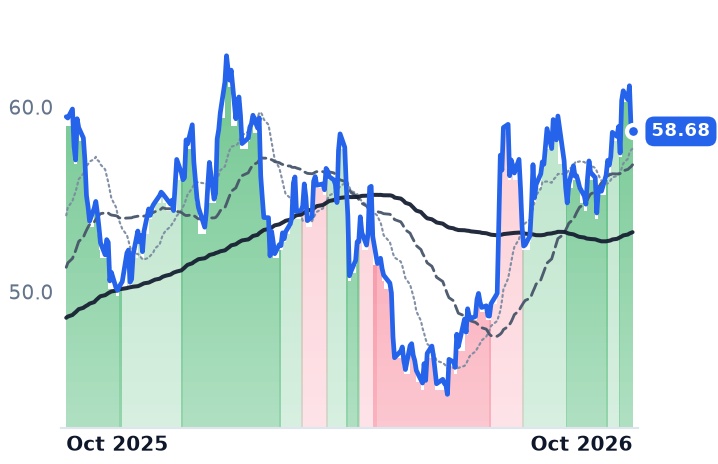
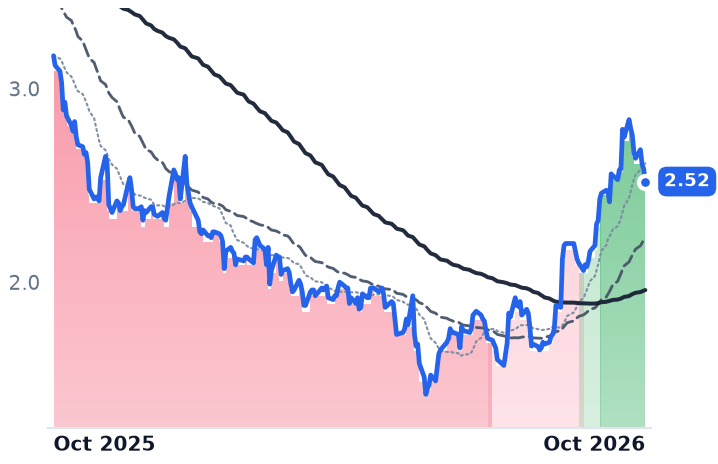
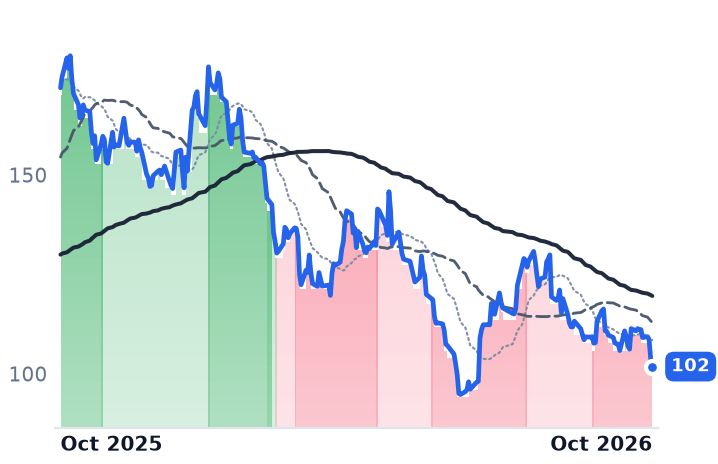
12-month price & trend
| Ticker | Mkt cap | P/E | P/E fwd | P/S | P/S fwd | P/GP | P/GP fwd | EV/EBITDA | FCF yld |
|---|---|---|---|---|---|---|---|---|---|
TAL | $6.4B | 2.1x | 7.4x | 2.0x | 1.7x | 3.6x | 3.0x | 6.6x | 10.0% |
EDU | $9.1B | 19.8x | 13.3x | 1.5x | 1.4x | 2.7x | 2.5x | 9.3x | 9.2% |
GOTU | $891.9M | n/m | — | 0.9x | — | 1.3x | — | n/m | 4.2% |
| Ticker | Mkt cap | P/E | P/E fwd | P/S | P/S fwd | P/GP | P/GP fwd | EV/EBITDA | FCF yld |
|---|---|---|---|---|---|---|---|---|---|
BABA | $275.1B | 23.4x | — | 1.7x | — | 4.5x | — | 12.3x | -4.4% |
Consensus projections
| Ticker | FY2026E | FY2027E | FY2028E | |
|---|---|---|---|---|
TAL | Revenue | +31.9% | +25.5% | +17.6% |
| EPS | +188.3% | +125.1% | −13.5% | |
EDU | Revenue | +14.8% | +19.0% | +12.4% |
| EPS | +27.1% | +26.3% | +15.9% | |
GOTU | Revenue | +16.4% | +13.4% | +11.0% |
| EPS | −102.1% | +1992.9% | +70.0% | |
BABA | Revenue | +2.3% | +9.6% | +12.6% |
| EPS | −49.0% | +30.8% | +40.6% |
Forward fiscal years only. Blank means no analyst coverage for that year.
TAL Education, which sells small-group classes for kindergarten-to-grade-12 students under the Xueersi and Izhikang brands plus learning tablets, reports second-quarter fiscal 2027 results before the market opens on Thursday 29 October, having lost 18.7% of its value in nine sessions with no filing or announcement of its own in between. New Oriental, which reports a day earlier, was flat across the same stretch. Gaotu Techedu fell 8.4%, and Alibaba, the readiest proxy for the New York-listed China complex, fell 8.6%.
The summer trade in these three was that the businesses rebuilt after Beijing banned for-profit academic tutoring in 2021 were compounding in unison: over three months to 22 October New Oriental rose 20.5% and Gaotu 51.8%. The accounts say the group has split, and it split on profit. On their latest reported quarters TAL ran an 18.1% operating margin, New Oriental 5.6% in a seasonally weak quarter and 11.4% across its fiscal year, and Gaotu minus 9.0%. The sharpest turn in the group belongs to the one share that has gone backward.
The margin came from centers leased a year earlier
TAL's May quarter put revenue at $758.4m, up 31.9% in dollars, with gross margin at 57.8% and operating income of $137.2m. Roughly seven points of that headline growth was currency translation: in renminbi the increase was about 25%. The company operated more than 600 learning centers across 44 cities as of its 30 July call, and because a center is leased and staffed before its seats are sold, the margin jump is mostly a utilization reading on capacity committed the year before.
The hardware question resolved the same way. Learning content, books, apps and devices reached 35.3% of fiscal 2026 revenue from 31.8%, and group gross margin widened to 55.4% from 53.3%. Weekly active devices passed 2 million units at about an hour of daily use each, and the T6 tablet launched in July 2026. "Our first quarter performance in fiscal year 2027 reflects solid execution across our businesses," president and chief financial officer Alex Peng said on 30 July.
New Oriental's growth sits in the lines the ban created
New Oriental's quarterly revenue growth accelerated through fiscal 2026 to 23.2%, and full-year operating income rose 50.7% on 15.9% more revenue, lifting the operating margin to 11.4% from 8.7%. Its physical network — 75 schools and 1,459 learning centers across 69 cities at 31 May 2026 — is 94% of the center count it held before the ban, carrying a different product mix: non-academic courses booked about 1,072,000 enrollments in the May quarter, while overseas test preparation, the line the ban never touched, grew 6%. "In this fiscal quarter, we executed cautious capacity expansion while carefully balancing revenue growth and operational efficiency," chief executive Chenggang Zhou said on 29 July. The company then guided fiscal 2027 revenue to $6,453.9m-$6,680.3m, growth of 14-18% and a deceleration. Its deferred revenue grew 14.8%, well behind the 23.2% it funds; TAL's book grew 25.9% against 31.9% revenue growth. At all three, prepaid tuition is filling more slowly than the income statement drains it.
Gaotu is the counterexample management itself describes. Gross margin of 66.5% in the June quarter is the best of the three, but selling expenses of RMB913.2m took 54.7% of revenue, about four-fifths of gross profit, and revenue growth has whipsawed from 30.7% to 19.9% over four quarters. "Footprint growth itself is not the main KPI," chief operating officer Bin Luo said on 27 August. Consensus asks for a RMB14.4m net profit in 2026 against a RMB101.2m loss already booked in the first half. Price-to-book of 5.70x is the only usable anchor on a loss-making business, against TAL's 0.47x.
A narrowing pool, and money that stays at the top
The new information about the market all three sell into arrived on 21 October, when Caixin reported a Peking University study finding that the share of Chinese students receiving academic tutoring fell to 20.1% in 2025 from 38.1% in 2017, with non-academic participation down to 16.7% from 22.4%. Spending per student fell only 11.8%, to RMB2,873, and the top 10% of students accounted for 75.8% of it. Enrollment growth now has to be taken from a shrinking, premium-skewed pool. Beijing has not loosened the rule either: in January 2026 regulators fined an unregistered education firm RMB67m explicitly to kill rumors of a reversal.
How much of the price action the businesses explain differs by name. New Oriental's three-month gain is supported by accelerating revenue and expanding margin, and at 13.3x forward earnings against 19.8x trailing it is paid for roughly 26% consensus earnings growth. Gaotu's 51.8% advance has no earnings underneath it. TAL's fall has no company cause: its forward price-to-gross-profit compressed from 3.73x on 9 October to 3.03x with no estimate revision, and the 21-22 October weakness across the complex traced to China's market regulator pressing e-commerce platforms on product quality, with TAL's own slide attributed to Chinese shares retreating on consumer worries ahead of its results. The likelier reading is the complex rather than the company, in a market where MSCI China consumer staples missed profit expectations by 47% last season and consumer sub-indexes sit near decade lows. Averaged over longer windows the price trend for all three still reads as rising, which at this point lags what the shares have actually done.
The split has a cause on each side. New Oriental earns on distribution density, TAL on filling centers and devices it has already paid for, Gaotu on traffic it rents by the quarter. Two of those three get a fresh reading inside 48 hours.
What neither print can settle is the arithmetic underneath all of it: a business can fill every seat it owns and still be selling into a country where four students in five now buy no tutoring at all.