

Falling Power Prices Shrank Air Products' Revenue and Widened Its Margin
Hypothesis Opus 5 · Research Opus 5 · Writing Opus 5 · Prompt v1.7
The revenue line of an industrial gas company cannot say whether its business improved, because the electricity and natural gas burned inside a customer's fenceline arrive in sales at zero margin. Air Products' Americas sales rose 5% last quarter with the energy cost rebilled to customers subtracting two points, and that subtraction added roughly 50 basis points to the segment's operating margin.
Linde's own filing splits its growth into six pieces, one of which is the contractual billing of energy cost variances. Where the two part is capital and cost. Air Products took a $2.9bn charge to walk away from Louisiana hydrogen, cut its capital plan, and reported better adjusted margin, return on capital and guidance. Linde's adjusted operating margin fell 60 basis points and its return on capital slipped to 23.5%, even as its signed gas-supply backlog hit a record.
| Ticker | Company | Segment | Trend · 13mo | 30D | 1Y |
|---|---|---|---|---|---|
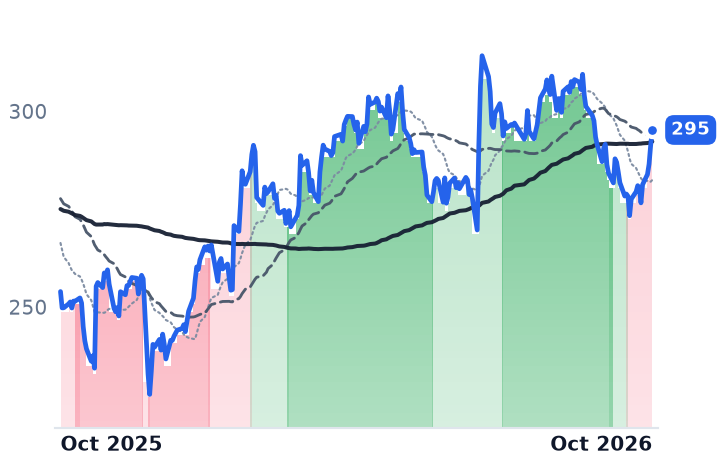
APD | Air Products and Chemicals | Industrial Gases | 🟢 Cont. Bull | +1.6% | +16.3% |
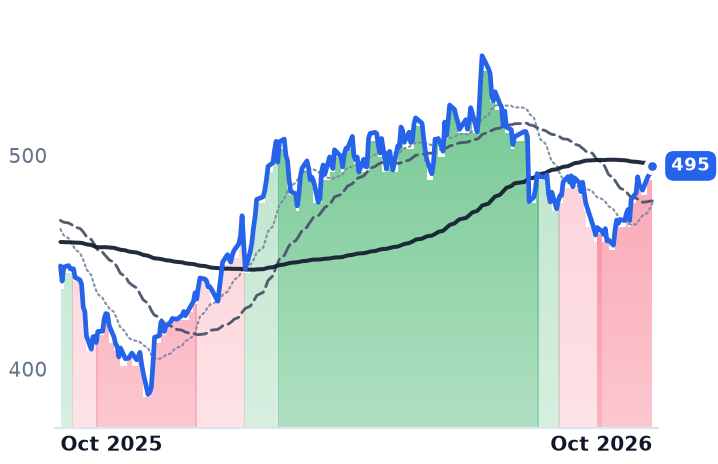
LIN | Linde | Industrial Gases | ⚠️ Emerging Bear | +6.9% | +10.4% |
12-month price & trend
| Ticker | Mkt cap | P/E | P/E fwd | P/S | P/S fwd | P/GP | P/GP fwd | EV/EBITDA | FCF yld |
|---|---|---|---|---|---|---|---|---|---|
APD | $65.8B | n/m | 20.4x | 5.2x | 4.9x | 16.3x | 15.3x | 18.9x | 3.1% |
LIN | $228.2B | 31.8x | 27.7x | 6.4x | 6.3x | 17.1x | 16.7x | 18.7x | 2.2% |
Consensus projections
| Ticker | FY2026E | FY2027E | FY2028E | |
|---|---|---|---|---|
APD | Revenue | +6.0% | +5.5% | +6.2% |
| EPS | +12.1% | +7.5% | +8.3% | |
LIN | Revenue | +7.3% | +4.9% | +5.8% |
| EPS | +8.9% | +9.6% | +10.2% |
Forward fiscal years only. Blank means no analyst coverage for that year.
Air Products' Americas business sold more gas in the June quarter and billed its customers less for the power that made it. Segment sales rose 5%, according to the company's quarterly filing: volumes added seven points, price was flat, and the energy cost passed through to customers subtracted two. The margin moved the other way, reaching 29.9% against 29.7% a year earlier, with about 50 basis points of that improvement coming from the same shrinking pass-through.
The top line of an industrial gas company is close to useless, then, as a gauge of whether the business got better. Most of the profit comes from air-separation units built inside a customer's fence under long-term take-or-pay contracts, where power and gas are rebilled at no margin and a fixed facility fee arrives whether the customer runs its plant or not. The meters that answer the question are operating margin, return on capital, and the money each company is committing to new plants. On those, Air Products and Linde have spent this year moving in opposite directions.
Two points of sales that were never profit
Linde, which supplies the same oxygen, nitrogen, argon and hydrogen and also builds the plants that make them, does the arithmetic in public. Its second-quarter 10-Q bridges 9% sales growth, to $9,289m, into six parts: two points of price, two of volume, two of currency, one of acquisitions, one from engineering, and one of "cost pass-through, representing the contractual billing of energy cost variances primarily to onsite customers." Half that growth carries no information about gas sold.
Air Products shows the same line running both ways inside one year. Over the nine months to 30 June, a higher pass-through added two points to Americas sales and cost the segment 50 basis points of margin, which fell to 29.0%.
Air Products got paid for retreating
On 26 June the company exited Casa Grande, Arizona and other small clean-energy distribution projects, citing slower-than-expected market development largely in hydrogen for mobility. Four days later it abandoned the Louisiana Clean Energy Complex, a low-carbon hydrogen and ammonia plant already under construction, on returns grounds. The pre-tax charge runs to $2.9bn, $2.2bn after tax, against cash costs capped at $925m. The NEOM green-hydrogen venture in Saudi Arabia survived; Air Products instead signed a marketing and distribution agreement with Yara for its renewable ammonia.
The shares rose 8.0% on announcement day, from $271.35 to $293.18. Capital spending guidance for fiscal 2026 came down to about $3.5bn from roughly $4.0bn, and the company is steering toward some $1.5bn a year of ordinary industrial-gas plants.
What the trading business did under that charge was improve. Adjusted operating income of $810m rose 9%, adjusted operating margin widened 110 basis points to 25.6%, adjusted earnings per share of $3.47 rose 12%, and return on capital reached 11.7%. Full-year adjusted earnings guidance went up to $13.39–$13.49. "Having taken additional decisions to further optimize our large project portfolio, we have a clear pathway to reduce capital expenditures and drive continued profitable growth through high-quality, traditional industrial gas projects," chief executive Eduardo Menezes said on 30 July.
Linde's margin gave way while its backlog hit a record
Linde's adjusted operating margin narrowed 60 basis points to 29.5% as cost inflation outran price and productivity. Chief executive Sanjiv Lamba, on 31 July, called it "another solid quarter, generating record sales and EPS while maintaining industry-leading profitability with 29.5% operating margin and 23.5% return on capital." That return was below the roughly 24% of the prior quarter. On the call Lamba put the roughly 30 basis points of decline excluding pass-through mainly on the US homecare business, and described the quarter's 2% price attainment as broad-based and generally tracking local inflation.
The order book did not crack. A long-term US electronics supply agreement lifted the contractual sale-of-gas backlog about $1bn to a record $8.1bn, within a total project pipeline near $11bn, and capital spending is guided to $5.5bn–$6.0bn. Linde fell 5.95% the day it reported.
Where the two de-ratings part company
Both stocks peaked on 2 July, Air Products at $314.19 and Linde at $546.64, and sit 6.0% and 9.4% below those marks; Air Products is still up 14.7% over twelve months.
For Air Products the results do not account for the slide. Price to gross profit has eased to 16.3x trailing from 17.5x in early May while margin, return on capital and guidance all improved, and the forward multiple of earnings is 20.4x. Linde's fall from 34.98x trailing earnings in early May to 31.8x rests on compression a reader can see in the filings.
One caveat sits against calling Air Products mispriced: the two now change hands at almost the same trailing enterprise value to cash earnings, 18.9x against Linde's 18.7x, while Air Products earns 11.7% on capital employed and Linde 23.5%. The likelier reading is a market pricing the return gap rather than missing the quarter. In a three-way oligopoly where Linde holds roughly 30% of the global market, Air Liquide about 24% and Air Products some 16%, the asset inside the fence is the moat, and the pressure point is renewal: bulk atmospheric gas contracts in North America and Western Europe get renegotiated as take-or-pay terms expire, which erodes a book without any volume falling.
The answer arrives in a cluster. Linde reports third-quarter results on 29 October and Air Liquide publishes revenue the same morning; Air Products holds its fiscal fourth-quarter call on 5 November. Whichever of them restates backlog or capital spending first will say more about the next decade of fenceline plants than any sales bridge can.