

ResMed's Masks Grew 13% Last Year, Faster Than the Machines That Need Them
Hypothesis Opus 5 · Research Opus 5 · Writing Opus 5 · Prompt v1.7
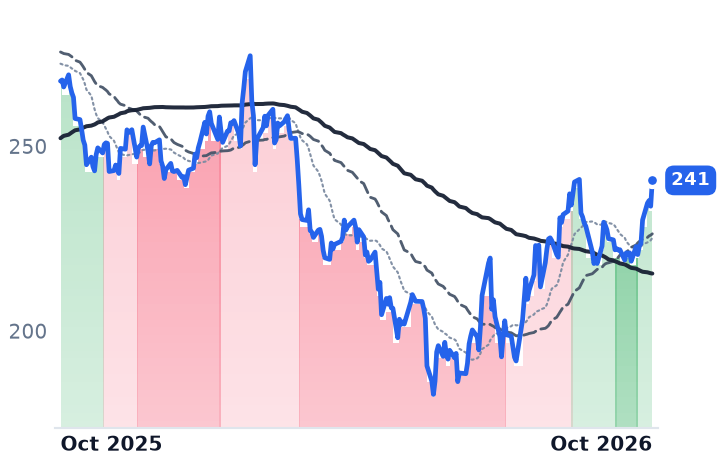
ResMed's advance since the start of October came with no company news attached to it: health care led a defensive rotation out of technology, and the forward earnings multiple expanded from roughly 18.1x to 19.9x on an unchanged fiscal 2027 consensus of $12.10 a share. The quarter the company last reported went the other way.
Mask and accessory revenue reached $2.085bn in the year to 30 June 2026, up 13%, while June-quarter reported gross margin fell to 58.8% from 60.8% and reported operating income declined 1.3%. Growth is coming from the consumable reorder, not from flow generators, life support or the software book being sold.
Inspire Medical, treating the same disease with a one-time implant, is the opposite architecture: revenue fell 7.6% last quarter, and the new surgical billing codes it won do not take effect until 2028.
| Ticker | Company | Segment | Trend · 13mo | 30D | 1Y |
|---|---|---|---|---|---|
RMD | ResMed | Respiratory Equipment & Supplies | 🌱 Emerging Bull | +4.9% | −10.0% |
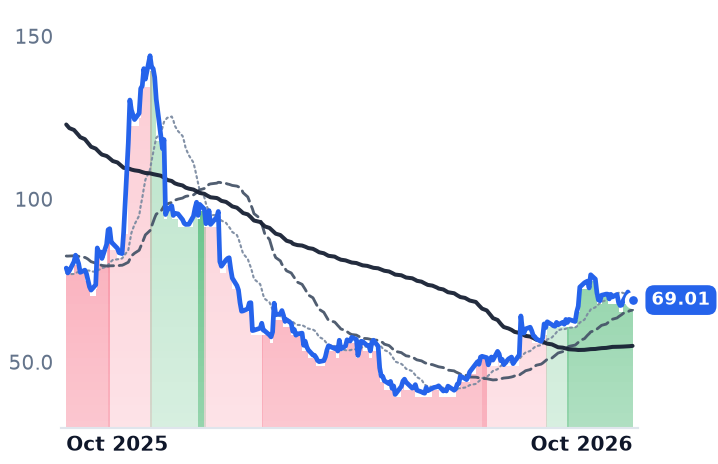
INSP | Inspire Medical Systems | Neural Implants & Surgical Robotics | 🌱 Emerging Bull | −7.5% | −12.5% |
12-month price & trend
| Ticker | Mkt cap | P/E | P/E fwd | P/S | P/S fwd | P/GP | P/GP fwd | EV/EBITDA | FCF yld |
|---|---|---|---|---|---|---|---|---|---|
RMD | $33.9B | 23.1x | 19.9x | 6.0x | 5.8x | 9.8x | 9.5x | 15.4x | 8.5% |
INSP | $2.0B | 14.8x | 55.7x | 2.2x | 2.3x | 2.6x | 2.7x | 22.8x | 5.9% |
Consensus projections
| Ticker | FY2026E | FY2027E | FY2028E | |
|---|---|---|---|---|
RMD | Revenue | +10.2% | +2.9% | +6.4% |
| EPS | +17.0% | +8.7% | +10.0% | |
INSP | Revenue | −6.0% | +3.9% | +6.5% |
| EPS | −26.4% | +18.9% | +29.5% |
Forward fiscal years only. Blank means no analyst coverage for that year.
Mask and accessory sales at ResMed, which sells flow generators, masks and headgear for sleep apnoea through sleep clinics and home-care dealers in roughly 140 countries, reached $2.085bn in the year to 30 June 2026, up 13% from $1.840bn. Group revenue grew 9.9%, which means the machines those masks attach to grew slower than the company did. The dealer reorders cushions and tubing on a resupply schedule; the flow generator sells once.
That annuity is the business now, and it is not what repriced the shares this month. ResMed has gained 10.0% in the nine sessions to 15 October, from $218.89 to $240.77, with nothing company-specific inside the window. Health care led a defensive rotation on 15 October, the sector exchange-traded fund up 2.58% in the session as money left leveraged technology; RBC Capital Markets moved health care to overweight and cut technology to market weight on valuation grounds. On unchanged fiscal 2027 consensus earnings of $12.10, the forward multiple went from about 18.1x to 19.9x in those nine sessions, by derivation from the closing prices: roughly half the distance back to the 24.2x the shares carried a year ago, against 15.1x at the 2 June low of $182.82.
The June quarter moved the other way
Revenue growth decelerated to 8.6% from 10.8% the prior quarter. Reported gross margin fell to 58.8% from 60.8% a year earlier, and reported operating income declined 1.3%. Management's non-GAAP gross margin for the same quarter was 62.3%, up 90 basis points; both are correct on their own basis, and the statutory series is the one showing compression.
Inside the mix, the resupply premium is regional. Americas sleep device revenue grew 8% against Americas masks at 10%; outside the Americas the order reverses, devices 13% against masks 12%. Life support devices fell 45% in the Americas and 38% elsewhere on the Astral halt. The third dollar in the ticker, residential care software, grew 2% in constant currency.
It is also the dollar leaving. ResMed agreed in June to sell its home health and hospice software unit, which includes HEALTHCAREfirst and Citus, to Frazier Healthcare Partners for $490m, with closing expected in the first quarter of fiscal 2027: the quarter reported on 29 October. Roughly $220m of revenue walks out with it, which is why consensus fiscal 2027 revenue growth of 2.9% is portfolio surgery and not a demand reading. The company also announced a $1.5bn repurchase and a 10% dividend raise for the year.
The drug threat shows up as a tailwind
Asked at the Morgan Stanley healthcare conference in September 2026 whether weight-loss drugs cannibalise airway pressure, chief executive Mick Farrell said: "We've got 2.5 million reasons that it's a tailwind. High start rate, high resupply at one year, and even higher than that resupply at three years." The company put therapy start rates 11 percentage points above a control group, with resupply 300 basis points higher at one year. A study of more than 100,000 patients found resupply enrolment halved first-year therapy termination.
Inspire sells the same disease once
Inspire Medical implants a hypoglossal-nerve stimulator per procedure, with no reorder behind it, and the architecture shows. Quarterly revenue went from 12.2% growth to 1.6% to a 7.6% decline, at $200.6m, with first-half operating income at a loss of about $1.6m against $50.95m for all of 2025, on a gross margin of 85.5%. The Senate rejected the resolution to block the Medicare prior-authorisation pilot 46-50 on 16 July, so the paperwork the implant queue runs through stays. Inspire did win new Category I billing codes from the American Medical Association on 1 October, but they take effect on 1 January 2028, with Medicare valuations not final until November 2027. Meanwhile Nyxoah's leadless Genio stimulator, approved in August 2025, is implanting at more than 50 US accounts on $4.5m of US revenue, with both companies suing each other in Delaware.
At 55.7x forward earnings on consensus that has 2026 earnings falling 26.4%, Inspire's shares price a recovery its own reimbursement calendar funds in 2028, well beyond the 3.9% revenue growth consensus pencils for 2027; the forward price-to-sales ratio of 2.34x sits above the trailing 2.22x, which is arithmetic for paying more for a smaller base. The shares are 7.5% lower over thirty days from an 18 September high of $76.78, and still 72% above the May low.
So the two tapes have different authors. Inspire's decline tracks its own disclosures. ResMed's gain does not: the annuity grew, the buyback is real, and the reported margin still fell in the last quarter anyone has seen, which leaves rotation as the likelier explanation for a multiple that re-rated on static estimates.
ResMed's report arrives on 29 October carrying a divestiture, a currency and a mask reorder cycle. What the revenue line will not carry is a count of how many people started therapy.