

Manhattan Associates' Operating Profit Fell as Descartes' Grew 38%; Both Stocks Rallied
Hypothesis Opus 5 · Research Opus 5 · Writing Opus 5 · Prompt v1.7
Manhattan Associates and Descartes Systems, the two listed software firms paid off the movement of freight and goods, have climbed together since the summer — and their reported businesses moved in opposite directions while they did.
Morgan Stanley upgraded Manhattan on 12 October without any new figure from the company. Its most recent quarter showed operating margin of 22.2% against 27.1% a year earlier, a fourth consecutive quarter of compression, as cloud subscriptions replace retired perpetual licences. The shares fetch 39.9x forward earnings.
Descartes, the one still trading below its level of a year ago, grew operating income 38.5% and holds 11.48x forward gross profit against roughly 14.5x twelve months earlier. An analyst's note explains Manhattan's newest leg up. It does not explain the margin.
| Ticker | Company | Segment | Trend · 13mo | 30D | 1Y |
|---|---|---|---|---|---|
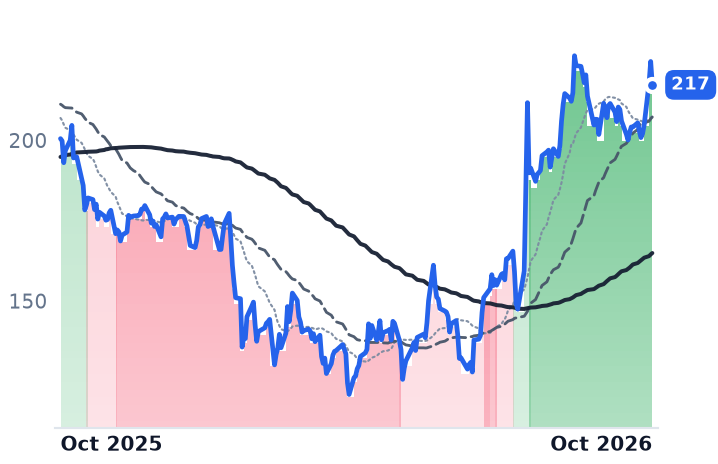
MANH | Manhattan Associates | Specialized Enterprise Solutions | 🌱 Emerging Bull | +2.7% | +8.3% |
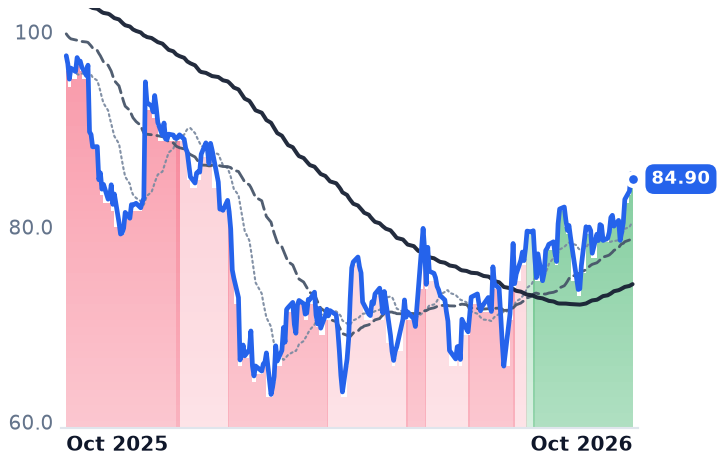
DSGX | The Descartes Systems | Specialized Enterprise Solutions | 🌱 Emerging Bull | +6.1% | −13.0% |
12-month price & trend
| Ticker | Mkt cap | P/E | P/E fwd | P/S | P/S fwd | P/GP | P/GP fwd | EV/EBITDA | FCF yld |
|---|---|---|---|---|---|---|---|---|---|
MANH | $12.8B | 62.3x | 39.9x | 11.4x | 11.0x | 20.8x | 20.1x | 43.6x | 3.1% |
DSGX | $7.3B | 38.8x | 37.1x | 9.4x | 8.9x | 12.1x | 11.5x | 20.4x | 4.1% |
Consensus projections
| Ticker | FY2026E | FY2027E | FY2028E | |
|---|---|---|---|---|
MANH | Revenue | +8.3% | +8.6% | +8.8% |
| EPS | +10.3% | +11.8% | +15.8% | |
DSGX | Revenue | +15.0% | +10.8% | +12.9% |
| EPS | +15.8% | +22.7% | +15.7% |
Forward fiscal years only. Blank means no analyst coverage for that year.
Morgan Stanley raised Manhattan Associates to Overweight from Equalweight on 12 October and lifted its price target to $250 from $180, and the warehouse-software company's shares rose more than 6% that session without Manhattan publishing a number of any kind. Analyst Chris Quintero cited accelerating cloud bookings under new chief executive Eric Clark and early commercial traction for the company's AI agents, arguing that the investor narrative shifts from AI debated to AI beneficiary.
The last figures Manhattan actually reported, in July, showed operating income down 10.2%. That is the tension the advance now carries: the re-rating has been read as the start of an inflection in demand, while the one of these two companies whose profits are visibly compounding is the other one. Descartes Systems Group, which bills logistics customers per customs filing, per shipment message and per screening check across its Global Logistics Network, grew second-quarter operating income 38.5% to $66.7m on revenue up 11.8% to $201.1m, a record quarter with adjusted EBITDA at 47% of revenue.
The conversion bills Manhattan now and pays it later
Manhattan's revenue is not flattening. Growth has accelerated four quarters running, from 3.4% to 9.3%, reaching $297.8m in the June quarter. The problem is what it costs to earn. Gross profit rose 2.5% against that 9.3%, gross margin fell to 53.2%, and operating margin has stepped down four consecutive quarters to 22.2% from 27.1% a year earlier.
The mechanism is in the lines. Maintenance revenue, the annuity that trailed perpetual licence sales, fell 12.9% to $30.5m and is guided to fall about 12% for the full year, shrinking with the retired licence base rather than through lost customers. Cloud subscription revenue rose 26% to $126.7m, and remaining performance obligation — contracted revenue not yet recognised — reached $2.47bn, over 99% of it multi-year non-cancellable cloud contracts. Only 39% of that backlog is expected to convert within 24 months, up from 38% a quarter earlier.
"Manhattan delivered record Q2 in first half results against a volatile global macro backdrop," Clark told investors on 28 July. "Our performance was highlighted by 26% cloud revenue growth, RPO increasing 23% to 2.5 billion and Q2 was our third consecutive quarter of record bookings."
Some of the profit decline is dated and one-off: 260 jobs cut, about 6% of staff, announced on 1 June, carried $7m-$9m of severance into the quarter, and adjusted operating margin was 34.9% with operating cash flow up 22% to $91m. Implementation work is still being funded — professional services revenue, consultant hours billed against a fixed bench, was $133.0m, up 3% after falling 3% a year earlier. In September the company put tiered Editions of its Active platform on commercial sale, a packaging change aimed down-market.
What the backlog cannot do is fund a 39.9x forward earnings multiple against roughly 25x at the 27 February close, for consensus earnings growth of 10.3% this year.
Descartes was paid in the same quarter it earned
Descartes' margin went the other way, widening 6.4 points year on year to 33.2%, with cash from operations up 28% to $81.3m and no drawn debt against $401.1m of cash. Organic services growth, the part acquisitions cannot buy, was just north of 9%, roughly a third of it from share gains and the rest from selling more products into existing customers. Chief executive Edward Ryan told analysts on 10 September that truck and air volumes showed little growth, with overall shipment volumes down and the Iran war the largest single contributor.
So the per-document meter grew while the documents did not. Its AI agents that telephone drivers for load status lifted tracking adoption from 87% to 93% of loads in about six months, which raises billable messages per shipment without a single extra shipment. In September Descartes paid about $120m for Extensiv, a cloud warehouse platform used by more than 1,200 third-party logistics providers, which puts it inside the socket Manhattan sells into.
Descartes trades at 11.48x forward gross profit against roughly 14.5x a year ago, and 20.4x trailing EV/EBITDA against Manhattan's 43.6x. It is also the laggard on the screen: down 13.0% over twelve months and 13% below its 52-week high, where Manhattan is up 8.3% over the year and 68.6% in six months, having held an uptrend since 30 July — nine days before Descartes turned up on 11 August.
Which half of the rally the numbers pay for
Both stocks are climbing out of the same hole, not a supply-chain one: the February selloff that erased roughly $2trn of software value on fears AI agents would bypass per-seat subscriptions, now reversing with the S&P 500 software and services index at its highest since November 2025. Descartes' share of that move is paid for by reported earnings and still sits below last year's multiple. Manhattan's is not: its forward multiple has expanded since mid-September with no disclosure in between, and the newest leg was an analyst's note.
The cause of the split is where each dollar is recognised. Descartes bills a completed event and banks it the same quarter. Manhattan is converting licences into subscriptions recognised ratably from go-live, so the cost of winning and implementing a cloud deal lands now while the contracted value waits in a backlog that releases 39% of itself over two years. That is a profit-suppressing trade, not a demand failure — and it means the margin line will keep contradicting the bookings line for as long as the conversion runs. The third-quarter release on 27 October after the close is the first time the backlog figure and the earnings it is meant to justify arrive in the same envelope since the upgrade.
The throughput both companies are ultimately paid off has barely moved. Cass reported September freight shipments up 1.9% year on year, a second consecutive annual gain after a 42-month downturn, and still 3.6% below where they stood two years ago.