

Methanex Gave Up a Trinidad Plant Over Gas Terms as Methanol Prices Were Surging
Hypothesis Opus 5 · Research Opus 5 · Writing Opus 5 · Prompt v1.7
Methanex and LSB Industries both convert cheap American natural gas into a bulk chemical, and over the past month their shares have moved in opposite directions. Methanex raised its October posted price for Asian buyers to $700 a tonne from $550 in September, after Iranian methanol stopped reaching export markets, and in June it surrendered an 860,000-tonne plant in Trinidad because it could not agree a commercially viable gas contract. Its constraint is feedstock availability, and tonnage decides the quarter.
LSB's selling price is set by the Tampa ammonia benchmark, which fell by roughly a third between May and September while its own gas stayed near $3.20 per million British thermal units. Methanex has cheapened as it has risen; LSB, at 16.8x forward earnings, remains dearer than CF Industries.
| Ticker | Company | Segment | Trend · 13mo | 30D | 1Y |
|---|---|---|---|---|---|
| The subject · what this brief is about | |||||
MEOH | Methanex | Basic Chemicals & Intermediates | 🟢 Cont. Bull | +1.5% | +78.9% |
LXU | LSB Industries | Basic Chemicals & Intermediates | 🔴 Cont. Bear | −9.6% | +15.7% |
| Compared against · context, not the story | |||||
CF | CF Industries | Nitrogen Fertilizers | 🟢 Cont. Bull | −8.0% | +40.8% |
12-month price & trend
| Ticker | Mkt cap | P/E | P/E fwd | P/S | P/S fwd | P/GP | P/GP fwd | EV/EBITDA | FCF yld |
|---|---|---|---|---|---|---|---|---|---|
MEOH | $4.9B | 56.7x | 6.7x | 1.2x | 1.0x | 4.0x | 3.5x | 7.6x | 15.1% |
LXU | $727.2M | 20.2x | 16.8x | 1.1x | 1.1x | 6.4x | 6.4x | 7.8x | 22.5% |
CF | $18.1B | 8.8x | 8.0x | 2.3x | 2.2x | 5.5x | 5.2x | 4.6x | 10.6% |
Consensus projections
| Ticker | FY2026E | FY2027E | FY2028E | |
|---|---|---|---|---|
MEOH | Revenue | +32.3% | −18.6% | −4.7% |
| EPS | +215.1% | −39.0% | −25.5% | |
LXU | Revenue | +9.8% | −3.0% | −0.8% |
| EPS | +74.0% | +26.3% | +4.2% | |
CF | Revenue | +16.6% | −9.6% | −6.1% |
| EPS | +67.9% | −24.7% | −20.6% |
Forward fiscal years only. Blank means no analyst coverage for that year.
Methanex, the world's largest supplier of methanol, gave up a plant in Trinidad and Tobago this summer because it could not agree a price for natural gas. The 860,000-tonne Titan unit was indefinitely idled on 29 June, with a $115m non-cash after-tax impairment and a $12m restructuring accrual, in the same months the methanol price was climbing hard. The existing contract was linked to methanol prices, and the company judged the economics unfavourable and any renewal likely to be worse.
The shares are widely read as a bet on that methanol price, and the price has obliged: Methanex lifted its October posted contract price for Asian markets to $700 a tonne, up $150 from September. But the revenue line cannot tell a reader whether the business got better. Realised price is struck against posted price after discounts that average about 15%, and the tonnes sold are partly bought in from other producers. What decides the quarter is how many tonnes its gas contracts let it make.
The tonne that never got made
In the second quarter, realised price reached $529 a tonne against $351 in the first, revenue rose 75.2% to $1,395m and gross margin went from 20.9% to 45.7%. The mix did not deteriorate: of 2,555,000 tonnes sold, 2,151,000 were Methanex's own product and only 247,000 were purchased third-party material. Production, though, fell to 2,213,000 tonnes from 2,391,000 on seasonal gas constraints in Chile, a planned winter outage in New Zealand and unplanned Trinidad outages, even as North America set a record 1.6m tonnes with Geismar, Louisiana contributing 1.1m.
The price step itself is a supply accident elsewhere. Iran, the second-largest methanol supplier at roughly 10m tonnes a year, has seen exports effectively cease since February, and assessments for cargoes delivered into China rose 64% between 5 August and 8 October. Methanex estimates 15m to 20m tonnes of annualised supply must transit the Strait of Hormuz. "Under current conditions, demand rationalization will increasingly be required until a resolution allowing Middle East production to resume and reach the market on a more normalized basis is found," chief executive Rich Sumner told investors on the 29 July call. For July and August the company guided realised price to roughly $460 to $485 and told investors to expect lower adjusted earnings in the third quarter.
At 6.7x forward earnings against 56.7x trailing, the trailing figure is mostly the Trinidad write-down and a first-quarter loss rather than a judgment on the business. Consensus has earnings per share falling 39% next year, to $5.79 from $9.49, which still leaves 11.0x. Measured against gross profit the stock has got cheaper while rising, 4.0x now against 4.7x in May, with market capitalisation up from $4.67bn to $4.91bn. The share count is 14.3% higher year on year from the equity issued for OCI Global's methanol business, and the remaining $290m of a term loan was repaid in the quarter.
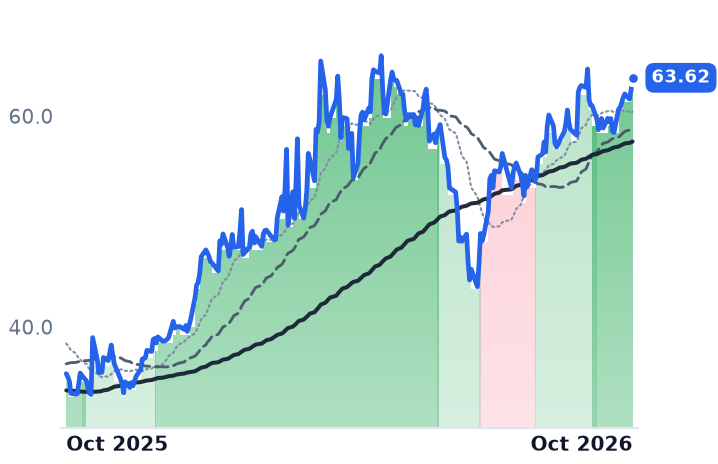
The shares have held an uptrend since mid-September and sit about 3% below the May high of $65.72, after a 33% drawdown into early July.
LSB's feedstock is cheap and its benchmark is falling
LSB Industries, an Oklahoma City producer of ammonia, urea ammonium nitrate and ammonium nitrate for farmers and industrial buyers, buys the same inexpensive gas, around $3.20 per million British thermal units in the third quarter to date, against European nitrogen costs near $700 a tonne on $19 to $20 gas, management told investors in July. Its problem is the output price. The Tampa ammonia benchmark that sets its next realisations fell from $825 a tonne in May to roughly $555 in September. The reported quarter looked worse than the business was: ammonia realised $658 a short ton, up 78%, volumes fell 46% on El Dorado and a pulled-forward Pryor turnaround costing $35m to $40m, and adjusted EBITDA still rose to $53.1m from $38.3m. El Dorado has since run at 1,380 tons a day against 1,150 of nameplate.
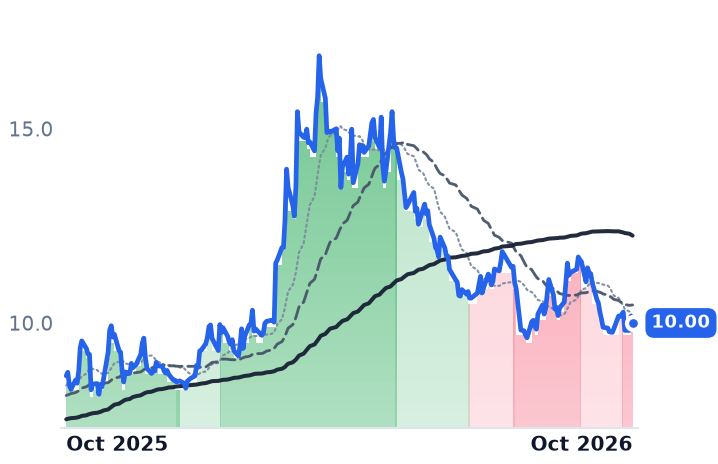
So one de-rating is rational and the other is not happening. LSB, down 40.8% from its March peak, trades at 16.8x forward earnings where CF Industries, twenty-five times its size and lower-cost, trades at 8.0x; price-to-gross-profit has fallen to 6.4x from 10.2x in May, which surrenders roughly two-thirds of the excess and not all of it. Methanex's slide ended with the quarter that explained it, and the posted price has since stepped up 27% in a month. Neither name moved on a single session: LSB's worst day in the past month was -4.6%, and the sell side raised Methanex targets to $74 and $75 in the first week of October.
Both report within two days at the end of October, and the figure that settles the Methanex question is tonnage. Full-year equity production guidance of about 9m tonnes depends on gas that Chilean, New Zealand and Trinidadian fields have to deliver at a price the company will pay, and Titan is what happens when they stop agreeing.