
Oilfield Service Firms Told the Dallas Fed Their Costs Outran the Prices They Charge
Hypothesis Opus 5 · Research Opus 5 · Writing Opus 5 · Prompt v1.7
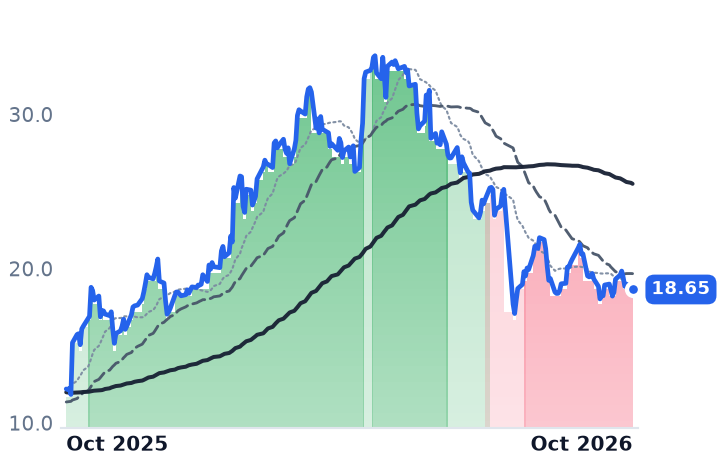
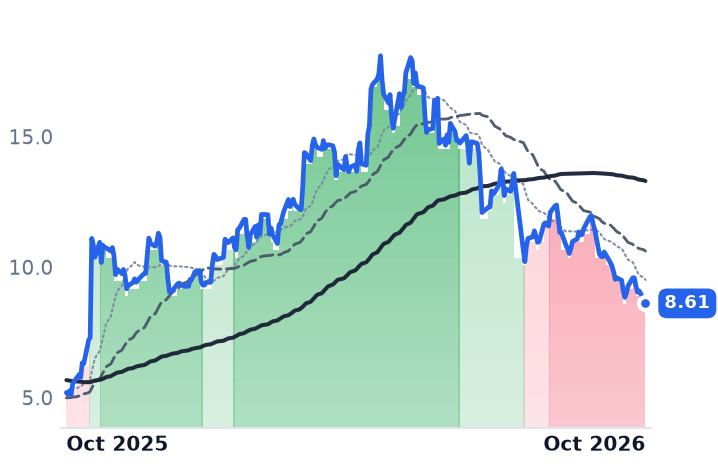
Drilling activity and crude prices both rose into October, yet the two listed companies paid to work on wells already drilled broke months-long uptrends on the same two sessions in late September. Neither break was about demand.
Ranger Energy billed 146,800 rig hours in the June quarter, up 25% year-on-year — almost exactly the fleet the American Well Services deal added in November — while hours rose 1% sequentially, and the company attributes its $772 hourly rate gain largely to passed-through fuel surcharges. Its cost of services still improved to 81% of revenue from 82%. Core Laboratories is the opposite case: its per-sample laboratory arm shrank 9% year-on-year at a 5% operating margin, and consensus has full-year earnings at $0.48 against $0.68 delivered in 2025.
Ranger's forward earnings are expected to rise and Core Labs' to fall, and the valuations now say so.
| Ticker | Company | Segment | Trend · 13mo | 30D | 1Y |
|---|---|---|---|---|---|
| The subject · what this brief is about | |||||
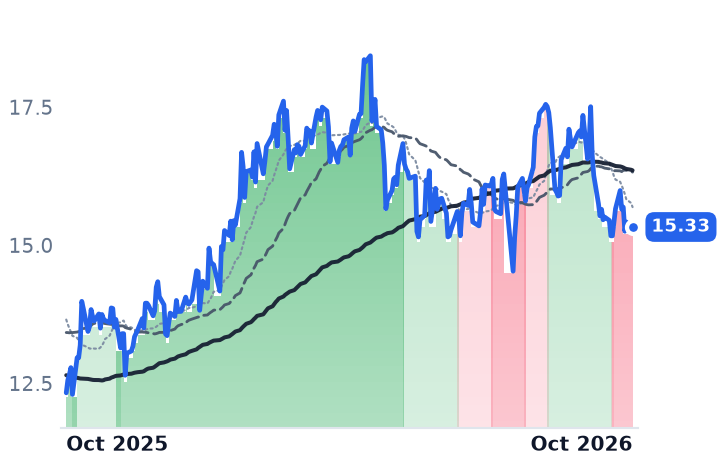
RNGR | Ranger Energy Services | Oil & Gas Equipment & Services | ⚠️ Emerging Bear | −7.4% | +24.3% |
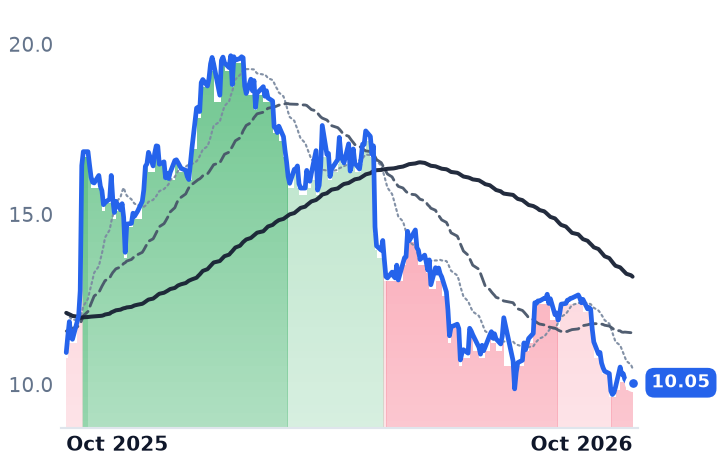
CLB | Core Laboratories | Oilfield Equipment & Tools | 🔴 Cont. Bear | −17.8% | −8.1% |
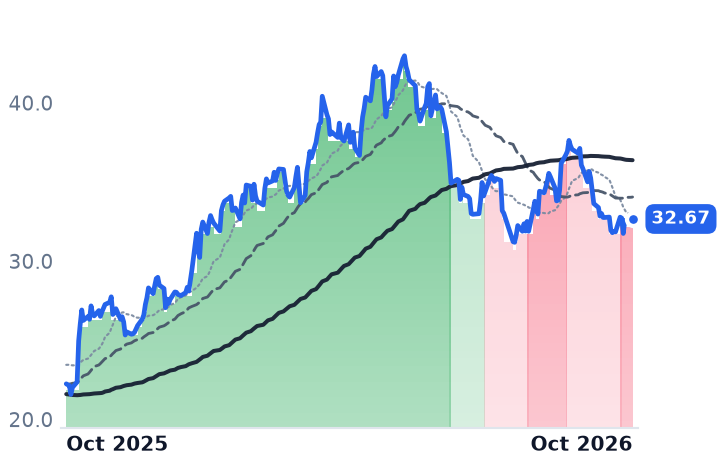
TUSK | Mammoth Energy Services | Conglomerates | 🟢 Cont. Bull | −8.5% | +25.0% |
| Compared against · context, not the story | |||||
HAL | Halliburton | Well Services & Stimulation | 🔴 Cont. Bear | −6.7% | +46.8% |
LBRT | Liberty Energy | Well Services & Stimulation | 🔴 Cont. Bear | −4.5% | +52.8% |
PUMP | ProPetro | Well Services & Stimulation | ⚠️ Emerging Bear | −18.0% | +65.9% |
WTTR | Select Water Solutions | Water Services & Energy Solutions | 🟢 Cont. Bull | −4.2% | +92.4% |
12-month price & trend
| Ticker | Mkt cap | P/E | P/E fwd | P/S | P/S fwd | P/GP | P/GP fwd | EV/EBITDA | FCF yld |
|---|---|---|---|---|---|---|---|---|---|
RNGR | $357.8M | 24.9x | 15.7x | 0.6x | 0.5x | 7.1x | 6.2x | 5.0x | 6.5% |
CLB | $468.3M | 18.1x | 21.1x | 0.9x | 0.9x | 5.0x | 5.1x | 9.7x | 2.3% |
HAL | $27.3B | 17.1x | 14.0x | 1.2x | 1.2x | 8.1x | 8.1x | 8.1x | 6.3% |
| Ticker | Mkt cap | P/E | P/E fwd | P/S | P/S fwd | P/GP | P/GP fwd | EV/EBITDA | FCF yld |
|---|---|---|---|---|---|---|---|---|---|
LBRT | $3.3B | 26.7x | 86.6x | 0.8x | 0.7x | 6.1x | 5.6x | 7.0x | -9.6% |
PUMP | $1.2B | n/m | — | 1.0x | 1.0x | 12.2x | 11.5x | 7.4x | -1.9% |
WTTR | $2.2B | 73.6x | 30.6x | 1.5x | 1.4x | 8.0x | 7.4x | 10.3x | -3.7% |
| Ticker | Mkt cap | P/E | P/E fwd | P/S | P/S fwd | P/GP | P/GP fwd | EV/EBITDA | FCF yld |
|---|---|---|---|---|---|---|---|---|---|
TUSK | $134.9M | 189.2x | — | 2.2x | 0.6x | — | — | 4.6x | -87.4% |
Consensus projections
| Ticker | FY2026E | FY2027E | FY2028E | |
|---|---|---|---|---|
RNGR | Revenue | +26.3% | +6.8% | −1.4% |
| EPS | +38.2% | +42.8% | +9.4% | |
CLB | Revenue | −1.8% | +2.8% | +6.0% |
| EPS | −34.9% | +50.9% | +33.2% | |
HAL | Revenue | +2.0% | +5.4% | +4.6% |
| EPS | +3.0% | +23.2% | +16.9% | |
LBRT | Revenue | +18.2% | +7.7% | +13.9% |
| EPS | −465.4% | −56.9% | +509.6% | |
PUMP | Revenue | −2.9% | +16.9% | +10.6% |
| EPS | −27.2% | −899.2% | +68.5% | |
WTTR | Revenue | +12.3% | +8.4% | +4.8% |
| EPS | +166.8% | +2.6% | +55.9% | |
TUSK | Revenue | +28.2% | — | — |
| EPS | −82.8% | — | — |
Forward fiscal years only. Blank means no analyst coverage for that year.
The Federal Reserve Bank of Dallas published its quarterly survey of energy firms on 30 September, and the oilfield service companies in it described a market with plenty of work and none of the pricing power. Their input-cost index came in at 60.4 against a prices-received index of 16.3. Their own outlook index was 4.6, against 50.0 for the exploration and production companies that hire them, and their operating-margin index fell to 37.2 from 52.2.
That lands against a year in which activity recovered. The U.S. rig count stood at 603 on 9 October and the frac spread count at 203, both up on the week, with Brent near $102.60 in early October after a Middle East war. Rising rigs were widely read as the setup for a service-pricing recovery. The two listed companies paid to work on wells that are already drilled say otherwise, and both broke uptrends they had held for months on 29 and 30 September.
Ranger added a quarter more rig hours and bought every one of them
Ranger Energy Services, the Houston contractor that sends high-specification workover rigs back to producing wells to pull tubing, plug them or log them, billed 146,800 rig hours in its High Specification Rigs segment in the June quarter, up 25% year-on-year. That is almost precisely the roughly 25% rig count added by American Well Services, bought for about $90.5m in November 2025. Sequentially, hours rose 1%.
The rate line is padded too. Realised pricing of $772 an hour was 5% above a year earlier, an increase Ranger's own filing says "largely" reflects "the pass through of fuel surcharges as well as certain changes in asset and regional revenue mix." A 540-rig fleet is the largest single participant in a market of 1,000 to 1,200 well-servicing rigs where the ten leading providers hold only 50-60%; scale of that kind does not set price.
The lines that carry no pass-through show a decent quarter. Cost of services was 81% of revenue against 82%. Wireline, the completion-linked segment funded out of customer capital budgets, fell 16% year-on-year to $18.6m but swung to $1.0m of operating income from a $2.4m loss in March. Chief executive Stuart Bodden said on the 28 July call the quarter "reinforced the earnings power we believed we could achieve following the AWS acquisition," and guidance of more than $100m of adjusted EBITDA for 2026 was reaffirmed; chief financial officer Melissa Cougle put the softness in rig margins down to "an unusual state sales-tax audit" and make-ready costs for new hybrid-electric rigs. At 5.0x trailing enterprise value to EBITDA, with a forward price-to-earnings of 15.7x against 24.9x trailing, the market is priced for those earnings arriving. The caveat is that the cheap denominator was acquired rather than grown: STEP Energy's U.S. coiled tubing assets closed on 8 October for roughly $27.5m, and first-half free cash flow was minus $1.7m even with $20.0m generated in the June quarter.
The laboratory is paid per cargo, and the cargoes stopped moving
Core Laboratories, which analyses reservoir rock and fluids in laboratories across some 50 countries and separately manufactures perforating charges and completion products, inverted the expected pattern. The asset-light lab was the weak half: Reservoir Description revenue fell 9% year-on-year to $78.7m at a 5% operating margin, while the factory half, Production Enhancement, grew 5% to $45.9m with margins before items of 12% against 5% three months earlier.
The reason is physical. Closure of the Strait of Hormuz cut global crude cargo movements 16% from pre-conflict levels, and an assay laboratory bills per cargo sampled. "Reservoir Description bore the greatest impacts of the Middle East conflict as crude assay work and reservoir characterization projects depend on field operations, active maritime hydrocarbon trade and transportation, timely sample acquisition, and access to client facilities," chairman and chief executive Lawrence Bruno told the second-quarter call. Consensus now has 2026 earnings of $0.48 a share against $0.68 delivered in 2025, which is why the forward price-to-earnings of 21.1x sits above the 18.1x trailing, and why 9.7x enterprise value to EBITDA is close to double Ranger's.
Two squeezes with different escapes
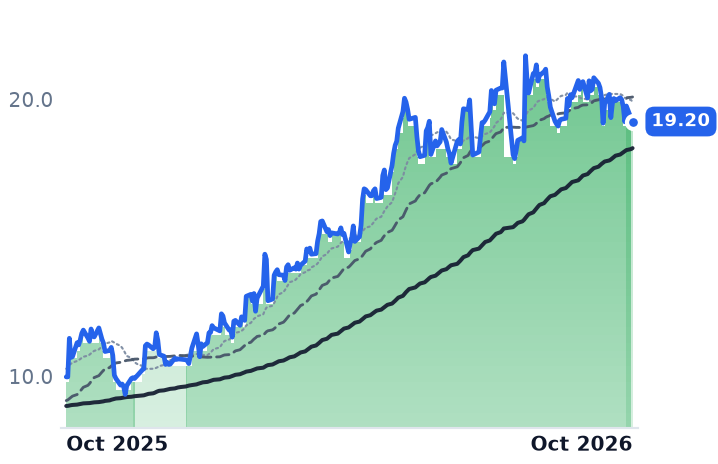
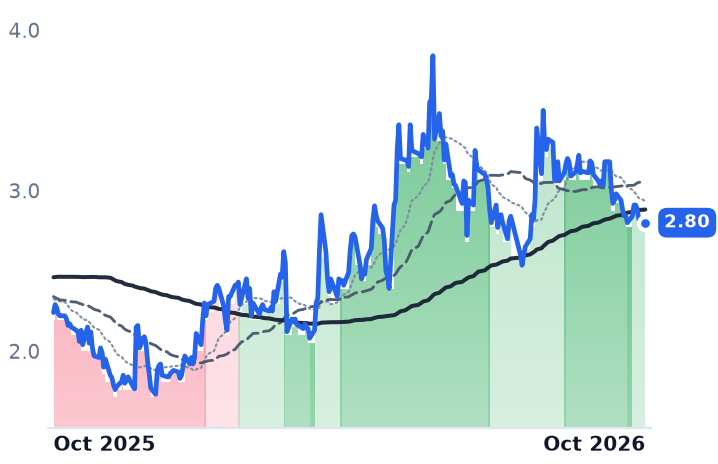
Most of Ranger's 11.6% thirty-day decline was shared with the rest of the sector: Halliburton fell 8.9% over the same stretch, Liberty Energy 11.0% and ProPetro 24.8%. Core Labs' 19.6% is its own, and extends a 41% fall over six months.
The split has a cause. Ranger's price is capped by a fragmented domestic market with spare capacity, but its volume is purchasable, and the one place it holds a premium is technology: Chevron contracted three more hybrid-electric ECHO rigs in July for 2027 Bakken delivery. Core Labs cannot buy sample volume at all; it needs tankers sailing and client sites open, and U.S. exploration budgets guided 5% lower to $59.1bn this year will not supply the difference.
So the late-September break reads as a judgment on price realization rather than on activity. It is only half-earned at Ranger, where margins widened and guidance held, and fully earned at Core Labs, where two consecutive quarters of falling operating income on barely lower revenue show a fixed-cost laboratory network losing leverage.
Ranger's hourly rate can be topped up with a fuel surcharge for as long as diesel cooperates. A sample count has no such padding: somebody has to put the cargo on the water first.