

Cipher Is Raising $850m to Finish the Data Halls That Replaced Its Mining Revenue
Hypothesis Opus 5 · Research Opus 5 · Writing Opus 5 · Prompt v1.7
A bitcoin miner converting its sheds into leasable data halls cannot show you the switch in its revenue line, and Cipher Digital's June quarter is the proof: sales fell 43.0% year on year to $24.8m with gross margin at -131.1%, because management decommissioned mining at Black Pearl to hand the building to Amazon Web Services.
On 13 October the company offered $850m of convertible notes due 2032 carrying no coupon, with proceeds going to the Barber Lake project and further construction; the shares fell 14.7% that session. Diluted shares were already up from 360.5m to 409.4m over five quarters, and the disclosed maximum development cost is $9.5m per megawatt of leasable IT load.
Hut 8 is running the same conversion on different money: investment-grade, non-recourse project notes at 6.192% matched to a 15-year lease. Cipher is paying in paper until the rent arrives.
| Ticker | Company | Segment | Trend · 13mo | 30D | 1Y |
|---|---|---|---|---|---|
| The subject · what this brief is about | |||||
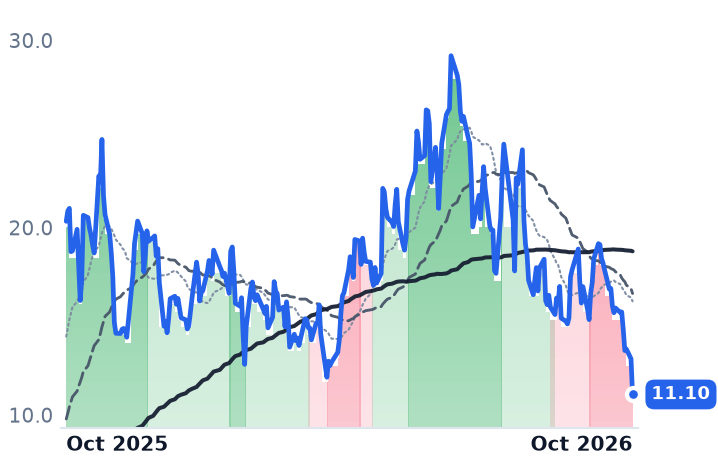
CIFR | Cipher Mining | Bitcoin Mining | ⚠️ Emerging Bear | −29.0% | −45.5% |
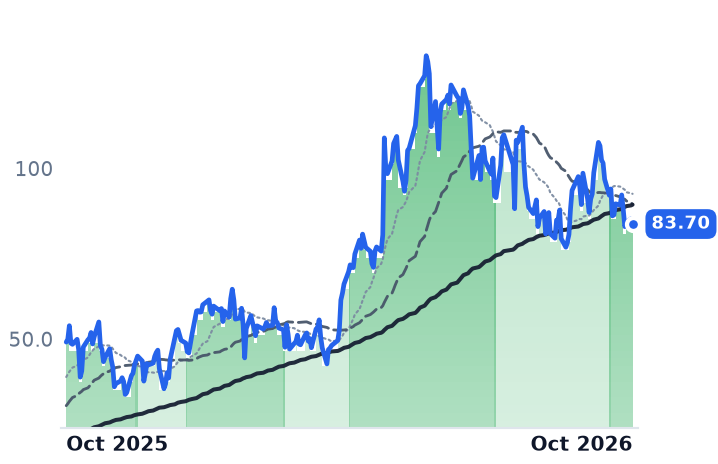
HUT | Hut 8 | Bitcoin Mining | 🟢 Cont. Bull | −8.2% | +70.4% |
NBIS | Nebius | Cloud Infrastructure & AI | 🟢 Cont. Bull | −2.9% | +52.1% |
| Compared against · context, not the story | |||||
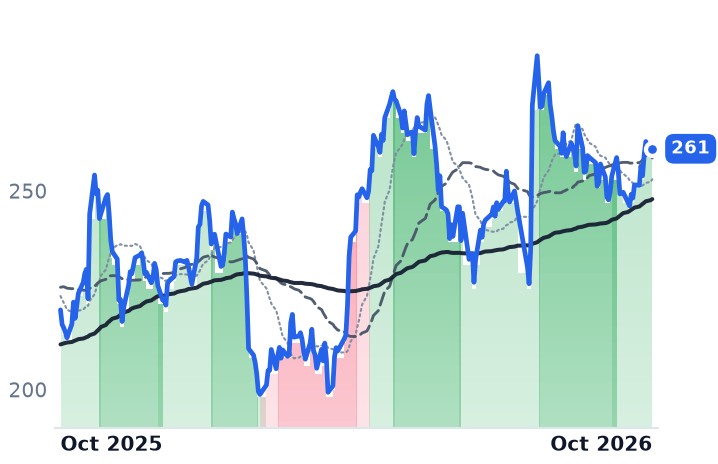
AMZN | Amazon.com | Online Marketplaces | 🟢 Cont. Bull | +2.8% | +18.4% |
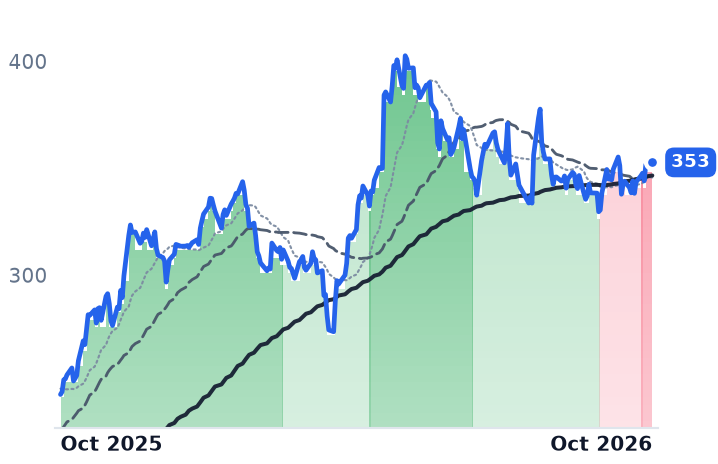
GOOGL | Alphabet | Search & Advertising | ⚠️ Emerging Bear | +1.0% | +44.5% |
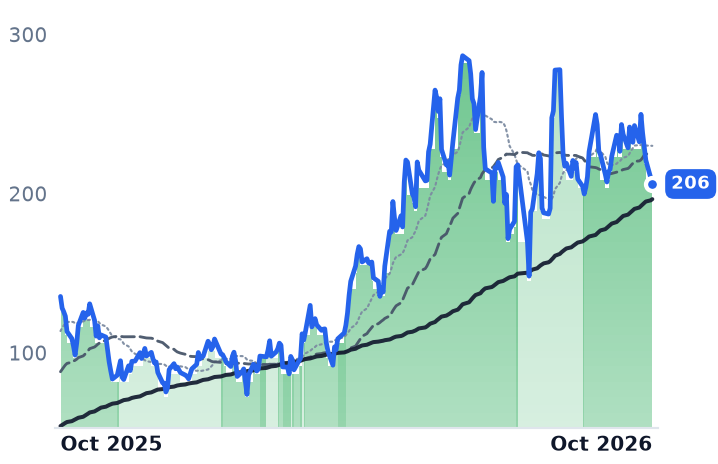
12-month price & trend
| Ticker | Mkt cap | P/E | P/E fwd | P/S | P/S fwd | P/GP | P/GP fwd | EV/EBITDA | FCF yld |
|---|---|---|---|---|---|---|---|---|---|
CIFR | $4.7B | n/m | — | 24.7x | 22.0x | — | — | n/m | -31.7% |
HUT | $9.4B | n/m | — | 32.5x | 32.3x | 128.7x | 128.0x | 210.8x | -7.8% |
AMZN | $2.8T | 20.6x | 20.3x | 3.6x | 3.4x | 7.1x | 6.6x | 11.6x | -0.4% |
| Ticker | Mkt cap | P/E | P/E fwd | P/S | P/S fwd | P/GP | P/GP fwd | EV/EBITDA | FCF yld |
|---|---|---|---|---|---|---|---|---|---|
GOOGL | $4.3T | 17.4x | 17.2x | 9.5x | 8.6x | 15.7x | 14.1x | 13.2x | 1.3% |
NBIS | $56.0B | 792.8x | — | 41.4x | 16.8x | 55.7x | 22.6x | 57.8x | -10.5% |
Consensus projections
| Ticker | FY2026E | FY2027E | FY2028E | |
|---|---|---|---|---|
CIFR | Revenue | −14.0% | +276.5% | +27.6% |
| EPS | +286.3% | −78.2% | −120.5% | |
HUT | Revenue | +21.3% | +96.2% | +131.7% |
| EPS | −1633.6% | −16.0% | −72.4% | |
AMZN | Revenue | +16.0% | +14.7% | +16.0% |
| EPS | +78.7% | −16.8% | +33.1% | |
GOOGL | Revenue | +24.5% | +23.8% | +20.7% |
| EPS | +93.6% | −26.1% | +19.1% | |
NBIS | Revenue | +507.1% | +262.2% | +87.8% |
| EPS | +71.6% | +75.7% | −69.2% |
Forward fiscal years only. Blank means no analyst coverage for that year.
Cipher Digital went back to the market for another $850m on 13 October, in convertible senior notes that carry a coupon of zero. The filed terms earmark the proceeds for capped calls, additional equity in the Barber Lake project and high-performance-computing construction across the near-term pipeline, with a 13-day option on a further $150m; the company simultaneously sought to exchange part of its 1.75% notes due 2030. The shares closed at $11.095, down 14.7%.
The quarter behind that offering looks like a company coming apart: revenue down 43.0% year on year to $24.8m, gross margin of -131.1%, a $267.5m net loss. It is the conversion working. Cipher decommissioned bitcoin mining at Black Pearl to clear the building for Amazon Web Services, so the revenue that vanished is revenue the company chose to switch off. For a converting miner the top line is mute. The meters that speak are contracted megawatts, the date they energize, the capex to get there and who pays it in the meantime.
Hashprice pays by the day, a lease pays by the kilowatt-month
What remains of the mining business is 207 MW at Odessa running about 11.6 exahash per second under a fixed-price power contract with Vistra Luminant near 2.8 cents per kilowatt-hour, which produced roughly 346 bitcoin in the June quarter. That fleet earns hashprice, the dollar revenue per petahash per second per day, which stood at about $40.45 on 3 October after roughly $27.70 in June. Bitcoin's price did that work: network difficulty has fallen about 19% from its November 2025 high of 155.97 trillion as miners exited or moved capital into AI.
The other dollar is fixed and contracted years ahead. Cipher's 15-year lease with Amazon Web Services is worth about $5.5bn on 216 MW of critical IT load at Black Pearl, triple-net: roughly $141 per kilowatt-month averaged across the term, by the arithmetic of the disclosed value, term and load.
No income statement can set those two side by side. One arrives daily at a price nobody at the company sets; the other arrives monthly, years after the ink dries.
Nine months from a signature to the first rent dollar
Cipher's first colocation contract, with Fluidstack at Barber Lake, was signed on 25 September 2025 for 168 MW of critical load. The first rent commenced at Black Pearl in August 2026, two months ahead of schedule after the tenant asked to accelerate delivery. Everything in between has to be built and paid for, and the AWS transaction carries a disclosed maximum development cost of $9.5m per IT megawatt — an order of magnitude above what an interruptible mining shed ever cost per megawatt.
It has been paid for in paper. A $150m convertible funded the first phase at Black Pearl, $1.1bn of notes due 2031 funded Barber Lake construction, and now $850m more. Diluted shares went from 360.5m to 409.4m across five quarters, before this week's issue.
The Alphabet warrant marks against Cipher's own stock
The dominant non-cash item in the June loss has nothing to do with megawatts or coins. Alphabet backstopped $1.73bn of Fluidstack's rent obligations in exchange for warrants over roughly 5.4% of Cipher on a pro forma basis, and the resulting liability is remeasured every quarter against Cipher's share price: a $150.5m loss in June, after a $43.6m gain in March. More than half the quarter's net loss was the stock going up.
This month's fall will book as a gain.
Hut 8 bought the same megawatts with cheaper money
Hut 8 is running the identical conversion through a different balance sheet. Its 245 MW River Bend lease, signed 17 December 2025 and also backstopped by Alphabet, is worth $7.0bn over 15 years with a 3.0% annual escalator, about $159 per kilowatt-month averaged; first data halls are expected in the second quarter of 2027, eighteen months after signature. Its AI landlord business earned $1.3m in the June quarter against 949 MW of contracted capacity and $26.6bn of base-term contract value.
The difference is the funding channel. Hut 8 closed $3.25bn of 6.192% senior secured notes due 2042, non-recourse, fully amortising and matched to the lease term, so the rent repays the debt that built the hall. Its shares still fell 15.6% over three months while revenue grew 81.4% and gross margin widened to 64.1%, leaving price-to-gross-profit at 128.7x against 62.8x in May.
What the results account for, and what they do not
Cipher fell 44.8% over three months, and some of that was shared with every converted miner: lease income arriving in 2027 and 2028 is discounted at a long yield that touched 5.36% on 7 October, and the converted miners sold off together in that session. The rest is specific. Amazon rose 5.4% over the same window, trades at 20.6x trailing earnings and carries $106.3bn of leases not yet commenced in one aggregate line of its March quarterly filing, Cipher's among them, unbroken out. The tenant's budget is not what moved. The landlord's share count is.
No conventional multiple survives the conversion: there are no earnings and gross profit is negative, leaving 24.7x trailing sales on a revenue line being deliberately shut down, against 30.7x in May when the market value was $6.87bn rather than today's $4.72bn. Morgan Stanley cut its target to $51.50 from $54.00 on 12 October and kept an overweight rating, which is to say the sell-side still marks the contracted asset at a level the equity no longer does.
Every converted miner is selling the same scarce thing, an energized megawatt with an interconnection behind it, and the tenants have investment-grade credit and patience. The question these two put differently is who carries the months before the first rent clears: at Hut 8, bondholders with a claim on the lease; at Cipher, whoever owns the shares when the converts turn into more of them.