

Rambus Is Growing by Selling Chips, Which Pay Less Than the Royalties They Replace
Hypothesis Opus 5 · Research Opus 5 · Writing Opus 5 · Prompt v1.7
Rambus's chip sales passed its patent royalties for the first time in the June quarter, and the company then guided those two lines in opposite directions for the three months it reports on 26 October. The growth dollar is the lower-margin one.
Across the four quarters to June, revenue of $756.3m was up 17.2% on the prior four while summed net income rose 4.6%. The royalty annuity, running near $290m a year, is now being billed about as fast as it is recognized, so timing is no longer hiding growth in it, and there isn't any. Meanwhile the per-module content step management is paid for, multiplexed-rank modules against a roughly $600m serviceable market, is dated to 2027 by Intel's and AMD's platform calendars.
The shares re-rated to 19.69x trailing gross profit from 16.06x a month earlier, with no report in between.
| Ticker | Company | Segment | Trend · 13mo | 30D | 1Y |
|---|---|---|---|---|---|
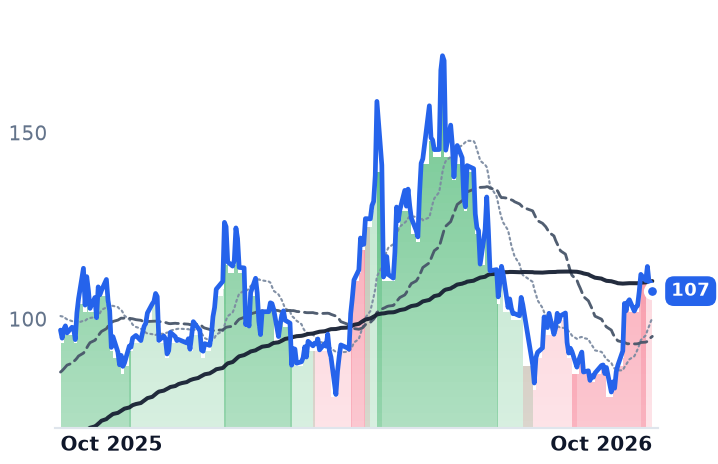
RMBS | Rambus | Interconnect & Storage IP | ⚠️ Emerging Bear | +33.7% | +10.8% |
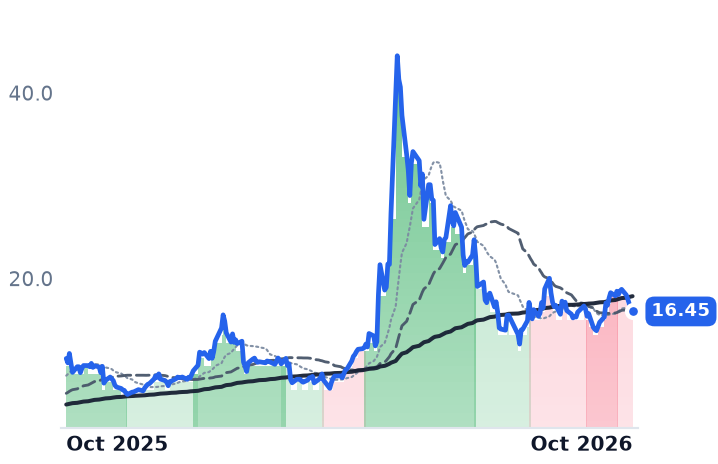
MRAM | Everspin Technologies | Memory (DRAM/NAND) | ⚠️ Emerging Bear | +11.7% | +44.6% |
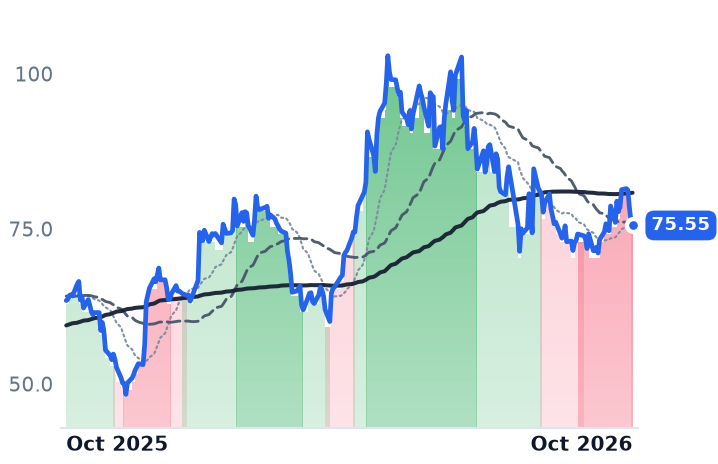
MCHP | Microchip Technology Incorporated | Analog & Mixed-Signal | ⚠️ Emerging Bear | +5.7% | +19.1% |
12-month price & trend
| Ticker | Mkt cap | P/E | P/E fwd | P/S | P/S fwd | P/GP | P/GP fwd | EV/EBITDA | FCF yld |
|---|---|---|---|---|---|---|---|---|---|
RMBS | $11.7B | 48.4x | 35.4x | 15.4x | 14.1x | 19.7x | 18.0x | 34.0x | 2.6% |
MRAM | $385.7M | n/m | — | 6.2x | 5.2x | 11.8x | 9.9x | 826.5x | -1.4% |
MCHP | $41.0B | 104.7x | 20.8x | 8.0x | 6.4x | 13.3x | 10.7x | 27.4x | 2.7% |
Consensus projections
| Ticker | FY2026E | FY2027E | FY2028E | |
|---|---|---|---|---|
RMBS | Revenue | +17.8% | +20.4% | +24.8% |
| EPS | +21.6% | +23.9% | +27.4% | |
MRAM | Revenue | +35.9% | +15.7% | +1.0% |
| EPS | +340.0% | −218.2% | +161.5% | |
MCHP | Revenue | +6.2% | +37.1% | +16.4% |
| EPS | +20.7% | +132.2% | +25.6% |
Forward fiscal years only. Blank means no analyst coverage for that year.
In the June quarter Rambus sold more memory-interface silicon than it collected in patent royalties for the first time, and then pointed the two lines in opposite directions. The San Jose company, which sells register clock drivers and power-management chips designed into DDR5 server memory modules and licenses memory and security cores to chip designers, guided September-quarter product revenue to $110-116m and royalties to $69-75m, up and down roughly 14% sequentially.
A record quarter was read as the AI memory build arriving at the company paid whenever somebody else's module ships. The four quarters to June tell a narrower story: revenue of $756.3m, up 17.2% on the prior four, carried summed net income up only 4.6%. Gross margin widened to 79.8%, and operating income still grew slower than revenue in each of the last two quarters. The mix is doing that, because the dollar supplying the growth is per-module silicon and the dollar it is displacing is a near-fully-margined annuity.
The annuity is now billed as fast as it is booked
Fixed-fee patent licensing is the line where reported revenue can mislead, since recognition is front-loaded at signing. That defense has stopped applying. June billings of $84.1m sat against $84.2m of recognized royalties; March was $70.8m billed against $69.6m recognized. Unbilled receivables of $27.8m and deferred revenue of $25.7m are small beside a royalty run-rate near $290m a year. The royalty line is reporting demand, and the guide takes it down.
The content step belongs to Intel's and AMD's calendars
Chief executive Luc Seraphin credited "the migration from 12 to 16 memory channels per processor" for the June outperformance on the 27 July call. That is the right meter: module units times dollar content, not bit prices. Micron's August-quarter margins and rising contract DRAM prices pass Rambus by entirely. Registered-module bit supply is growing 15-20% while high-bandwidth memory absorbs a rising share of the top three suppliers' wafers, about 22% this year and 30% next; Baird cut its 2027 module unit growth estimate to 12-15%. Management said it saw no pricing opportunity in the shortage.
The upgrade cycle is real and late. Rambus puts the multiplexed-rank module market at roughly $600m, with initial volumes late in 2026 and material revenue in 2027; Intel adds second-generation support to its Xeon 6900P platform in the first quarter of 2027. The socket is contested by Renesas, at roughly 35% of the register-clock-driver market, and by Montage Technology. And the memory-pooling promise the category is named for stays in the IP business: management called merchant Compute Express Link silicon a fragmented, ASIC-like market it addresses by licensing, with silicon IP guided to 10-15% annual growth.
A re-rating with no report in between
The shares closed at $107.47 on 9 October, up 22.6% in thirty days, which lifted price-to-trailing-gross-profit to 19.69x from 16.06x a month earlier and back within 6% of the 20.92x struck in early May. Gross profit did grow 28% over that stretch, so part of the move is earned. The rest is sector re-risking after a selloff that cost a semiconductor basket roughly $2.1 trillion from the late-June peak, with Argus raising its target to $123 on 23 September the only company-specific news in the window. Rambus remains 37% below its 3 June close of $170.66.
So the results account for the direction of the advance and not its level. A multiple from May has been restored to a business whose highest-margin line is guided lower, whose unit meter is being marked down by the people who forecast module shipments, and whose content step arrives with 2027 server platforms. Forward estimates still model revenue growth near 18% this year and 20% next, with earnings per share growing faster than sales, which requires the operating leverage that the last two quarters did not deliver.
Rambus reports third-quarter results on 26 October at 2:00 p.m. Pacific. It is the first look at whether a flat annuity and a growing chip business still add up to a company earning more than it did a year ago.