

Interest on Affirm's Own Loan Book Outearns Its Merchant Fees Nearly Two to One
Hypothesis Opus 5 · Research Opus 5 · Writing Opus 5 · Prompt v1.7
Affirm's revenue line is structurally unable to say whether its credit is performing, because four unlike dollars sit on the same transaction: a merchant fee on interest-free volume, interest on loans it holds, a gain on loans it sells, and card interchange. The largest of them is interest income, at $2.05bn of $4.26bn in fiscal 2026, against merchant network revenue of $1.15bn.
The meter that carries funding cost and credit losses is revenue less transaction costs against volume, and it widened to roughly 4.14% of gross merchandise volume from 4.03%, with 30-day delinquency on monthly instalment loans improving to 2.5%. All of that was public on 27 August; the shares then fell 12% before rising 18% into early October with no filing in between, while the gross-profit multiple re-expanded to 9.5x from 8.4x in mid-September. Klarna's loss rate is improving too and its shares are at post-listing lows on a revenue guidance cut. Remitly, paid a take rate on remittances, has no credit book at all.
| Ticker | Company | Segment | Trend · 13mo | 30D | 1Y |
|---|---|---|---|---|---|
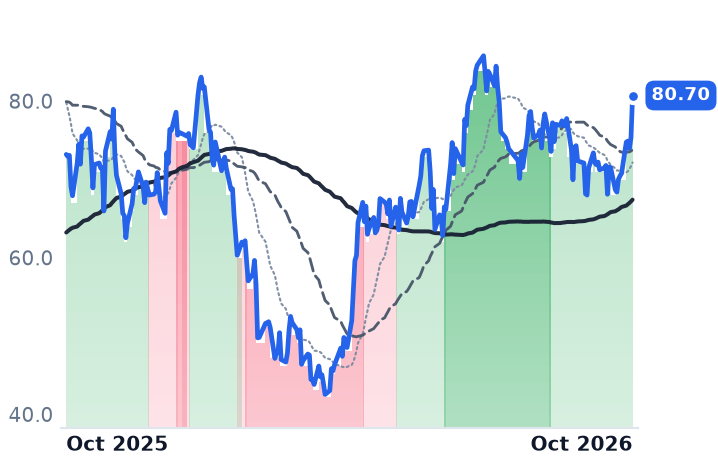
AFRM | Affirm | Consumer Fintech & Lending | 🟢 Cont. Bull | +13.0% | +10.3% |
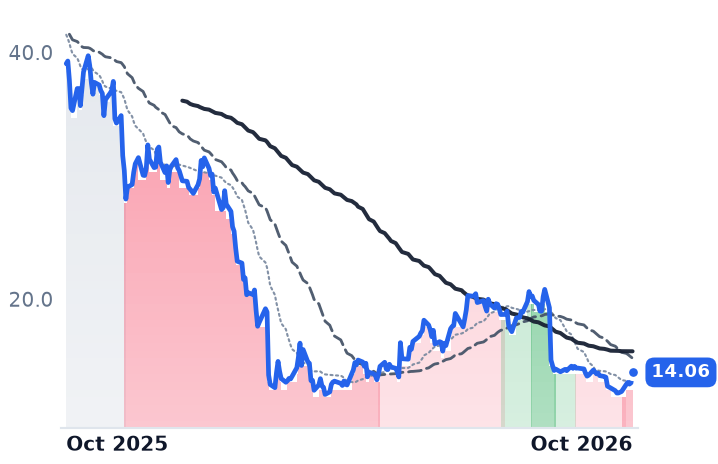
KLAR | Klarna | Consumer Fintech & Lending | 🔴 Cont. Bear | +1.7% | −64.0% |
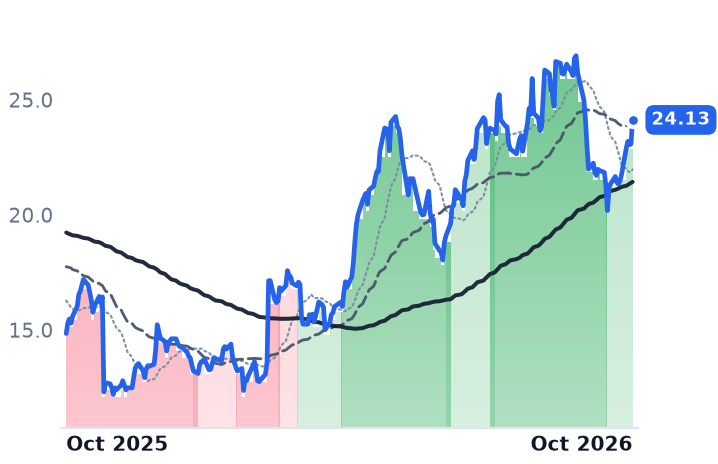
RELY | Remitly Global | Consumer Fintech & Lending | 🟢 Cont. Bull | +9.7% | +62.5% |
12-month price & trend
| Ticker | Mkt cap | P/E | P/E fwd | P/S | P/S fwd | P/GP | P/GP fwd | EV/EBITDA | FCF yld |
|---|---|---|---|---|---|---|---|---|---|
AFRM | $27.0B | 14.1x | 40.5x | 6.5x | 4.9x | 9.5x | 7.2x | 27.5x | 3.7% |
KLAR | $5.3B | n/m | — | 1.3x | 1.3x | 2.1x | 2.1x | 19.3x | -71.5% |
RELY | $5.1B | 16.6x | 17.3x | 2.8x | 2.6x | 4.7x | 4.3x | 19.4x | 8.6% |
Consensus projections
| Ticker | FY2026E | FY2027E | FY2028E | |
|---|---|---|---|---|
AFRM | Revenue | +32.0% | +30.6% | +24.6% |
| EPS | +2220.4% | +60.5% | +45.3% | |
KLAR | Revenue | +17.9% | +13.8% | +15.3% |
| EPS | −96.7% | −2236.4% | +75.8% | |
RELY | Revenue | +22.7% | +19.4% | +19.1% |
| EPS | +97.1% | −23.6% | +23.9% |
Forward fiscal years only. Blank means no analyst coverage for that year.
Affirm Holdings, the point-of-sale instalment lender that lets shoppers in the US, UK and Canada spread a purchase over terms from one month to forty-eight, took in more money last fiscal year from interest on loans sitting on its own balance sheet than from the merchants who pay it to offer interest-free credit. Interest income was $2.05bn of $4.26bn of fiscal-2026 revenue; merchant network revenue, up 30%, was $1.15bn.
That matters because buy-now-pay-later shares are traded as a read on the shopper's health, and revenue is treated as the read. It cannot be. Four unlike dollars land on one transaction, and only one of them is priced off the shopper's credit at all.
Four unlike dollars, one purchase
The merchant discount rate is charged on interest-free volume, where the retailer and not the buyer pays for the credit: Pay-in-X was 16% of fiscal-2026 volume and 0% APR instalment loans another 14%. Consumer interest income comes off the longer interest-bearing loans Affirm keeps, which is why that line is roughly half of revenue. A third dollar, gain on sales of loans, was $596.6m — a credit decision recognised up front as a capital-markets spread when the loan is sold into a forward-flow agreement. The fourth is card interchange, $294.0m, from the Affirm Card, which is attached to 19% of active customers. "We need to make sure that the Affirm Card isn't just the best card in the world," founder and chief executive Max Levchin told investors on 27 August. "It's also the best way to use Affirm."
Stack those and revenue can grow in a quarter when the economics decay.
Where the credit charge actually lands
The honest meter is revenue less transaction costs measured against volume, because funding cost, the provision for credit losses and the subsidised share of volume all land there. It was $589m in the June quarter, 4.2% of gross merchandise volume, and $812m or 5.8% before the credit provision — the same disclosure read with and without the credit charge. Across the full year the measure rose to $2.08bn on $50.2bn of volume, about 4.14%, against roughly 4.03% a year earlier: a widening unit margin on volume up 37%.
Affirm has to borrow before it can lend, and the borrowing got cheaper. Aggregate funding debt of $9.8bn splits into $5.3bn of securitisation notes, $3.3bn of warehouse facilities and about $1.1bn of convertibles, and the average annualised funding cost in the June quarter fell 103 basis points to 5.8%. Thirty-day delinquency on monthly instalment loans improved to 2.5% from the 2.7%-2.8% range of the prior three quarters, with an allowance of $563m against $9.56bn of gross loans held for investment. Management guided fiscal-2027 revenue less transaction costs to 4.16% of volume, above its own prior 3.25%-4.0% range, crediting favourable debt capital markets. "We are in control of the credit reality," Levchin said on the same call. "You would see us slow down growth before you would see us have a real credit disturbance."
A re-rating with no filing behind it
None of that is what moved the shares. Affirm closed at $77.76 the session after the report, slid 12% to $68.15 by 9 September, then rose 18% to $80.70 by 9 October. Price to gross profit — the fitting measure, since a roughly $1.5bn deferred-tax release leaves a trailing price-to-earnings ratio of 14.1x against 40.5x forward — went from 8.4x trailing in mid-September to 9.5x on 9 October, 7.2x forward, entirely on price. The likelier reading is the cost of money: implied odds of an October Fed hike collapsed from near 69% to 16.5% in the first week of the month after New York Fed president John Williams cooled the talk, and a lender with $9.8bn of funding debt prices the policy path straight into its cost of goods sold. A DBS Bank upgrade on 1 October helped; TD Cowen cut its target to $110 from $124 on 6 October while keeping a buy rating.
The bank and the remitter
Klarna Group, the London-headquartered payments provider that also runs a digital retail bank, carries the same interest-free receivable from the opposite side of the balance sheet: about 90% of its book is funded by consumer deposits, roughly $11.7bn to $13bn of them at 30 June, with a capital ratio rather than a counterparty's appetite as the constraint. Its credit line is improving — provisions fell to 0.52% of volume, a third consecutive decline — and its shares are down 66% over twelve months, at 1.3x trailing sales, the lowest since the September 2025 listing and 2.1x trailing gross profit. The cause sits above credit: full-year volume guidance cut to $149bn-$151bn from more than $155bn on German retail weakness and some $600m of adverse currency, consensus growth of 17.9% for 2026 against 31.6% delivered in 2025, and a chief financial officer and chief marketing officer both departing in early 2027.
Remitly Global, the Seattle digital remittance business serving immigrants sending money to nearly 150 countries, is the contrast that defines the group: no loan book, a fraud loss line instead of a credit one, and a take rate of roughly 2.11% of send volume in the June quarter against about 2.23% a year earlier on our arithmetic — a compressing spread on volume up 27%, trading at 16.6x trailing and 17.3x forward earnings.
So two lenders' disclosed loss rates improved while the sector narrative worsened: LendingTree's 2025 survey found 41% of users had made a late payment, up from 34%. The companies' own books and the industry's survey data point opposite ways, and nothing filed closes the gap. What the August numbers establish is that Affirm's spread widened on cheaper funding with losses flat; what they do not establish is the October advance, which arrived on a rate expectation.
Affirm reports after the close on 5 November, covering the first quarter it has funded since the Fed began raising its policy rate again. Whatever that costs shows up in the one line its revenue cannot show.