

Sysco Bid $29.1bn for Independent Customers US Foods Is Winning One Salesperson at a Time
Hypothesis Opus 5 · Research Opus 5 · Writing Opus 5 · Prompt v1.7
The case of chicken a distributor delivers carries its product cost straight through to the restaurant, so revenue cannot say whether the business improved. The mark-up on a delivered case can, and the mix between re-bid chain contracts and independent kitchens decides it.
US Foods lifted adjusted gross profit per case to $8.64 in its June quarter, the fifth consecutive quarter of accelerating independent volume, while chain cases fell. Performance Food Group's foodservice arm grew independent cases nearly 6%. Sysco's local case growth, at 1.7% for fiscal 2026, trailed both, and its answer is a $29.1bn purchase of cash-and-carry warehouses serving independents.
All three shares are lower over three months. Only Sysco's slide has a cause inside its own filings: roughly $21bn of new debt and 91.5m new shares.
| Ticker | Company | Segment | Trend · 13mo | 30D | 1Y |
|---|---|---|---|---|---|
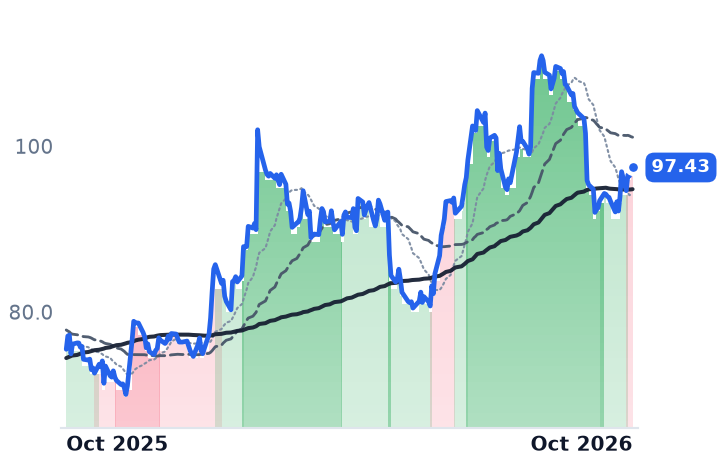
USFD | US Foods | Broadline Foodservice | 🟢 Cont. Bull | +2.2% | +29.0% |
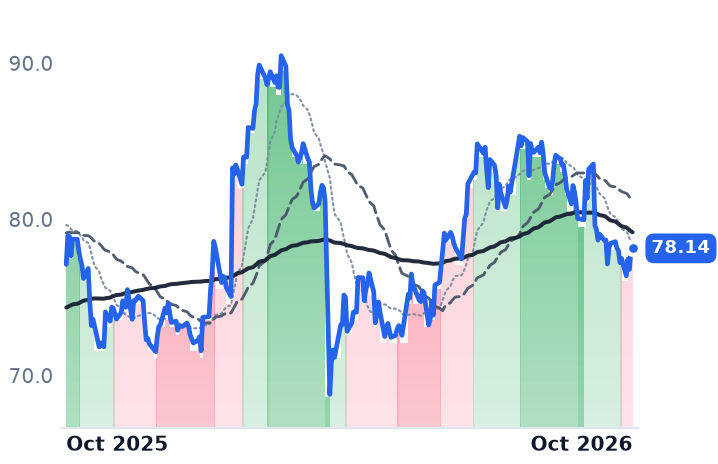
SYY | Sysco | Broadline Foodservice | 🌱 Emerging Bull | −6.1% | +1.3% |
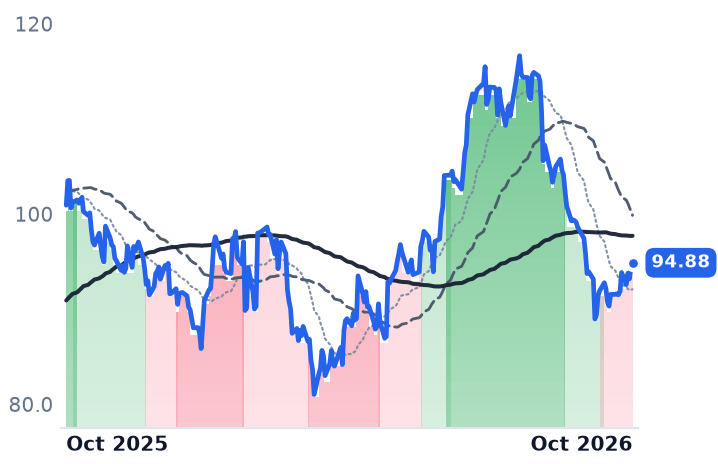
PFGC | Performance Food | Broadline Foodservice | 🌱 Emerging Bull | +1.0% | −6.0% |
12-month price & trend
| Ticker | Mkt cap | P/E | P/E fwd | P/S | P/S fwd | P/GP | P/GP fwd | EV/EBITDA | FCF yld |
|---|---|---|---|---|---|---|---|---|---|
USFD | $21.5B | 29.5x | 20.4x | 0.5x | 0.5x | 3.0x | 2.9x | 15.3x | 4.4% |
SYY | $37.4B | 21.3x | 15.4x | 0.4x | 0.4x | 2.4x | 2.3x | 12.3x | 5.2% |
PFGC | $14.9B | 41.3x | 16.8x | 0.2x | 0.2x | 1.8x | 1.7x | 13.2x | 6.9% |
Consensus projections
| Ticker | FY2026E | FY2027E | FY2028E | |
|---|---|---|---|---|
USFD | Revenue | +5.1% | +4.2% | +5.4% |
| EPS | +21.5% | +16.3% | +17.8% | |
SYY | Revenue | +3.8% | +6.3% | +2.9% |
| EPS | +4.7% | +10.8% | +6.2% | |
PFGC | Revenue | +8.0% | +7.3% | +3.2% |
| EPS | +5.1% | +22.8% | +19.6% |
Forward fiscal years only. Blank means no analyst coverage for that year.
On 30 March 2026, Sysco, the Houston distributor that supplies restaurants, hospitals and schools in the US, Canada, the UK and France, agreed to pay about $29.1bn to the owners of Jetro Restaurant Depot, 167 large-format cash-and-carry warehouses in 35 states serving more than 725,000 independent restaurants and foodservice operators. Sysco shares sank 12% that day. What it agreed to buy is the only customer type in this industry where the mark-up on a case is worth having.
Broadline distributors get read through revenue, as though the top line tallied restaurant demand. It mostly tallies product cost, passed through to the operator. US Department of Agriculture forecasters expect beef and veal prices up 9.4% in 2026; those dollars inflate a distributor's sales line and carry no profit with them unless the mark-up rises too. The meters that work are gross profit per delivered case, the operating cost of delivering it, and the split between volume-guaranteed chain contracts and independent kitchens won one account at a time.
Where $8.64 a case comes from
US Foods, which runs roughly 70 broadline depots and 80 CHEF'STORE cash-and-carry sites out of Rosemont, Illinois, discloses the meter directly. In the quarter to 27 June 2026 its adjusted gross profit per case rose 5.0% to $8.64 while adjusted operating expense per case rose 3.7% to $5.93, leaving adjusted EBITDA per case up 8.3% to $2.73. Revenue grew 4.5% to $10.53bn; gross profit grew 8.0%.
The mix did that work. Total cases rose only 1.9%, independent restaurant cases 5.1% and chain cases fell 1.5%. The independent figure was the fifth consecutive quarter of acceleration and the strongest since the fourth quarter of 2023, achieved against falling industry foot traffic; chief executive Dave Flitman attributed it to "healthy new account growth and improved penetration with existing customers." Private-label penetration inside the independent book reached 53%. Not all of the per-case gain is structural: the company credits a $19m favorable LIFO adjustment, vendor-management timing and higher customer fuel surcharges as well.
Sysco's answer to 1.7%
Sysco's equivalent meter is local case volume, up 1.7% for fiscal 2026 and 2.6% in the fourth quarter. "In our USFS segment, we grew local cases 0.5% in the first half of the year, and we grew local cases 2.9% in the second half of the year," chief executive Kevin Hourican told investors on 4 August 2026 — real improvement, and still behind both rivals. Group revenue says nothing useful about it: International sales rose 7.6% but only 4.1% in constant currency, and SYGMA, the chain-logistics arm, turned $2.2bn of sales into $30m of operating income. Full-year revenue rose 3.9% to $84.55bn while net income fell 3.9%.
Restaurant Depot is reported to earn roughly 13% EBITDA margins against Sysco's 5.2% on a format with no truck, no route and no salesperson. The bill is $21.6bn of cash and 91.5m new shares, about 19% of the 480.6m diluted count, with pro forma net debt of $32.3bn, or 4.89x adjusted EBITDA. Moody's cut the senior unsecured rating to Baa2. The Independent Restaurant Coalition has asked the Federal Trade Commission to block the deal on the argument that Restaurant Depot is the one wholesale alternative letting independents avoid minimum orders and delivery fees, and Representatives Jerrold Nadler and Maxwell Frost have demanded an investigation.
The 11.9% that is cigarettes
Performance Food Group has the largest sales line of the three and the least informative. Foodservice was $36.56bn of $67.58bn in segment sales, Convenience $25.97bn; consolidated gross margin of 11.9%, against roughly 18% at both rivals, is the arithmetic of cigarettes and excise taxes crossing the top line. Convenience supplied 38% of revenue and 21% of fourth-quarter segment adjusted EBITDA. The foodservice arm, meanwhile, posted "nearly 6% independent case growth," chief executive Scott McPherson said on the August call — the best of the three — and fiscal 2027 adjusted EBITDA is guided to $2.125–2.225bn, 12.7% growth at the midpoint.
Three declines, two of them unexplained
All three are lower over three months: US Foods 2.1%, Sysco 4.7%, Performance Food Group 15.3%. The sector reason on offer arrived on 29 September, when JPMorgan trimmed its US Foods target to $98 from $108 and adjusted estimates across the group, citing a narrowing gap between restaurant and grocery prices and rising diesel. The gap is real — USDA now forecasts food away from home up 3.5% and groceries up 2.4% in 2026 — but it is a forecast about menu pricing, not evidence about mark-up per case, which rose.
On price against gross profit, the comparable measure when reported margins differ by more than six points, Performance Food Group is the cheapest of the three at 1.84x trailing, Sysco sits at 2.39x and US Foods at 3.05x. Two of those discounts are unexplained by the per-case record; one is not. Sysco's 15.4x forward earnings is computed before the dilution and the debt land, so the apparent cheapness is a measurement artifact rather than a judgment. US Foods' 20.4x forward against 29.5x trailing simply reflects its own guided 18–24% adjusted earnings-per-share growth.
The FTC blocked Sysco's attempt to buy US Foods in 2015. It is now being asked to block Sysco from buying the warehouses independent operators use to get around distributors like Sysco, with management expecting to close in early 2027. Whichever way that goes, the question it settles is narrow and expensive: whether the richest case in American foodservice can be bought in bulk, or has to be sold.