

MercadoLibre's $16.4bn Brazilian Loan Book Is Why One Election Round Moved It 10%
Hypothesis Opus 5 · Research Opus 5 · Writing Opus 5 · Prompt v1.7
A sovereign-politics result, not a quarterly report, was the largest single-day event of MercadoLibre's year. Brazil's first round on 4 October forced a 25 October runoff and sent investors into Brazilian financial assets; MercadoLibre, which books 52.6% of its revenue there and carries a $16.4bn consumer and merchant loan portfolio funded at Brazilian policy rates, closed the next session up nearly 10%.
The lending slab, not the marketplace, is what moved. Operating income still fell 17.2% in the June quarter as free-shipping subsidy cut gross margin to 40.9%, and nothing in the credit meters changed in the window. Sea fell 12.6% over the same thirty days on a sell-side downgrade; Coupang's bounce off a 52-week low is Korean. Only MercadoLibre has a Brazil mechanism, and its price-to-gross-profit multiple has already gone from 5.39x in August to 6.38x.
| Ticker | Company | Segment | Trend · 13mo | 30D | 1Y |
|---|---|---|---|---|---|
| The subject · what this brief is about | |||||
MELI | MercadoLibre | Online Marketplaces | 🌱 Emerging Bull | −1.6% | −11.4% |
SE | Sea | Online Marketplaces | 🌱 Emerging Bull | −11.7% | −47.3% |
CPNG | Coupang | Regional/Niche E-commerce | 🔴 Cont. Bear | +7.4% | −49.3% |
| Compared against · context, not the story | |||||
XP | XP | Diversified Financial Services | 🟢 Cont. Bull | +61.3% | +105.8% |
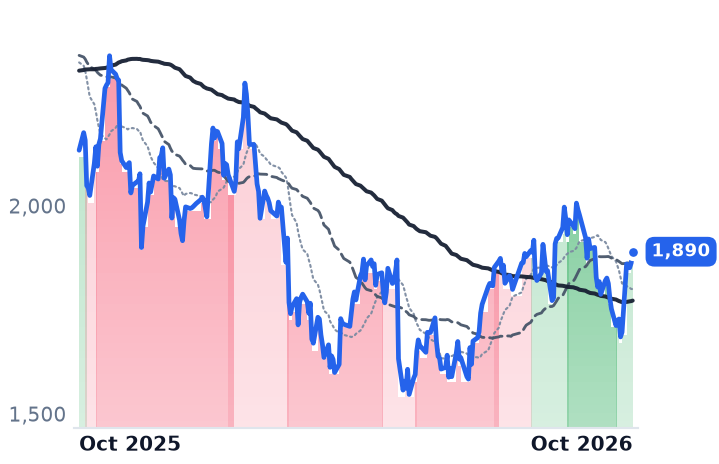
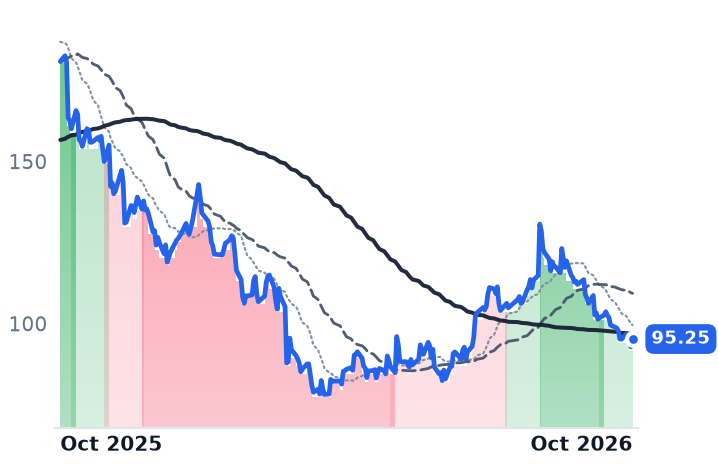
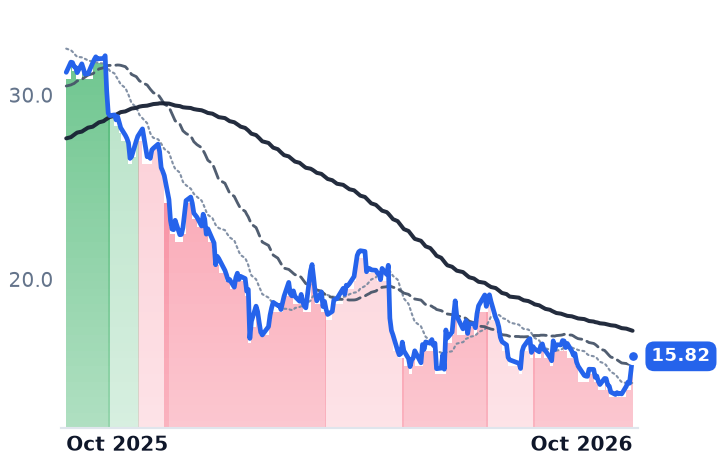
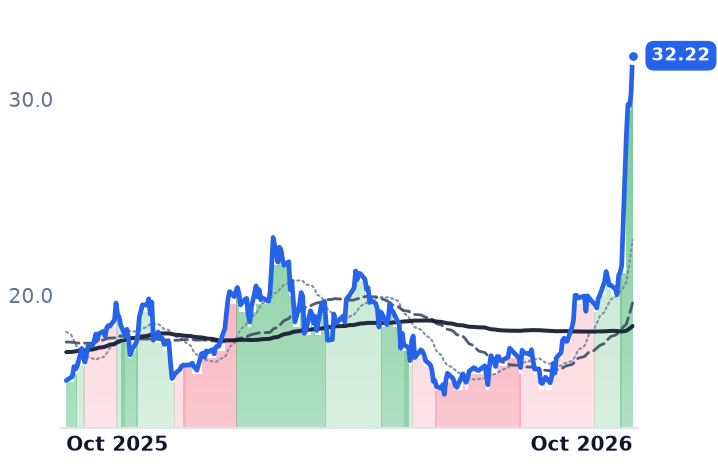
12-month price & trend
| Ticker | Mkt cap | P/E | P/E fwd | P/S | P/S fwd | P/GP | P/GP fwd | EV/EBITDA | FCF yld |
|---|---|---|---|---|---|---|---|---|---|
MELI | $95.8B | 51.4x | 49.4x | 2.7x | 2.3x | 6.4x | 5.4x | 31.0x | 12.3% |
SE | $57.2B | 35.1x | 26.1x | 2.1x | 1.8x | 4.7x | 4.1x | 20.2x | 5.4% |
CPNG | $28.4B | n/m | — | 0.8x | 0.8x | 2.8x | 2.7x | 873.7x | 0.4% |
| Ticker | Mkt cap | P/E | P/E fwd | P/S | P/S fwd | P/GP | P/GP fwd | EV/EBITDA | FCF yld |
|---|---|---|---|---|---|---|---|---|---|
XP | $9.2B | 9.0x | — | 2.5x | — | 3.8x | — | 19.3x | 25.1% |
Consensus projections
| Ticker | FY2026E | FY2027E | FY2028E | |
|---|---|---|---|---|
MELI | Revenue | +45.6% | +29.0% | +23.6% |
| EPS | −5.4% | +45.1% | +36.7% | |
SE | Revenue | +40.1% | +22.9% | +15.4% |
| EPS | +14.7% | +29.0% | +24.4% | |
CPNG | Revenue | +6.3% | +13.9% | +12.3% |
| EPS | −410.1% | −162.9% | +123.7% | |
XP | Revenue | +17.2% | +13.8% | +12.0% |
| EPS | +14.0% | +14.3% | +14.3% |
Forward fiscal years only. Blank means no analyst coverage for that year.
The day after Brazil's presidential first round, MercadoLibre's shares closed up 9.7% on 1.25m shares against the prior session's 390,000. Nothing in the marketplace had changed. Flávio Bolsonaro had taken 47.03% of valid votes to Lula's 45.16%, beating the polling average and forcing a 25 October runoff, and the session that followed was a repricing of Brazilian fiscal risk: the Bovespa closed at a record 206,911, up about 8%, the dollar fell more than 4% against the real, and Itaú Unibanco's US listing gained 15%.
MercadoLibre, which runs Latin America's largest online marketplace alongside the Mercado Pago payments and lending arm, belongs in that group for a reason its revenue line does not make obvious. Brazil generated $15.2bn of its $28.9bn of 2025 net revenues and financial income, about 52.6%. But the route from a Brazilian election to its earnings runs through a lender's funding cost, not through parcels shipped.
The slab that decides the quarter
Mercado Pago's credit portfolio reached $16.4bn in the June quarter, up 75% year on year, held on balance sheet with a provision against it. Net interest margin after losses was 21%, improved from 18% in the prior quarter, with 15-to-90-day arrears at 7.0% of the book and 4.6% on credit cards; management called those levels close to historical lows. The card book is run at minus 2.5% margin after losses by design, with cohorts reaching breakeven in twelve to eighteen months.
Funding that book is where Brazilian policy reaches the income statement. Copom cut the Selic to 14.00% on 5 August and to 13.75% in September, a fifth consecutive quarter-point reduction and 125 basis points below the 15.00% cycle peak, with minutes still insisting policy stay restrictive. An election outcome read as fiscal discipline is, for this company, a forecast about the cost of money it lends.
The commerce dollar meanwhile keeps getting thinner. Revenue growth accelerated for a fourth straight quarter, to 49.8% in the three months to June, and operating income fell 17.2% to $683m, with gross margin at 40.9% against 45.6% a year earlier as the company subsidises Brazilian shipping to hold volume against Shopee, Amazon, Temu and TikTok Shop.
Sea's bad month was written in Singapore
Sea, the Singapore owner of Shopee, the Monee lending arm and the Garena games business, has no Brazil mechanism, and it fell 12.6% over the same thirty days in which MercadoLibre rose 0.8%. The cause is dated: DBS analyst Sachin Mittal cut the stock to Hold on 1 October and his target to $105 from $148, writing that Shopee is "strengthening its moat, but at a cost to margins." The business disagrees with the shares: revenue grew 48.1% to $7.788bn in the June quarter, gross margin widened to 45.6%, operating income rose 28.4% to $626m, and Monee's $11.1bn loan book held its 90-day non-performing ratio at 1.0%. "With this solid momentum, we are optimistic that Shopee will achieve the milestone of $1 billion in adjusted EBITDA for the full year," chairman and chief executive Forrest Li told investors on 11 August. At 26.1x forward earnings against 35.1x trailing, it is the only one of the three whose multiple assumes profits rise.
Coupang's bounce is a Korean story
Coupang, the Korean retailer that owns the inventory it sells and delivers it on its own Rocket network, rose 14.8% over the same five sessions, off a 52-week low and with no Latin American revenue at all. Its de-rating is domestic: a $409m privacy fine booked in the June quarter took the operating loss to $556m, revenue growth has decelerated to 3.9%, gross profit shrank 2.6%, and Korea's Fair Trade Commission has opened proceedings over an obstructed on-site inspection while seeking a ₩140bn penalty on search rankings. "The vast majority of our customer spend never moved," founder and chief executive Bom Kim told investors on 4 August, putting margin recovery in Product Commerce out to next year. At 2.83x gross profit it is the cheapest of the three, on the only gross profit that is shrinking.
What has repriced is the multiple
None of these operating meters moved in the five sessions that produced the gains. MercadoLibre's price-to-gross-profit multiple has gone from 5.39x in late August to 6.38x now, roughly an 18% re-expansion with no new operating data, and its trailing price-to-earnings of 51.4x sits only 3.9% above the forward 49.4x — the arithmetic of consensus modelling 2026 earnings per share at $38.24 against $40.41 in 2025, with recovery to $55.48 deferred to 2027. The five-day move is multiple repair on a sovereign forecast rather than evidence that the credit book or the take rate inflected, and the forecast itself is unsettled: the first runoff poll, from Datafolha on 8 October, gave Flávio 52% to Lula's 48%, inside the margin of error, even as JPMorgan and Deutsche Bank upgraded Brazilian equities and XP had the best session in its listed history.
MercadoLibre reports third-quarter results after the close on 4 November, ten days after the runoff. The vintages originated through this year's book growth will not have seasoned by then, which is the uncomfortable part of owning a marketplace that also lends: the election result arrives in weeks, and the loan losses arrive whenever they arrive.