
Palo Alto and CrowdStrike Booked Orders Faster Than Revenue; Their Shares Ran Faster Still
Hypothesis Opus 5 · Research Opus 5 · Writing Opus 5 · Prompt v1.7
Palo Alto Networks is paid for displacing several incumbent vendors at once, and it grants free use of its platforms until the customer's old contracts lapse. That pushes the money into deferred revenue and leaves the reported revenue line unable to show whether the strategy is working. Its remaining performance obligation grew 34% last fiscal year, well ahead of revenue; CrowdStrike's net new contracted revenue grew 51%, roughly twice its revenue growth; Cloudflare, which bills by the request, shows a one-point gap between the two.
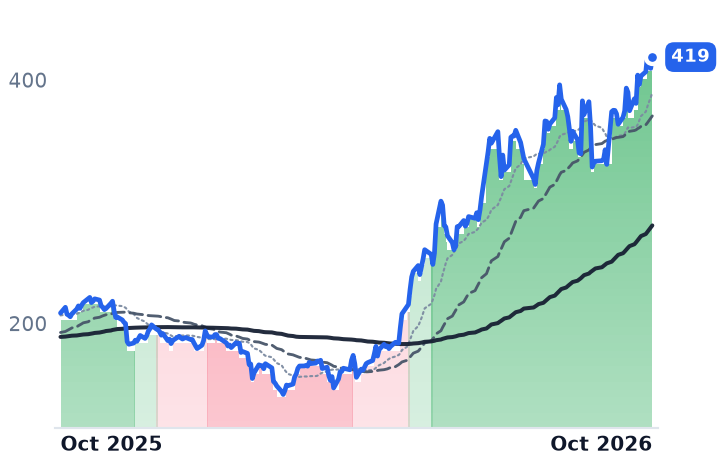
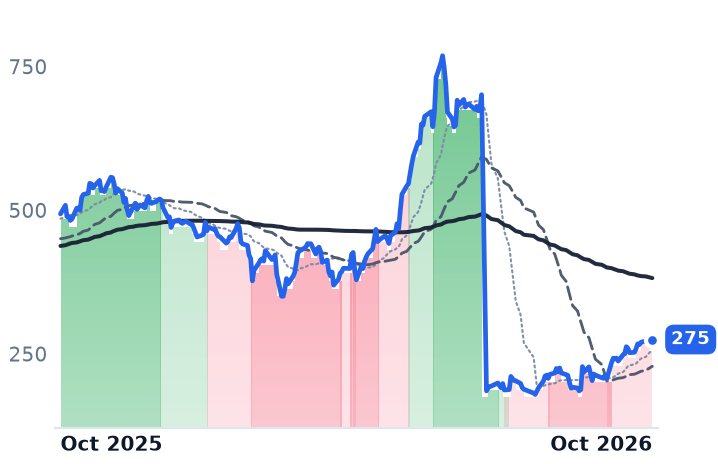
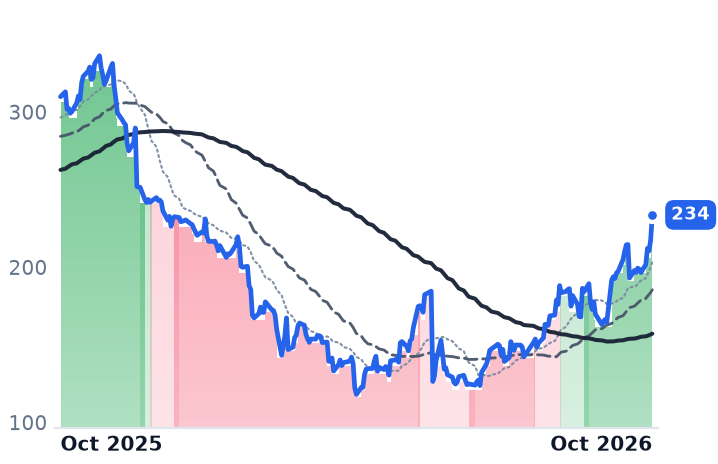
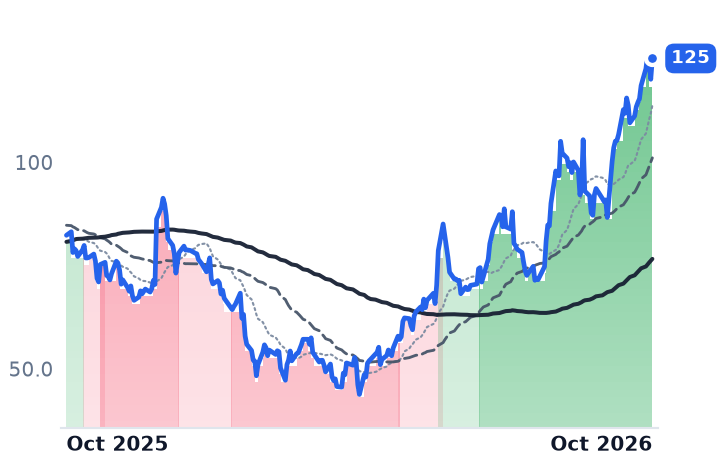
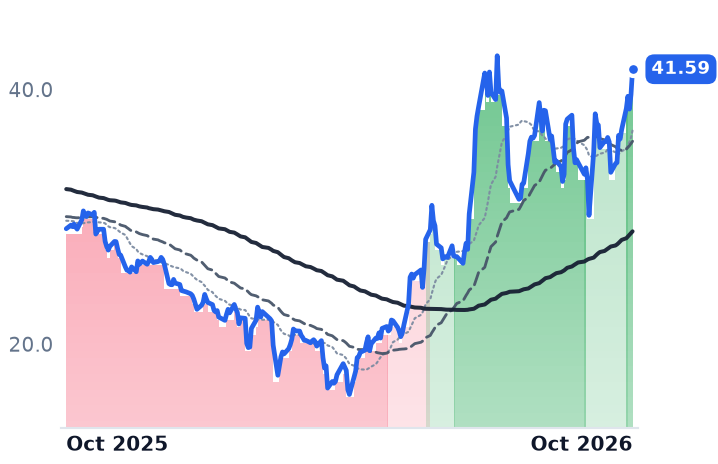
The order books support the business case. The prices have gone further: a dollar of Palo Alto's trailing gross profit costs 42.3x today against 20.2x on 3 May 2026, and a dollar of CrowdStrike's costs 69.0x against 32.1x. CrowdStrike's apparent twelve-month collapse is a four-for-one stock split showing through unadjusted closing prices; adjusted, those twelve months are up 116%.
| Ticker | Company | Segment | Trend · 13mo | 30D | 1Y |
|---|---|---|---|---|---|
| The subject · what this brief is about | |||||
PANW | Palo Alto Networks | Cybersecurity & Threat Protection | 🟢 Cont. Bull | +22.2% | +100.8% |
CRWD | CrowdStrike | Cybersecurity & Threat Protection | 🔴 Cont. Bear | +29.0% | −44.3% |
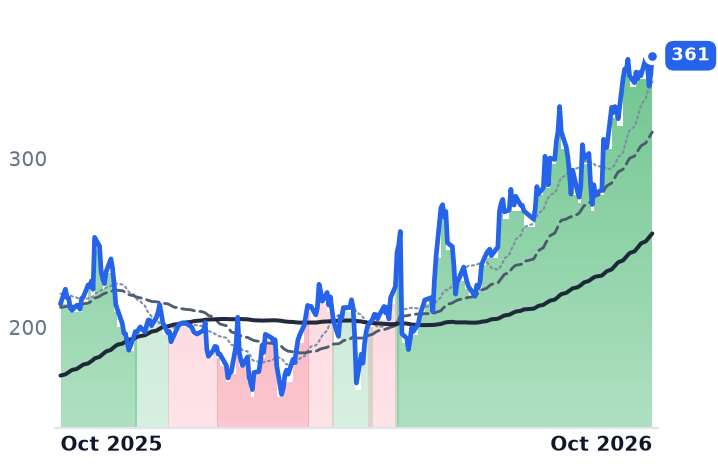
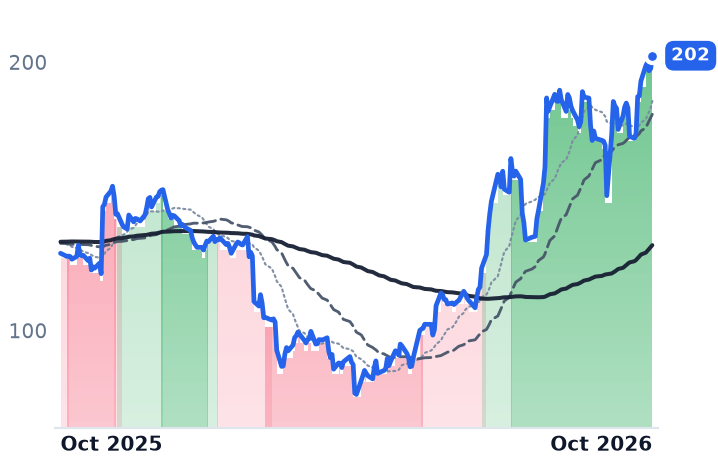
NET | Cloudflare | Network & Application Delivery | 🟢 Cont. Bull | +16.8% | +68.8% |
| Compared against · context, not the story | |||||
ZS | Zscaler | AI & Data Intelligence | 🌱 Emerging Bull | +40.4% | −24.6% |
FTNT | Fortinet | Network Security Appliances | 🟢 Cont. Bull | +21.7% | +134.5% |
OKTA | Okta | Identity & Access Management | 🟢 Cont. Bull | +36.4% | +159.8% |
S | SentinelOne | Cybersecurity & Threat Protection | 🟢 Cont. Bull | +30.9% | +52.3% |
RBRK | Rubrik | Other | 🟢 Cont. Bull | +37.7% | +52.0% |
TENB | Tenable | Cybersecurity & Threat Protection | 🟢 Cont. Bull | +26.3% | +43.1% |
QLYS | Qualys | Cybersecurity & Threat Protection | 🟢 Cont. Bull | +19.7% | +57.1% |
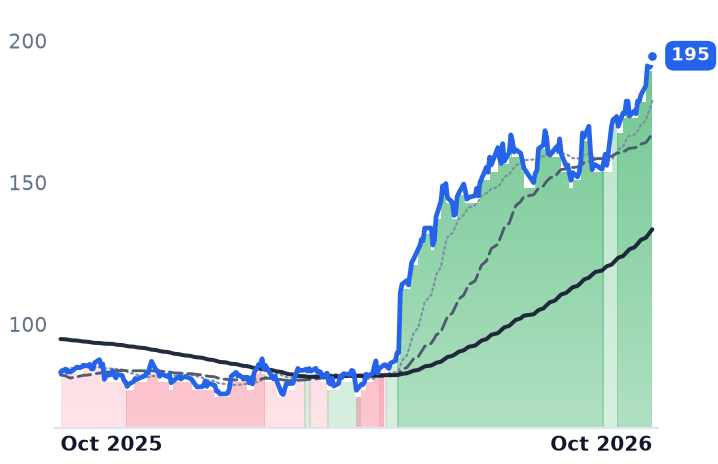
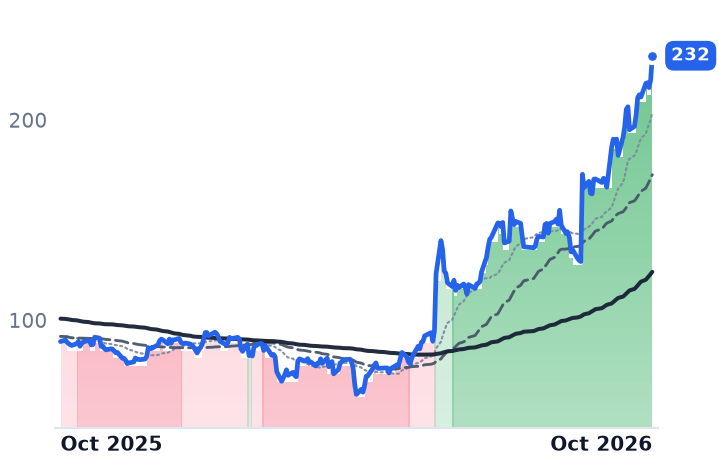
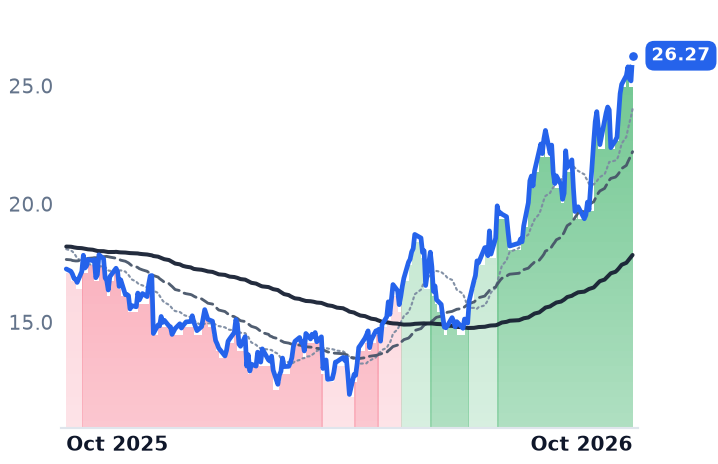
12-month price & trend
| Ticker | Mkt cap | P/E | P/E fwd | P/S | P/S fwd | P/GP | P/GP fwd | EV/EBITDA | FCF yld |
|---|---|---|---|---|---|---|---|---|---|
PANW | $341.3B | 910.4x | 100.0x | 29.7x | 24.1x | 42.3x | 34.2x | 221.6x | 1.2% |
CRWD | $280.1B | — | 219.6x | 51.9x | 46.6x | 69.0x | 62.0x | 631.5x | 0.6% |
NET | $128.1B | n/m | 286.2x | 51.0x | 44.7x | 70.3x | 61.5x | — | 0.3% |
| Ticker | Mkt cap | P/E | P/E fwd | P/S | P/S fwd | P/GP | P/GP fwd | EV/EBITDA | FCF yld |
|---|---|---|---|---|---|---|---|---|---|
ZS | $31.9B | n/m | 40.4x | 9.5x | 8.1x | 12.4x | 10.6x | 176.0x | 2.7% |
FTNT | $132.8B | 63.3x | 52.5x | 17.6x | 16.4x | 21.9x | 20.3x | 45.0x | 2.3% |
OKTA | $34.0B | 121.2x | 52.2x | 11.1x | 10.6x | 14.2x | 13.5x | 84.6x | 2.9% |
| Ticker | Mkt cap | P/E | P/E fwd | P/S | P/S fwd | P/GP | P/GP fwd | EV/EBITDA | FCF yld |
|---|---|---|---|---|---|---|---|---|---|
S | $7.2B | n/m | 61.3x | 6.9x | 6.0x | 9.3x | 8.1x | n/m | 0.6% |
RBRK | $22.0B | n/m | 212.0x | 14.2x | 13.0x | 17.8x | 16.2x | n/m | 1.5% |
TENB | $2.4B | n/m | 11.0x | 2.3x | 2.2x | 3.0x | 2.8x | 23.3x | 11.1% |
| Ticker | Mkt cap | P/E | P/E fwd | P/S | P/S fwd | P/GP | P/GP fwd | EV/EBITDA | FCF yld |
|---|---|---|---|---|---|---|---|---|---|
QLYS | $3.2B | 15.9x | 11.9x | 4.6x | 4.4x | 5.6x | 5.3x | 11.4x | 9.2% |
Consensus projections
| Ticker | FY2026E | FY2027E | FY2028E | |
|---|---|---|---|---|
PANW | Revenue | +24.3% | +24.1% | +14.3% |
| EPS | +15.5% | +10.8% | +16.1% | |
CRWD | Revenue | +22.2% | +25.0% | +22.7% |
| EPS | −1.2% | +34.9% | +27.6% | |
NET | Revenue | +33.7% | +28.4% | +27.0% |
| EPS | +38.1% | +32.6% | +34.3% | |
ZS | Revenue | +25.2% | +17.9% | +16.3% |
| EPS | +29.2% | +18.3% | +14.7% | |
FTNT | Revenue | +20.2% | +11.3% | +11.1% |
| EPS | +28.0% | +9.4% | +13.1% | |
OKTA | Revenue | +12.0% | +10.9% | +10.0% |
| EPS | +24.3% | +14.1% | +10.6% | |
S | Revenue | +22.4% | +19.9% | +17.6% |
| EPS | +723.4% | +83.7% | +43.0% | |
RBRK | Revenue | +48.7% | +32.0% | +21.5% |
| EPS | −90.5% | −389.4% | +52.5% | |
TENB | Revenue | +8.4% | +7.1% | +6.9% |
| EPS | +27.0% | +10.5% | +10.1% | |
QLYS | Revenue | +8.6% | +7.0% | +6.6% |
| EPS | +8.6% | +9.2% | +5.3% |
Forward fiscal years only. Blank means no analyst coverage for that year.
Palo Alto Networks waits out its rivals' paperwork. It sells hardware and software firewalls plus subscription security services to large enterprises, service providers and governments, and it wins those accounts by granting free use of its platforms until the contracts the customer already signed elsewhere expire. The economics move into deferred revenue, which means the reported revenue line of a company selling platform consolidation cannot show the thing being sold.
Ten listed security vendors rose double digits over the thirty days to 9 October, an advance read as the market finally paying for that consolidation: one supplier taking over several incumbents' jobs across a customer's estate. The contracted order books support the business half of the reading at all three of the large names that disclose them. The price half has run well past it. Each dollar of Palo Alto's trailing gross profit cost 20.2x on 3 May 2026 and 42.3x now, while the distance between its trailing and forward multiples implies gross-profit growth only in the teens.
The quarter it wins hardest is the quarter revenue looks slowest
"We believe we can build customer confidence in our platforms by approaching them well before their point product contracts expire. After we gain their contractual commitment, we have offered an extended roll out period where we can demonstrate our ability to deliver these platform benefits," chairman and chief executive Nikesh Arora said when he introduced the no-cost bridge; the company said at the time that revenue growth would run lower than expected for 12 to 18 months as a result.
It is now measurable in both directions. In fiscal 2026 Palo Alto displaced legacy vendors in nearly 100 accounts representing more than $400m of total contract value, nearly double the prior year, and annual billings rose to roughly 30% of bookings from 27%. Revenue grew 24.5% to $11.48bn. Next-generation security annual recurring revenue grew 63% to $9.10bn, remaining performance obligation grew 34% to $21.2bn, and the current portion of it also rose 34%, to $9.3bn. Hardware is down to 19.9% of revenue. "Platformization is the only viable strategy for real time defense," Arora told investors on 1 September.
Two caveats ride with those meters. Palo Alto closed its $21.1bn purchase of the identity vendor CyberArk on 11 February 2026, lifting revenue and the recurring-revenue figure at once, which is why fiscal 2027 guidance puts that meter up 22% to 23% against the 63% just reported. Gross margin fell just over three percentage points to 70.4%, and reported profit is no help at all: full-year GAAP net income fell 72.9% to $307m on acquisition amortization. Cash reads cleaner, with adjusted free cash flow up 35% to $4.41bn.
A stock split made the best twelve months look like a loss
The same machine runs a step further along at CrowdStrike, which sells endpoint, cloud, identity and log-management modules on its Falcon platform. In the quarter to 31 July it reported record net new annual recurring revenue of $333m, up 51%, against revenue growth of 26% — the fifth consecutive quarter of revenue acceleration — with ending contracted revenue of $5.84bn. The pool of pre-committed dollars customers draw down across modules, sold as Falcon Flex, more than doubled to $2.29bn, and gross retention held at 97%. Full-year net-new guidance was raised 6.3 percentage points, to about 34% growth.
"We are in an arms race. AI is driving more cyber attacks. AI is driving more cyber spending," founder and chief executive George Kurtz told investors on 26 August.
The price record disguises all of this. The board approved a four-for-one stock split on 3 June 2026, and unadjusted closes show a 46% twelve-month fall — a mechanical discontinuity, not a market move. Split-adjusted, the same twelve months are up 116%, the strongest of the four names here. The re-rating is not disguised: a dollar of trailing gross profit cost 32.1x on 3 May and 69.0x now, 62.0x on forward estimates, for a company holding roughly a fifth of the endpoint market against Microsoft Defender for Endpoint's 15% to 20%, with the standing risk that Microsoft bundles more of it.
Cloudflare bills requests, so its revenue keeps up
Cloudflare is the useful stress case. Its edge network charges by the request and by contract, and second-quarter revenue grew 36% while current remaining performance obligation grew 35% — a one-point gap, against the 2.6-times gap at Palo Alto. Customers spending over $100,000 a year reached 4,698, up 27% and 73% of revenue, with dollar-based net retention at 120%. "For the first time in human history, in Q2, more than 50% of the traffic flowing across Cloudflare's network was not human," co-founder and chief executive Matthew Prince said on 6 August. Gross margin fell to 71.8% from 74.9% as inference compute displaced software mix; no AI revenue line is broken out. On trailing gross profit it is the dearest of the three at 70.3x, 61.5x forward, against 45.4x in early May.
One print set four prices
The thirty-day move traces to a single report. On 27 August, the session after CrowdStrike's results, CrowdStrike rose 21.3%, Palo Alto 12.8%, Zscaler 11.0% and Cloudflare 8.7%; Palo Alto's own print three days later cost it 13% over two sessions before it recovered. Software stocks have reached their highest level since November 2025 as the sector's expected 2026 earnings growth climbed to 20.6% from 13.8% at the end of March, per LSEG data. Zscaler shows how little the meters mattered: the strongest thirty-day gainer of the ten at 41.5%, carrying a price-to-gross-profit of 10.1x in late July — roughly a fifth of CrowdStrike's on the same date — while guiding the slowest growth of the group at 16.6% to 17.4% contracted-revenue growth.
So the order books explain the direction and almost none of the magnitude. Palo Alto's deferral is real, documented and self-inflicted, and its wins land in the obligation line first; CrowdStrike's commitment pool converts at twice the pace revenue shows; Cloudflare's dollar arrives as it is consumed, which is why its gap is one point and its margin is falling. What none of the three supplies is five months of gross-profit growth equal to a doubled multiple. Consensus sits between 10% and 19% above trailing gross profit at each name, derived from the trailing and forward multiples themselves, and the re-rating was several times that.
The free period is the whole strategy and the whole exposure. A customer who commits today may not be billed until a competitor's contract lapses, so the prices set in August rest on revenue nobody will recognize for a year or more. One soft quarter of net new contracted revenue would not disprove the mechanism — it would simply be the only evidence anyone gets to see.