

Enphase's 2027 Forecast Needs a Third More Core Sales to Replace a Tax-Deadline Pre-Buy
Hypothesis Opus 5 · Research Opus 5 · Writing Opus 5 · Prompt v1.7
Enphase's revenue line still looks like a hardware business selling into a soft market. A large slice of it is equipment bought by leasing companies purely to lock in a tax credit before a construction deadline, and it does not repeat.
Deutsche Bank's 7 October downgrade put the arithmetic in print: after about $255m of such safe-harbour sales in 2026, Street estimates for 2027 implicitly require core organic revenue to grow roughly 33%. Enphase's own June quarter showed the split, with US revenue down about 3% while what distributors sold on to installers fell 34%.
SolarEdge is the opposite business trend on the same policy dollar, with sales up 19.6% and gross margin at 27.5%, yet the two trade at nearly the same price per dollar of gross profit.
| Ticker | Company | Segment | Trend · 13mo | 30D | 1Y |
|---|---|---|---|---|---|
| The subject · what this brief is about | |||||
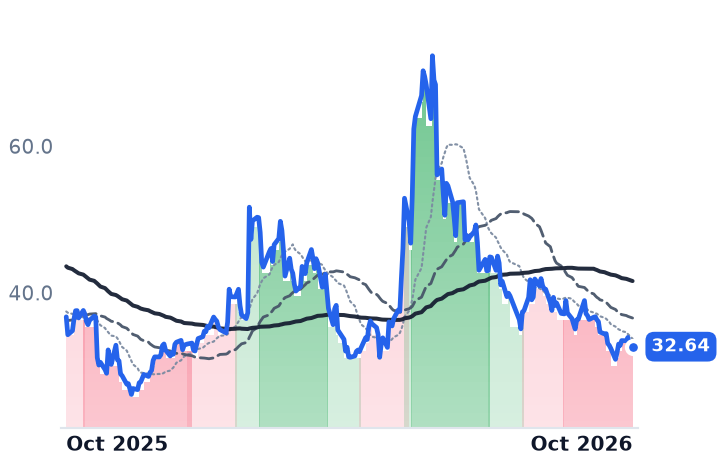
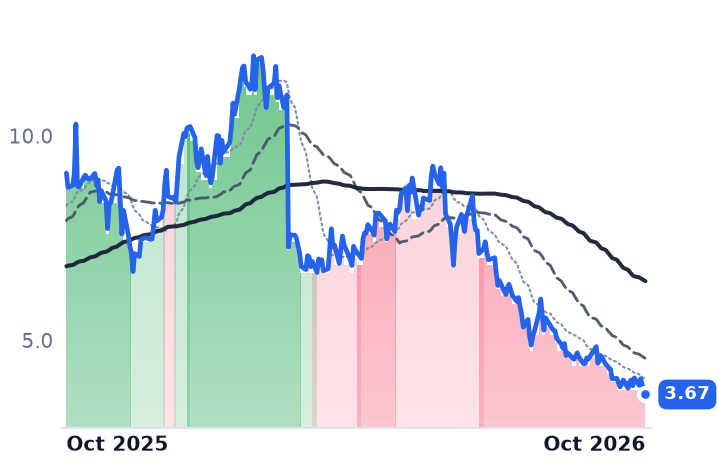
ENPH | Enphase Energy | Inverters & Power Electronics | 🔴 Cont. Bear | −12.1% | −11.1% |
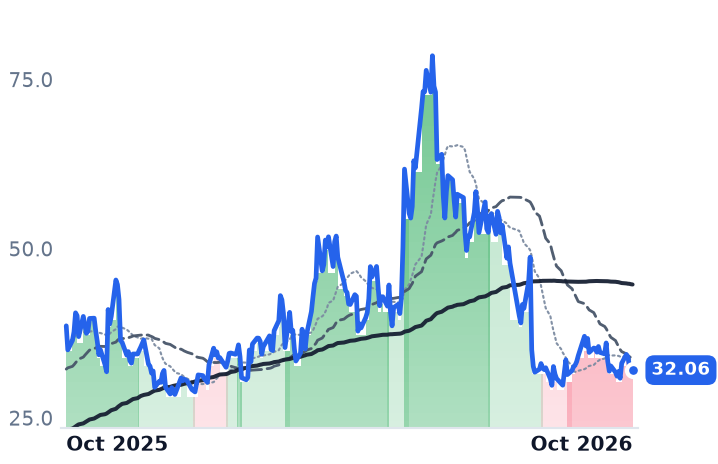
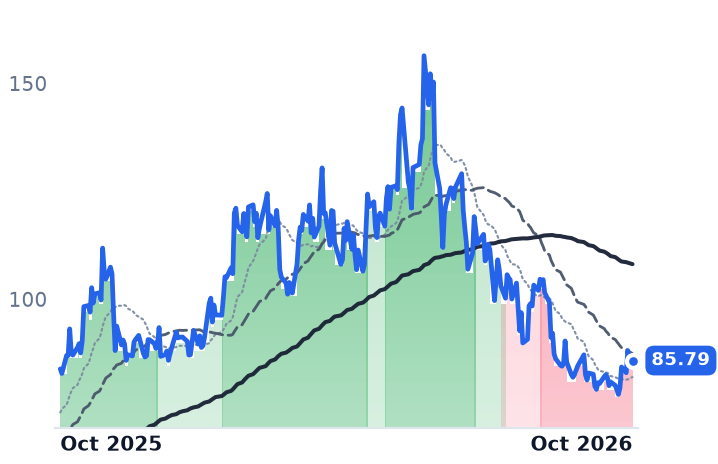
SEDG | SolarEdge Technologies | Inverters & Power Electronics | ⚠️ Emerging Bear | −10.0% | −17.0% |
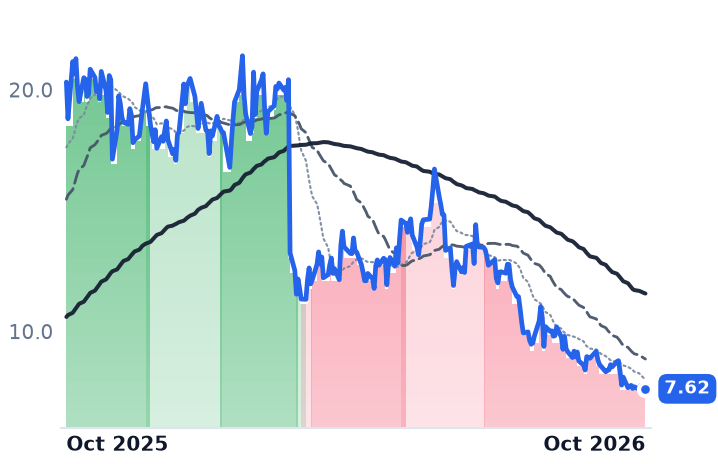
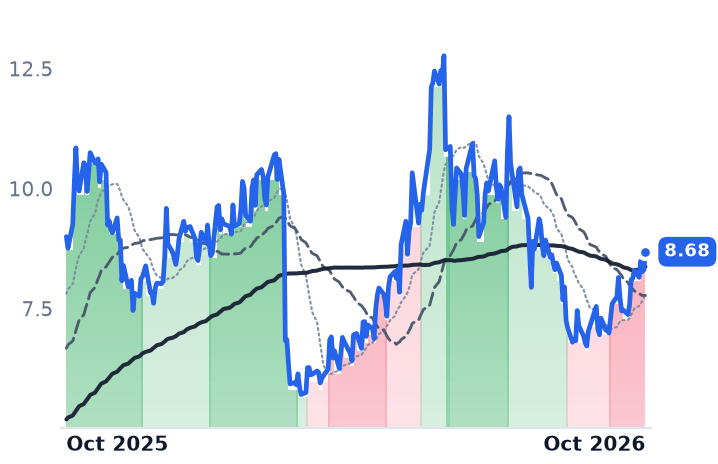
RUN | Sunrun | Residential Solar Installers | 🔴 Cont. Bear | −13.6% | −62.5% |
| Compared against · context, not the story | |||||
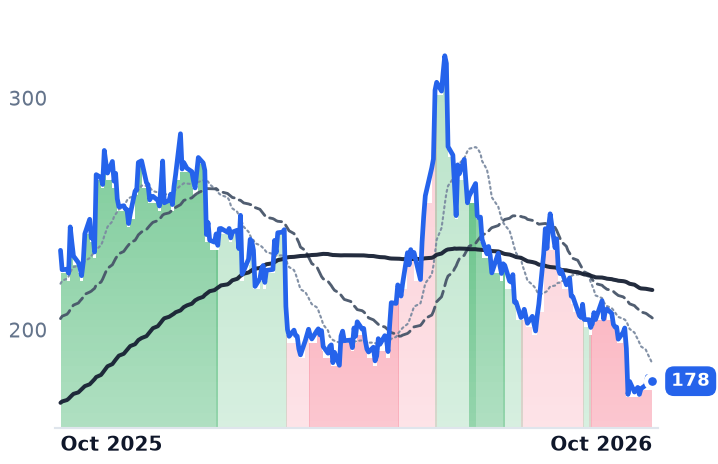
FSLR | First Solar | Solar Module Manufacturers | ⚠️ Emerging Bear | −13.1% | −24.1% |
ARRY | Array Technologies | Solar Tracking Systems | 🔴 Cont. Bear | −17.1% | −59.6% |
NXT | Nextpower | Other | ⚠️ Emerging Bear | +4.0% | +2.3% |
SHLS | Shoals Technologies | Solar System Components | ⚠️ Emerging Bear | +22.8% | −3.5% |
12-month price & trend
| Ticker | Mkt cap | P/E | P/E fwd | P/S | P/S fwd | P/GP | P/GP fwd | EV/EBITDA | FCF yld |
|---|---|---|---|---|---|---|---|---|---|
ENPH | $4.3B | 32.2x | 16.5x | 3.3x | 3.7x | 7.0x | 7.8x | 20.0x | 3.5% |
SEDG | $2.0B | n/m | — | 1.5x | 1.5x | 6.6x | 6.8x | n/m | 4.6% |
RUN | $1.8B | 4.5x | 6.4x | 0.5x | 0.6x | 1.5x | 1.7x | 18.4x | -74.7% |
| Ticker | Mkt cap | P/E | P/E fwd | P/S | P/S fwd | P/GP | P/GP fwd | EV/EBITDA | FCF yld |
|---|---|---|---|---|---|---|---|---|---|
FSLR | $19.1B | 10.9x | 10.1x | 3.6x | 3.8x | 8.1x | 8.6x | 7.2x | 7.9% |
ARRY | $589.2M | n/m | 5.1x | 0.5x | 0.4x | 2.0x | 1.7x | 248.5x | 22.9% |
NXT | $14.9B | 24.7x | 21.2x | 4.1x | 3.5x | 12.3x | 10.4x | 18.3x | 3.7% |
| Ticker | Mkt cap | P/E | P/E fwd | P/S | P/S fwd | P/GP | P/GP fwd | EV/EBITDA | FCF yld |
|---|---|---|---|---|---|---|---|---|---|
SHLS | $1.4B | 45.8x | 21.0x | 2.5x | 2.3x | 7.7x | 7.2x | 23.5x | -3.6% |
Consensus projections
| Ticker | FY2026E | FY2027E | FY2028E | |
|---|---|---|---|---|
ENPH | Revenue | −19.4% | +1.8% | +12.3% |
| EPS | −29.2% | +6.1% | +22.3% | |
SEDG | Revenue | +10.4% | +10.2% | +14.0% |
| EPS | −85.2% | −311.2% | +116.3% | |
RUN | Revenue | +28.0% | +2.3% | +13.2% |
| EPS | −13.0% | −67.7% | −47.4% | |
FSLR | Revenue | −1.7% | +17.1% | +11.7% |
| EPS | +20.3% | +33.1% | +26.2% | |
ARRY | Revenue | +13.2% | +11.9% | +5.3% |
| EPS | +12.5% | +17.9% | +9.7% | |
NXT | Revenue | +22.3% | +22.3% | +18.0% |
| EPS | +13.8% | +6.1% | +21.9% | |
SHLS | Revenue | +32.7% | +9.1% | +11.0% |
| EPS | +5.1% | +27.4% | +16.3% |
Forward fiscal years only. Blank means no analyst coverage for that year.
Enphase Energy, which makes the microinverters that turn a rooftop array's direct current into household alternating current, has spent 2026 shipping a large volume of equipment that nobody will install for years. On 7 October Deutsche Bank downgraded the shares and put arithmetic on what that leaves behind: set aside roughly $255m of safe-harbour sales booked this year, and consensus estimates for 2027 require core organic revenue to grow about 33%. The bank's own 2027 adjusted earnings number, $1.73 a share, sits 21% below the Street.
That matters because the stock's falling price-to-earnings ratio has been read as a business getting cheaper. It is better read as a denominator getting smaller. Enphase trades at 32.2x trailing earnings and 16.5x forward, but its forward price-to-sales multiple of 3.7x sits above the 3.3x trailing, and forward price-to-gross-profit of 7.8x above 7.0x trailing: consensus expects next year's sales and gross profit to be lower than this year's. Full-year 2025 revenue was $1.47bn; the 2026 estimate is $1.18bn, with 2027 growth of under 2%.
The deadline that pulled the sales forward
The Section 25D credit that paid homeowners a share of a cash or loan purchase ended for any system installed after 31 December 2025, with no phase-out. What survives in 2026 is Section 48E, claimable only by the company that owns a leased or power-purchase system, and 48E ends for solar placed in service after 31 December 2027 unless construction began by 4 July 2026. Buying hardware early is how a leasing company starts construction on paper, which is why the purchases clustered into mid-2026.
Enphase is the supplier of that hardware. Safe-harbour revenue was $84.3m in the June quarter against $34.5m in March, inside total revenue of $291.9m that fell 19.6% year on year. Third-quarter guidance of $290-320m includes about $75m of safe-harbour shipments, roughly a quarter of the midpoint.
The underlying channel is weaker than the revenue line. US revenue fell about 3% in the June quarter while US sell-through, what distributors actually sold on to installers, fell 34%; European revenue rose about 35%. Enphase exited the quarter with channel inventory normal for batteries and slightly elevated for microinverters, and guided to under-shipping in the September quarter to work it down. The reported 60% gross margin, meanwhile, was lifted 15.6 points by $45.4m of tariff refunds credited against cost of revenues.
Chief executive Badri Kothandaraman has not hidden where this goes. The industry "must evolve rapidly" toward leases and power purchase agreements, he said in remarks reported on 24 July 2025, adding that his "personal view is that we will see a 20% drop" in the residential market from 2025 to 2026.
A rival grew into the same de-rating
SolarEdge Technologies, which sells string inverters and power optimizers from its base in Herzliya, Israel, ran the other way. June-quarter revenue rose 19.6% to $346.2m and GAAP gross margin reached 27.5% from 11.1% a year earlier, delivering its first non-GAAP operating profit since 2023, $10.2m. "Strong demand in Europe combined with strength in U.S. C&I, more than offset industry-wide softness in U.S. residential," chief executive Shuki Nir said of the quarter. Then the company guided September revenue to $310-340m, below what it had just delivered, citing US residential uncertainty, and the shares fell about 24%.
On price per dollar of gross profit the two are now within a whisker: 6.6x for the Israeli company against 7.0x for Enphase, whose multiple is down from 14.55x in May. The market is pricing the shared policy dollar rather than either company's reported trend.
The demand did not move house
The tidy version of this story has volume migrating from homeowners to leasing companies. Sunrun, the largest US residential solar and storage financier, says otherwise: June-quarter storage installed fell 15% year on year to 332 MWh and aggregate subscriber value fell 24% to $1.2bn, with full-year guidance cut to $4.6-4.9bn from $4.8-5.2bn. Value per customer rose 10%, to $55,033, on bigger systems and a 74% battery attachment rate. Fewer, larger, better-monetized systems. The market itself installed 995 MWdc in the quarter, the segment's weakest in five years, and Wood Mackenzie and the Solar Energy Industries Association now model a 23% contraction for 2026.
So the de-rating that took both inverter names out of uptrends on 7 July has a cause the earnings do not contradict. Enphase's profits are holding up on falling sales because tariff refunds and credit monetization are doing work a price increase would normally do, while the sales themselves are partly a deadline being met. The Israeli company's recovery is real and geographic, and its own guidance says US housing is not the source. A 10-year Treasury yield at 5.24%, its highest since 2002, sets the loan rate a homeowner now pays without a credit, and it is the context both stocks have been trading on.
The September quarter is the first in which the pre-buy shrinks rather than grows. Whatever core demand is left will be visible in it, unobscured by a deadline that has already passed.