

Williams Is Spending Past Its Cash Flow on Pipelines That Start Up in 2027 and 2029
Hypothesis Opus 5 · Research Opus 5 · Writing Opus 5 · Prompt v1.7
The strongest set of quarterly numbers on the gas-pipeline shelf belongs to the member spending beyond the cash it generates. Williams' June-quarter operating income rose 33.3% and its operating margin reached 38.7%, yet its trailing free-cash-flow yield is minus 0.25% and the shares carry 15.7x trailing earnings before interest, taxes, depreciation and amortization against Kinder Morgan's 12.6x.
The group's September fall splits by cause. Williams and DT Midstream are priced on cash dated 2027 to 2030, discounted at a long bond paying more than either dividend; Kinder Morgan's accounts contradict its own decline outright; and the Appalachian drillers upstream were hit by a $3 gas price that firm contracts keep out of pipeline revenue.
| Ticker | Company | Segment | Trend · 13mo | 30D | 1Y |
|---|---|---|---|---|---|
| The subject · what this brief is about | |||||
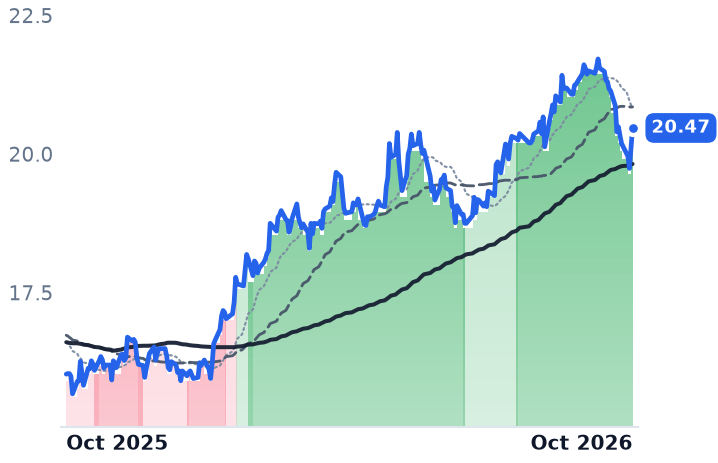
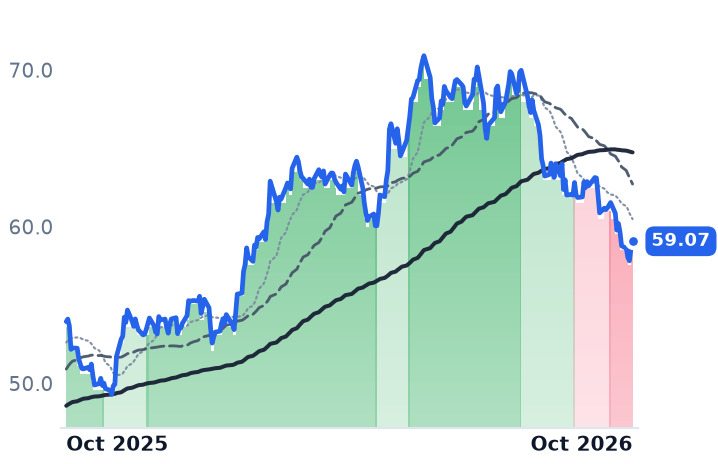
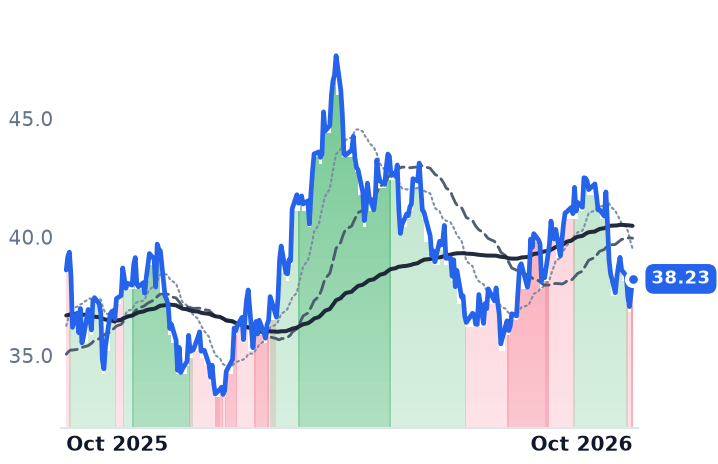
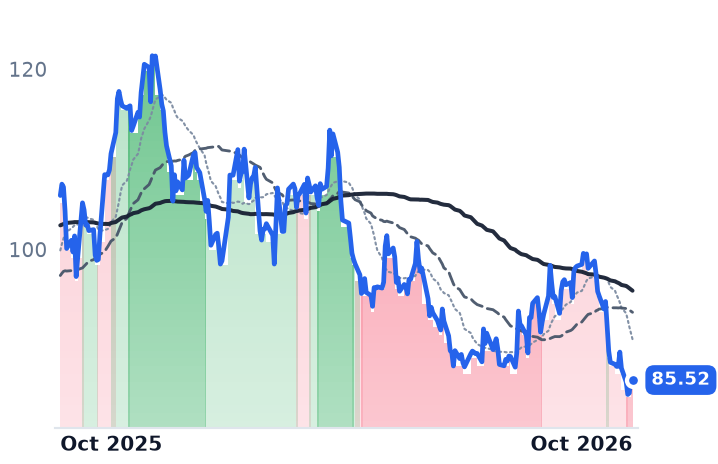
WMB | The Williams Companies | Natural Gas Pipelines & Transmission | 🟢 Cont. Bull | −6.0% | +12.7% |
KMI | Kinder Morgan | Natural Gas Pipelines & Transmission | ⚠️ Emerging Bear | −2.4% | +13.6% |
DTM | DT Midstream | Natural Gas Pipelines & Transmission | ⚠️ Emerging Bear | −7.3% | +7.1% |
| Compared against · context, not the story | |||||
EQT | EQT | Appalachian Shale Gas | 🔴 Cont. Bear | −9.5% | −11.8% |
ET | Energy Transfer | Natural Gas Pipelines & Transmission | 🟢 Cont. Bull | −4.6% | +27.7% |
TRP | TC Energy | Natural Gas Pipelines & Transmission | ⚠️ Emerging Bear | −6.4% | +9.5% |
RRC | Range Resources | Appalachian Shale Gas | ⚠️ Emerging Bear | −9.5% | −1.0% |
EXE | Expand Energy | Appalachian Shale Gas | 🔴 Cont. Bear | −13.4% | −19.3% |
12-month price & trend
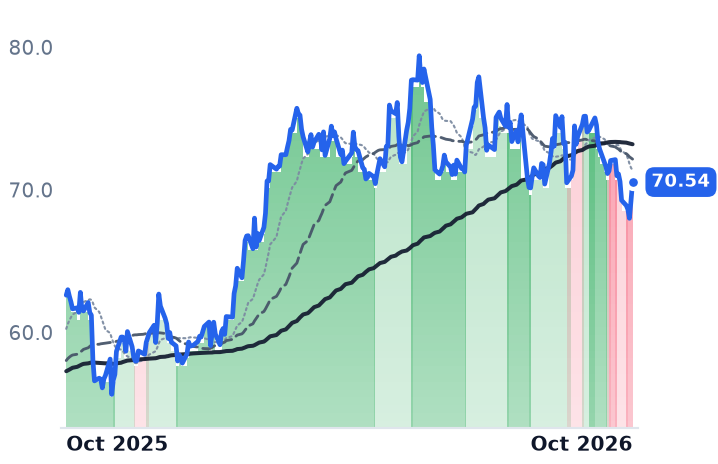
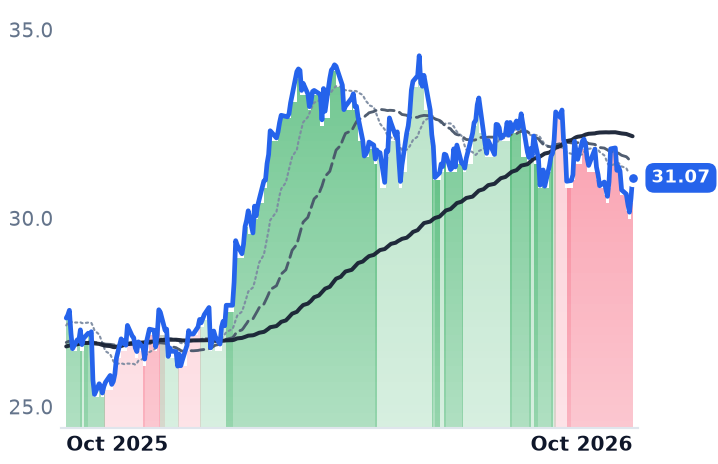
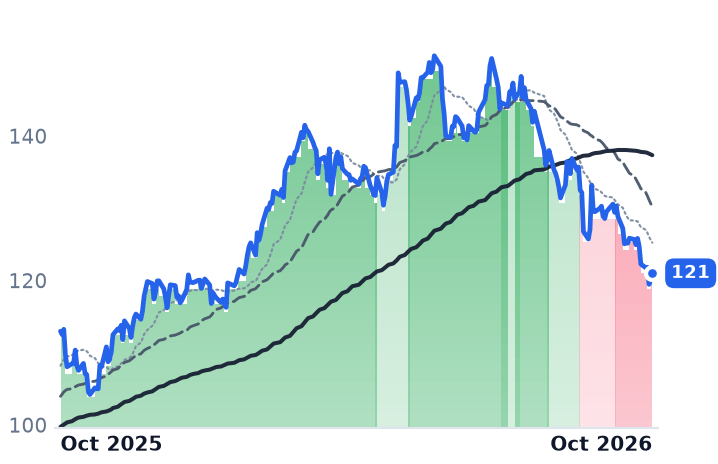
| Ticker | Mkt cap | P/E | P/E fwd | P/S | P/S fwd | P/GP | P/GP fwd | EV/EBITDA | FCF yld |
|---|---|---|---|---|---|---|---|---|---|
WMB | $86.3B | 28.0x | 28.7x | 7.1x | 7.0x | 9.6x | 9.5x | 15.7x | -0.2% |
KMI | $69.2B | 19.9x | 20.2x | 3.9x | 3.8x | 7.0x | 6.9x | 12.6x | 5.6% |
DTM | $12.3B | 26.3x | 25.6x | 9.4x | 9.2x | 14.9x | 14.5x | 14.3x | 3.9% |
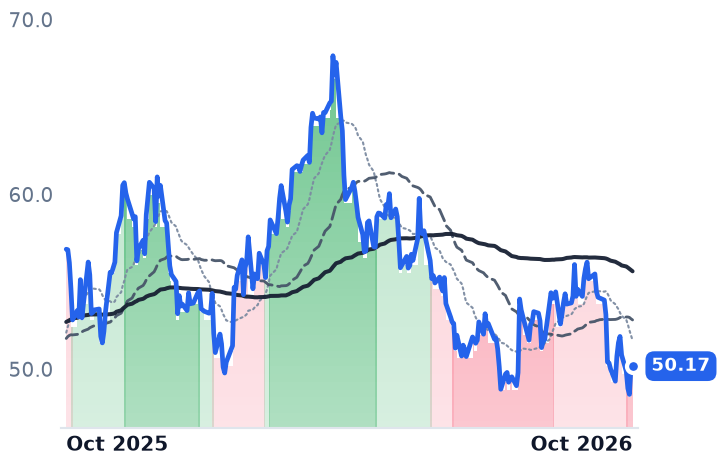
| Ticker | Mkt cap | P/E | P/E fwd | P/S | P/S fwd | P/GP | P/GP fwd | EV/EBITDA | FCF yld |
|---|---|---|---|---|---|---|---|---|---|
EQT | $31.4B | 11.0x | 12.4x | 3.4x | 3.4x | 4.9x | 5.0x | 6.0x | 12.0% |
ET | $72.1B | 13.0x | 13.4x | 0.7x | 0.7x | 2.9x | 2.7x | 9.7x | 7.2% |
TRP | $66.2B | 26.6x | 16.9x | 5.8x | 4.1x | 11.2x | 8.0x | 13.8x | 4.4% |
| Ticker | Mkt cap | P/E | P/E fwd | P/S | P/S fwd | P/GP | P/GP fwd | EV/EBITDA | FCF yld |
|---|---|---|---|---|---|---|---|---|---|
RRC | $8.9B | 10.5x | 9.3x | 2.7x | 2.5x | 5.6x | 5.3x | 7.0x | 13.1% |
EXE | $19.4B | 7.2x | 9.8x | 1.5x | 1.5x | 2.3x | 2.3x | 3.4x | 13.1% |
Consensus projections
| Ticker | FY2026E | FY2027E | FY2028E | |
|---|---|---|---|---|
WMB | Revenue | +8.4% | +14.4% | +15.5% |
| EPS | +15.7% | +6.3% | +16.8% | |
KMI | Revenue | +8.6% | +1.6% | +5.1% |
| EPS | +19.8% | −0.0% | +9.0% | |
DTM | Revenue | +7.9% | +4.6% | +9.9% |
| EPS | +7.7% | +6.0% | +11.9% | |
EQT | Revenue | +9.9% | −0.8% | +11.9% |
| EPS | +37.2% | −5.4% | +40.3% | |
ET | Revenue | +35.3% | +1.9% | +4.9% |
| EPS | +16.7% | +3.6% | +7.4% | |
TRP | Revenue | +6.7% | +4.4% | +5.3% |
| EPS | +7.3% | +5.4% | +6.2% | |
RRC | Revenue | +17.9% | +2.5% | +8.0% |
| EPS | +41.2% | −4.0% | +20.2% | |
EXE | Revenue | +14.7% | −4.1% | +6.9% |
| EPS | +43.3% | −1.6% | +24.1% |
Forward fiscal years only. Blank means no analyst coverage for that year.
Williams Companies, which owns the Transco trunk line carrying gas from the Gulf Coast to the eastern seaboard, completed its roughly $5.5bn purchase of Momentum Midstream on 3 September, adding more than 4,000 miles of gathering pipe, 6 billion cubic feet a day of Haynesville gathering capacity and three take-or-pay pipelines. The growth project the deal was built around, a $1.5bn Transco-corridor expansion called Delta Access with 2.25 Bcf/d of initial capacity, is expected online in the first quarter of 2029.
Pipelines have been owned as the direct claim on gas demand from data centers and liquefied natural gas export terminals, and the reported numbers support that claim: Williams' June-quarter operating income rose 33.3%. What changed in September was the price of waiting for the rest. Capital leaves the building in 2026 and the revenue arrives from 2027 onward, discounted at a long bond that kept making new highs in the meantime. The 30-year Treasury yield climbed to 5.61% by 1 October, its highest since 2002; Williams' $2.10 annual dividend pays 3.0% at the current share price.
What the $16bn backlog is dated for
Williams' expansion book runs to roughly $16bn representing 14 Bcf/d. Southeast Supply Enhancement, at 1,597 million cubic feet a day, is scheduled for the third quarter of 2027; Northeast Supply Enhancement, at 400 MMcf/d, for the fourth quarter of 2027; Power Express, at 750 MMcf/d, for the third quarter of 2030. The last large piece to actually enter service was Louisiana Energy Gateway, 1.8 Bcf/d, in July 2025.
The pattern repeats at Kinder Morgan, which moves gas across roughly 83,000 miles of pipeline. Its sanctioned backlog stood at $9.6bn at the end of the June quarter, falling $500m only because more than $650m of projects started up; the remaining $8.5bn is expected to earn back its cost at about 5.6 times first-full-year project cash earnings. The $1.7bn Mississippi Crossing line, 208 miles carrying up to 2.1 Bcf/d into Alabama, completed federal permitting on 8 September with service as early as the second quarter of 2028.
Not a dollar of either book shows up in this year's revenue line.
The best quarter carries the thinnest cash flow
Williams reported the strongest June quarter of the three: revenue up 10.2% to $3.053bn, operating income up 33.3% to $1.182bn, and an operating margin of 38.7% against 32.0% a year earlier. It is also the only one of the three outspending its own cash, at 15.7x trailing EV/EBITDA against DT Midstream's 14.3x, with a trailing free-cash-flow yield of minus 0.25%. On earnings it has already come down, to 28.0x trailing from 34.1x in early May, with the market value barely lower.
Kinder Morgan is the mirror. Its operating income grew faster than revenue in three of the last four quarters, up 17.8% in the June quarter on 10.8% revenue growth, with margin widening to 30.1% from 28.3%. It trades at 12.6x EV/EBITDA, the cheapest of the three, and carries a 5.6% trailing free-cash-flow yield, the highest; its trailing earnings multiple is 19.9x against 21.7x in May.
DT Midstream's de-rating is the one its own results explain. Revenue growth halved from 27.3% in the December quarter to 11.0% in June, operating-income growth fell from 38.1% to 11.6%, and consensus has revenue up 4.6% in 2027 before step-ups of 19.1% in 2029 and 30.7% in 2030, the cash-flow shape a rising long bond punishes hardest. At 26.3x trailing earnings it has fallen from 32.5x in May, and its forward multiple of 25.6x prices almost no expansion. Jefferies cut its target to $145 from $155, Scotiabank to $168 from $176 and Mizuho to $147 from $153, all without downgrading.
Why the drillers' bad quarter stays upstream
The gas price has been punishing. Henry Hub settled at $3.03 per million British thermal units on 30 September after two months under $3, with US dry gas output setting a daily record on 17 September and the Energy Information Administration expecting a record 3,985 Bcf in storage at end-October; summer prices averaged 6% below last summer's. EQT, which drills Appalachian gas, reported June-quarter revenue down 29.2% to $1.81bn and an operating margin of 25.1% against 44.3%.
Almost none of that reaches the pipelines. About 92% of DT Midstream's 2025 Pipeline revenue came from firm service contracts, structured as fixed demand charges or minimum volume commitments that pay regardless of what flows. At Kinder Morgan the volume-exposed leg grew: gathering volumes rose 26% year over year, led by a 54% increase in the Haynesville, and management said its largest customers are hedged, leaving most of those volumes price-insensitive. DT Midstream's chief executive, David Slater, told investors on 30 July that "our entire asset footprint is kind of lit up like a Christmas tree right now, and we've never seen that before while we've owned these assets."
The price action separates on the same line. Over the 30 days to 2 October the five large pipeline names fell about 5% on average, Williams 6.2% and Kinder Morgan least at 2.8%, while Expand Energy fell 13.9%, EQT 10.0% and Range Resources 10.0%. Twelve-month returns for the pipelines remain positive, Williams up 11.8%; DT Midstream is the weakest over three months at minus 16.3%.
So the two legs fell together for unrelated reasons, and they do not trade on the same plane: EQT changes hands at 6.0x EV/EBITDA with a 12.0% free-cash-flow yield. For the drillers the cause is the commodity. For the pipelines the likelier reading is the discount rate, since their reported results got better and what reprices when the long bond makes new highs is contracted cash that has not started arriving. On that reading DT Midstream's fall is the one the business earned, through halved growth; Williams' premium rests on in-service dates in 2027, 2029 and 2030; and Kinder Morgan's decline is the one its accounts contradict.
The demand behind those projects is not in question. Permits are issued, capacity is subscribed, the pipe is being laid. What the last month repriced is what a dollar arriving in 2029 is worth to a buyer who can collect more from a long Treasury bond in the meantime than the pipeline pays him to wait.