

Governments and Apple, Not Phone Users, Pay for Direct-to-Device Satellite Service Today
Hypothesis Opus 5 · Research Opus 5 · Writing Opus 5 · Prompt v1.7
Satellite-to-smartphone service is sold as a subscriber story, yet neither listed pure play collects a dollar from a phone user. AST SpaceMobile's June-quarter revenue of $31.5m came from gateway hardware and US government contract work, and gross margin fell to 25.2% from 100% a year earlier as the line began carrying costs. The company has roughly 12 satellites in orbit against the 45 to 60 it says continuous US, European and Japanese coverage requires, and owes at least $80m a year for leased L-band spectrum whether or not anything launches.
Globalstar does get paid at scale for satellite-to-phone work: Apple is 63% of revenue, $869m of mostly Apple prepayments sit on the balance sheet, and $550m of capex is largely reimbursable. Service revenue fell 5% on the timing of those reimbursements. Amazon's $90-a-share merger agreement, signed in April, now sets the share price.
| Ticker | Company | Segment | Trend · 13mo | 30D | 1Y |
|---|---|---|---|---|---|
| The subject · what this brief is about | |||||
ASTS | AST SpaceMobile | Satellite & Broadband Services | 🔴 Cont. Bear | −11.9% | −20.0% |
GSAT | Globalstar | Specialty & Small Carriers | 🟢 Cont. Bull | +1.6% | +86.9% |
| Compared against · context, not the story | |||||
AMZN | Amazon.com | Online Marketplaces | 🟢 Cont. Bull | −1.4% | +14.8% |
12-month price & trend
| Ticker | Mkt cap | P/E | P/E fwd | P/S | P/S fwd | P/GP | P/GP fwd | EV/EBITDA | FCF yld |
|---|---|---|---|---|---|---|---|---|---|
ASTS | $23.7B | n/m | — | 205.7x | 147.8x | — | — | n/m | -6.9% |
GSAT | $10.8B | n/m | — | 38.3x | 37.7x | 78.0x | 76.6x | 172.7x | 1.7% |
AMZN | $2.9T | 21.2x | 21.1x | 3.7x | 3.5x | 7.3x | 6.8x | 11.9x | -0.4% |
Consensus projections
| Ticker | FY2026E | FY2027E | FY2028E | |
|---|---|---|---|---|
ASTS | Revenue | +174.7% | +344.1% | +146.7% |
| EPS | +98.2% | −45.8% | −119.7% | |
GSAT | Revenue | +4.9% | +21.3% | +48.7% |
| EPS | −1748.3% | −83.3% | −399.0% | |
AMZN | Revenue | +15.9% | +14.6% | +16.0% |
| EPS | +76.8% | −16.1% | +30.8% |
Forward fiscal years only. Blank means no analyst coverage for that year.
AST SpaceMobile, which builds phased-array satellites designed to talk straight to ordinary unmodified handsets, booked $31.5m of revenue in the June quarter against $1.2m a year earlier. It kept about a quarter of that as gross profit, because what it sold was gateway hardware and work on US government contracts: three new awards with funded near-term value above $100m, on top of more than $125m of cumulative government funding.
The jump in the revenue line has been read as the moment direct-to-device connectivity — satellite service to handsets nobody has to modify, sold through mobile carriers — began earning money. The margin says something narrower. Gross margin was 100% in the June quarter of 2025 and 25.2% this year, the signature of a line that has started carrying the cost of goods it ships. Commercial service revenue is expected to ramp in 2027.
Twelve satellites against forty-five
The company's own meter is the constellation. AST says continuous service across the United States, Europe and Japan takes roughly 45 to 60 satellites, and about 90 for continuous global coverage. As of October it has around twelve in orbit: five Block 1 units from September 2024, one deployed in February, three launched in June and three in August. Another was placed in a lower orbit than planned on 19 April and de-orbited, costing the June quarter a $125.9m loss on involuntary conversion. Initial US service with AT&T and Verizon will be non-continuous.
The demand side is contracted. Definitive agreements run with AT&T through 2030, Vodafone through 2034 and Verizon for coverage starting in 2026, inside partnerships with more than 60 operators, and the Federal Communications Commission authorized up to 248 satellites in April. Backlog is about $1.30bn, and full-year revenue guidance of $150m to $200m was held.
The spectrum bill that does not wait for a launch
One obligation runs whether or not anything flies. Under agreements signed on 22 March 2025, AST's spectrum vehicle owes at least $80m a year for 80-plus-year rights to up to 40 MHz of Ligado's L-band in the US and Canada, plus 5 MHz at 1670–1675 MHz, with roughly $550m more due at closing. Ligado filed for Chapter 11 in January 2025, the same month the deal was struck.
Capital spending was about $610m in the June quarter against $257m in the March quarter, roughly 19 dollars of capex for every dollar of revenue. Funding it has cost ownership: diluted shares rose 23.6% year over year to 299.1m, and July brought $1.15bn of 1.625% convertible notes, leaving pro forma cash above $3.7bn.
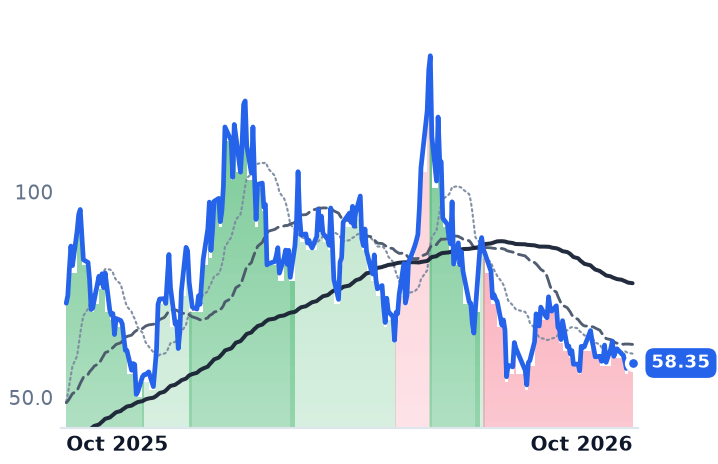
The shares sit 56.2% below the $133.09 close of 28 May and are down 27.6% over three months. The sharpest day of the year was 16 July, a 17% fall the day after a $1bn convertible offering was announced. B. Riley's Mike Crawford cut the stock to Neutral with a $65 target from $85. At 205.7x trailing sales against 387x in early May, the de-rating arrived while revenue grew.
"With the largest phased arrays ever deployed in low Earth orbit… we believe we are uniquely positioned to deliver scalable direct-to-device connectivity for both commercial and government customers around the world," chairman and chief executive Abel Avellan said on 10 August.
Globalstar's dollar is a reimbursement and its price is a contract
Globalstar, which runs a 24-satellite low-earth-orbit fleet plus SPOT trackers and commercial internet-of-things airtime, is the one listed operator already paid at scale for satellite-to-phone work. Apple was 63% of revenue in the June quarter, deferred revenue stood at $869m of largely Apple prepayments, and $550m of capex is largely reimbursable under the services agreements. Service revenue fell 5% on the timing of reimbursement service fees while commercial internet-of-things activations hit a record: the pass-through is what moved the line.
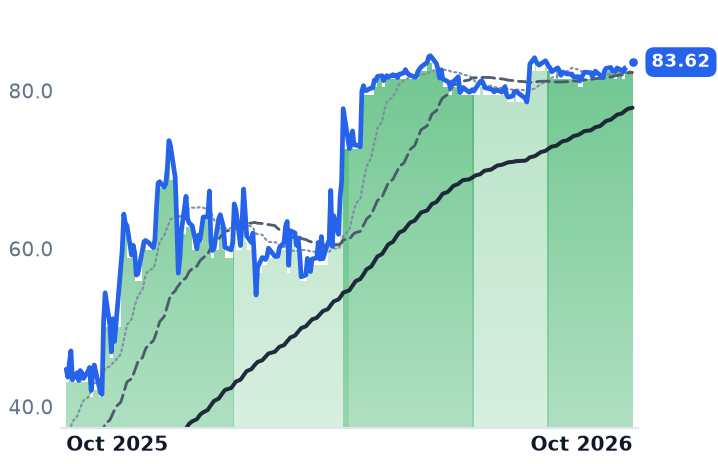
None of that sets the price. Since 13 April, Globalstar has been under a definitive merger agreement with Amazon at $90 a share in cash or 0.3210 Amazon shares capped at $90, about $11.57bn, with holders of some 58% of voting power already consenting and closing expected in 2027. Consideration can fall by up to $110m if operational milestones are missed. Closes have stayed inside a $78.57–$84.43 range for five months, and the 5 October close of $83.62 is 7.6% under the cash terms. The company has said it does not intend to hold further earnings calls or update guidance.
So a twelve-month gain of 98.5% in Globalstar rests on a contract while operating income went from $6.15m to -$4.78m, and AST's three-month decline came with revenue up and guidance intact. The split is funding, not demand. AST buys satellites, spectrum and launches years before any airtime bill arrives, and each raise reprices the equity; Globalstar's buyer has fixed what its shares are worth, and the customer behind 63% of its revenue is migrating iPhone Emergency SOS to Amazon Leo as part of the same arrangement.
The live competitor is further along than either and sells less than both plan to. SpaceX has launched more than 650 direct-to-cell satellites and T-Mobile's T-Satellite went commercial in July 2025 as a $10-a-month add-on, but voice service remains in testing through 2026, and Amazon's own direct-to-device service is not due to start until 2028.
For now the whole category's revenue comes from three places: a defense budget, an iPhone maker's prepayment and a capex invoice sent back to the customer. The first phone bill is still ahead of all of it.