

Medicare Prior Authorization, Not Weight-Loss Drugs, Shrank Inspire Medical's Revenue
Hypothesis Opus 5 · Research Opus 5 · Writing Opus 5 · Prompt v1.7
A sleep-apnea implant earns nothing until a payer approves it, and since the start of this year that approval has run through an artificial-intelligence screen in six states. Inspire Medical quantified the resulting delays at roughly $40m in its June quarter and $120–130m for the year, against a revenue plan originally set at $1,003–1,013m.
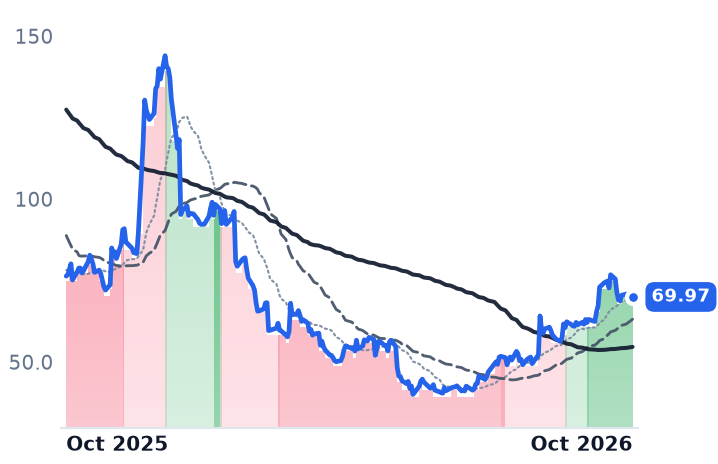
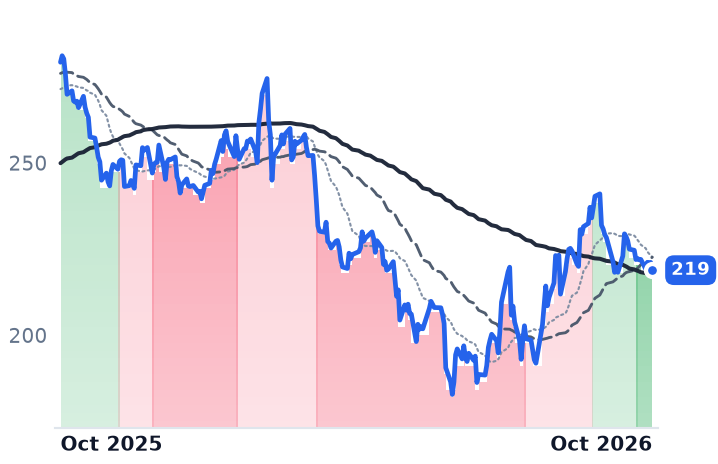
The structural-decline story told about weight-loss drugs was pinned on the wrong gatekeeper. Inspire's management calls those drugs only a modest contributor; its US revenue fell 9.6% in the quarter while international revenue rose 33.6%. ResMed, which earns the other kind of sleep dollar — a flow generator followed by mask and tubing resupply — reports that among 2.5m patients holding both prescriptions, drug holders are about 11% more likely to start airway-pressure therapy. Inspire's shares are up 49% in three months on a shrinking year; ResMed's are down 20.9% over twelve months on 9.9% revenue growth.
| Ticker | Company | Segment | Trend · 13mo | 30D | 1Y |
|---|---|---|---|---|---|
INSP | Inspire Medical Systems | Sleep & Respiratory Care | 🌱 Emerging Bull | +12.1% | −8.4% |
RMD | ResMed | Sleep & Respiratory Care | 🌱 Emerging Bull | −1.1% | −21.6% |
12-month price & trend
| Ticker | Mkt cap | P/E | P/E fwd | P/S | P/S fwd | P/GP | P/GP fwd | EV/EBITDA | FCF yld |
|---|---|---|---|---|---|---|---|---|---|
INSP | $2.0B | 15.0x | 58.6x | 2.3x | 2.4x | 2.6x | 2.8x | 23.2x | 5.8% |
RMD | $31.8B | 21.0x | 18.1x | 5.6x | 5.5x | 9.2x | 8.9x | 14.5x | 9.1% |
Consensus projections
| Ticker | FY2026E | FY2027E | FY2028E | |
|---|---|---|---|---|
INSP | Revenue | −6.0% | +3.9% | +6.5% |
| EPS | −29.0% | +23.2% | +32.0% | |
RMD | Revenue | +10.2% | +2.9% | +6.4% |
| EPS | +17.0% | +8.7% | +9.9% |
Forward fiscal years only. Blank means no analyst coverage for that year.
Before a sleep-apnea implant generates a dollar, somebody has to authorize it. Since the first of January, in six states, that somebody is a Medicare contractor running an artificial-intelligence screen, and Inspire Medical, whose entire revenue line is one implanted nerve stimulator for moderate-to-severe obstructive sleep apnea, told investors the delays cost it roughly $40m in the June quarter and $120–130m across 2026.
The market has spent two years attributing that kind of shortfall to Eli Lilly. Since tirzepatide, sold as Zepbound, won an obstructive sleep apnea indication in 2024, the read on sleep device companies has been structural decline: a pill replaces a machine. Inspire's own management calls weight-loss drugs only a modest contributor to near-term pressure and names reimbursement disruption as the driver of its guidance revision. The gatekeeper that changed this year works for the Centers for Medicare & Medicaid Services.
Six states, one procedure, and a two-digit modifier
CMS launched its Wasteful and Inappropriate Service Reduction model on 1 January 2026, applying machine-assisted prior authorization inside Original Medicare to a short list of services in Arizona, New Jersey, Ohio, Oklahoma, Texas and Washington through the end of 2031. Hypoglossal nerve stimulation, Inspire's procedure, was the only ear, nose and throat procedure included, which the specialty society attributes to how fast its utilization had been growing. Records obtained in a transparency lawsuit brought by the Electronic Frontier Foundation show initial approval in Texas running at 62%, rising to 84% after human review, against 92% nationally in Medicare Advantage.
A second piece of plumbing hits the surgeon instead of the hospital. Because the newer Inspire V device performs fewer services than its predecessor, two Medicare Administrative Contractors now require a "reduced services" modifier on the professional fee, cutting as much as 30% off a national average payment of $723.
Most contractors do not require it. Inspire's response has been to coach surgeons on their documentation.
The damage is domestic and nowhere else. June-quarter revenue of $200.6m fell 7.6%, with US revenue down 9.6% and international revenue up 33.6%. Initial 2026 guidance of $1,003–1,013m was cut to $825–875m in January and nudged to $835–875m in August. Gross margin did rise 150 basis points to 85.5% on Inspire V mix, but that generation was still in limited release, with 101 patients implanted at 11 US centers. First-half operating income was a loss of about $1.6m, after $51m for all of 2025.
"Our second quarter results reflect the increased discipline and focus we are bringing to the business as we continue to support customers through the evolving coding and reimbursement environment," chief executive Tim Herbert said on 3 August. The restructuring announced alongside it, Project Horizon, carries $20–25m of charges to free roughly $30m of annual investment capacity.
The dollar that needs no second signature
ResMed sells into the same disease on opposite terms: a flow generator through home medical equipment dealers, then masks, cushions and headgear that reorder without a fresh authorization each time. In the June quarter, Americas masks and accessories grew 10% against 8% for sleep devices.
It is also the only one of the two to have measured the drug question. Tracking 2.5m de-identified patients holding both a positive-airway-pressure prescription and a weight-loss prescription, ResMed reports that at 90 days after diagnosis more than 40% of patients have started airway-pressure therapy against under 3% starting a drug, and that dual-prescription patients are roughly 11% more likely to begin therapy and more than 6% more likely to log a resupply event at three years. Chief executive Mick Farrell's summary: "there is no downside of someone having a GLP-1 prescription."
The queue is priced as temporary
ResMed's fiscal 2026 revenue of $5.65bn grew 9.9%, with gross margin up 180 basis points to 61.2% and operating income up 12.3%. The shares are down 20.9% over twelve months at 18.1x forward earnings against 21.0x trailing, carrying two self-inflicted drags on next year: no new Astral ventilator sales in fiscal 2027, a $75m headwind, and the $490m sale of the MatrixCare software business, which contributed about $220m of revenue.
Inspire is the reverse arrangement. Its shares closed at $69.97 on 2 October, up 49% in three months and 75% off their May low, still around half the December 2025 peak, with much of the autumn advance owing to broker target increases: Stifel to $80 on 11 September, RBC Capital to $75 later that month. Consensus has revenue falling 6.0% this year and earnings per share falling 29%, which is how a stock reaches 58.6x forward earnings. Trailing price-to-sales of 2.25x, against roughly 4.5x at the December peak, is the one anchor that still reads cheap.
The two businesses split on who holds the meter. ResMed's revenue per patient compounds through resupply with nobody standing between the reorder and the dollar, and its own tracking data say the diagnostic funnel is widening rather than draining, so its de-rating looks like the market marking down portfolio surgery it can already see in the guide. Inspire's revenue passes through an authorization queue and a surgeon's fee schedule it does not set, and its recovery is being priced on management's stated view that the disruption is temporary and growth resumes in 2027. The reported numbers do not settle that: a sixth of the annual plan is sitting in other people's inboxes.
That queue may not survive its own paperwork. The model faces potential repeal following a Government Accountability Office determination, which would hand Inspire back the largest identified drag on its year without the company selling a single additional device. The biggest variable in a single-product implant company's 2026 belongs to people who have never handled the product.