

Upstart Grew Revenue 42% and Lined Up $7.45bn of Loan Buyers as Its Shares Fell 57%
Hypothesis Opus 5 · Research Opus 5 · Writing Opus 5 · Prompt v1.6
Three consumer lenders fell together in late September, and not one of the drops was about credit. The Federal Reserve raised rates a quarter point on 16 September, its first increase since July 2023, and the ten-year Treasury followed to about 5.2% — while the market that buys these lenders' loans got busier and cheaper, with top-rated three-year prime auto paper pricing at 37 basis points over benchmarks, tighter than a month before.
Upstart sells the loans its models approve and grew revenue 42.3% last quarter. Affirm keeps $9.56bn of loans on its own books against funding debt it doubled to $3.3bn, so a higher base rate is a real and new cost there. Nu Holdings' fall traces to a reported £8bn-£10bn approach for Monzo, roughly $11bn-$13bn.
The base rate earns part of Affirm's de-rating. Upstart's does not follow from anything in its own numbers.
| Ticker | Company | Segment | Trend · 13mo | 30D | 1Y |
|---|---|---|---|---|---|
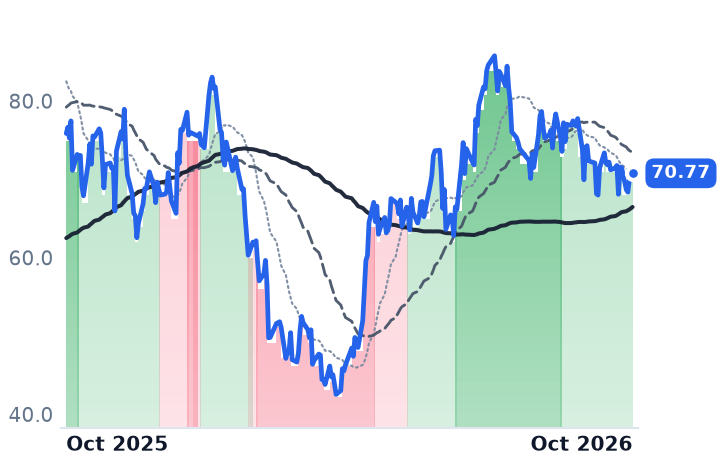
AFRM | Affirm | Consumer Fintech & Lending | 🟢 Cont. Bull | −2.2% | −6.7% |
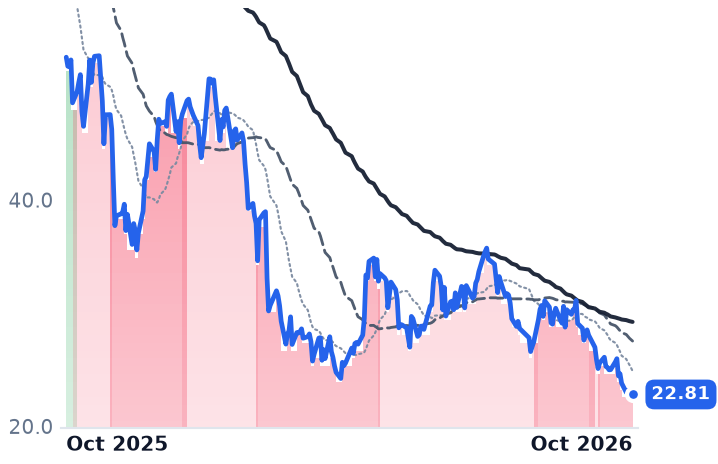
UPST | Upstart | Digital Payments & Fintech Platforms | 🔴 Cont. Bear | −18.7% | −56.6% |
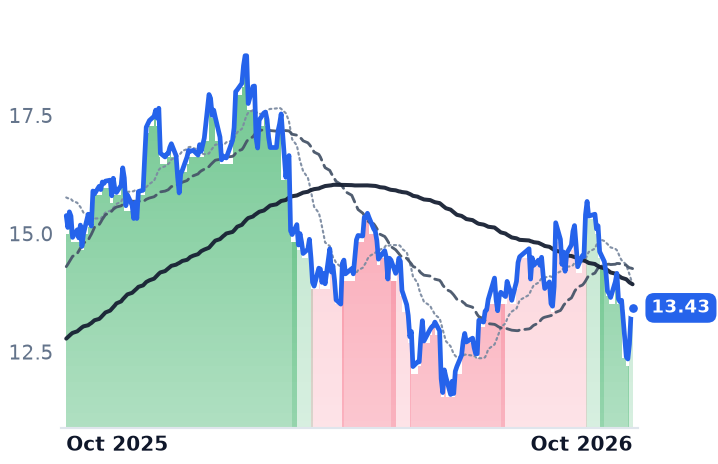
NU | Nu | Emerging Markets & Specialized Banking | ⚠️ Emerging Bear | −12.6% | −12.7% |
12-month price & trend
| Ticker | Mkt cap | P/E | P/E fwd | P/S | P/S fwd | P/GP | P/GP fwd | EV/EBITDA | FCF yld |
|---|---|---|---|---|---|---|---|---|---|
AFRM | $23.7B | 12.4x | 35.6x | 5.7x | 4.3x | 8.3x | 6.3x | 24.9x | 4.2% |
UPST | $2.2B | 36.7x | 33.7x | 1.7x | 1.5x | 1.8x | 1.6x | 43.0x | -13.6% |
NU | $65.0B | 18.1x | 15.4x | 3.4x | 2.8x | 7.6x | 6.5x | 19.5x | -6.5% |
Consensus projections
| Ticker | FY2026E | FY2027E | FY2028E | |
|---|---|---|---|---|
AFRM | Revenue | +32.0% | +30.6% | +24.7% |
| EPS | +2220.4% | +60.1% | +45.7% | |
UPST | Revenue | +37.1% | +30.9% | +27.6% |
| EPS | −59.4% | +185.3% | +82.0% | |
NU | Revenue | +63.1% | +23.0% | +24.5% |
| EPS | +43.1% | +28.7% | +29.2% |
Forward fiscal years only. Blank means no analyst coverage for that year.
Upstart Holdings, which runs an artificial-intelligence underwriting platform for banks and credit unions and holds no bank charter of its own, spent this year lining up people to buy the loans its models approve. It has announced roughly $7.45bn of forward purchase commitments during 2026 — up to $4bn from Castlelake alone, plus Fortress, Centerbridge and a joint Eltura Ventures and Aperture Investors facility — and in late September priced a $400m consumer-loan securitization, its 52nd. Its shares are down 56.9% over twelve months and 19.0% in September alone.
For any lender that does not take deposits, the business question is whether somebody will buy the loan and at what price. Through the third quarter the answer improved. About $255bn of consumer asset-backed paper had priced, roughly 16% ahead of 2025 at the same point, and spreads on top-rated three-year prime auto bonds stood at 37 basis points over benchmarks on 24 September, three tighter than a month earlier. Truist Securities expects issuance up another 10% next year because issuers can borrow on better terms.
What moved was the rate underneath all of it. The Federal Reserve raised its target range to 3.75%-4.00% on 16 September, its first hike since July 2023, and the ten-year Treasury rose to about 5.2% by the end of the month, roughly 45 basis points above where it sat in mid-September. On 23 September Upstart and Affirm each fell 4% while the broader financials group barely moved, with no company news at either. Affirm in fact spent that session launching instalment payments at Amazon's UK checkout — interest-free over three payments above £50, or up to 48 months at a 22% representative rate.
Who holds the paper
The base rate bites unequally. Affirm Holdings, whose button at checkout splits purchases over one to 48 months and which bills merchants for the service, chose to carry the risk: $9.56bn of loans held for investment at 30 June against $7.03bn a year earlier, funding debt doubled to $3.3bn, an average cost of funds near 5.8%. Revenue less transaction costs — the company's own gross-profit line — ran 4.2% of volume, and on the 27 August call it guided fiscal 2027 to 4.16%, crediting favorable debt capital markets. Thirty-day delinquencies on monthly instalment loans improved to 2.5%. "We are in control of the credit reality. You would see us slow down growth before you would see us have a real credit disturbance," founder and chief executive Max Levchin told investors that day.
The business behind it is not the problem. Affirm's fiscal 2026 operating income was $870.9m against a loss of $87.3m the year before; the June quarter's operating margin reached 24.3% versus 6.6%. The honest caveat is the top line: year-over-year growth slid from 33.6% to 24.3% across the four quarters, while consensus still carries fiscal 2027 revenue 30.6% above the prior year's estimate. Affirm trades at 6.34x forward gross profit against 8.31x trailing and roughly 9.6x trailing in mid-August; its trailing price-to-earnings ratio of 12.4x is meaningless, inflated by a deferred-tax valuation-allowance release of about $1.46bn.
Upstart's June quarter put revenue at $377.2m, up 42.3%, with operating income of $17.2m, more than tripled, and only $1.06bn of loans on its own books — 5.9% of outstandings. "We grew, our credit performed, and we expanded margins. We didn't have to trade one for another," chief executive Paul Gu said on the 4 August call. Its shares now fetch 1.61x forward gross profit, down from 2.55x a month earlier, and 2.76x book. Two things argue for caution anyway: the company's own macro index has been stuck at 1.50, implying defaults around half again what a normal economy would produce, and consensus modelled $1.671 of 2025 earnings per share against the $0.45 delivered.
The deposit-funded case
Nu Holdings, the Brazil-based digital bank with retail operations in Mexico and Colombia, pays for its loans with customer money: $45.3bn of deposits at 88% of interbank rates, three percentage points cheaper than a year earlier, with net interest margin up 180 basis points to 22.9%. Revenue grew 49.9% and net income 66.5% in the June quarter. Early-stage delinquencies improved 16 basis points to 4.8% while loans more than 90 days overdue rose 35 basis points to 6.9%, which the company tied to seasonal migration from the first quarter. Its drop has nothing to do with any of that: Sky News reported on 26 September that Monzo was in talks over a sale to Nubank at £8bn-£10bn, about $11bn-$13bn, and Nu shed roughly $6.6bn of market value on 28 September — a fall of about 9% to 10%, depending on the closing price used — on a day the broad American market slipped under 1%. It trades at 15.4x forward earnings and 4.92x book on a business earning near 30% on equity.
So the September repricing divides cleanly. Affirm's is partly earned: it holds the paper, it borrowed to do so, and the coupon on that borrowing just went up — rational repricing of a changed input, and the reason its guided gross-profit margin is the number to watch rather than volume. Nu's discount prices an acquisition nobody has quantified. Upstart's is the one that follows from nothing in its own accounts; with buyers committing billions and spreads tightening, the likelier reading is that rate-sensitive consumer lenders were sold as a group.
Levchin's promise is that Affirm can slow growth before credit breaks. The cost it cannot slow is the interest on the $3.3bn it has already borrowed to keep the loans.