

Grupo Galicia Guided a 12% Return on Equity; Argentine Sovereign Debt Yields About 11.7%
Hypothesis Opus 5 · Research Opus 5 · Writing Opus 5 · Prompt v1.6
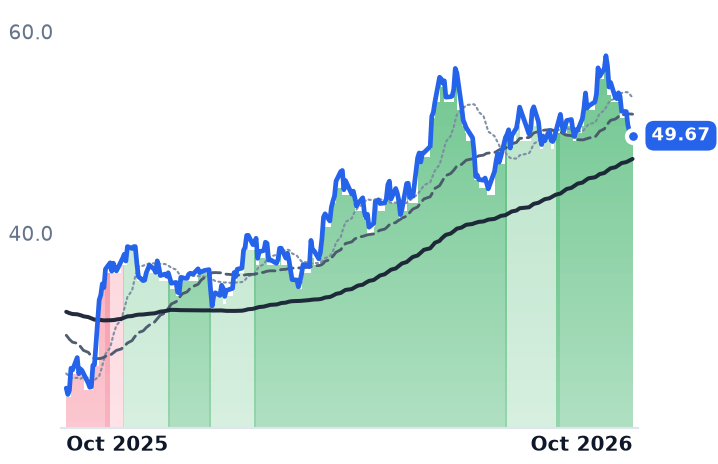
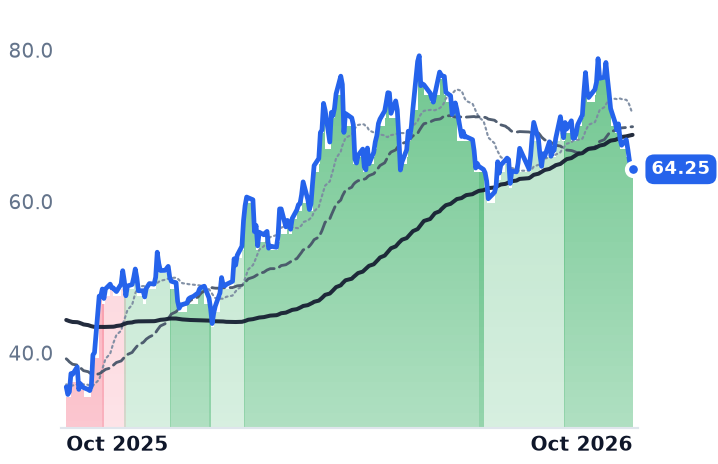
Argentina's four New York-listed banks all reported better June quarters, and all four have since fallen between 28% and 36% over three months. The quarters were earned the same way — deposit costs fell faster than asset yields, which widened Banco Macro's margin excluding currency effects to 23.5% — and that arithmetic ends once deposit rates hit their floor.
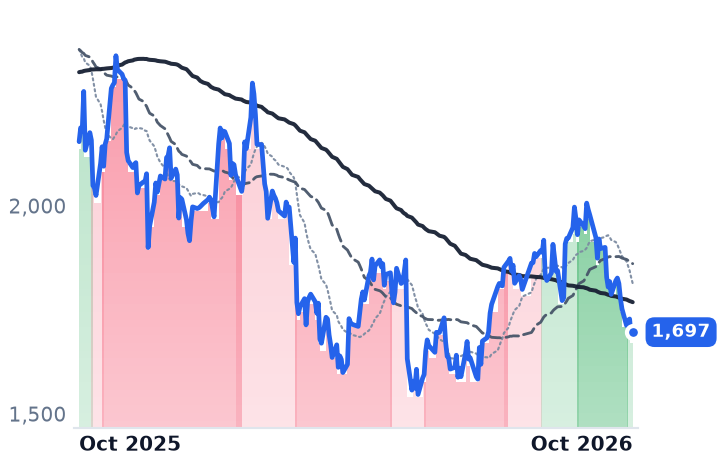
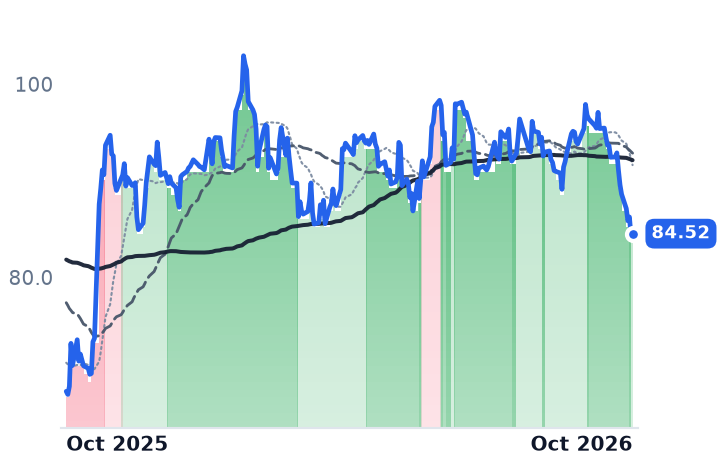
Every one of them also cut real loan-growth guidance, Macro to 2-5% from a prior 15-20%, while delinquency on household loans across the Argentine system reached 12.9% in July, the highest since 2004. But the slide tracks the price of Argentine sovereign risk, which added roughly 100 basis points in September to its high for the year. Galicia, Macro and BBVA Argentina now trade near book value; Supervielle, which has the cleanest credit book of the four, below it. The dollar earners, YPF and Vista, held.
| Ticker | Company | Segment | Trend · 13mo | 30D | 1Y |
|---|---|---|---|---|---|
| The subject · what this brief is about | |||||
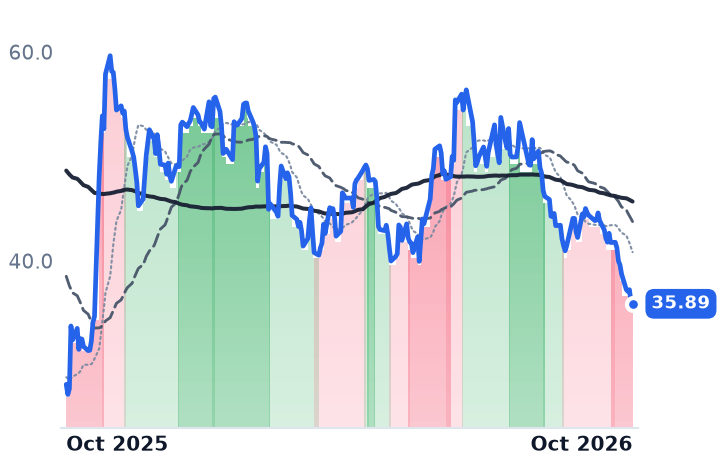
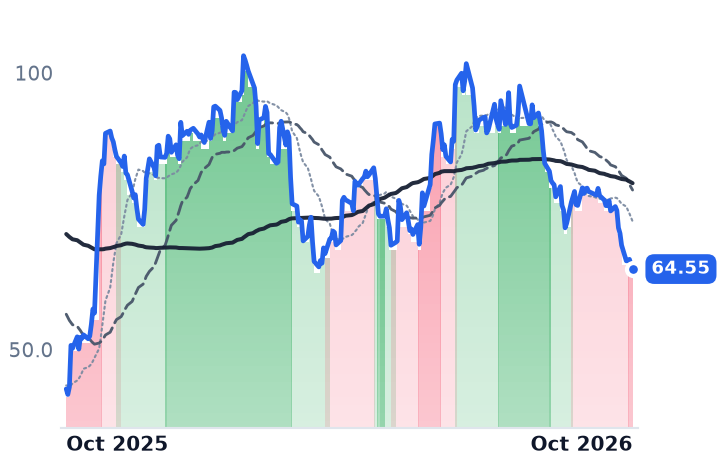
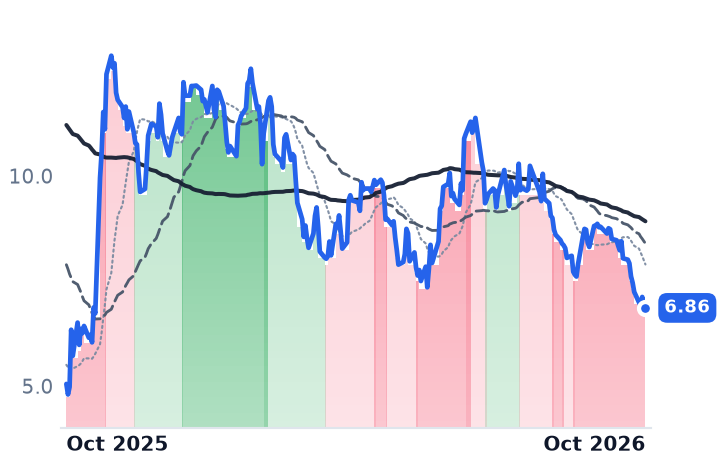
GGAL | Grupo Financiero Galicia | Latin America & Caribbean Banks | 🔴 Cont. Bear | −19.1% | +27.4% |
BMA | Banco Macro | Latin America & Caribbean Banks | ⚠️ Emerging Bear | −17.8% | +50.5% |
SUPV | Grupo Supervielle | Latin America & Caribbean Banks | 🔴 Cont. Bear | −22.0% | +35.8% |
| Compared against · context, not the story | |||||
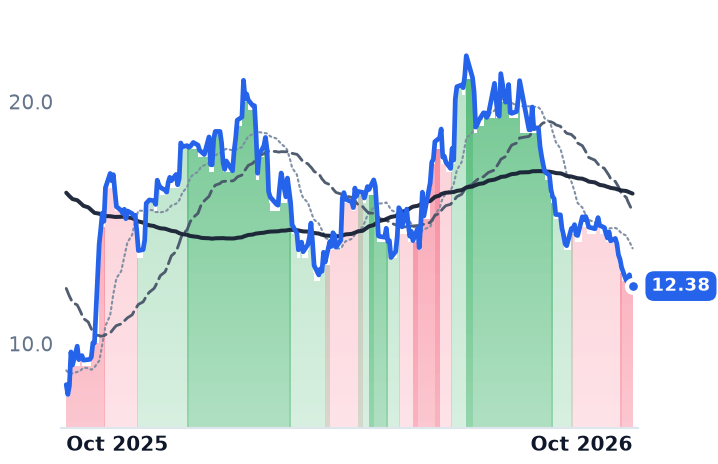
BBAR | Banco BBVA Argentina | Latin America & Caribbean Banks | 🔴 Cont. Bear | −16.5% | +49.0% |
YPF | YPF Sociedad Anónima | Upstream Exploration & Production | 🟢 Cont. Bull | −5.6% | +101.7% |
VIST | Vista Energy, S.A.B. de C.V | International & Offshore | 🟢 Cont. Bull | −12.9% | +80.9% |
MELI | MercadoLibre | Online Marketplaces | 🌱 Emerging Bull | −14.2% | −21.2% |
ARGT | Global X - MSCI Argentina ETF | Asset Management - Global | 🟢 Cont. Bull | −12.3% | +23.9% |
12-month price & trend
| Ticker | Mkt cap | P/E | P/E fwd | P/S | P/S fwd | P/GP | P/GP fwd | EV/EBITDA | FCF yld |
|---|---|---|---|---|---|---|---|---|---|
GGAL | $5.8B | 53.9x | — | 0.8x | — | 1.9x | — | 21.7x | -2.4% |
BMA | $4.1B | 15.8x | — | 1.0x | — | 1.7x | — | 6.5x | 34.5% |
SUPV | $600.6M | n/m | — | 0.5x | — | 1.2x | — | n/m | -110.9% |
| Ticker | Mkt cap | P/E | P/E fwd | P/S | P/S fwd | P/GP | P/GP fwd | EV/EBITDA | FCF yld |
|---|---|---|---|---|---|---|---|---|---|
BBAR | $2.5B | 14.1x | — | 0.7x | — | 1.6x | — | 4.4x | 239.7% |
YPF | $19.5B | n/m | — | 1.6x | — | 5.3x | — | 7.8x | 9.7% |
VIST | $6.7B | 8.1x | 7.3x | 2.0x | 1.6x | 4.1x | 3.3x | 4.5x | 4.0% |
| Ticker | Mkt cap | P/E | P/E fwd | P/S | P/S fwd | P/GP | P/GP fwd | EV/EBITDA | FCF yld |
|---|---|---|---|---|---|---|---|---|---|
MELI | $86.0B | 46.2x | 44.5x | 2.4x | 2.1x | 5.7x | 4.8x | 30.8x | 14.5% |
ARGT | $860.6M | — | — | — | — | — | — | — | — |
Consensus projections
| Ticker | FY2026E | FY2027E | FY2028E | |
|---|---|---|---|---|
GGAL | Revenue | +25.0% | +22.2% | +18.6% |
| EPS | +187.6% | +68.4% | +50.8% | |
BMA | Revenue | +40.3% | +17.3% | +17.9% |
| EPS | +133.3% | +44.5% | +33.1% | |
SUPV | Revenue | +35.3% | +27.2% | +21.8% |
| EPS | −369.1% | +116.0% | +38.6% | |
BBAR | Revenue | +40.9% | +24.3% | +20.3% |
| EPS | +169.1% | +42.4% | +44.9% | |
YPF | Revenue | +26.8% | −6.6% | +3.3% |
| EPS | +1603.6% | −14.4% | +17.8% | |
VIST | Revenue | +70.3% | +4.5% | +8.9% |
| EPS | +35.2% | +2.9% | +12.3% | |
MELI | Revenue | +45.3% | +28.3% | +24.6% |
| EPS | −5.7% | +44.2% | +38.5% |
Forward fiscal years only. Blank means no analyst coverage for that year.
Argentina's four New York-listed banks each reported a better June quarter than the one before it, and each has since lost close to a third of its market value. What changed between the results and October was the price of lending to their government.
JP Morgan's Argentina country-risk spread added almost 100 basis points over September, touching 655 basis points intraday on 2 October before closing at 646 — the highest reading of the year, and above the 600 level at which Argentina stays locked out of international debt markets. The cause starts in New York, where the 10-year Treasury yield touched 5.34%, its highest since 2002 in a global bond sell-off before retreating to 5.175%. For a lender holding roughly a quarter of its assets in Argentine government paper, that spread is simultaneously an asset yield and a cost of equity. It is the second of the two that re-rated.
How the quarter was earned
All four banks made the same trade in the June quarter: they let deposits reprice downward faster than loans and bonds did. At Banco Macro, a retail and corporate lender now shrinking its network to about 370 branches from 402, asset yields fell 280 basis points sequentially while funding costs fell 550, so net interest margin excluding currency effects widened 30 basis points to 23.5% and net income rose 36.8% from a year earlier. At Grupo Supervielle, the smallest of the group at a $601m market value, margin expanded 250 basis points to 20.3%, above its own full-year guidance, for the identical reason. Grupo Financiero Galicia — the holding company behind Banco Galicia and the Naranja X consumer-credit platform, and the largest of the four at $5.8bn — held its margin at 17.0%, helped by inflation-indexed bond yields and gains on securities sales. Its net interest income fell 3% sequentially; income from financial instruments rose 275% on derivatives and securities disposals.
That is carry income, and carry has a floor. Banco Macro's income from government securities fell 18% from the previous quarter. BBVA Argentina, the local subsidiary of Spain's BBVA, expects its headline margin to fall about 200 basis points by year-end and is building roughly two-thirds of its securities book in bonds indexed to the greater of inflation or the Tamar money-market rate, explicitly to defend net interest income over one to three years. None of this is legible in reported revenue: under the hyperinflation restatement these issuers apply, Galicia's 2025 revenue rose 16.9% while its net income fell 86.9%.
What the business does explain
The private-credit growth that was the bull case is being withdrawn by the banks themselves. Macro cut 2026 real loan growth to 2-5% from 15-20%. Supervielle cut its target to 10-15% from above 20% as total loans slipped 1% sequentially. Galicia guides to 10-15% with the majority in dollars — its peso loan book shrank 4% in the quarter while dollar lending to oil, gas and exporters grew 19%, even as its loan market share reached 15.1%, up 69 basis points, helped by the HSBC Argentina integration.
Credit is seasoning underneath. Delinquency on household loans across the Argentine system hit 12.9% in July, the highest since 2004 and more than double a year earlier, against 3.6% for companies. Galicia's group non-performing loan ratio reached 10.6% — 8.3% at the bank, 19.7% at Naranja X. "for the year-end, we are expecting to be around 17% from almost 20% levels that we have during the second quarter," Hernán García, Naranja X's chief financial officer, said on the 26 August call. Macro's ratio rose to 6.25%, with consumer loans at 8.4%; Supervielle's improved to 5.5%, some 210 basis points below the system.
The dollar earners sat it out
YPF, the state-controlled integrated oil company, and Vista Energy, the Vaca Muerta shale producer, carry the same election and sovereign risk and went the other way. Vaca Muerta output set a record near 400,000 barrels a day in the third quarter, up 35% year on year, with Brent at $102.70 a barrel on 2 October, up 59% from a year earlier after the renewed blockade on Iranian exports. YPF set a 52-week high on 15 September and trades 13.8% below it; over three months YPF rose 11.9% and Vista 6.5% while the banks fell 28% to 36%. The oil shock that widened Argentina's spread paid its exporters. The difference between the two groups is the currency the revenue arrives in.
The verdict
Macro now trades at 1.07x book value, down from 1.23x in mid-September; Galicia at 1.02x, BBVA Argentina at 0.99x, Supervielle at 0.83x. "we see our ROE around 10% for the year... we see that that will continue improving, I would say, around 12%, try to end the year with something around 12%," Gonzalo Covaro, Galicia's chief operating and financial officer, told investors on 26 August. A dollar buyer of Argentine sovereign paper collects roughly 11.7% today, adding the 646-basis-point spread to the Treasury yield. The comparison is approximate — the banks' guided returns are inflation-adjusted peso returns, not dollar ones — but at book value, a mid-teens-at-best return on a seasoning consumer book is thin compensation for owning the bond's risk through a levered balance sheet.
So the June results earn none of this fall, the loan-growth downgrades and the household delinquency earn part of it, and the remainder is the discount rate. The likelier reading is that the market has stopped paying for disinflation and started pricing how the Treasury funds itself next year.
October alone carries about ARS 27 trillion, roughly $17.7bn, of peso maturities — all of it due before any of these banks reports again. Their deposit books are the other side of that trade.