

Ormat Booked $65.7m of Tax Credits in a Half-Year It Reported $71.2m of Profit
Hypothesis Opus 5 · Research Opus 5 · Writing Opus 5 · Prompt v1.6
Ormat's reported profit this year leans on the tax code more than on the megawatt-hour. Two disclosures inside the income-tax line of its June quarterly filing — income from selling tax benefits, and transferable investment tax credits — together equal roughly 92% of first-half net income, a comparison the company does not itself draw.
Meanwhile the contracted geothermal business grew 5.8% in the June quarter, with the acceleration coming from merchant batteries whose gross margin management has guided lower. Holding geothermal output flat requires continuous drilling: the trailing free-cash-flow yield is minus 4.6%. At 44.6x trailing and 36.5x forward earnings against a consensus 2027 earnings decline, the de-rating is doing rational work on composition. Fervo, whose first 33-megawatt block just entered service, is the same equation from the drilling end at 1.52x book.
| Ticker | Company | Segment | Trend · 13mo | 30D | 1Y |
|---|---|---|---|---|---|
| The subject · what this brief is about | |||||
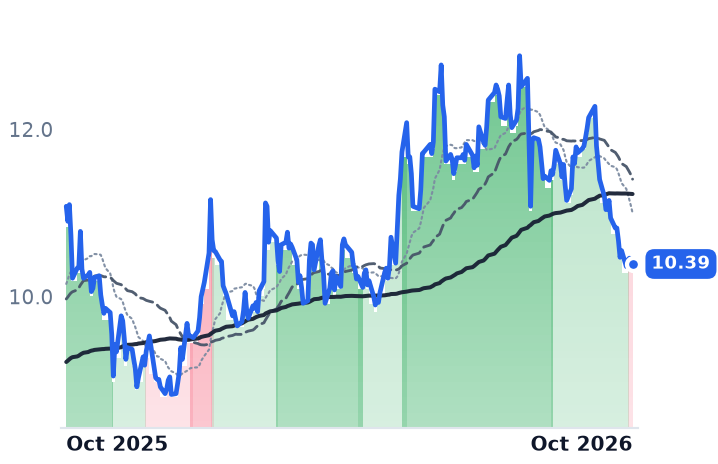
ORA | Ormat Technologies | Geothermal & Specialized | ⚠️ Emerging Bear | −11.9% | −10.5% |
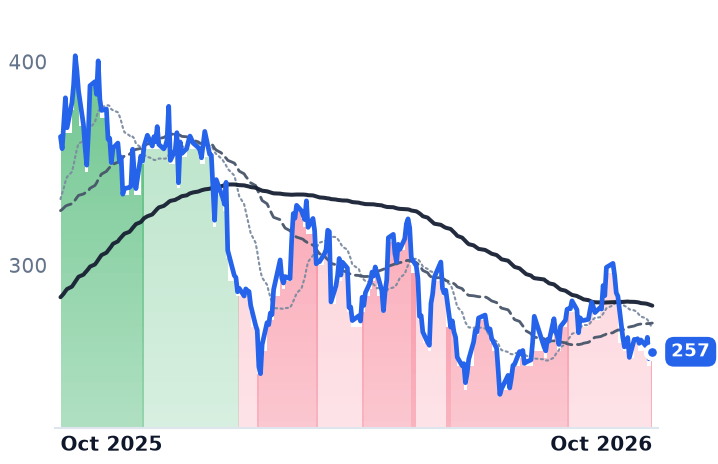
FRVO | Fervo Energy | Emerging & Specialized Energy | 🔴 Cont. Bear | −20.4% | −60.5% |
| Compared against · context, not the story | |||||
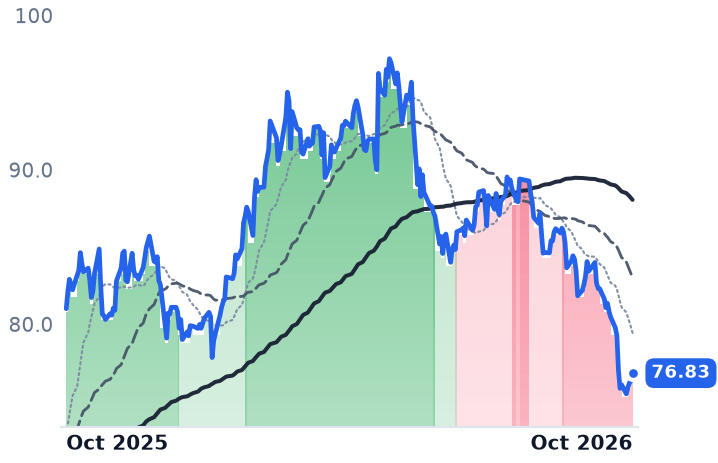
BEP | Brookfield Renewable Partners | Diversified Renewable Generators | ⚠️ Emerging Bear | −9.7% | +4.7% |
CWEN | Clearway Energy | Wind & Solar Developers | 🔴 Cont. Bear | −7.8% | −7.1% |
XIFR | XPLR Infrastructure | Renewable & Infrastructure Assets | 🟢 Cont. Bull | −14.4% | −6.2% |
NEE | NextEra Energy | Vertically Integrated Utilities | 🔴 Cont. Bear | −7.9% | −5.2% |
CEG | Constellation Energy | Diversified Renewable Generators | 🔴 Cont. Bear | −13.9% | −29.1% |
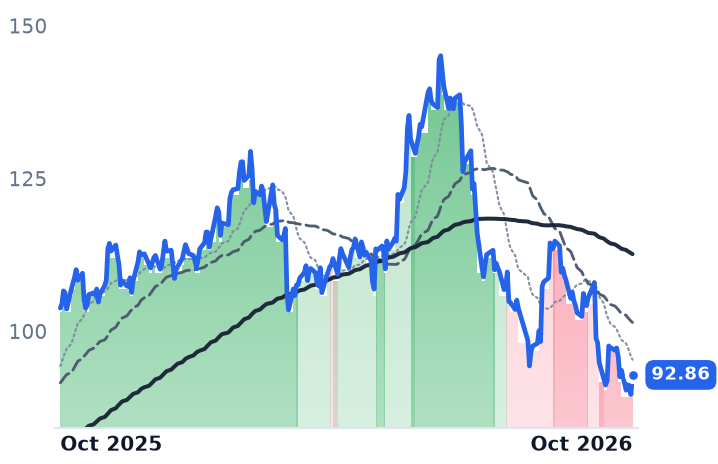
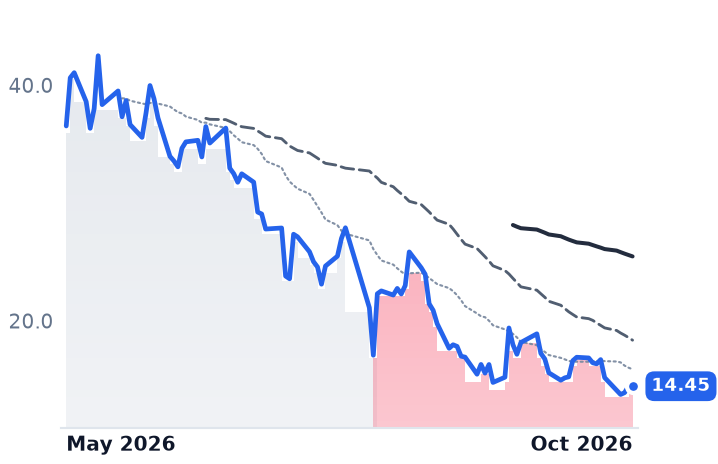
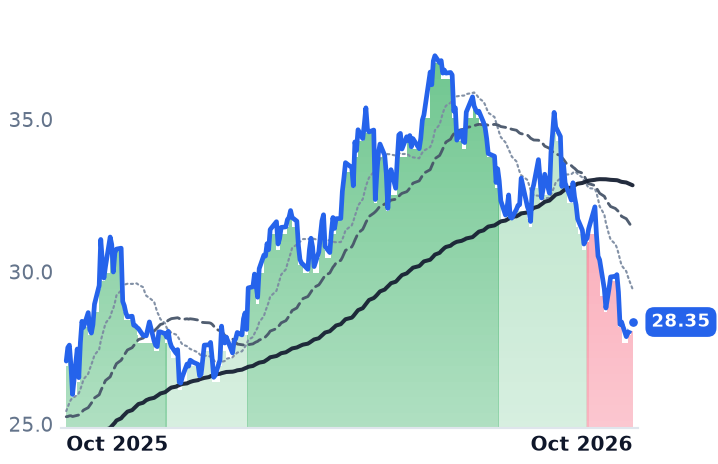
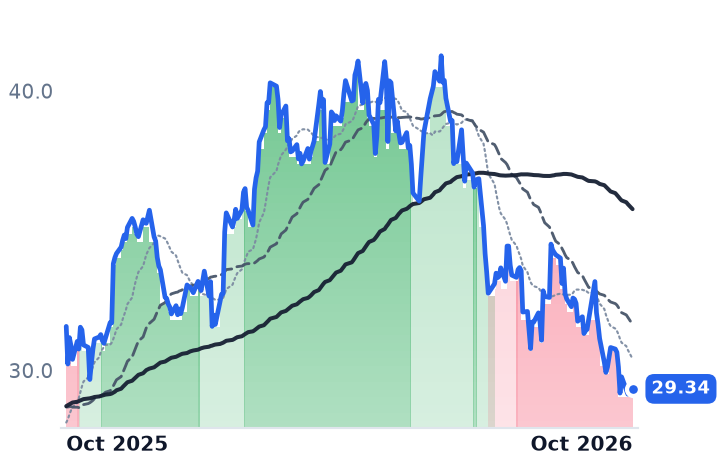
12-month price & trend
| Ticker | Mkt cap | P/E | P/E fwd | P/S | P/S fwd | P/GP | P/GP fwd | EV/EBITDA | FCF yld |
|---|---|---|---|---|---|---|---|---|---|
ORA | $5.7B | 44.6x | 36.5x | 4.8x | 4.8x | 17.2x | 17.3x | 19.8x | -4.6% |
FRVO | $4.1B | n/m | — | — | 759.0x | — | — | n/m | -10.7% |
BEP | $8.7B | 61.6x | — | 1.4x | 1.3x | 5.6x | 5.3x | 9.6x | -54.4% |
| Ticker | Mkt cap | P/E | P/E fwd | P/S | P/S fwd | P/GP | P/GP fwd | EV/EBITDA | FCF yld |
|---|---|---|---|---|---|---|---|---|---|
CWEN | $6.3B | 40.3x | — | 4.0x | 3.8x | 7.6x | 7.2x | 14.3x | 10.7% |
XIFR | $994.6M | 15.7x | 9.3x | 0.8x | 0.7x | 4.8x | 4.3x | 8.8x | -63.7% |
NEE | $160.3B | 17.2x | 19.3x | 5.5x | 5.2x | 7.7x | 7.2x | 15.1x | -6.3% |
| Ticker | Mkt cap | P/E | P/E fwd | P/S | P/S fwd | P/GP | P/GP fwd | EV/EBITDA | FCF yld |
|---|---|---|---|---|---|---|---|---|---|
CEG | $94.5B | — | 21.8x | — | 2.8x | — | — | 13.9x | 0.3% |
Consensus projections
| Ticker | FY2026E | FY2027E | FY2028E | |
|---|---|---|---|---|
ORA | Revenue | +21.4% | −2.1% | +10.6% |
| EPS | +16.4% | −4.2% | +27.8% | |
FRVO | Revenue | +3857.3% | +1212.9% | +179.6% |
| EPS | −91.0% | −26.3% | −19.6% | |
BEP | Revenue | +3.9% | +9.1% | −3.3% |
| EPS | +11.0% | −9.8% | +9.3% | |
CWEN | Revenue | +14.5% | +11.5% | +12.2% |
| EPS | −116.0% | −318.9% | +60.4% | |
XIFR | Revenue | +0.8% | +4.7% | +1.3% |
| EPS | −849.6% | −44.0% | −144.3% | |
NEE | Revenue | +8.9% | +9.7% | +9.0% |
| EPS | +7.5% | +9.0% | +8.6% | |
CEG | Revenue | +37.2% | +2.5% | +5.3% |
| EPS | +28.9% | +10.4% | +26.4% |
Forward fiscal years only. Blank means no analyst coverage for that year.
Where the profit comes from
Most of Ormat Technologies' first-half profit did not come from selling electricity. The company — which owns roughly 1,355 megawatts of geothermal, solar and recovered-energy plants and separately manufactures the power blocks that rival developers buy — reported $71.2m of net income for the six months to June. Inside the income-tax line of its quarterly filing sit $33.2m of income from the sale of tax benefits and $32.5m of transferable investment tax credits: $65.7m together, about 92% of the reported figure, on a comparison Ormat does not itself present.
That is what the phrase "firm clean baseload" looks like on an income statement. A geothermal plant sells output under contracts running two decades at an average realized price of $92.6 per megawatt-hour in 2025, down from $94.3 the year before. The reservoir underneath it declines whether or not demand grows. So the reported earnings arrive largely through the tax code, and the cash goes back into the ground.
The field decays on its own schedule
A Stanford Geothermal Workshop case study of Kenya's Olkaria East field — part of the complex where Ormat operates plants — records reservoir pressure falling 2–4% a year and natural steam decline of 2–3% annually, with production held flat only after make-up wells were connected. More than 50 re-injection wells have been drilled there.
That physics shows up as capital spending behaving like a second depreciation charge. Ormat's rest-of-2026 program runs to about $587m, including $139m of exploration, drilling and development and $36m of maintenance capital on plants already operating. Roughly $436m of it lands in the Electricity segment, against guided Electricity revenue of $710–725m for the year. The trailing free-cash-flow yield is minus 4.6%. In 2024 the consolidated fleet generated 7,450,071 megawatt-hours — about 850 megawatts of continuous output, indicatively, from a portfolio now near 1,355 megawatts including solar and recovered-energy assets.
What actually grew
Second-quarter revenue rose 10.6% to $258.8m and gross margin widened to 26.5%, but the geothermal line grew 5.8%, to $169.3m, and generation 3%. The Electricity segment "built on its growth momentum during the quarter, driven by contributions from our Blue Mountain geothermal power plant acquired in June 2025, improved performance at our Olkaria and Puna power plants, and lower curtailments in the USA," chief executive Doron Blachar told investors on the second-quarter call. Blue Mountain was bought, not drilled.
The acceleration came from merchant batteries, where revenue nearly tripled to $42.8m at a 56.2% gross margin — a margin management guided down to 30–40% in the second half. Over five years consolidated gross margin has compressed from 39.9% to 27.6%, and reported net income has sat near $124m for three straight years.
Fervo, from the drilling end
Fervo Energy, the Houston enhanced-geothermal developer that listed on Nasdaq in May, is the same equation inverted: its entire value is making the drilling cheap enough to finance. Cost across the first four horizontal wells at Cape Station in Utah fell from $9.4m to $4.8m, and spud-to-rig-release from 70 days in Nevada to an average of 21, per CNBC. The first 33-megawatt block reached commercial operation on 30 September, a day inside its contractual deadline, against a binding offtake book of about 1,054 megawatts. The June quarter carried $113,000 of revenue and a $59.5m net loss. With $2.1bn of cash against a $4.15bn market value, 1.52x book is the only anchor that means anything; management has guided 2027 revenue to a deliberately wide $60–80m because of transmission curtailment it says is unique to that year.
What the de-rating earns
Ormat fell 11.3% in the month to 2 October and sits 36% below its May high, though only 7.1% lower over twelve months; Fervo fell 19.6%. Contracted generation sold off together — XPLR Infrastructure down 12.7%, Constellation 11.2%, NextEra 7.5% — as Treasury yields kept climbing through September. Jefferies cut its target to $104 while raising its 2030 estimates, citing "mark-to-market adjustments against a higher cost of equity". JPMorgan trimmed on "a slightly higher mix of its fiscal 2027 estimated pro forma EBITDA derived from tax credits".
Most of the fall is earned. At 44.6x trailing and 36.5x forward earnings, down from 56.1x trailing earlier this year, Ormat is still priced richly against consensus that has 2027 earnings per share falling 4.2% to $2.44 and against cash consumption after capital spending. The discount rate explains the timing; profit composition explains the level. What nothing yet explains is the gap between the axes — management's 2030 target of $1.0–1.1bn of EBITDA sits a fifth above consensus and was raised into a falling share price. The test is not capacity added but whether Electricity gross margin climbs back toward the 40% that plan assumes, and whether credit buyers keep paying.
Ormat's first contract with a data-center operator — 20 years, about 13 megawatts to Switch from the Salt Wells plant in Nevada — starts delivering in the first quarter of 2030. The scarcity everyone is bidding for shows up, here, in four years.