

Stem's Shares Are Worth Less Than Its Convertible Debt After the Pivot to Solar Software
Hypothesis Opus 5 · Research Opus 5 · Writing Opus 5 · Prompt v1.7
A company that stopped reselling batteries now monitors 38.3 GW of other people's solar plants, and its stock has lost four-fifths of its value in a year. Stem's June-quarter revenue fell 12.3%, and the whole of that decline was the battery-resale line it deliberately abandoned; software and services revenue grew, gross margin widened to 41.3%, and adjusted earnings before interest, taxes, depreciation and amortization were positive for a fifth straight quarter.
The operating business does not account for the fall; the capital structure does. $46.3m of convertible notes and negative book equity rank ahead of a $38.2m equity. At the hardware end of the same demand, Enphase is the opposite case: more units shipped for less money per watt, and a margin a third of which comes from a production tax credit.
| Ticker | Company | Segment | Trend · 13mo | 30D | 1Y |
|---|---|---|---|---|---|
| The subject · what this brief is about | |||||
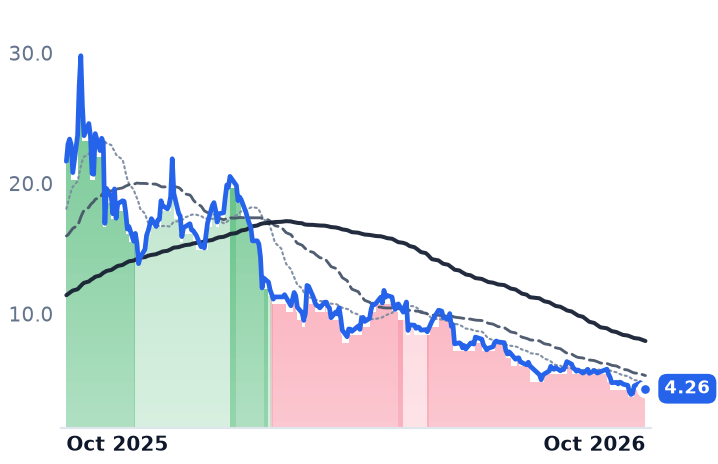
STEM | Stem | Renewable Utilities | 🔴 Cont. Bear | −23.5% | −80.4% |
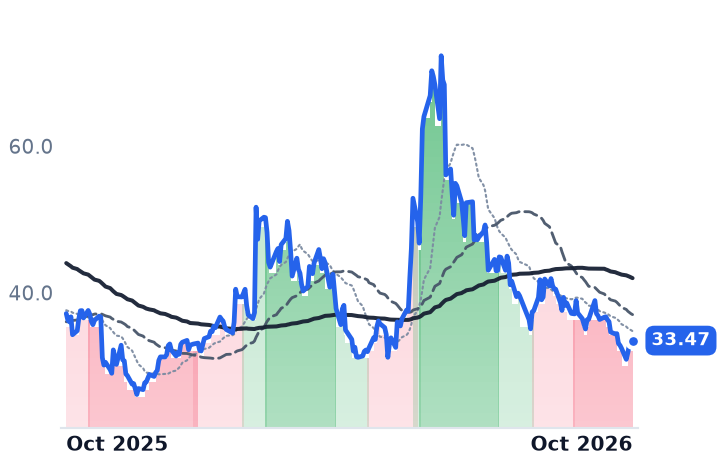
ENPH | Enphase Energy | Inverters & Power Electronics | 🔴 Cont. Bear | −8.0% | −9.9% |
| Compared against · context, not the story | |||||
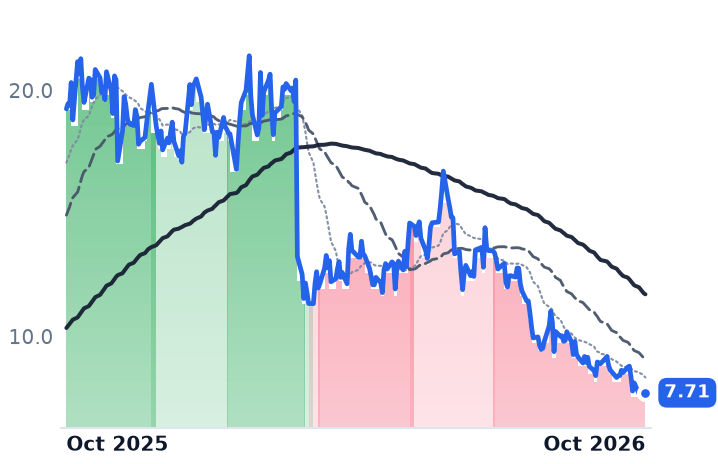
RUN | Sunrun | Residential Solar Installers | 🔴 Cont. Bear | −13.3% | −59.9% |
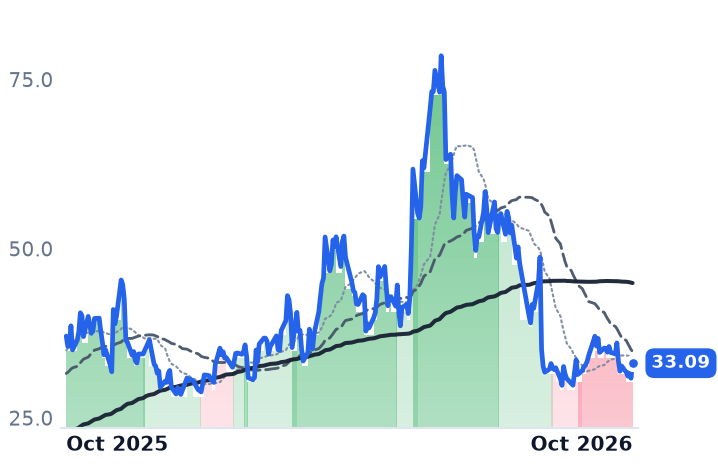
SEDG | SolarEdge Technologies | Inverters & Power Electronics | ⚠️ Emerging Bear | −3.2% | −10.8% |
12-month price & trend
| Ticker | Mkt cap | P/E | P/E fwd | P/S | P/S fwd | P/GP | P/GP fwd | EV/EBITDA | FCF yld |
|---|---|---|---|---|---|---|---|---|---|
STEM | $38.2M | n/m | — | 0.3x | 0.3x | 0.7x | 0.7x | n/m | 15.2% |
ENPH | $4.4B | 32.8x | 16.8x | 3.3x | 3.7x | 7.1x | 8.0x | 25.3x | 3.5% |
RUN | $1.8B | 4.5x | 6.1x | 0.5x | 0.6x | 1.5x | 1.7x | 23.0x | -74.4% |
| Ticker | Mkt cap | P/E | P/E fwd | P/S | P/S fwd | P/GP | P/GP fwd | EV/EBITDA | FCF yld |
|---|---|---|---|---|---|---|---|---|---|
SEDG | $2.2B | n/m | — | 1.7x | 1.7x | 7.6x | 7.6x | n/m | 4.0% |
Consensus projections
| Ticker | FY2026E | FY2027E | FY2028E | |
|---|---|---|---|---|
STEM | Revenue | +0.1% | +17.5% | +22.8% |
| EPS | +31.7% | −14.2% | −45.1% | |
ENPH | Revenue | −19.2% | +3.7% | +10.9% |
| EPS | −29.1% | +10.1% | +17.3% | |
RUN | Revenue | +29.7% | +3.5% | +12.9% |
| EPS | −8.2% | −65.9% | −38.3% | |
SEDG | Revenue | +12.0% | +11.1% | +11.4% |
| EPS | −86.2% | −370.0% | +91.7% |
Forward fiscal years only. Blank means no analyst coverage for that year.
Stem has spent the past year deleting revenue on purpose, and the June quarter shows what is left. The company sells software that monitors and dispatches solar plants and battery systems for developers, utilities and independent power producers, and it used to buy battery hardware from manufacturers and resell it alongside. That line brought in $5.0m a year ago and $0.3m this time — which is the entire 12.3% revenue decline the quarter reported.
Everything the exit was meant to buy arrived with it. Gross margin widened to 41.3% from 33.4%. Adjusted EBITDA rose 63% to $6.2m, a fifth consecutive positive quarter, and bookings rose 39% from the March quarter to $36.8m. The shares fell 80.3% over twelve months anyway. What decides that price is not an argument about the business but the ranking of the claims on it, and Stem's shareholders rank last.
Thirty-eight gigawatts of other people's solar
The growth engine is not behind-the-meter storage, which is how the company is usually filed. Stem ended June with 38.3 GW of solar assets under management against 1.8 GWh of storage, both up sequentially; revenue from the PowerTrack monitoring platform rose 11% to about $11m. Contracted annual recurring revenue reached $69.0m from $67.2m three months earlier, against year-end guidance of $65-70m. PowerTrack also went abroad in the quarter, taking over as the control system for a 420 MWh battery bolted onto the existing 135 MW Granja Solar plant in Chile and winning two 80 MWh systems in Hungary.
"The second quarter reflected strong momentum across our core PowerTrack platform and continued expansion of our international footprint," chief executive Arun Narayanan said on 12 August.
The hardware end of the same dollar
Who pays for a residential solar system changed hands this year. The 30% Section 25D homeowner credit expired on 31 December 2025 while the commercial Section 48E credit survived, so federal value now reaches only systems somebody else owns, and roughly 69% of 2026 US installations are projected to be third-party owned. The handover is going badly: the third quarter brought 995 MWdc of US residential installs, down 12% year on year, and the Solar Energy Industries Association and Wood Mackenzie deepened their 2026 contraction forecast to 23% from 21%, blaming installers' difficulty converting from cash and loan sales to third-party ownership and scarce tax-equity capital.
Enphase, which makes the microinverter that converts one solar module's output to household current and sells it through distributors rather than to homeowners, is where that shows up as price. June-quarter revenue of $291.9m was down 19.6%, a third straight fall of roughly a fifth, and US sell-through — installations actually completed — fell 34% year on year. Yet shipments rose 12.8% sequentially to about 1.59 million microinverters while revenue rose 3.2%. Dividing revenue by shipped capacity gives a blended $0.403 per watt DC against $0.451 three months earlier, a 10.7% fall: more boxes, less money, a buyer that is now a procurement desk.
"We are not stopping and waiting. We are not waiting for things to improve. We are taking matters into our own hands," chief executive Badrinarayanan Kothandaraman told investors on 28 July.
The 60.0% gross margin that appears to contradict all this is borrowed. A $45.4m tariff refund added 15.6 points to it, and the company guided September-quarter GAAP gross margin down to 42-45% because the refund does not repeat. Underneath sits Section 45X: $85.2m of production credits generated in the first half, disclosed on the July call, equal to roughly 31% of the $275.4m of first-half gross profit, with 1.58 of the 1.59 million microinverters shipped from Texas and South Carolina and therefore credit-bearing. Enphase trades at 7.09x trailing gross profit, against 14.55x in mid-May, and its forward price-to-sales multiple of 3.73x sits above the trailing 3.33x — the signature of a denominator consensus expects to shrink, not of a cheap stock.
Where the two prices come from
Enphase's de-rating is earned. Volumes are up, revenue per watt is down, the margin leans on a credit that steps down from 2030, and three banks cut their targets inside the September slide, Goldman Sachs and Jefferies on the 21st and Citigroup to $37 on the 29th — all of it after the Federal Reserve's quarter-point increase on 16 September, which bears directly on twenty-year lease cash flows.
Stem's is not. The operating numbers moved the right way in every line that matters, and the stock has been in an unbroken downtrend for 92 sessions since 19 May; it fell from $5.76 on 8 September to $3.82 on the 23rd, jumped 15.1% the session UBS upgraded it to Buy with a $7.00 target, and closed the month lower anyway. What the market is pricing is a residual. Stem still lost $7.67m at the operating line and $14.38m net; book equity is negative; the 4.25% convertible notes due 2030 carried an estimated fair value of $46.3m at 30 June against $38.4m of cash; and a $200m shelf is live against a $38.2m market value. At 0.26x trailing sales the shares look like a software business on sale; they are a claim behind debt, on a business whose contracted revenue is worth nearly twice what the equity is.
Both companies now depend on money that has to be released by the Treasury before it can be spent. The foreign-entity safe-harbor tables that govern whether tax-equity investors can underwrite this equipment at all still do not exist, with a statutory deadline of 31 December 2026 and Enphase expecting nothing final before the first half of 2027. Until they are published, the buyer of last resort for an American solar panel is a tax lawyer waiting on a table.