

Bloom Energy's Fuel-Cell Stacks Now Last Five Years, and Its Service Line Earns 22% Margins
Hypothesis Opus 5 · Research Opus 5 · Writing Opus 5 · Prompt v1.6
The companies whose data-center power revenue is growing fastest were marked down this summer, and the one that sells customers a way around the grid took an S&P 500 seat in September. Caterpillar's power generation revenue grew 72% in the June quarter on a record $72.1bn group backlog; Cummins' genset segment is now its highest-margin business and the company raised full-year guidance. Both de-rated anyway — Caterpillar to 31 times forward earnings against a decade near 16.
Bloom Energy earns part of its re-rating in cash: revenue up 165.5% year on year, service margin at 22%, product backlog near $6bn. It also issued 39% more shares, and at 107 times forward earnings the order book has to convert. Fluence and Eos hold record backlogs on 5.1% and -71.0% gross margins; Tesla deployed more storage at a thinner energy margin.
| Ticker | Company | Segment | Trend · 13mo | 30D | 1Y |
|---|---|---|---|---|---|
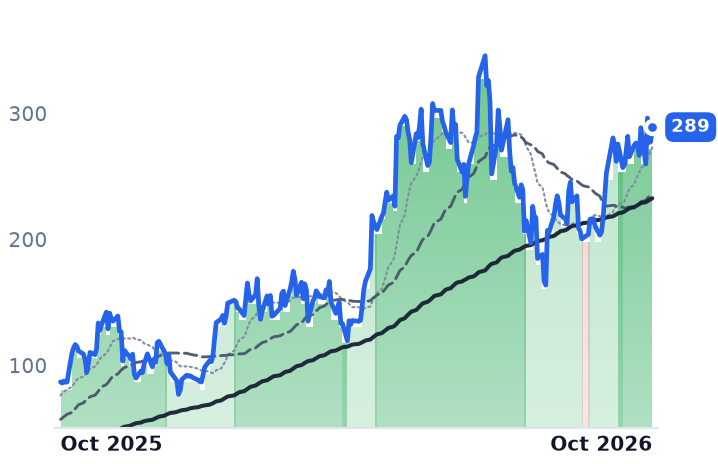
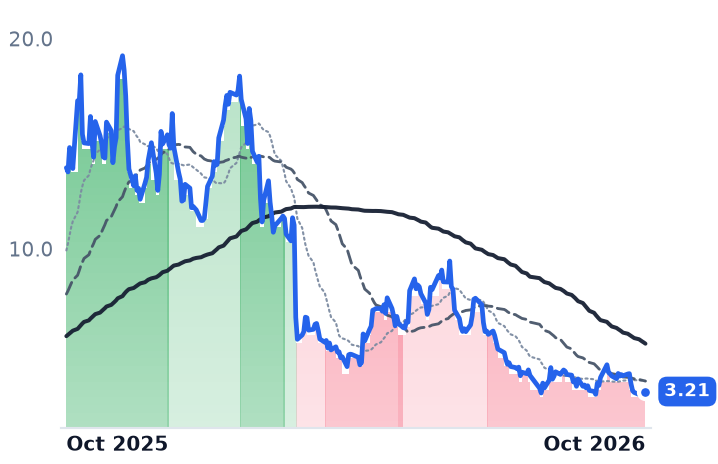
BE | Bloom Energy | Fuel Cell & Hydrogen | 🟢 Cont. Bull | +14.3% | +232.5% |
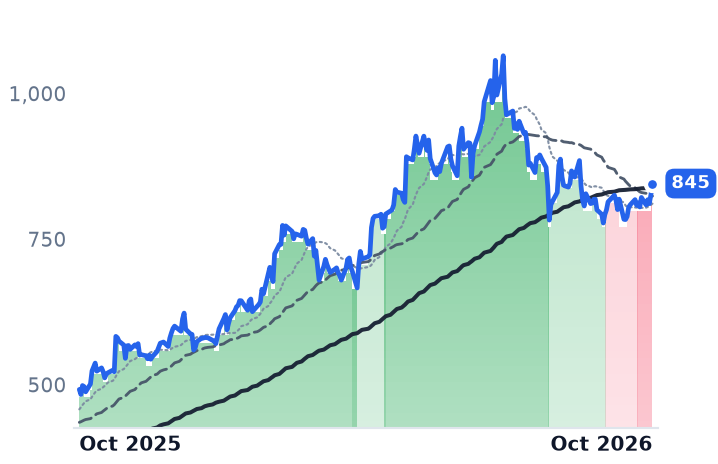
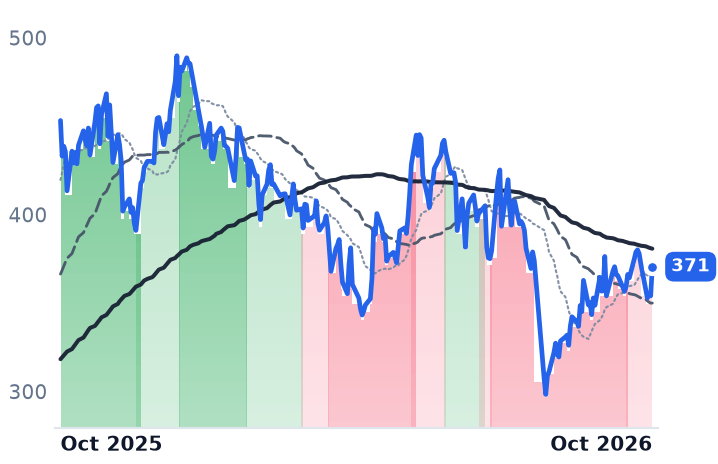
CAT | Caterpillar | Heavy Construction & Mining | ⚠️ Emerging Bear | +3.9% | +71.9% |
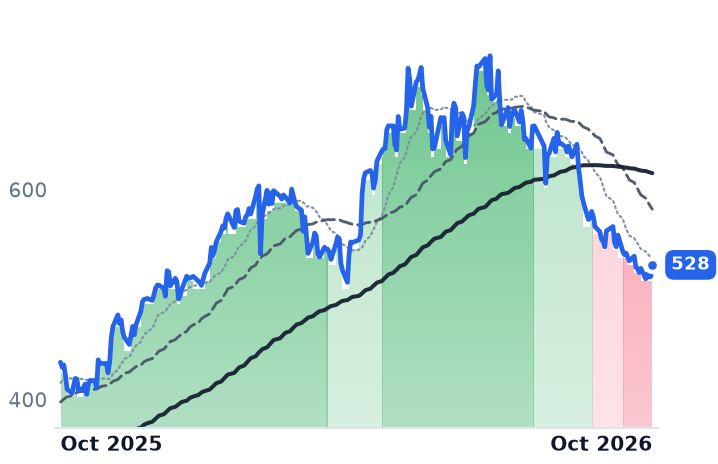
CMI | Cummins | Power & Propulsion Systems | ⚠️ Emerging Bear | −5.8% | +21.3% |
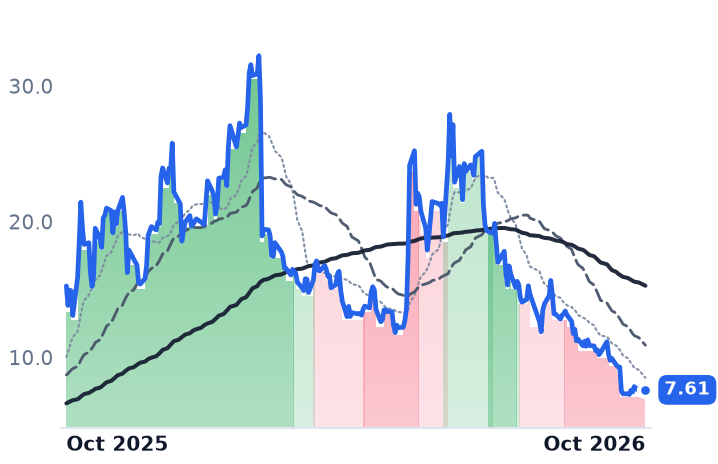
FLNC | Fluence Energy | Energy Storage Systems | ⚠️ Emerging Bear | −26.5% | −50.1% |
EOSE | Eos Energy Enterprises | Energy Storage & Batteries | 🔴 Cont. Bear | −17.3% | −76.8% |
TSLA | Tesla | EV Startups & Luxury | 🔴 Cont. Bear | +4.7% | −18.2% |
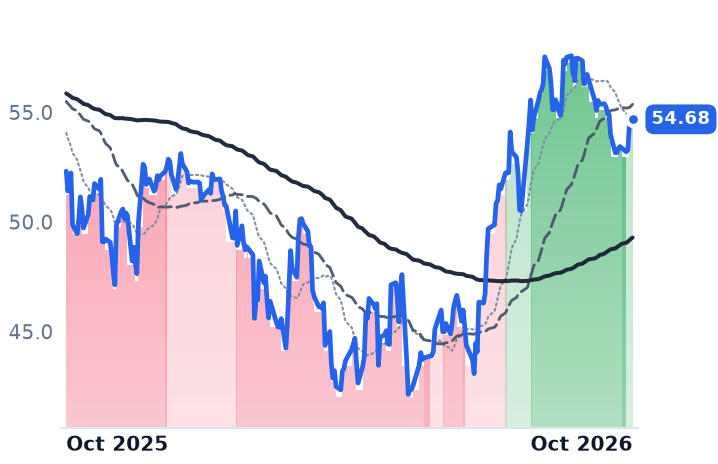
ALRM | Alarm.com | Security & Compliance | 🌱 Emerging Bull | −3.2% | +4.5% |
12-month price & trend
| Ticker | Mkt cap | P/E | P/E fwd | P/S | P/S fwd | P/GP | P/GP fwd | EV/EBITDA | FCF yld |
|---|---|---|---|---|---|---|---|---|---|
BE | $85.2B | 346.0x | 107.1x | 27.4x | 20.7x | 87.6x | 66.3x | 243.9x | 0.7% |
CAT | $389.4B | 36.2x | 31.0x | 5.2x | 4.9x | 15.4x | 14.5x | 24.6x | 2.3% |
CMI | $72.9B | 26.9x | 17.9x | 2.1x | 1.9x | 8.3x | 7.7x | 15.7x | 4.6% |
| Ticker | Mkt cap | P/E | P/E fwd | P/S | P/S fwd | P/GP | P/GP fwd | EV/EBITDA | FCF yld |
|---|---|---|---|---|---|---|---|---|---|
FLNC | $1.4B | n/m | — | 0.5x | 0.4x | 5.8x | 4.7x | n/m | -9.4% |
EOSE | $929.5M | n/m | — | 4.3x | 3.0x | — | — | n/m | -45.3% |
TSLA | $1.5T | 314.1x | 221.9x | 14.1x | 13.7x | 74.9x | 72.9x | 121.2x | 0.4% |
| Ticker | Mkt cap | P/E | P/E fwd | P/S | P/S fwd | P/GP | P/GP fwd | EV/EBITDA | FCF yld |
|---|---|---|---|---|---|---|---|---|---|
ALRM | $2.7B | 23.0x | 18.9x | 2.5x | 2.5x | 4.0x | 3.9x | 13.2x | 8.8% |
Consensus projections
| Ticker | FY2026E | FY2027E | FY2028E | |
|---|---|---|---|---|
BE | Revenue | +115.8% | +68.0% | +46.3% |
| EPS | +389.4% | +83.9% | +62.5% | |
CAT | Revenue | +19.8% | +11.1% | +11.1% |
| EPS | +46.0% | +19.0% | +19.5% | |
CMI | Revenue | +13.2% | +9.3% | +8.3% |
| EPS | +29.7% | +17.0% | +16.4% | |
FLNC | Revenue | −2.5% | +29.2% | +23.8% |
| EPS | +277.1% | −76.7% | −169.5% | |
EOSE | Revenue | +104.1% | +87.2% | +86.5% |
| EPS | −82.9% | −69.8% | −181.4% | |
TSLA | Revenue | +12.2% | +13.2% | +18.4% |
| EPS | +0.9% | +34.9% | +39.9% | |
ALRM | Revenue | +8.3% | +4.5% | +5.3% |
| EPS | +15.0% | +6.1% | +7.2% |
Forward fiscal years only. Blank means no analyst coverage for that year.
Bloom Energy's fuel cells were selected in late September for Aligned Data Centers' 2-gigawatt "Project Phoenix" campus at Shippingport, Pennsylvania, and days before that the company replaced Molson Coors in the S&P 500. Fluence Energy, which integrates grid-scale battery systems, spent the same month cutting fiscal-2026 revenue guidance to roughly $2.4bn from a midpoint near $3.0bn, blaming delays ramping its Houston factory. Caterpillar and Cummins announced nothing.
Underneath the month sits a question of attribution: which of these companies is actually paid for on-site data-center power, and how much of each one's money comes from it. The answer nearly inverts the share prices. The two incumbent engine makers have the fastest-growing power businesses on the shelf and the worst-behaved shares; the fuel-cell company, the only one of the six with no construction, mining or truck-engine core, got the index seat and the order.
What Bloom actually sells twice
Bloom Energy builds solid-oxide fuel cells that convert natural gas or hydrogen into electricity without combustion, then sells a long-dated service contract on the same hardware. The service line was historically the loss-maker, because the stacks wore out. Service margin reached 22% in the June quarter, up 977 basis points year on year, the fifth straight quarter in double digits, because stack life went from nine months in 2018 to roughly five years, with annual price escalators written into the contracts.
The product side scaled at the same time. June-quarter revenue was $1.065bn, up 166%, with product revenue up 215% and full-year guidance raised to $3.9-4.2bn. Net income was $196.3m against a $42.6m loss a year earlier; operating margin reached 17.1%, almost entirely through leverage over fixed cost, since gross margin slipped to 33.4% from 36.1%. Product backlog stands near $6bn, about two and a half times a year ago, inside a roughly $20bn total. "We have visibility currently based on what we are working for 25 gigawatts of deployments," founder-chief executive K. R. Sridhar told investors on the July 28 call.
Two things qualify that. Diluted shares rose 39% year on year, so the ramp was partly equity-funded. And the stock now carries 107.1x forward earnings and 87.6x trailing gross profit, against 60.3x in late August — consensus needs revenue to reach $4.11bn this year and $6.91bn next for that to compress. Fuel is the physical limit: Matthew Smith of Chronometer Partners, speaking on a July 21 podcast, put a latest-generation Bloom unit's appetite at roughly 150 million cubic feet of gas a day per gigawatt and judged that at 2 to 5 gigawatts a year of capacity "there isn't the gas for that unless you take it from something else."
The incumbents were marked down on politics
Caterpillar's June quarter was its first above $20bn, revenue up 24%, operating margin 20.9% against 17.6%, and a record $72.1bn backlog, up about 92% year on year, some Power & Energy customers ordering into 2030. Power generation revenue grew 72%. The company cut its full-year tariff estimate to about $2.2bn from $2.5bn. "No one is slowing down at the moment," chief executive Joe Creed said on the call.
What broke was the multiple it started from. David Giroux told Barron's in July that Caterpillar averaged about 16x earnings over the past decade before trading near 38x on data-center enthusiasm; at 31.0x forward it is still roughly double the decade norm. The trigger was permitting. Baird downgraded the stock in July, citing New York's moratoria as "a recipe for further multiple compression." New York's governor had barred construction of hyperscaler sites drawing 50 megawatts or more for up to a year — the first statewide pause — after residential power prices rose nearly 68% since 2019. Local opposition blocked or delayed at least 75 projects worth nearly $130bn in the first quarter alone.
Cummins is harder to explain. Power Systems, its genset arm, booked $2.3bn in the quarter, up 19%, at 24.5% segment EBITDA against 22.8% — the highest-margin line in the company, and about a quarter of revenue against the Engine segment's third. There is no freight downturn in the print: the company raised group guidance to 10-13% growth and Engine guidance to 9-14% on improving North American truck demand. The blemish was cost, not orders — EBITDA margin fell to 17.5% from 18.4% on incentive compensation, freight and research spending, and earnings per share came in at $6.73 against $7.26 expected. The shares sit 27.4% below their high at 17.9x forward earnings, with consensus 2026 earnings up about 30%.
The storage leg is a margin story
Fluence holds a record backlog of about $6.4bn while reported gross margin fell to 5.1% from 14.8%, and now guides to an adjusted loss near $200m. Eos Energy, which makes zinc-based grid batteries, holds a record $807m backlog across about 3.4 gigawatt-hours and has never sold a battery above cost — gross margin was -71.0% last quarter, improved from -203.2% a year earlier, against $305.5m of unrestricted cash and $191.8m of first-half operating outflow. Tesla, the only profitable storage comparison, deployed 13.5 gigawatt-hours, up 41%, while energy gross margin fell to 20.4% from 30.3% on a vendor cell warranty charge; at $3.1bn of $28.2bn in revenue the energy line is 11% of a company valued at 221.9x forward earnings for automotive reasons.
So the verdict splits three ways. Bloom's revenue, service margin and converting backlog earn most of its re-rating; the final stretch, from about $206 to near $290 in under a month, coincides with mechanical index buying and leaves a multiple that only the 2027 consensus justifies. Caterpillar's de-rating is paid for by where its multiple began, not by its order book, which is growing faster than it has in years. Cummins is the one nothing in the current numbers accounts for: its data-center business is its best, its guidance went up, and it trades near half Caterpillar's forward earnings multiple. And Fluence and Eos de-rated on the cost of making the product, with their order books at records.
New York's pause applies to sites pulling 50 megawatts or more from the grid. A campus that generates its own power is not one of those — which is exactly what Bloom is being paid for, until somebody has to permit the pipeline that feeds it.