

Whirlpool Is Paying the Appliance Tariff It Welcomed; SharkNinja Won $247.1m Back
Hypothesis Opus 5 · Research Opus 5 · Writing Opus 5 · Prompt v1.6
The tariff written to protect American appliance plants is being paid by the largest American appliance maker, and refunded to the importer it was meant to tax. Whirlpool builds roughly 80% of what it sells in the United States and told investors last year that the Section 232 steel duties had finally given it a level playing field; its North America appliance operating margin has since halved, to 2.7% from 5.9%.
SharkNinja moved production out of China, watched the duties on its Asian sourcing struck down in February, and has $247.1m of refund claims accepted by customs.
The split is not clean. SharkNinja's forward earnings multiple looks cheaper than its trailing 36.9x only because of that one-off credit, and Whirlpool's more urgent problem is $7.1bn of debt against a market value near $2.0bn.
| Ticker | Company | Segment | Trend · 13mo | 30D | 1Y |
|---|---|---|---|---|---|
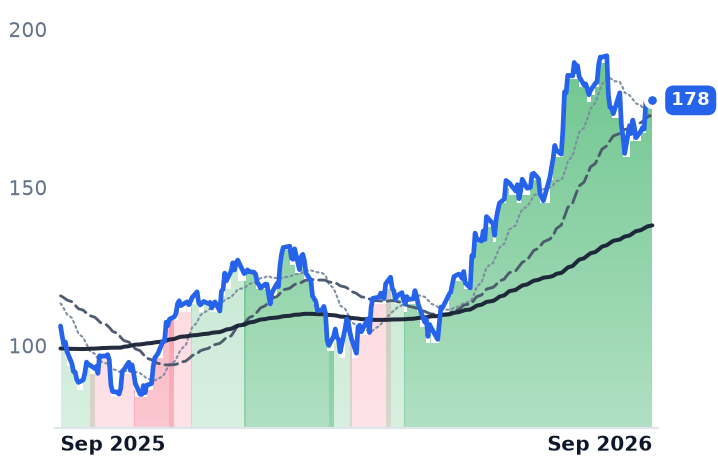
SN | SharkNinja | Kitchen & Home Appliances | 🟢 Cont. Bull | −7.4% | +67.2% |
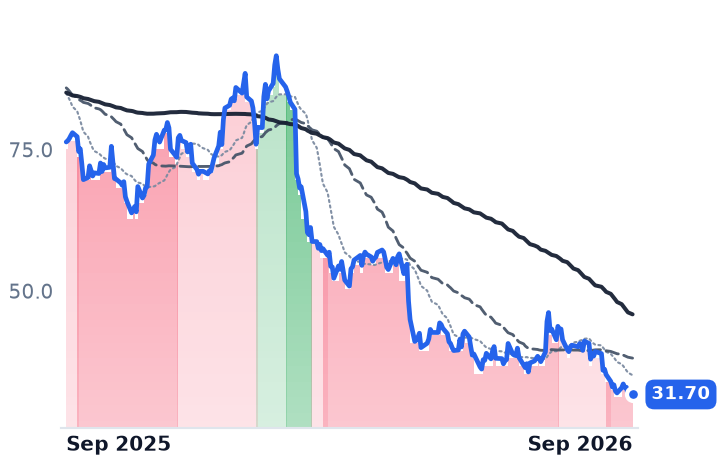
WHR | Whirlpool | Kitchen & Home Appliances | 🔴 Cont. Bear | −22.2% | −58.5% |
12-month price & trend
| Ticker | Mkt cap | P/E | P/E fwd | P/S | P/S fwd | P/GP | P/GP fwd | EV/EBITDA | FCF yld |
|---|---|---|---|---|---|---|---|---|---|
SN | $25.8B | 36.9x | 27.7x | 3.7x | 3.4x | 7.6x | 7.0x | 24.1x | 3.1% |
WHR | $2.0B | 10.6x | 17.2x | 0.1x | 0.1x | 1.0x | 1.0x | 9.1x | -7.9% |
Consensus projections
| Ticker | FY2026E | FY2027E | FY2028E | |
|---|---|---|---|---|
SN | Revenue | +17.5% | +12.9% | +11.0% |
| EPS | +27.4% | +15.6% | +11.3% | |
WHR | Revenue | −5.0% | +3.5% | +3.9% |
| EPS | −72.6% | +93.2% | +45.8% |
Forward fiscal years only. Blank means no analyst coverage for that year.
Whirlpool spent last year telling investors that a steel tariff had finally arranged the American appliance market in its favor. It has instead become the one large appliance maker in the country paying that tariff on every unit it builds at home.
Section 232 of the Trade Expansion Act taxes steel and goods derived from it. In June 2025 the Commerce Department added eight household-appliance categories to the derivative list — combined refrigerator-freezers, washers, dryers, freezers, dishwashers, ranges and ovens, food waste disposals — at 50% on the steel content. A proclamation effective 6 April 2026 went further, applying the duty to the full customs value of covered articles rather than to metal content, at 50% for primary metal articles and 25% for derivatives substantially made of steel, aluminum or copper. The asymmetry is structural. A company that manufactures domestically buys the taxed input; the protective half of the bargain only reaches competitors whose finished goods actually cross the border and land in a covered annex.
Whirlpool — refrigeration, laundry, cooking and dishwashers sold to retailers and builders under the Whirlpool, Maytag and Speed Queen names among others — sits on the wrong side of that. Chief executive Marc Bitzer called the new regime "finally the environment which allows a level playing field" and said footprint optimization and the Section 232 update "meaningfully strengthened our competitive advantage as a domestic producer," arguing that Asian rivals' access to tariff-free Chinese steel handed them roughly $70 of cost advantage per product. The same company then guided to a $225m tariff cost for the year despite that domestic base.
The importer's bill went the other way
The duties that were taxing the importer are gone. On 20 February 2026 the Supreme Court ruled 6-3 that the International Emergency Economic Powers Act does not authorize the President to impose tariffs, voiding the reciprocal rates. A flat 10% surcharge under Section 122 of the Trade Act of 1974 replaced them within hours and lapsed on 24 July, giving way to 12.5% Section 301 rates; Vietnam went from 46% to 12.5%, Thailand from 36% to 12.5%.
SharkNinja — Shark vacuums and steam mops, Ninja air fryers, blenders and coffee systems, sold through retail, e-commerce and direct — had already moved nearly all production out of China to Vietnam, Thailand, Indonesia, Malaysia and Cambodia. Its 2026 outlook now assumes minimum rates of 10% to 12.5%, and it filed $247.1m of refund claims that customs accepted in July, to be booked as a reduction of cost of sales in the third quarter.
The two books
Whirlpool's June-quarter revenue fell 6.8% to $3.52bn while gross profit fell 26.8%, four times the rate of the sales decline — fixed-cost deleverage. Gross margin compressed 343 basis points to 12.6%. In North America, segment operating margin was 2.7% against 5.9% a year earlier on $2.4bn of sales, with US industry demand down 3.4%. Pricing has not yet reached the per-unit economics: a 10% promotional price increase in April, its largest in a decade, was followed by 4% on list in July. The demand backdrop is a frozen resale market — existing-home sales ran at a 3.98m annual rate in August, down 1.2% year on year — which strips out the trade-up replacement that carries the mix and leaves lower-margin break-fix demand.
The balance sheet is the louder problem. The dividend was suspended in May to fund more than $900m of debt paydown. A rescue equity raise of roughly $800m priced common stock at $69.00, against $31.70 today, lifting weighted-average diluted shares toward 71.3m from 57.4m. In June the company swapped roughly 1%-coupon paper for $1.0bn of 7.500% and $1.0bn of 7.875% second-lien secured notes, and 2026 interest expense guidance rose to $350m from $300m. Guidance for 2026 ongoing earnings has been cut four times, from about $7.00 to $2.50-$3.00; consensus sits at $1.83 against $5.66 actually earned in 2025. That is why the forward earnings multiple of 17.2x is above the 10.6x trailing figure — the denominator collapsed faster than the price. Enterprise value is 9.2x trailing earnings before interest, taxes, depreciation and amortization, a figure consensus expects to fall 26.8% this year.
SharkNinja's June quarter grew 22.2% to $1.77bn. "Q2 was a standout performance for SharkNinja, with net sales growth accelerating to 22.2%, our fastest pace since 2024," chief executive Mark Barrocas said in the 5 August release. Adjusted gross margin still slipped about 70 basis points to 48.7% on US tariff cost, currency and retailer activations; operating income rose only 6.4% and net income fell 7%. The fastest-growing part of the book sits beyond US trade policy entirely: international sales rose 36.6%, against 15.5% at home.
The verdict
Incidence flipped by court ruling rather than by pass-through, and the market has priced that faster than either management has narrated it. Whirlpool's de-rating is earned, but only partly by steel: a shrinking industry, a $50m step-up in interest and a dilutive rescue equity explain more of it than the tariff line does. SharkNinja's advance is genuine volume and geography — yet the apparent discount in its forward multiple is not. The refund is worth roughly $1.75 a share before tax on 141.5m diluted shares, about $1.31 after; strip it from the $6.45-$6.55 adjusted guidance and the forward multiple sits near 34x, barely below 36.9x trailing. Roughly half those duties were expensed in 2025, so third-quarter gross margin will carry a credit for last year's costs.
Both prints are close. Whirlpool's third quarter is most commonly dated 26 October, SharkNinja's 5 November. The settling lines are narrow: whether North America margin climbs back toward last year's 5.9% now that both price increases are in the base, and what SharkNinja's gross margin looks like with the refund taken out.
Two Septembers ago these two shares closed within a dime of each other. Section 232 was meant to make the American plant the cheap place to build an appliance; so far it has mostly made steel more expensive there.