

Packaging Corp Sought a $140-a-Ton Increase. The Index Confirmed $70.
Hypothesis Opus 5 · Research Opus 5 · Writing Opus 5 · Prompt v1.6
Containerboard's published price has risen all year, and not one of the four big North American producers has turned it into operating profit. The increases exist because mills closed — roughly 4m tons of capacity permanently shut since 2023 — while box shipments fell 1.9% year-over-year in the first quarter.
Costs rose alongside: recycled fiber, freight and electricity, with Graphic Packaging re-guiding 2026 inflation to at least $150m. Gross margin fell year-over-year at all four names in the June quarter.
The market has split them regardless — Packaging Corporation of America and Smurfit Westrock are higher over twelve months, International Paper and Graphic Packaging much lower — and the first quarter to carry a full month of the September increase is not reported until late October.
| Ticker | Company | Segment | Trend · 13mo | 30D | 1Y |
|---|---|---|---|---|---|
| The subject · what this brief is about | |||||
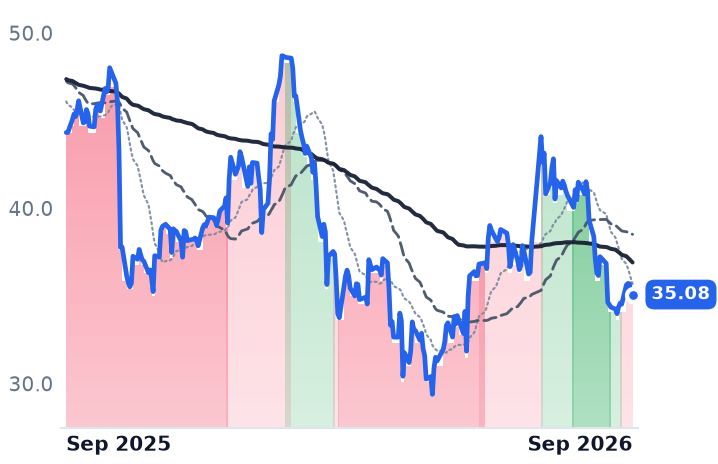
IP | International Paper | Corrugated & Containerboard | 🔴 Cont. Bear | −15.5% | −20.9% |
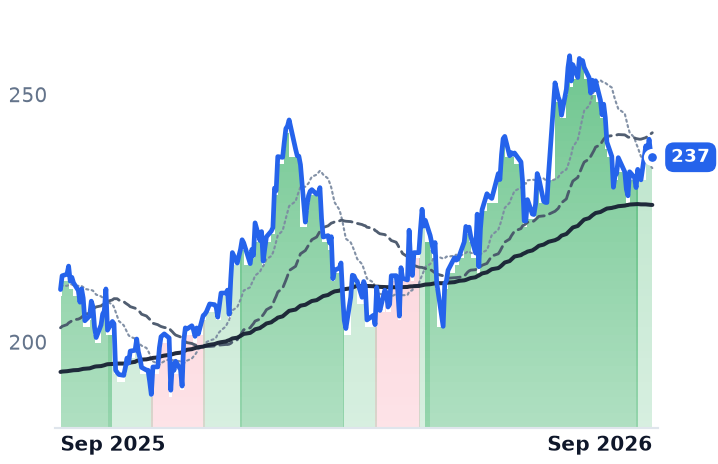
PKG | Packaging Corporation of America | Corrugated & Containerboard | 🟢 Cont. Bull | −4.3% | +12.7% |
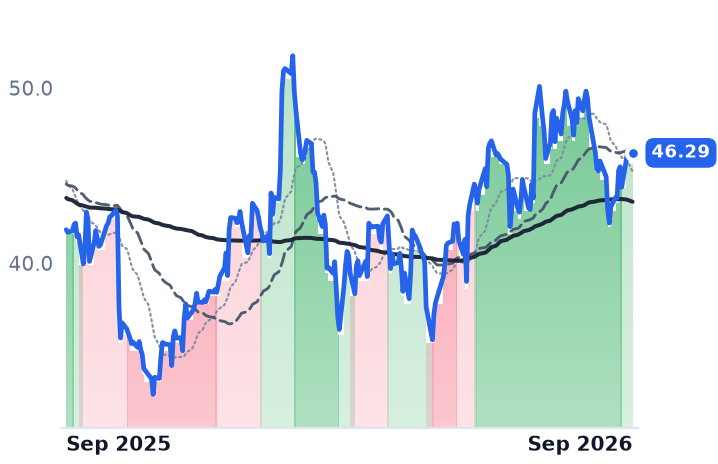
SW | Smurfit Westrock | Corrugated & Containerboard | 🟢 Cont. Bull | −7.1% | +10.5% |
| Compared against · context, not the story | |||||
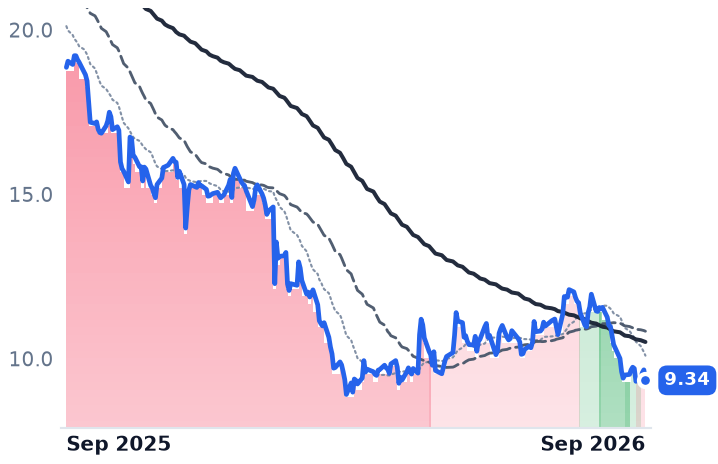
GPK | Graphic Packaging | Corrugated & Containerboard | 🔴 Cont. Bear | −19.2% | −50.5% |
12-month price & trend
| Ticker | Mkt cap | P/E | P/E fwd | P/S | P/S fwd | P/GP | P/GP fwd | EV/EBITDA | FCF yld |
|---|---|---|---|---|---|---|---|---|---|
IP | $18.6B | n/m | 25.9x | 0.8x | 0.8x | 2.8x | 2.7x | n/m | 2.6% |
PKG | $21.1B | 30.7x | 22.6x | 2.2x | 2.1x | 11.0x | 10.4x | 13.6x | 3.5% |
SW | $24.3B | 47.3x | 20.9x | 0.7x | 0.8x | 4.2x | 4.2x | 8.6x | 4.4% |
| Ticker | Mkt cap | P/E | P/E fwd | P/S | P/S fwd | P/GP | P/GP fwd | EV/EBITDA | FCF yld |
|---|---|---|---|---|---|---|---|---|---|
GPK | $2.8B | 14.2x | 13.0x | 0.3x | 0.3x | 2.1x | 2.1x | 9.1x | 6.8% |
Consensus projections
| Ticker | FY2026E | FY2027E | FY2028E | |
|---|---|---|---|---|
IP | Revenue | −0.2% | +5.8% | +1.6% |
| EPS | +462.6% | +124.5% | +15.4% | |
PKG | Revenue | +11.0% | +7.6% | +2.6% |
| EPS | +5.5% | +29.9% | +4.9% | |
SW | Revenue | +3.1% | +5.8% | +2.2% |
| EPS | −7.5% | +57.4% | +13.2% | |
GPK | Revenue | +1.0% | +2.0% | +2.0% |
| EPS | −61.4% | +53.6% | +12.6% |
Forward fiscal years only. Blank means no analyst coverage for that year.
Packaging Corporation of America, which makes containerboard and converts nearly all of it into shipping boxes, retail cartons and point-of-sale displays, told customers in late July it wanted $140 more for every ton of containerboard from 1 September. That is roughly double a normal move, and the trade press called it unprecedented. Cascades, Smurfit Westrock and International Paper followed within days at $100 and $80 a ton. When Fastmarkets RISI published its September data, it recognized $70 a ton on linerboard and $100 on corrugating medium.
That gap matters more here than in most industrial goods, because containerboard's selling price is not negotiated quietly per customer but published by a trade journal, and box contracts reset off it. And the increase was manufactured by withdrawing supply: the US corrugated industry has permanently closed roughly 3.5–4m tons of capacity since 2023, about 2m of it since the start of 2025. Demand went the other way. Box shipments fell 1.9% year-over-year in the first quarter, containerboard production fell more than 8%, and Bloomberg Intelligence forecasts a 1.5% decline in shipments for the full year. The Association of Independent Corrugated Converters, the buyers' side, publicly opposed the third increase of the year, noting that producers historically announce large numbers and secure smaller ones.
The cost leg moved with the price leg
Old corrugated containers, the recycled fiber that feeds recycled-grade mills, rose every month of 2026 from roughly $80 a ton toward $100–130; that is still below the five-year average of about $140, so this is normalization off a depressed base. Freight and electricity rose too — International Paper cited exactly those three inputs when justifying its own increase. The result is visible in the June quarter: gross margin fell year-over-year at all four names despite a rising index.
Packaging Corporation grew June-quarter revenue 14.7% to $2.49bn and produced no additional operating profit at all, with operating income flat and net income down 20.5% to $192.1m. Its volumes are the best in the group: total corrugated shipments rose 24.3% per day against a year earlier, and excluding the Greif containerboard business bought for $1.8bn in September 2025, legacy shipments still rose 4.1% per day to a quarterly record. Greif added $0.14 of earnings per share. None of it reached the operating line, and the pattern is four quarters old: revenue growth of 6.0%, 10.1%, 10.6% and 14.7%, against operating income down slightly in each.
International Paper is the same squeeze without the growth. June-quarter revenue fell 11.3% to $6.0bn, operating income fell to $45m from $186m — a margin of 0.75% — and the company posted a $12m net loss. Its answer is supply: five sites closing across six states for an expected $230m earnings improvement, the Georgetown pulp mill shut, a paper machine at DS Smith's Kemsley mill in the UK closing while another is modernized, and $500m of DS Smith synergies targeted by 2027. "We are taking cost and complexity out of the business," chief executive Andy Silvernail told investors on the second-quarter call, where management also cut its second-half demand assumption from a 1% uptick to generally stable. Its North American box volumes rose 1.7% a day — share gain in a shrinking market.
Smurfit Westrock, the Dublin-headquartered combination of Smurfit Kappa and WestRock and the largest of the four by market value, reported the widest gap between commentary and accounts. Revenue rose 1.1% to $8.03bn; operating income fell 44% to $309m, halving the margin over five quarters. Paper markets "are as strong as I have seen in my lifetime within this industry," chief executive Tony Smurfit said on the 29 July call, with the company sold out of nearly every grade. Management's own explanation of the timing is the key to the group: the mill-side increases will be recovered through its converting operations through this year and into next.
Graphic Packaging shows the cost leg with no index to offset it. It sells folding cartons, cups and food containers off bleached and recycled paperboard grades to consumer-goods and quick-service restaurant buyers, not linerboard, and it re-guided 2026 inflation to at least $150m from $60–65m. Gross margin fell to 13.35% from 19.19%, operating income 56%, and consensus 2026 earnings per share of $0.72 is 61% below the $1.48 it delivered in 2025 — against $5.5bn of net debt.
What the shares did, and what they did not settle
September was broad rather than papery: three quarters of the 3,344 symbols priced daily are down over the trailing month, the average decline 4.3%. Within that, International Paper (−15.5%) and Graphic Packaging (−18.3%) were outliers; Packaging Corporation (−4.3%) and Smurfit Westrock (−7.1%) were not. Over twelve months the four do not move together at all: Packaging Corporation is up 11.6% and Smurfit Westrock 5.7%, while International Paper is down 24.0% and Graphic Packaging 52.1%. The clearest company-specific news in the month was a valuation call — BofA Securities cut its Packaging Corporation target to $260 from $280 on 11 September while keeping a Buy — and JPMorgan raised its target to $320 twelve days later.
So the verdict splits. The de-rating at Graphic Packaging is doing rational work: earnings estimates cut 61% and the shares at 0.86x book. International Paper's decline has outrun a business whose volumes are growing and whose 2027 consensus of $3.04 a share puts it near 12x, though its trailing price-to-earnings and enterprise-value multiples are unusable after 2025's $3.5bn net loss, so the cheapness rests on 0.77x sales and 1.28x book. Packaging Corporation, at 22.6x forward earnings and 13.6x trailing enterprise value to EBITDA against Smurfit Westrock's 8.6x, is priced for a 2027 step-up to $13.61 that its last four quarters have not begun to deliver. Smurfit Westrock has advanced without paying for it. What none of them has yet shown is a quarter in which the published price beat the cost of making the board.
Fastmarkets has proposed adding a corrugated box cost index alongside its containerboard prices. When the benchmark that sets an industry's revenue needs a second benchmark to describe what buyers actually pay, the distance between an announcement and a dollar has become the business.