

Four Buying Groups Set 90% of US Generic Prices; Teva's Branded Trio Sidesteps Them
Hypothesis Opus 5 · Research Opus 5 · Writing Opus 5 · Prompt v1.6
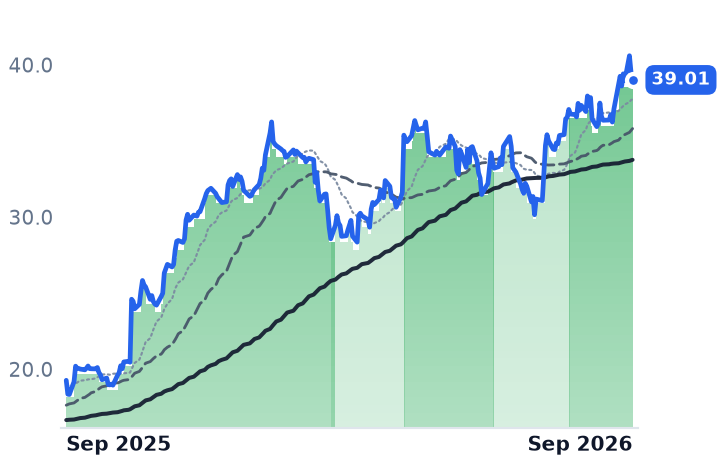
A twelve-month advance that reads as a generics revival is three winners averaged against three losers. Teva, Amneal and Viatris rose sharply; Amphastar, Dr. Reddy's Laboratories and ANI Pharmaceuticals fell. What separates them is not skill at generics — a generic pill's price is negotiated with a handful of buying consortia and erodes by contract design — but whether a company sells something it prices itself.
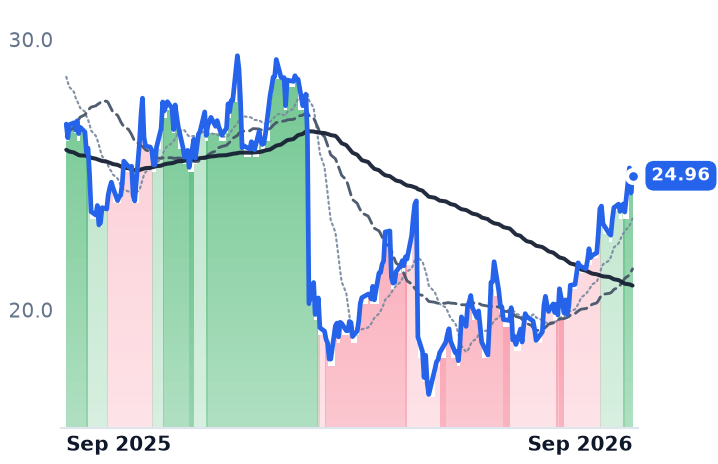
Teva's June-quarter gross profit grew 2.4% while Austedo, which it prices, delivered $696m. Amphastar's gross margin has slid from 54.5% in 2023 to 49.5% in 2025: hard-to-make injectables earn a rent with a clock on it, refreshed only by the next approval.
Teva now carries the group's highest forward earnings multiple; ANI Pharmaceuticals, growing revenue fastest of the six, trades at 8.0x.
| Ticker | Company | Segment | Trend · 13mo | 30D | 1Y |
|---|---|---|---|---|---|
| The subject · what this brief is about | |||||
TEVA | Teva Pharmaceutical Industries | Generic & API Manufacturers | 🟢 Cont. Bull | +2.8% | +102.4% |
AMPH | Amphastar Pharmaceuticals | Generic & API Manufacturers | 🟢 Cont. Bull | +14.4% | −7.1% |
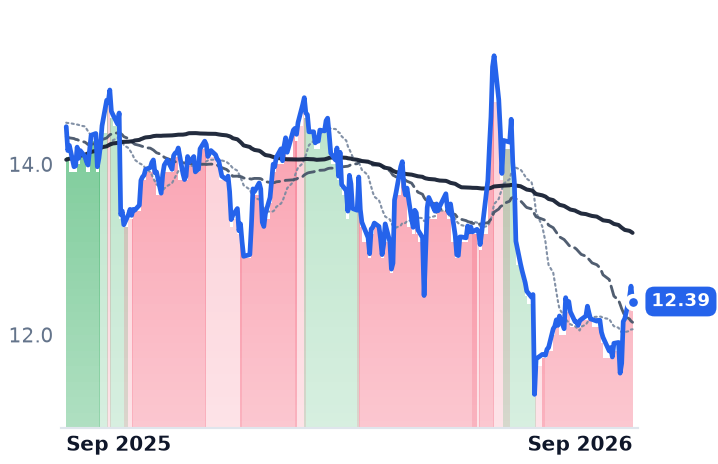
RDY | Dr. Reddy's Laboratories | Generic & API Manufacturers | 🔴 Cont. Bear | +0.4% | −14.2% |
| Compared against · context, not the story | |||||
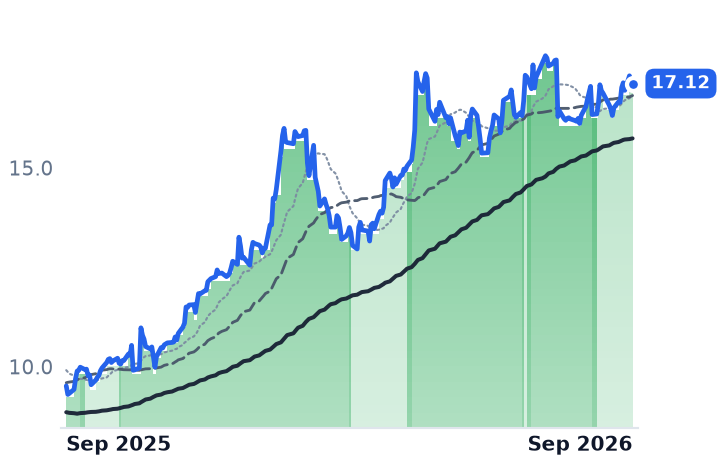
VTRS | Viatris | Generic & API Manufacturers | 🟢 Cont. Bull | +2.4% | +79.9% |
AMRX | Amneal Pharmaceuticals | Generic & API Manufacturers | 🟢 Cont. Bull | +9.1% | +99.1% |
ANIP | ANI Pharmaceuticals | Generic & API Manufacturers | 🔴 Cont. Bear | −0.1% | −21.6% |
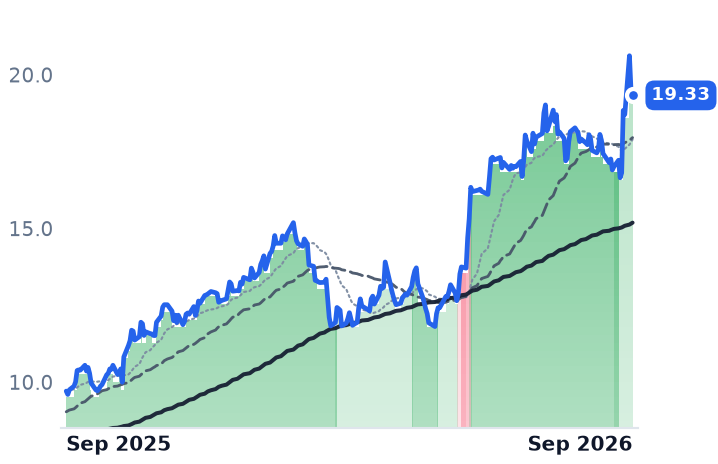
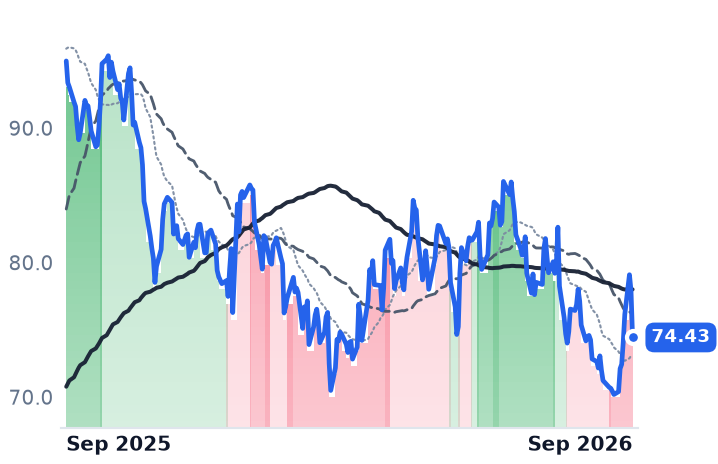
12-month price & trend
| Ticker | Mkt cap | P/E | P/E fwd | P/S | P/S fwd | P/GP | P/GP fwd | EV/EBITDA | FCF yld |
|---|---|---|---|---|---|---|---|---|---|
TEVA | $45.4B | 61.4x | 19.4x | 2.6x | 2.7x | 4.9x | 5.2x | 18.9x | 5.3% |
AMPH | $1.1B | 14.3x | 8.4x | 1.5x | 1.5x | 3.2x | 3.1x | 9.0x | 13.9% |
RDY | $10.3B | 30.3x | — | 3.0x | — | 6.0x | — | 15.9x | 1.5% |
| Ticker | Mkt cap | P/E | P/E fwd | P/S | P/S fwd | P/GP | P/GP fwd | EV/EBITDA | FCF yld |
|---|---|---|---|---|---|---|---|---|---|
VTRS | $19.9B | n/m | 6.8x | 1.4x | 1.3x | 3.9x | 3.9x | 12.4x | 9.4% |
AMRX | $6.2B | 38.9x | 19.0x | 2.0x | 2.0x | 5.0x | 5.0x | 13.5x | 1.3% |
ANIP | $1.7B | 15.4x | 8.0x | 1.7x | 1.5x | 2.7x | 2.4x | 6.5x | 9.4% |
Consensus projections
| Ticker | FY2026E | FY2027E | FY2028E | |
|---|---|---|---|---|
TEVA | Revenue | −0.2% | +4.6% | +4.6% |
| EPS | −23.0% | +53.8% | +11.9% | |
AMPH | Revenue | +3.1% | +4.9% | +3.0% |
| EPS | −13.6% | +7.1% | +6.3% | |
RDY | Revenue | +7.4% | +1.4% | +11.7% |
| EPS | −10.9% | −28.8% | +32.5% | |
VTRS | Revenue | +4.7% | +1.8% | +3.2% |
| EPS | +8.6% | +5.9% | +7.9% | |
AMRX | Revenue | +4.7% | +9.0% | +10.9% |
| EPS | +27.4% | +17.3% | +21.4% | |
ANIP | Revenue | +27.1% | +11.5% | +8.4% |
| EPS | +23.2% | +12.9% | +14.2% |
Forward fiscal years only. Blank means no analyst coverage for that year.
Four customers
The American generic drug business has four customers. Red Oak Sourcing, ClarusONE, Walgreens Boots Alliance Development and Econdisc Contracting Solutions — joint ventures pairing the big pharmacy chains with the big wholesalers — together buy more than 90% of the generic volume purchased in the United States. A manufacturer that wins approval to copy an off-patent molecule does not enter a market. It negotiates a per-pill price with effectively four counterparties, and that price goes down.
So the past twelve months in generics are not the revival the group average suggests. Among six US-listed makers of generics and active ingredients, three roughly doubled or better — Teva up 100.6%, Amneal 96.4%, Viatris 78.3% — while Amphastar, Dr. Reddy's Laboratories and ANI Pharmaceuticals all fell, ANI by 21.9%. The split does not sort by who is best at generics. It sorts by who sells something the four buyers do not price, and whose balance sheet was being marked for distress a year ago.
Teva sold itself out of the contract
Teva Pharmaceutical Industries, the Tel Aviv maker of generics, specialty medicines and active ingredients, reported June-quarter revenue of $4.14bn, down 0.8%. Gross profit grew 2.4%, all of it mix: margin reached 52.0% against 50.3% a year earlier. Underneath sit two opposite businesses. Austedo, its tardive dyskinesia treatment, delivered $696m, up 40% in local currency, and full-year guidance rose to $2.45–2.60bn — a midpoint that reaches in 2026 the $2.5bn the company had targeted for 2027. With Uzedy and Ajovy, the three brands Teva prices itself grew 43% and are guided to roughly $3.7bn this year, about a fifth of group revenue. Meanwhile US generics including biosimilars fell 31% to $660m, mostly because generic Revlimid drew additional entrants.
"The innovative portfolio is reshaping our financial profile with stronger revenue growth, margins, and free cash flow," chief executive Richard Francis told investors on the 29 July call.
The other half of the doubling is credit, not commerce. Net debt to EBITDA fell to 2.42x from 3.10x against a 2.0x target for 2027, and on 4 September S&P Global Ratings raised Teva to BBB−, the last agency to restore investment grade; Teva then refinanced $4.9bn at lower coupons. That cuts the cost of the capital structure without changing what a pill earns.
The scarcity rent has a clock on it
Amphastar Pharmaceuticals, a California maker of difficult injectables and inhalation products — enoxaparin, glucagon kits, naloxone, and the BAQSIMI nasal glucagon franchise bought from Eli Lilly — is the test of whether manufacturing difficulty buys durable pricing. On its own numbers, it buys a lease. Gross margin fell from 54.5% in 2023 to 49.5% in 2025 while operating income dropped 31.7% to $140.4m, and the March quarter bottomed at 41.1%. June's recovery to 50.8% came from brand-new approvals — ipratropium bromide inhalation aerosol carrying 180-day exclusivity, teriparatide and iron sucrose — which chief financial officer Bill Peters set against pricing pressure in BAQSIMI and glucagon. BAQSIMI is the erosion in miniature: net sales fell 3% to $45.5m while prescriptions rose 17%, volume adding $6.9m and rebates and discounts taking about $8.1m away. A $100m milestone payment to Lilly falls due in the September quarter.
Integration did not protect Dr. Reddy's
Dr. Reddy's Laboratories, the Hyderabad group that makes the active ingredients it formulates, had a collapse rather than a grind: June-quarter revenue of ₹81.2bn fell 5.0%, gross margin dropped to 46.5% from 56.9%, and net income fell 68.5%. Generic semaglutide launched in Canada on the first G7 authorization, then stopped after roughly 180,000 pens, with a ₹2.4bn provision — about $27m converted — and supply now expected in November. Chief executive Erez Israeli blamed "semaglutide-related challenges" and an impurity that emerged at scale-up. But fiscal 2026 gross margin had already fallen to 52.8% from 58.5%, with operating income down 32.0% — the deterioration predates the pens.
Nor is this a reshoring trade. Generics, biosimilars and their ingredients are excluded from the April 2026 Section 232 order that set a 100% default rate on patented pharmaceutical imports — an advantage, not a cost. The exclusion is provisional: the order mandates a generics policy review within a year, and a phased generics tariff has been trailed for 2028.
What the group pays for
Viatris, the Pennsylvania group behind EpiPen, Lyrica and the Semglee biosimilar, grew June-quarter revenue 4.9% to $3.76bn with gross profit up 9.3% — its first growth after sliding from $17.9bn of annual revenue in 2021 to $14.3bn in 2025 — and still trades at 6.8x forward earnings, the cheapest of the six. Amneal, whose AvKARE unit supplies the Departments of Defense and Veterans Affairs, grew revenue 9.9% and operating income 31.1%, but at 19.0x forward and a 1.3% free-cash-flow yield its shares have run well ahead of that. ANI Pharmaceuticals, the Minnesota maker of Cortrophin Gel and the ILUVIEN and YUTIQ eye implants, grew revenue 25.9% to $266m and nearly tripled operating income — and fell 21.9% over the year, into 8.0x forward earnings and the group's lowest enterprise value against EBITDA at 6.5x.
Teva, the biggest gainer, is the most expensive on 19.4x forward earnings and 18.9x EV/EBITDA. That multiple sits on a deliberate trough — consensus has 2026 earnings per share at $2.01, down 23%, before $3.10 in 2027, which would be about 12.6x. Consensus also has group gross profit essentially flat this year. So the branded pivot and the investment-grade upgrade earn a real part of the doubling; the rest is the market paying now for 2027. Amphastar's decline is earned by its own margin line. ANI is the cell nothing in the generics story explains.
The arithmetic of the four buyers did not change this quarter. The only force that lifts a generic price is a rival walking away — and the walking away is measurable: US drug shortages now last, on average, more than five years.