

Analog Devices Paid $1.5bn for In-Package Power as Communications Revenue Grew 84%
Hypothesis Opus 5 · Research Opus 5 · Writing Opus 5 · Prompt v1.6
The chip company most investors still file under industrial and automotive analog is now selling power into AI racks — and its shares have been sold as if the cycle were rolling over.
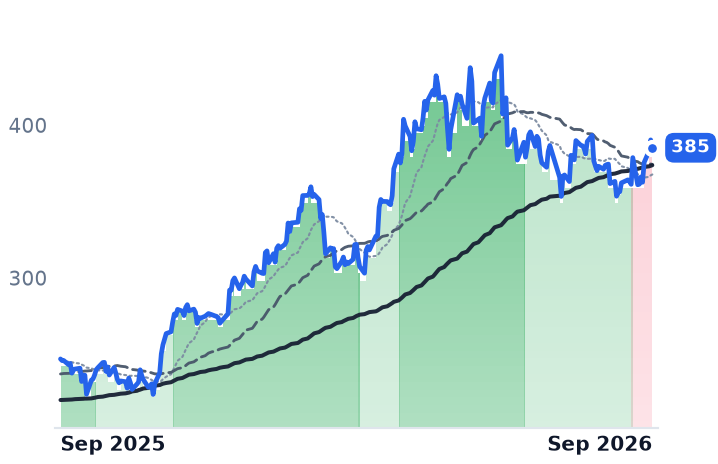
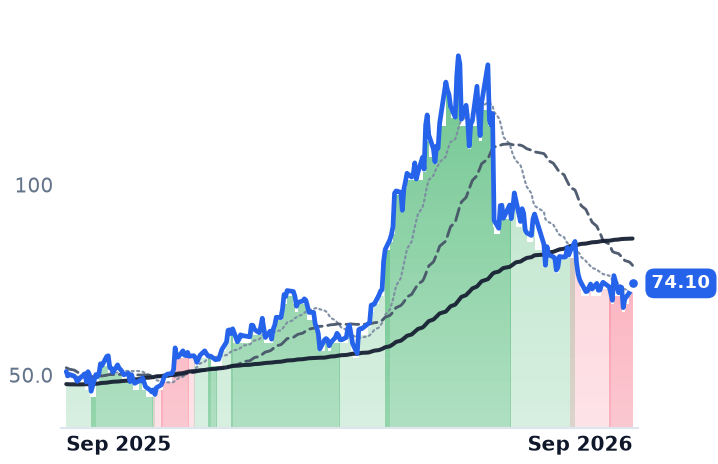
Analog Devices reported its first $4bn quarter on 19 August, with year-over-year revenue growth accelerating across three quarters to 39.6%, and data center is now 80% of its communications segment. The stock sits 13.5% below its June high, and trailing price/earnings has compressed from 57.9x in mid-August to 45.5x while forward estimates rose.
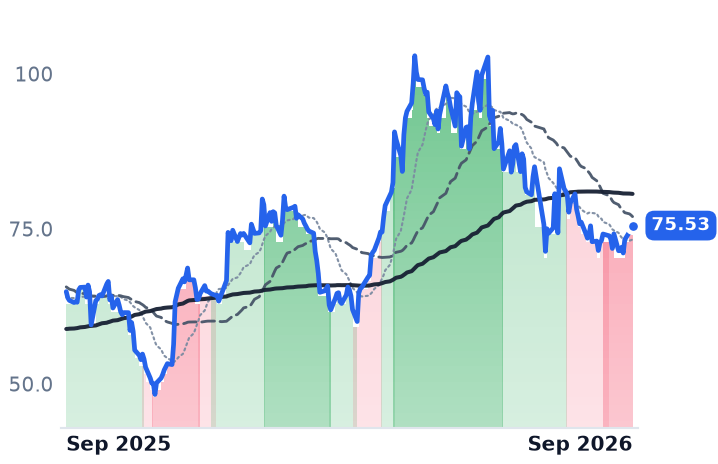
The split inside this group is sharp. Monolithic Power grew enterprise data-center revenue 164% and has fallen since early September. Vicor, whose September guidance raise came from patent royalties rather than shipped modules, is the only one of the six power and analog names rising this month.
| Ticker | Company | Segment | Trend · 13mo | 30D | 1Y |
|---|---|---|---|---|---|
| The subject · what this brief is about | |||||
ADI | Analog Devices | Analog & Mixed-Signal | 🟢 Cont. Bull | +3.1% | +56.0% |
MPWR | Monolithic Power Systems | Analog & Mixed-Signal | ⚠️ Emerging Bear | +3.9% | +50.0% |
VICR | Vicor | Other | ⚠️ Emerging Bear | +46.3% | +436.2% |
| Compared against · context, not the story | |||||
TXN | Texas Instruments Incorporated | Analog & Mixed-Signal | 🟢 Cont. Bull | +4.8% | +50.9% |
ON | ON Semiconductor | Analog & Mixed-Signal | ⚠️ Emerging Bear | +2.8% | +45.5% |
MCHP | Microchip Technology Incorporated | Analog & Mixed-Signal | ⚠️ Emerging Bear | +2.8% | +16.4% |
NVDA | NVIDIA | AI & Data Center GPUs | 🟢 Cont. Bull | +6.1% | +27.4% |
12-month price & trend
| Ticker | Mkt cap | P/E | P/E fwd | P/S | P/S fwd | P/GP | P/GP fwd | EV/EBITDA | FCF yld |
|---|---|---|---|---|---|---|---|---|---|
ADI | $187.6B | 45.5x | 29.9x | 13.5x | 12.4x | 20.5x | 18.9x | 29.8x | 2.6% |
MPWR | $66.6B | 82.7x | 49.4x | 20.3x | 16.0x | 36.9x | 29.1x | 64.8x | 0.9% |
VICR | $12.8B | 88.8x | 79.1x | 27.1x | 21.0x | 47.8x | 37.1x | 97.1x | 0.4% |
| Ticker | Mkt cap | P/E | P/E fwd | P/S | P/S fwd | P/GP | P/GP fwd | EV/EBITDA | FCF yld |
|---|---|---|---|---|---|---|---|---|---|
TXN | $243.5B | 40.3x | 31.3x | 12.5x | 11.1x | 21.5x | 19.0x | 27.9x | 2.2% |
ON | $27.2B | 44.3x | 21.9x | 4.4x | 4.2x | 11.7x | 11.1x | 22.3x | 6.5% |
MCHP | $40.3B | 102.8x | 20.4x | 7.9x | 6.3x | 13.1x | 10.5x | 27.0x | 2.8% |
| Ticker | Mkt cap | P/E | P/E fwd | P/S | P/S fwd | P/GP | P/GP fwd | EV/EBITDA | FCF yld |
|---|---|---|---|---|---|---|---|---|---|
NVDA | $5.5T | 34.3x | 25.0x | 21.5x | 13.9x | 29.0x | 18.7x | 28.3x | 2.2% |
Consensus projections
| Ticker | FY2026E | FY2027E | FY2028E | |
|---|---|---|---|---|
ADI | Revenue | +37.8% | +22.1% | +11.6% |
| EPS | +65.8% | +29.4% | +18.0% | |
MPWR | Revenue | +49.2% | +28.7% | +20.2% |
| EPS | +54.8% | +31.0% | +20.2% | |
VICR | Revenue | +34.9% | +54.2% | +22.1% |
| EPS | +65.5% | +67.5% | +32.4% | |
TXN | Revenue | +24.0% | +13.8% | +10.6% |
| EPS | +55.6% | +20.7% | +17.1% | |
ON | Revenue | +9.2% | +13.1% | +13.9% |
| EPS | +37.1% | +40.6% | +30.5% | |
MCHP | Revenue | +6.2% | +37.1% | +16.4% |
| EPS | +20.7% | +132.2% | +25.6% | |
NVDA | Revenue | +65.1% | +84.2% | +43.2% |
| EPS | +59.0% | +91.7% | +42.0% |
Forward fiscal years only. Blank means no analyst coverage for that year.
Analog Devices closed a $1.5bn all-cash purchase of Empower Semiconductor on 7 July, buying a company that puts voltage conversion inside the processor package. Six weeks later the Wilmington, Massachusetts maker of data converters, amplifiers and power-management chips reported its first $4bn quarter, with communications revenue up 84% year over year and data center accounting for 80% of that segment. Optical and power within it each more than doubled.
That matters because Analog Devices is still read as the industrial and automotive analog cycle in listed form — distributor channels, lead times, restocking. The reading has stopped describing the company. Power delivery inside an artificial-intelligence rack is now a contested socket, and three firms are being paid for it three different ways: per part, per socket, and — in one case — per patent.
The record quarter the market marked down
Analog Devices' growth is accelerating, not fading: revenue rose 30.4% year over year in fiscal first quarter 2026, 37.2% in the second and 39.6% in the third, while operating margin widened from 31.5% to 40.1% across the same stretch. Industrial, still 49% of revenue, grew 53%; automotive, a quarter of the business, grew 16%. "ADI delivered a strong third quarter, exceeding the midpoint of our revenue, margin, and earnings outlook as we capitalized on broad-based demand," chief executive and chair Vincent Roche said on 19 August. On the same call, management called intermediate-to-core conversion — feeding 6,000-amp, sub-one-volt processors — one of the fastest and largest growing analog opportunities, and said book-to-bill was not unusually elevated, with customers running lean and minimal restocking.
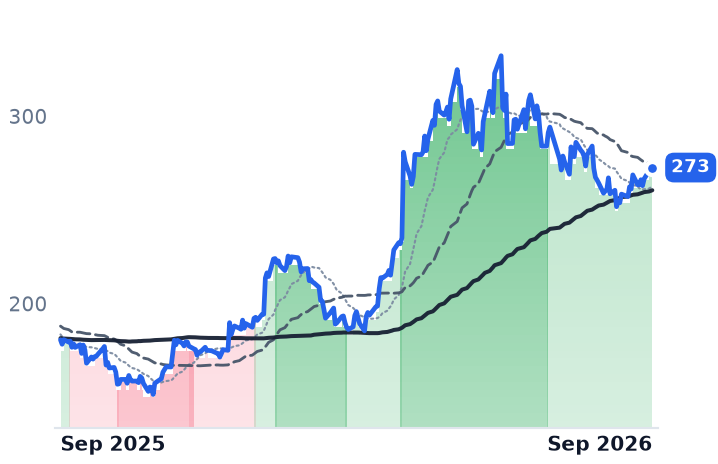
The shares have gone the other way. Analog Devices closed at $385.23 on 23 September, 13.5% below its 22 June close, though still up 56% over twelve months, and its trend turned negative in the second week of September — three weeks after the record print. Trailing price/earnings has fallen to 45.5x from 57.9x in mid-August, most of that delivered by a higher earnings base rather than by the 1.3% decline in market value; forward earnings are 29.9x against consensus for 66% earnings growth this fiscal year. The company guided fourth-quarter revenue to a record $4.3bn, plus or minus $100m, and does not report again until 1 December. Across the wider group the drawdowns are worse — onsemi is down 44.7% from its high, Microchip 26.6%, Texas Instruments 18.0% — which makes sector de-rating the likelier reading than anything discoverable about Analog Devices itself.
The other two meters
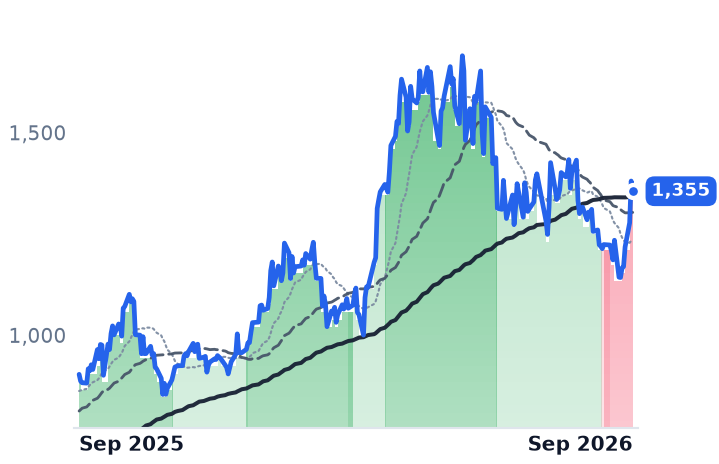
Monolithic Power Systems, which designs the power-management chips inside Nvidia reference boards, is the direct socket-content read, and it is accelerating: enterprise data revenue of $380.6m in the June quarter, up 164% year over year and 38.8% of the company, with the full-year growth floor for that segment raised from 85% to 130%. "Our results demonstrate the strength of our diversified model," founder-chief executive Michael Hsing said on 30 July. The stock has fallen since early September and sits 19.8% below its high, at 36.9x trailing gross profit against the roughly 39x that marked the top of its range five weeks ago.
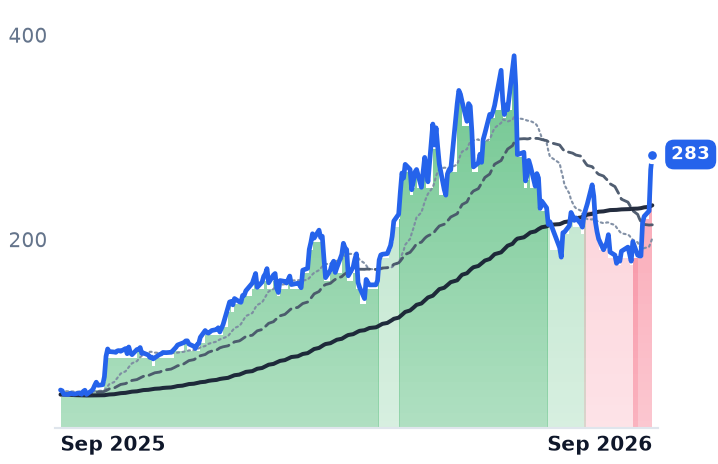
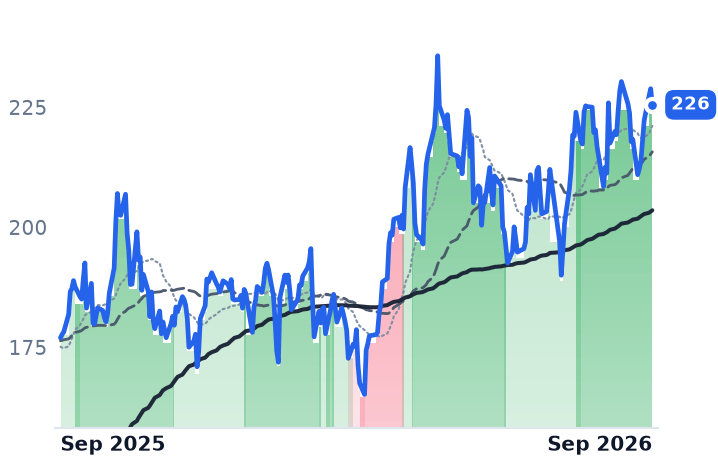
Vicor, the Andover module maker whose vertical power delivery patents cover the architecture the industry is migrating onto, is the exception — and the reason is legal. On 16 September it licensed those patents to a leading AI original-equipment manufacturer on terms that let the licensee buy the modules from someone else, then on 21 September doubled its third-quarter sequential growth guidance to more than 20% citing royalties from it. Its shipped business is strong underneath — advanced products up 45% sequentially to $94.2m and one-year backlog up 26% to $379.7m — and the reported 1.6% revenue growth is an artifact: the year-ago quarter contained a $45m patent-litigation settlement, and core revenue grew 49.3% without it. Gross margin's rise to 58.0% from 55.2% is likewise part mix, since royalty dollars carry almost no cost of goods. At 79.1x forward earnings, Vicor is dearer than when a near-identical share price implied roughly 68x in May.
What the money actually buys
Royalty income is real revenue, but it is paid on someone else's shipments at a rate that rises as litigation escalates — it does not scale with Vicor's own fab, and the second fab that chief executive Patrizio Vinciarelli said in July is necessary on the path to $2.5bn of revenue is a fixed cost that royalties will not fill. Analog Devices and Monolithic Power are the two here converting AI rack demand into shipped silicon, and both are being priced as analog cyclicals rolling over while their data-center lines compound. Nothing in either company's disclosure explains the de-rating; the shares are carrying a sector verdict their own numbers contradict.
Between now and 1 December there is no Analog Devices print to settle it. The next news out of this group may well come from a docket rather than a fab.