

Tanker Rates Passed $1.2m a Day With Hormuz Shut; Iran Offered a Seven-Day Reopening
Hypothesis Opus 5 · Research Opus 5 · Writing Opus 5 · Prompt v1.6
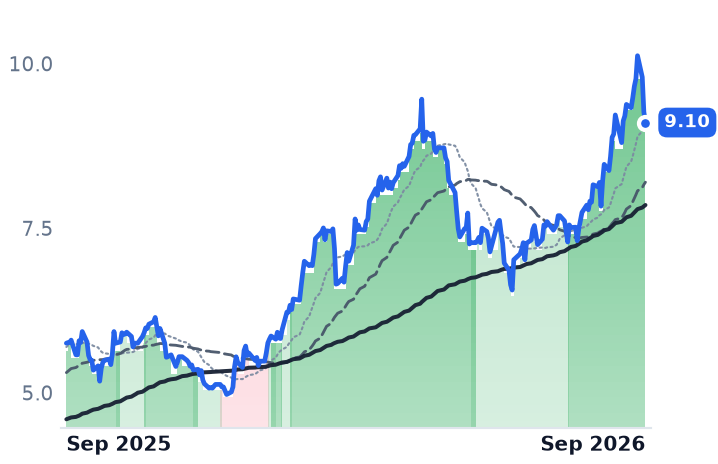
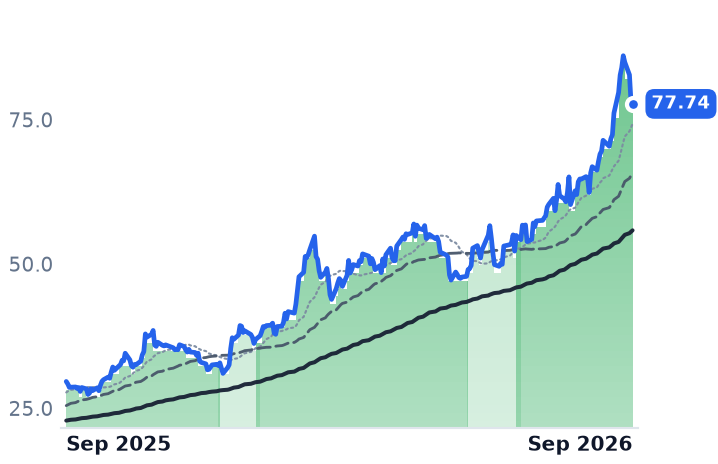
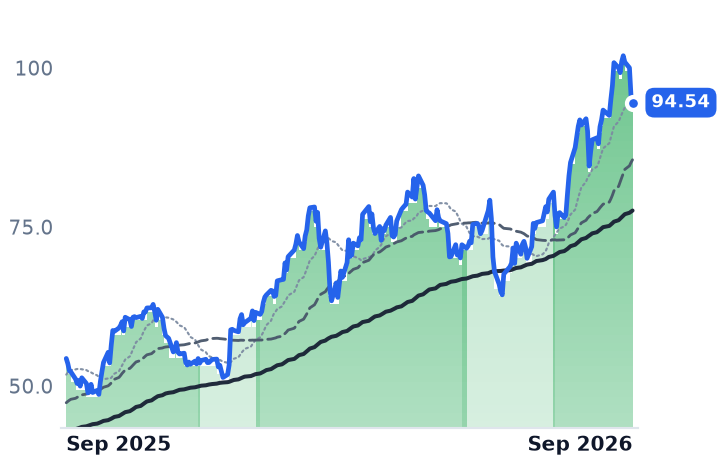
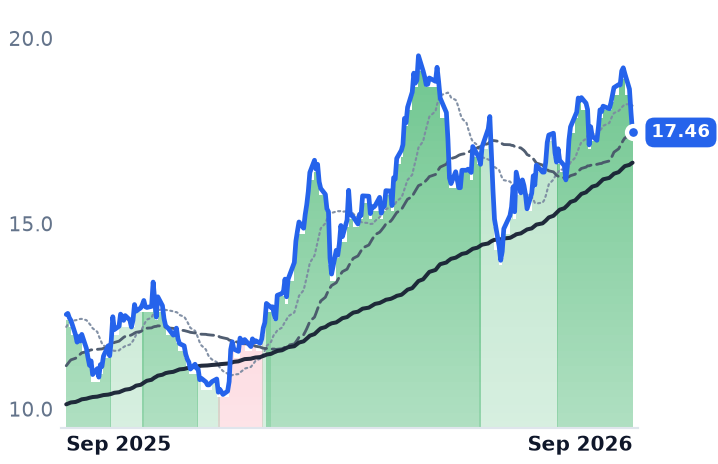
Tanker shares peaked on 17–18 September and then fell together for three sessions — while the freight rates those ships earn were printing all-time records. The break was diplomatic: a senior Iranian official said Iran could reopen the Strait of Hormuz within a week if Washington lifts its naval blockade, and crude-freight futures dropped about 24% intraday on 22 September.
The operating side is unanimous. Okeanis grew second-quarter revenue 239% at a 76.7% gross margin; Teekay ran Suezmaxes at $109,200 a day against roughly $9,700 of cash breakeven. The group splits on what that is worth. Teekay holds $1.215bn of cash and no debt at 1.38x book; Okeanis trades at 3.43x book with consensus halving its 2027 earnings; Hafnia has 80% of third-quarter days fixed at $30,716, below what it just realised.
| Ticker | Company | Segment | Trend · 13mo | 30D | 1Y |
|---|---|---|---|---|---|
| The subject · what this brief is about | |||||
HAFN | Hafnia | Oil & Chemical Tankers | 🟢 Cont. Bull | +12.0% | +58.3% |
ECO | Okeanis Eco Tankers | Oil & Chemical Tankers | 🟢 Cont. Bull | +19.3% | +162.2% |
TNK | Teekay Tankers | Oil & Chemical Tankers | 🟢 Cont. Bull | +2.7% | +74.0% |
| Compared against · context, not the story | |||||
ASC | Ardmore Shipping | Oil & Chemical Tankers | 🟢 Cont. Bull | −4.3% | +39.1% |
NAT | Nordic American Tankers | Oil & Chemical Tankers | 🟢 Cont. Bull | +8.9% | +134.5% |
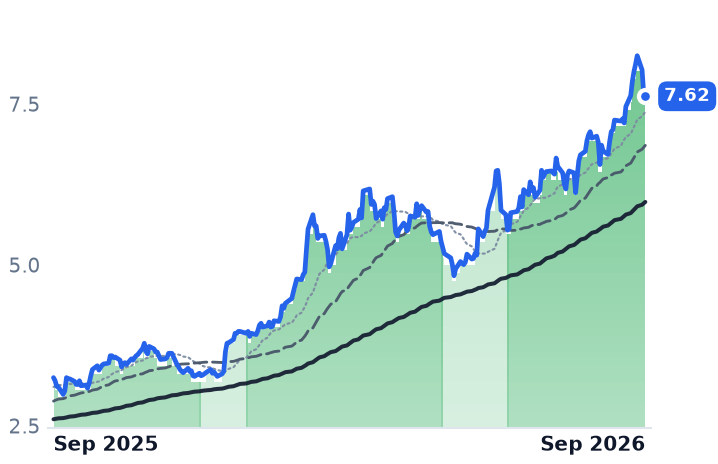
12-month price & trend
| Ticker | Mkt cap | P/E | P/E fwd | P/S | P/S fwd | P/GP | P/GP fwd | EV/EBITDA | FCF yld |
|---|---|---|---|---|---|---|---|---|---|
HAFN | $4.5B | 7.0x | 6.3x | 1.7x | 3.5x | 7.3x | 14.9x | 6.2x | 12.0% |
ECO | $2.6B | 7.2x | 4.5x | 4.2x | 3.0x | 6.3x | 4.6x | 7.0x | 1.5% |
TNK | $3.3B | 5.5x | 5.3x | 2.8x | 3.1x | 6.6x | 7.2x | 3.7x | 11.2% |
| Ticker | Mkt cap | P/E | P/E fwd | P/S | P/S fwd | P/GP | P/GP fwd | EV/EBITDA | FCF yld |
|---|---|---|---|---|---|---|---|---|---|
ASC | $777.3M | 7.4x | 6.6x | 2.1x | 2.8x | 5.6x | 7.5x | 5.2x | 1.7% |
NAT | $1.7B | 14.0x | 9.1x | 4.6x | 5.3x | 12.2x | 13.9x | 11.1x | 6.8% |
Consensus projections
| Ticker | FY2026E | FY2027E | FY2028E | |
|---|---|---|---|---|
HAFN | Revenue | +31.2% | −17.7% | −16.3% |
| EPS | +112.5% | −35.6% | −25.1% | |
ECO | Revenue | +217.7% | −35.9% | −29.0% |
| EPS | +382.5% | −50.0% | −36.0% | |
TNK | Revenue | +69.1% | −23.8% | −26.5% |
| EPS | +163.3% | −38.2% | −31.9% | |
ASC | Revenue | +37.7% | −20.6% | −13.9% |
| EPS | +184.0% | −42.5% | −32.1% | |
NAT | Revenue | +65.7% | −2.1% | −36.6% |
| EPS | +700.0% | −37.8% | −70.5% |
Forward fiscal years only. Blank means no analyst coverage for that year.
Two days ago the fixture books said one thing about the fourth quarter. Since then the spot market said the opposite, and the shares ignored both. Between Friday 18 September and Wednesday 23 September all five listed oil and chemical tanker owners fell together — Hafnia by 10.0%, Okeanis Eco Tankers by 8.5%, Ardmore Shipping by 8.3%, Nordic American Tankers by 7.6% and Teekay Tankers by 6.3% — in the same days the Baltic Exchange's benchmark Middle East Gulf–China route for very large crude carriers ran above $1.2m a day. Okeanis and Teekay set their highest closes of the year on 17 September. They turned down into record freight.
The cause is dated and specific. A senior Iranian official told Reuters that Iran could reopen the Strait of Hormuz within seven days if the United States eases military pressure and lifts its naval blockade of Iranian ports, a proposal passed to Washington through mediators. The Breakwave Tanker Shipping exchange-traded fund, which holds near-dated crude freight futures, fell about 24% intraday on Tuesday 22 September before recovering ten points of that. What is at stake is not this quarter's cash — that is already earned — but whether the earnings power itself survives a phone call.
The mechanism is vessel-days, not barrels
Hormuz has been effectively shut since early March, running between five and eleven transits a day under naval escort against roughly 125 before the war. Gulf crude bound for Asia goes around the Cape, and cargoes that do come out are shuttled short-haul and transferred ship-to-ship in the Gulf of Oman onto larger tonnage. The result is perverse and it is the whole trade: Breakwave counts more very large crude carriers in the Arabian Gulf and Gulf of Oman today than the region held before the war, moving fewer absolute barrels. Fewer barrels, more ship-days. The benchmark route was assessed near $451,000 a day on 16 September, at $982,072 a day on 18 September, and past $1.2m in the week of 21 September. Clarksons reckons 130 earning days at those rates equal the entire value of an average ten-year-old ship. "What is happening is truly unprecedented," Poten & Partners' head of marine research Erik Broekhuizen said.
What the quarter actually paid
Every one of the five accelerated in the June quarter with large margin expansion. Okeanis, a Piraeus owner of eighteen scrubber-fitted crude tankers run by fourteen employees, grew revenue 239% to $318.9m at a 76.7% gross margin, earned about $181,000 per vessel per day fleetwide and paid out 89% of net income as a $5.25 dividend. Teekay, which runs roughly 48 crude and product carriers plus ship-to-ship transfer services, grew revenue 63.0% and posted record Suezmax spot earnings of $109,200 a day against a cash breakeven near $9,700 — roughly eleven times over, so rate converts to cash almost whole. Ardmore, a product and chemical owner of some 25 mid-size ships, earned $51,900 a day on medium-range tonnage against $10,800 of operating breakeven.
The split inside the group is crude versus clean, and it is measurable. Roughly two-thirds of the world's LR2 product tankers are now hauling crude; in the Baltic's 11 September assessment a Mediterranean crude cargo paid just over $115,200 a day while a comparable clean cargo running east through Suez paid just under $38,000. That is why Hafnia — the largest of the five at $4.55bn, running about 200 product tankers plus a pool and technical-management business — grew revenue 40.2% yet has 80% of third-quarter days fixed at $30,716 a day against $44,093 realised in the second quarter, all of it booked before crude went to seven figures. "We are still experiencing disruptions to Gulf flows and rising tensions have reestablished the Red Sea chokepoints, dislocating oil flows across the world," Mikael Skov, then chief executive, told investors on the 28 August call; he handed over to Søren Steenberg Jensen on 1 September. Ardmore, the product-only name, is the one of the five down over thirty days, by 5.1%.
Three different prices for the same weather
Teekay carries $1.215bn of cash against zero debt, booked $55.2m of gains selling two ships, and trades at 1.38x book and 3.74x trailing enterprise value to earnings before interest, tax, depreciation and amortisation — the cheapest asset anchor here, on an 11.2% free-cash-flow yield. Okeanis, up more than any of them over a year, sits at 3.43x book, with 2026 consensus earnings of $17.38 a share that the same analysts halve to $8.70 for 2027 — about 8.9x next year. Nordic American, 24 Suezmaxes and eighteen employees, is the outlier at 3.61x book and 14.0x trailing earnings. Hafnia's 12.0% free-cash-flow yield and 1.72x book look moderate; Ardmore at 1.11x book is close to the steel. Forward estimates across all five are cut between 36% and 50% into 2027.
The defence that these are cheap assets is not available. Crude tanker ordering hit roughly 27% of the operating fleet in 2026 — Okeanis' own management has called a 32% orderbook for the largest class a genuine medium-term consideration — and secondhand values are up 30% to 90% by age bracket, with resale ships fetching about $172m against $132m for a newbuilding. Steel is priced for the same weather the shares are.
So the business earns the advance to date and nothing more. Second-quarter margins, the cash at Teekay and the distributions at Okeanis and Hafnia are all real and all banked. What the last three sessions repriced is the duration of a closure, and on that the analysts do not agree: BRS expects sharp normalisation through 2027 and 2028, Breakwave warns the ordering boom produces an industry downcycle, while Morgan Stanley argues effective supply stays tight past 2027. Hafnia's own management named the mechanism that ends it: reopen Hormuz and the Red Sea, and the inefficiency ton-miles from transfers and long ballast legs simply vanish.
Seven transits a day instead of 125 is the entire thesis, and Tehran has offered to fix it in a week.