

Kalshi Traded $4.86bn of Football Bets Untaxed by States; DraftKings Pays New York 51%
Hypothesis Opus 5 · Research Opus 5 · Writing Opus 5 · Prompt v1.6
Four companies sit under one online-betting label and their businesses have stopped resembling each other. DraftKings took 15% more wagers in the June quarter than a year earlier and booked less revenue on them; a $151m operating profit a year ago became a loss. Flutter cut full-year guidance and changed chief executives as its US sportsbook revenue fell 15% while its US online casino grew 14%. Rush Street, majority online casino, accelerated to 46% revenue growth and raised guidance; Super Group, out of the United States entirely, earned a 25% operating margin.
What is breaking is one product in one country — a sports bet, taxed at state rates that keep rising, sold against a federally regulated exchange that pays no state gaming tax at all and whose legality two appeals courts have now decided differently.
| Ticker | Company | Segment | Trend · 13mo | 30D | 1Y |
|---|---|---|---|---|---|
| The subject · what this brief is about | |||||
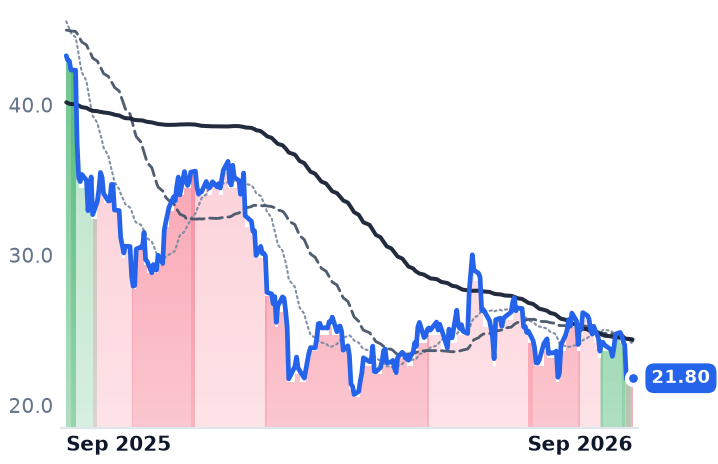
DKNG | DraftKings | Online Sports Betting & iGaming | 🔴 Cont. Bear | −16.1% | −49.6% |
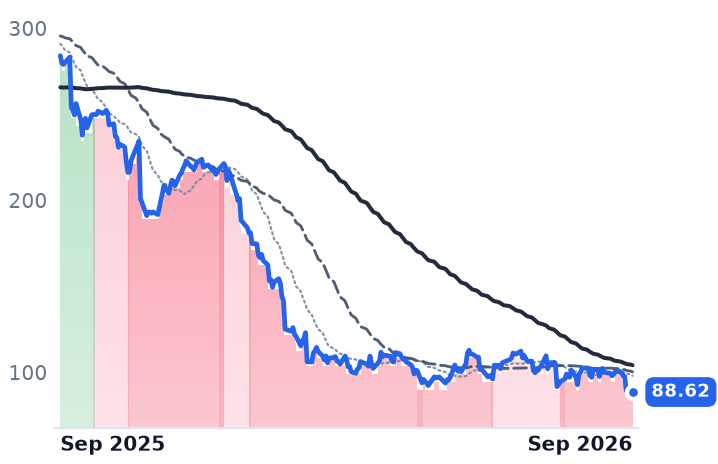
FLUT | Flutter Entertainment | Online Sports Betting & iGaming | 🔴 Cont. Bear | −13.6% | −68.8% |
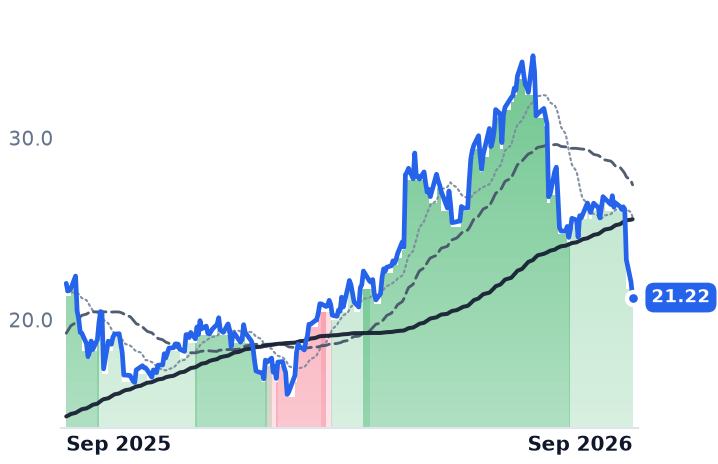
RSI | Rush Street Interactive | Online Sports Betting & iGaming | 🟢 Cont. Bull | −19.7% | −3.5% |
| Compared against · context, not the story | |||||
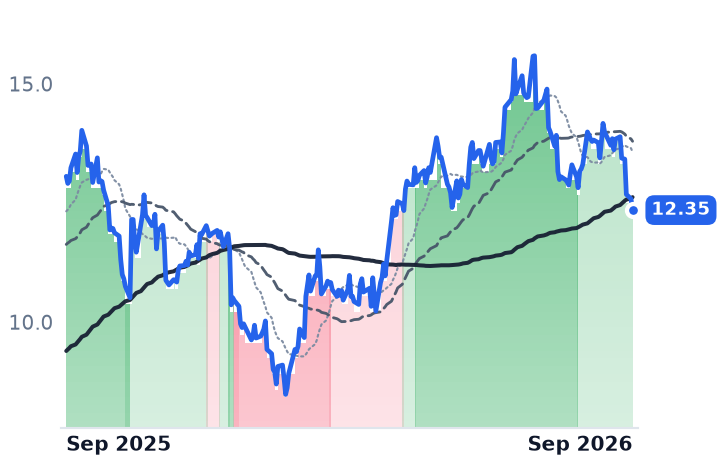
SGHC | Super Group (SGHC) | Online Sports Betting & iGaming | 🟢 Cont. Bull | −11.7% | −5.4% |
12-month price & trend
| Ticker | Mkt cap | P/E | P/E fwd | P/S | P/S fwd | P/GP | P/GP fwd | EV/EBITDA | FCF yld |
|---|---|---|---|---|---|---|---|---|---|
DKNG | $10.8B | n/m | 184.0x | 1.7x | 1.6x | 4.3x | 4.0x | 71.9x | 5.7% |
FLUT | $15.4B | n/m | 18.5x | 0.9x | 0.9x | 2.1x | 2.0x | 16.6x | 5.0% |
RSI | $5.3B | 69.1x | 34.2x | 3.8x | 3.3x | 11.0x | 9.5x | 25.9x | 3.3% |
| Ticker | Mkt cap | P/E | P/E fwd | P/S | P/S fwd | P/GP | P/GP fwd | EV/EBITDA | FCF yld |
|---|---|---|---|---|---|---|---|---|---|
SGHC | $6.3B | 16.9x | 16.9x | 2.6x | 2.7x | 8.8x | 9.3x | 9.5x | 4.0% |
Consensus projections
| Ticker | FY2026E | FY2027E | FY2028E | |
|---|---|---|---|---|
DKNG | Revenue | +11.0% | +13.1% | +12.1% |
| EPS | −175.9% | +633.3% | +83.4% | |
FLUT | Revenue | +7.9% | +8.4% | +8.7% |
| EPS | −36.7% | +50.7% | +41.2% | |
RSI | Revenue | +42.4% | +16.0% | +15.7% |
| EPS | +53.9% | +35.4% | +25.7% | |
SGHC | Revenue | +20.9% | +8.6% | +8.2% |
| EPS | +69.7% | +17.0% | +10.8% |
Forward fiscal years only. Blank means no analyst coverage for that year.
DraftKings handled $13.1bn of sports wagers in the June quarter and kept less money than it did on a smaller number of bets a year earlier. Revenue at the Boston operator, which runs mobile and retail sportsbooks in 18 states alongside its own online casino brands, fell about 5% to $1.44bn; gross profit fell 16%; and the $151m operating profit of a year earlier became a $68m loss.
That gap between bets taken and dollars kept is the mechanism the whole industry runs on, and it is worth spelling out. A sportsbook is not paid for handle. It keeps a structural hold on the amount wagered, hands a slice straight back as free bets and odds boosts that are netted out of revenue rather than shown as marketing, then pays state gaming tax on what remains — 51% of gross gaming revenue in New York — before a dollar of customer acquisition is counted. A federally regulated event contract on the same football game pays fees to the Commodity Futures Trading Commission and no state gaming tax whatsoever. That asymmetry, rather than any collapse in gambling demand, is what has split this group in two.
What actually went missing
DraftKings' sports net revenue margin fell to 6.8% from 8.7%, and chief executive Jason Robins put roughly $80m of that on customer-friendly sport outcomes — variance, which reverses. Monthly unique payers rose about 9% to 3.6 million while average revenue per payer fell 13% to $132, a decline the company attributed to promotional reinvestment behind new customers on both its sportsbook and its prediction-market product. Full-year guidance of $6.5–6.9bn of revenue and $700–900m of adjusted earnings before interest, tax, depreciation and amortization was maintained, not cut, alongside a budgeted $200–300m of spending on Predictions this year. The guided range is roughly $1bn of core operating profit less a chosen build.
The tax, unlike the hold, does not reverse. Illinois layered $0.25 on each of an operator's first 20 million online wagers and $0.50 thereafter on top of a graduated 20–40% rate; because DraftKings and FanDuel are the only two books clearing 20 million Illinois bets a year, Citizens Bank estimated a $79m hit to DraftKings and $86m to FanDuel before mitigation. Flutter answered by charging Illinois customers 50 cents a bet. New Jersey, Louisiana and Maryland all raised rates; Ohio rejected a proposal to double its 20% rate and Michigan declined too.
The untaxed socket
Kalshi, the federally regulated event-contract exchange, traded $4.86bn during the opening week of the National Football League season, with single-day records above $2.4bn on both Saturday and Sunday. A pricing sample that week put Kalshi's implied margin at 4.32%, narrower than FanDuel and DraftKings on core markets, though the books stayed stronger on combination bets. A competitor that pays no state gaming tax and prices tighter forces the taxed incumbent to match or lose handle. The legal question is unsettled: the Third Circuit ruled in April that event contracts are swaps under exclusive federal jurisdiction, the Ninth Circuit ruled the opposite, and the split is headed for the Supreme Court.
Robins is spending into it. "Based on the trends we're seeing, we could see meaningfully more investment," he said at a Wells Fargo conference in September, "and I think that's a good thing because it should accelerate our revenue and our gross profit for next year."
Two of the four are not in this story
Flutter, which owns FanDuel plus Paddy Power, Sky Bet, PokerStars and Sisal, cut full-year guidance on August 5 by $395m of revenue and $210m of profit, the US profit line alone down 22% to $760m, and replaced chief executive Peter Jackson with Dan Taylor effective October 1. Its own decomposition isolates the wound: US revenue down 6%, sportsbook down 15%, online casino up 14%, while international revenue rose 10% and Southern Europe and Asia rose 36%.
Rush Street Interactive, the Chicago operator of BetRivers with 912 employees, is majority online casino, and its revenue growth has accelerated four quarters running, to 46% and a record $393.8m, with monthly active users up 58% and guidance raised to $1.56–1.60bn. Asked on July 29 whether prediction markets were taking wallet share, chief executive Richard Schwartz told analysts: "I think the answer is we don't believe so." Super Group, owner of the Betway sportsbook and Spin casino brands, completed a full exit from the United States and posted record quarterly revenue of $684m at a 25% operating margin — no American gaming tax, no exchange competitor, and shares up 16% over six months.
Where the money is priced
DraftKings' earnings sit too close to zero for a price-to-earnings figure to carry meaning; against gross profit the shares trade at 3.99x forward versus 4.29x trailing, with a 5.7% trailing free-cash-flow yield. Flutter's 18.5x forward earnings is measured against a consensus that has itself fallen 36.7% this year, on an equity now worth $15.4bn against DraftKings' $10.8bn while carrying nearly three times the revenue. Rush Street, the one business whose meters accelerated, is the dearest of the four at 34x forward earnings — and its shares sit 38.5% below their July peak, having fallen 13% the day after the raise on worries about its own marketing plans. Super Group trades near 9.5x trailing enterprise value to operating profit.
On September 18 all four gapped down together — DraftKings 9.3%, Flutter 8.4%, Rush Street 10.5%, Super Group 5.5%, Flutter changing hands on 6.9m shares against 0.28m the session before. Two of those four collect no American sports-betting revenue at all.
So the de-rating is earned in direction and indiscriminate in aim. The sporting variance reverses by definition; the state tax does not; and the third variable — whether an exchange can sell the same football outcome without paying it — will be settled by judges rather than by any operator's pricing. The first full season of that contest is being played right now, and the scoreboard arrives with November's results.