

SailPoint Books $70m of AI-Driven Recurring Revenue; Okta Still Bills Agents by the Seat
Hypothesis Opus 5 · Research Opus 5 · Writing Opus 5 · Prompt v1.6
Two identity-software vendors sell into the same AI-agent demand and only one of them has put an invoice on it. SailPoint, priced per identity governed, reported annual recurring revenue up 25% to $1.231bn with net revenue retention of 113% — and its shares are down over twelve months. Okta, priced per workforce user, folded agent sign-on into the seat product it already sells; its finance chief called the revenue immaterial for this fiscal year.
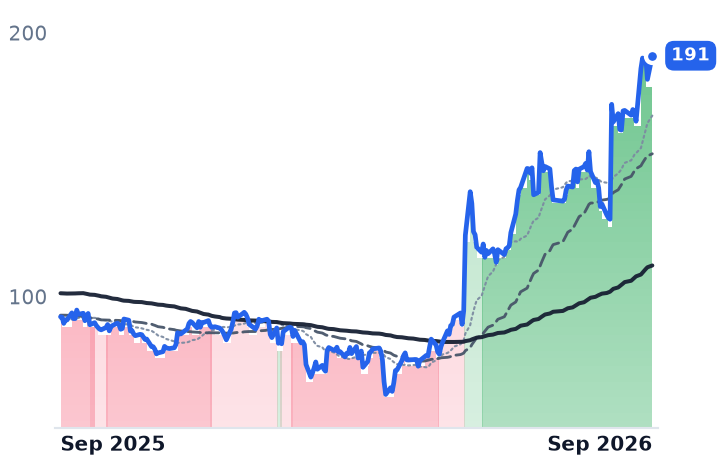
The market has paid the one that is not billing. Okta closed at a five-year high on September 21 after target raises that lifted multiples rather than estimates, with revenue growth slowing a fourth straight quarter to 10.6%. Its profits earn part of the move: operating margin of 13.3% against 5.6%. Consensus models no re-acceleration at all.
| Ticker | Company | Segment | Trend · 13mo | 30D | 1Y |
|---|---|---|---|---|---|
OKTA | Okta | Identity & Access Management | 🟢 Cont. Bull | +46.1% | +107.1% |
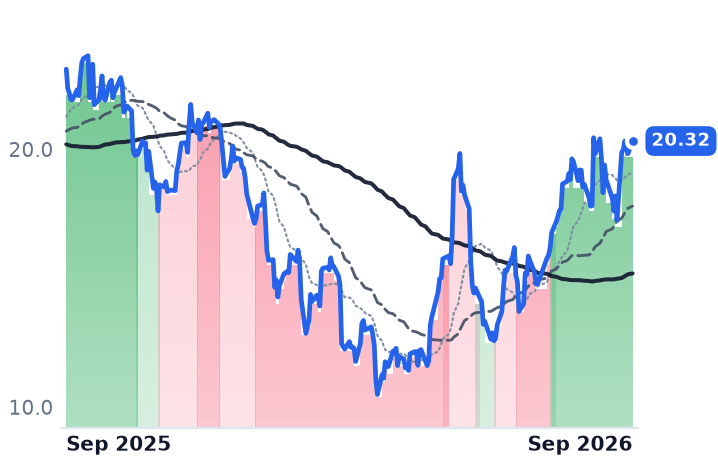
SAIL | SailPoint | Identity & Access Management | 🌱 Emerging Bull | +12.1% | −12.1% |
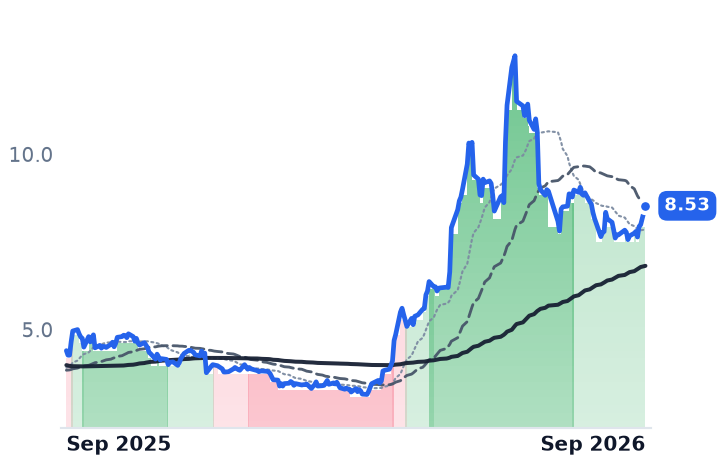
BB | BlackBerry | Identity & Access Management | 🟢 Cont. Bull | +11.5% | +93.9% |
12-month price & trend
| Ticker | Mkt cap | P/E | P/E fwd | P/S | P/S fwd | P/GP | P/GP fwd | EV/EBITDA | FCF yld |
|---|---|---|---|---|---|---|---|---|---|
OKTA | $31.8B | 113.2x | 48.7x | 10.3x | 9.9x | 13.2x | 12.6x | 78.9x | 3.1% |
SAIL | $11.5B | n/m | — | 9.9x | — | 14.9x | — | n/m | 1.6% |
BB | $5.0B | 85.3x | 44.9x | 8.6x | 8.2x | 11.2x | 10.6x | 51.6x | 1.3% |
Consensus projections
| Ticker | FY2026E | FY2027E | FY2028E | |
|---|---|---|---|---|
OKTA | Revenue | +12.0% | +10.9% | +9.9% |
| EPS | +24.3% | +14.1% | +10.6% | |
BB | Revenue | +0.2% | +13.4% | +10.5% |
| EPS | +1183.3% | +28.3% | +20.3% |
Forward fiscal years only. Blank means no analyst coverage for that year.
Two identity vendors sell into the same AI-agent story and only one of them has put an invoice on it. SailPoint, which charges by the identity it governs, reported AI-driven annual recurring revenue above $70m in the July quarter — more than 30% of net new ARR — with total ARR up 25% to $1.231bn and dollar-based net revenue retention of 113%. Okta, which charges per workforce user per month, folded agent sign-on into its existing seat product as a price uplift; finance chief Brett Tighe called the revenue "still immaterial" for this fiscal year.
That difference is now the whole argument in identity software, and last week it got priced. Okta closed at a five-year high on September 21, carried there by target raises that lifted the multiple rather than the estimates: Needham went to $230 from $200 ahead of Okta's Oktane conference and BTIG to $219 from $187, while Bank of America's $200 came explicitly from raising its calendar-2027 enterprise-value-to-sales multiple from nine times to eleven. The average Street target of $186.73 now sits below the share price.
Two meters, and agents fit neither
Okta, the largest independent seller of workforce single sign-on and multi-factor authentication, runs two billing units: seats for the workforce product and monthly active end-users for Auth0, its developer-facing customer identity business. Agent single sign-on was folded into the standard edition with a consumption cap built but not switched on — scaffolding for a meter that does not yet run. Okta prices the service as an uplift on seats it already sells, on mostly one-year agreements, billing per user rather than per agent.
The scale problem that creates is one Okta itself describes. An enterprise it was courting had 50 Claude agents running when the evaluation began. "And then we came back a few weeks and there was 1,500 Claude agents in the environment," chief executive Todd McKinnon told investors on the August 26 earnings call. Neither number reaches an invoice. Brett Tighe, Okta's chief financial officer, was direct on the same call: "Still immaterial. Still very small. We're very early innings… for FY '27, we don't think it's going to be material."
What Okta discloses instead is momentum without a unit: dozens of agent-related deals, 26 software vendors supporting its Cross-App Access standard, and newer products — governance, privileged access, threat protection — at 30% of second-quarter bookings. The core meters slowed. Revenue of $805m grew 10.6%, a fourth consecutive quarterly deceleration, and net retention was 107%, one point better than a year earlier. Bookings ran ahead of that — current remaining performance obligations rose 14% — but management guided the third quarter to 11-12%.
SailPoint sells the other half of identity: governance, deciding which entitlements each human, contractor and machine account may hold, priced against identities governed. An agent is an identity whether or not it is an employee. Its Entro acquisition took discovery coverage past 1,200 non-human identity types. ARR reached $1.231bn on 25% growth, software-as-a-service ARR grew 36%, backlog accelerated to $1.9bn, and the AI-driven line passed $70m against a $100m target for this year and $800m by fiscal 2029. Co-founder and chief executive Mark McClain named the forcing function on the September 9 call: "The EU AI Act contains specific human oversight and audit logging requirements, which are scheduled to become enforceable as early as 2027."
What the shares did with that
SailPoint's reported revenue of $308.8m grew 16.8%, well under its ARR, because term licenses recognized up front are migrating to ratable subscriptions. The shares fell 2.8% on the day it published those results. Over twelve months they are down 12.1%, at $20.32 against the $20.00 at which Thoma Bravo re-listed the company in February 2025 still holding roughly 88.5% of the stock. The sponsor debt is gone — the term loans were repaid in full during 2025 — so what hangs over the equity is share supply.
Okta's month, by contrast, is two sessions. Its August beat-and-raise added a third in one day, and a sector-wide rally on September 14 that followed an essay on AI risk by Anthropic's Dario Amodei — a document Okta did not write — added another eighth; the other eighteen trading days were collectively negative.
Gross margins differ by thirteen points, at 79.6% for Okta against 66.5% for SailPoint, so sales multiples do not compare between them. Against trailing gross profit, Okta is at 13.24 times, up from 5.97 times on May 3 while the gross profit underneath grew about 15%. SailPoint is the dearer of the two at 14.93 times, and it is the one growing bookings at 25%.
The verdict
Okta has earned a re-rating on profits, not on growth: operating income of $107m more than doubled year on year and operating margin widened to 13.3% from 5.6%, on a debt-free balance sheet with $2.3bn of cash and guided free-cash-flow margin of 28-29%. What it has not earned is the doubling. Consensus carries no re-acceleration whatever — roughly 11% this fiscal year and under 10% the next — so every dollar above the old multiple is payment for a meter Okta's own finance chief says will not matter this year. SailPoint has the meter and the disclosed dollars and its stock has gone nowhere, which points to the 88.5% stake overhead rather than to the business.
McKinnon told investors agent identity "could be the biggest category of cyber." Oktane, where Okta stages its product announcements, comes next; the test is not another keynote but whether the November quarter reports agents as something the company charges for.