

Old Dominion Raises Rates 4.9% Into Falling Shipments While Saia Fills Docks With Weight
Hypothesis Opus 5 · Research Opus 5 · Writing Opus 5 · Prompt v1.6
Three less-than-truckload carriers published August operating data on the same September morning and described three incompatible businesses. Old Dominion moved 2.4% fewer shipments than a year earlier and is pushing a general rate increase through anyway from October 5. Saia's tonnage per workday jumped 8.7% — but its shipment count rose 1.1%, the rest was heavier freight, and because less-than-truckload bills by hundredweight, that heavier freight actually cut its revenue per hundredweight excluding fuel by 2.2% in the June quarter.
The result is a margin gap that widened rather than closed: Old Dominion ran a 70.1% operating ratio in the second quarter against Saia's 86.9%. Both stocks fell hard anyway, and both multiples have come down roughly a third since May. Old Dominion's de-rating is mostly the unwinding of a price it could not grow into; Saia's is harder to dismiss.
| Ticker | Company | Segment | Trend · 13mo | 30D | 1Y |
|---|---|---|---|---|---|
| The subject · what this brief is about | |||||
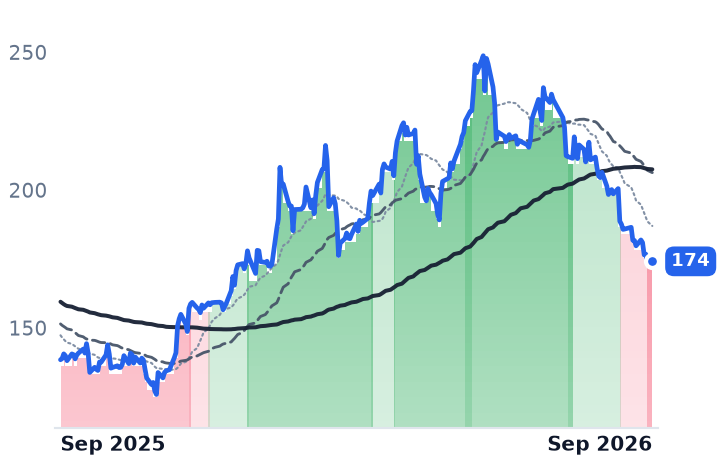
ODFL | Old Dominion Freight Line | Less-Than-Truckload (LTL) | 🟢 Cont. Bull | −13.6% | +25.8% |
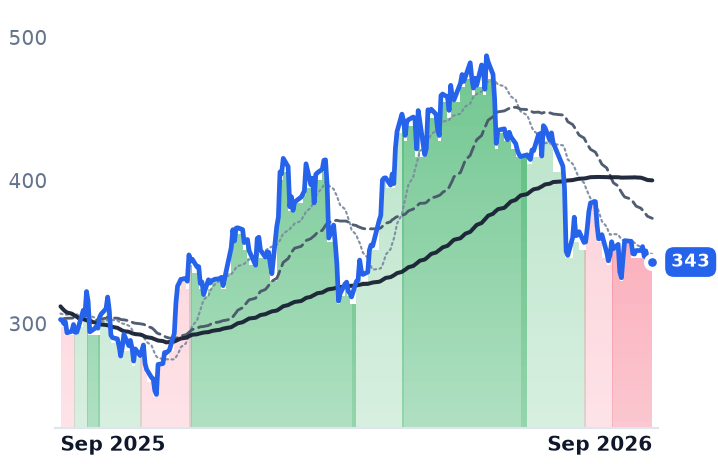
SAIA | Saia | Less-Than-Truckload (LTL) | ⚠️ Emerging Bear | −1.9% | +13.3% |
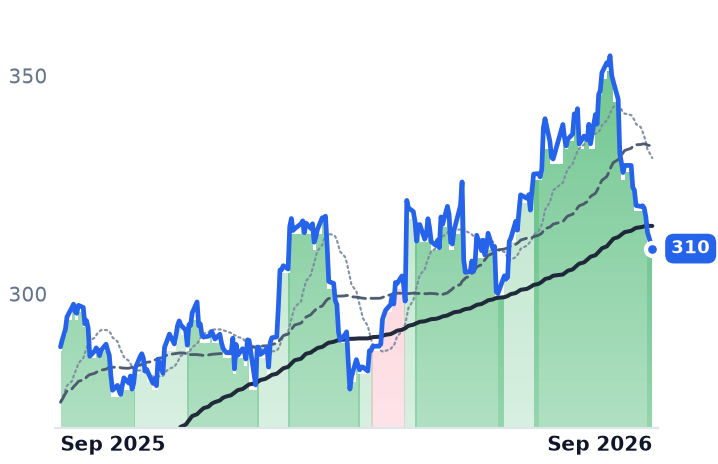
NSC | Norfolk Southern | Class I Railroads | 🟢 Cont. Bull | −12.1% | +7.8% |
| Compared against · context, not the story | |||||
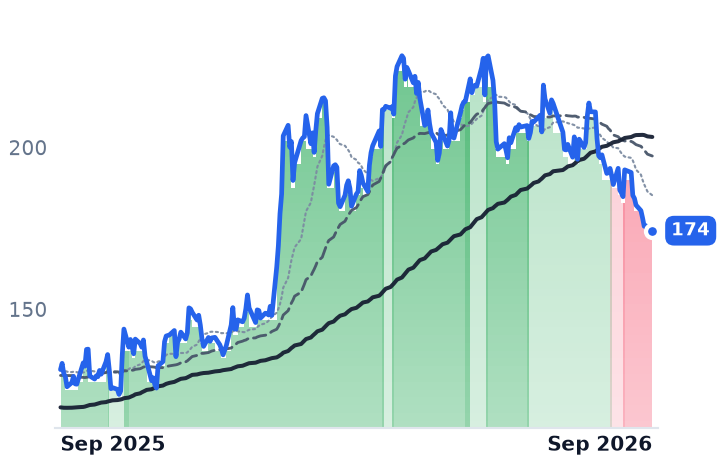
XPO | XPO Logistics | Truckload & LTL | ⚠️ Emerging Bear | −9.2% | +32.7% |
12-month price & trend
| Ticker | Mkt cap | P/E | P/E fwd | P/S | P/S fwd | P/GP | P/GP fwd | EV/EBITDA | FCF yld |
|---|---|---|---|---|---|---|---|---|---|
ODFL | $36.4B | 33.7x | 30.1x | 6.5x | 6.2x | 20.5x | 19.4x | 19.9x | 3.1% |
SAIA | $9.3B | 33.4x | 30.6x | 2.7x | 2.6x | 16.9x | 15.9x | 14.9x | 2.8% |
XPO | $20.5B | 51.1x | 32.0x | 2.4x | 2.3x | 18.8x | 17.8x | 18.8x | 2.9% |
| Ticker | Mkt cap | P/E | P/E fwd | P/S | P/S fwd | P/GP | P/GP fwd | EV/EBITDA | FCF yld |
|---|---|---|---|---|---|---|---|---|---|
NSC | $69.5B | 26.4x | 23.8x | 5.5x | 5.2x | 10.3x | 9.8x | 15.7x | 5.5% |
Consensus projections
| Ticker | FY2026E | FY2027E | FY2028E | |
|---|---|---|---|---|
ODFL | Revenue | +7.8% | +7.9% | +9.0% |
| EPS | +21.2% | +14.2% | +15.3% | |
SAIA | Revenue | +12.2% | +7.5% | +8.3% |
| EPS | +21.9% | +25.3% | +20.7% | |
XPO | Revenue | +11.5% | +5.3% | +6.6% |
| EPS | +52.2% | +18.8% | +21.3% | |
NSC | Revenue | +8.5% | +4.3% | +4.6% |
| EPS | +8.0% | +10.5% | +9.5% |
Forward fiscal years only. Blank means no analyst coverage for that year.
On September 3, the three big publicly traded less-than-truckload carriers each put out August operating data within hours of one another. They serve overlapping shippers on overlapping lanes, and they reported three businesses that barely resemble each other.
That matters because of how this industry actually earns a dollar. A less-than-truckload carrier consolidates pallet-sized freight from many customers into one trailer, moves it across a fixed network of owned terminals and dock doors, and bills by hundredweight — per hundred pounds, not per shipment. Every driver, dock and door is a fixed cost that runs whether the trailer is full or not. So the only two levers are what you charge per pound and how much freight you can pour over a given set of docks. The three carriers are pulling different ones.
Old Dominion prices; Saia fills
Old Dominion, the largest US less-than-truckload carrier with 251 service centers, is holding price and letting freight walk. August shipments per day fell 2.4% and tons per day 0.9%, while revenue per hundredweight excluding fuel rose 4.8% quarter to date. It then announced a 4.9% general rate increase effective October 5 — a pricing action taken into a falling shipment count. "Old Dominion produced solid revenue growth for July and August, with underlying demand trends remaining relatively consistent as the quarter has progressed," chief executive Marty Freeman said in the September 3 update.
It is working on the income statement. June-quarter revenue rose 10.4% to $1.554bn after falling 2.9% in the March quarter, operating income grew 30.0%, and the operating ratio — operating costs as a share of revenue — improved to 70.1% from 74.6%.
Saia, which absorbed a large share of the terminals surrendered when Yellow collapsed in 2023, is doing the opposite. Its August tonnage per workday rose 8.7% on shipments per workday up just 1.1%, with weight per shipment up 7.5%. Since the meter is the hundredweight, heavier freight fills the dock while diluting yield: Saia's June-quarter revenue per hundredweight ex-fuel fell 2.2%, on a 3.9% rise in average shipment weight.
Saia's revenue still grew 17.1% to a record $956.5m and operating income 26.0%. But its operating ratio improved only to 86.9% from 87.8%, so the gap behind Old Dominion widened over the year from 13.3 points to 16.9. The reason is arithmetic the company does not hide: after roughly $1bn of real estate spending since 2022 and 33 new terminals, its 2023 and 2024 vintage facilities still run an operating ratio in the low 90s against a company average of 86.9%.
XPO answered the same August a third way, taking 5.7% more shipments that were 1.8% lighter — buying shipment count where Saia bought weight.
The fuel line, and the September break
Diesel is distorting all of it. On-highway prices hit a record $6.285 a gallon in the week of September 14, roughly 68% above a year earlier. Surcharge tables inflate reported revenue — Old Dominion's revenue per hundredweight is up 11.3% as reported against 4.8% without fuel — but they reset on a lag, so the cost arrives before the recovery. J.B. Hunt's mid-September warning on exactly that point took the whole freight complex down with it.
The shares had already broken. Old Dominion fell 15.7% in the month to September 21 and 20.7% over three months, leaving it 30% below its twelve-month high; Saia is down 21.3% over three months. Neither move came from guidance: Citi's June downgrade to Sell cited valuation rather than the business, and the underlying demand data is stabilizing — the American Trucking Associations' tonnage index rose 0.5% in August, its first monthly gain since March.
What each de-rating earns
Old Dominion now trades at 33.7 times trailing earnings and 30.1 times forward, against 46.1x in May, on 19.9 times enterprise value to EBITDA. Most of that compression is the market declining to pay a growth price for a carrier whose volumes are still shrinking in its fourth soft year — a de-rating the business largely earns, even as earnings improve. Saia's trailing multiple fell from 49.3x in May to 33.4x, and on enterprise value to EBITDA — the measure that matters when one company has borrowed to build terminals and the other self-funds — it is the cheapest of the three at 14.9x, against consensus earnings growth of 21.9% this year and 25.3% next. XPO sits between them at 18.8x.
The honest split is this: Old Dominion's problem is a price that got ahead of a network it is deliberately shrinking into, and Saia's is a network that got ahead of the freight. Only one of those is fixable by the freight cycle arriving.
On October 5 Old Dominion tries to charge 4.9% more for moving less. Whether shippers pay it — with a record fuel surcharge already on the same invoice — is the cleanest test of pricing discipline this cycle has offered.