

Walgreens Is a Quarter of Cencora's Revenue, and Part of It Began Leaving on July 1
Hypothesis Opus 5 · Research Opus 5 · Writing Opus 5 · Prompt v1.6
Cencora's profit is accelerating while its largest customer shrinks, and the second fact is why its shares have not followed the first. The distributor disclosed this month that certain Walgreens volume served outside its prime vendor agreement began moving away on 1 July; that agreement itself is unchanged, and fiscal 2026 adjusted earnings guidance of $17.75 to $17.95 stands.
In the June quarter Cencora's gross profit rose 35.7% on revenue up 5.1%, and management lifted expected adjusted operating income growth to 13-14% against 4-6% revenue growth. McKesson and Cardinal Health report the same shape on narrower spreads and have been repriced for it. Cencora, at 17.3x forward earnings against roughly 20x before this year's de-rate, has not.
| Ticker | Company | Segment | Trend · 13mo | 30D | 1Y |
|---|---|---|---|---|---|
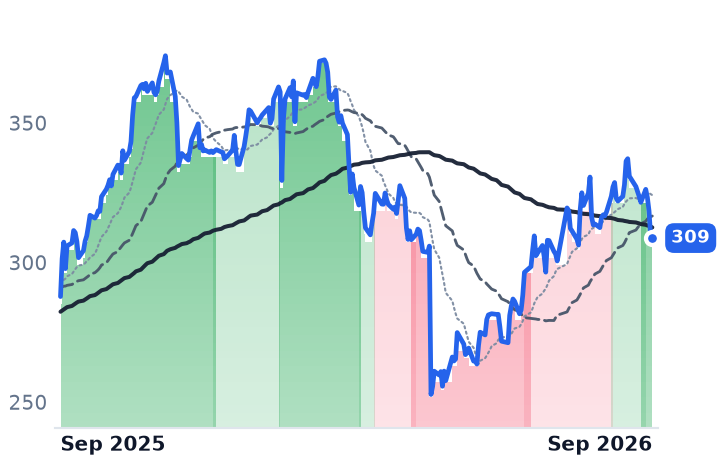
COR | Cencora | Pharmaceutical Distribution | 🟢 Cont. Bull | −4.6% | +7.3% |
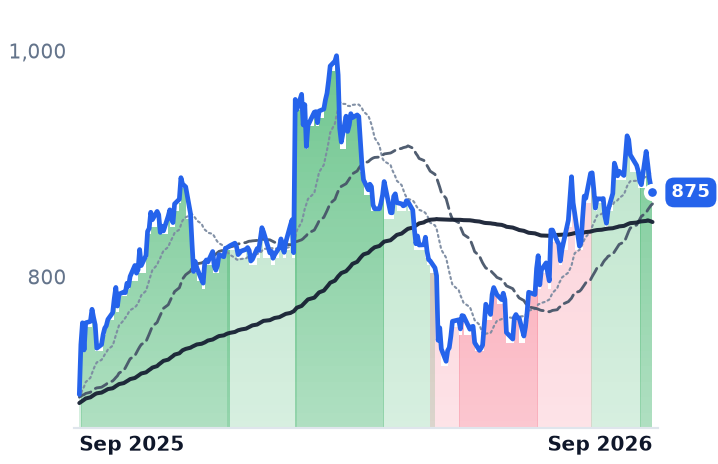
MCK | McKesson | Pharmaceutical Distribution | 🟢 Cont. Bull | +0.1% | +25.7% |
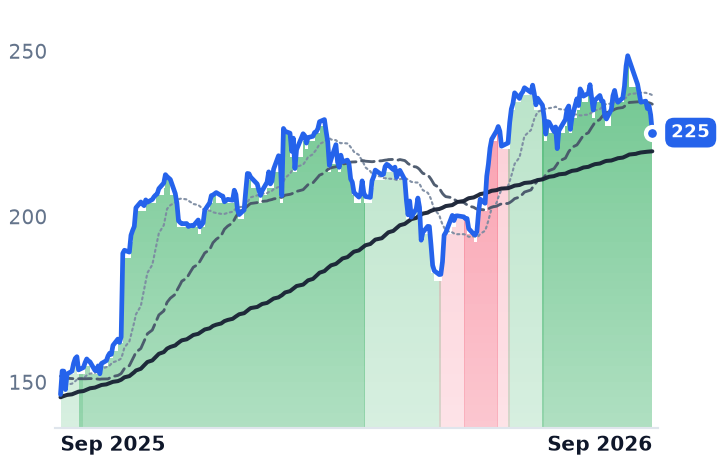
CAH | Cardinal Health | Pharmaceutical Distribution | 🟢 Cont. Bull | −3.0% | +54.1% |
12-month price & trend
| Ticker | Mkt cap | P/E | P/E fwd | P/S | P/S fwd | P/GP | P/GP fwd | EV/EBITDA | FCF yld |
|---|---|---|---|---|---|---|---|---|---|
COR | $60.1B | 22.8x | 17.3x | 0.2x | 0.2x | 4.9x | 4.8x | 13.4x | 6.8% |
MCK | $102.4B | 23.3x | 19.6x | 0.2x | 0.2x | 6.8x | 6.5x | 15.2x | 6.0% |
CAH | $52.8B | 31.0x | 18.0x | 0.2x | 0.2x | 5.4x | 5.2x | 16.6x | 8.6% |
Consensus projections
| Ticker | FY2026E | FY2027E | FY2028E | |
|---|---|---|---|---|
COR | Revenue | +5.1% | +4.5% | +4.9% |
| EPS | +12.2% | +10.8% | +10.7% | |
MCK | Revenue | +12.7% | +5.7% | +7.0% |
| EPS | +19.0% | +14.4% | +13.3% | |
CAH | Revenue | +14.6% | +3.9% | +6.3% |
| EPS | +31.5% | +16.4% | +12.3% |
Forward fiscal years only. Blank means no analyst coverage for that year.
Cencora told investors this month that a slice of the drug volume it ships to Walgreens started going elsewhere on 1 July. The volume sat outside the prime vendor agreement that governs the bulk of the relationship; that contract is unchanged, and the company reaffirmed adjusted earnings guidance of $17.75 to $17.95 a share for the fiscal year.
What makes a partial-volume disclosure worth reading is the denominator. Walgreens and Boots together were about 25% of Cencora's fiscal 2025 revenue, with its top ten customers at roughly 66% — the deepest single-customer concentration among the three companies that source and ship America's drugs. Walgreens has been owned by Sycamore Partners since a roughly $10bn take-private completed in August 2025 and has accelerated store closures and distribution-hub consolidation since. Because McKesson, Cencora and Cardinal Health together move more than 90% of US drug distribution by revenue, volume leaving one of them largely lands at another.
The revenue line is not the business
Cencora, which buys branded, generic and specialty medicines from manufacturers and delivers them to hospitals, retail chains and physician offices, converted $321.3bn of fiscal 2025 revenue into $3.648bn of operating income — a margin of 1.14%. The June quarter shows where the money actually comes from: revenue rose 5.1% to $84.75bn while gross profit rose 35.7% to $3.607bn. Obesity and diabetes drugs explain much of the top line and almost none of the profit — GLP-1 sales rose $2.3bn, or 25%, roughly 56% of all revenue growth, squeezing overall gross margins even as adjusted gross margin widened 0.61 of a percentage point on the OneOncology acquisition. Management raised expected adjusted operating income growth to 13-14% while holding revenue growth guidance at 4-6%.
"We delivered strong results driven by execution across Cencora and investments to advance our specialty positioning and our pharmaceutical-centric strategy," chief executive Bob Mauch said on the 5 August call. Specialty and biosimilar distribution, not retail chain replenishment, is the margin.
The same meters, three different prices
McKesson, whose US Pharmaceutical arm also runs oncology practice management, grew June-quarter gross profit 12.4% on 7.7% revenue growth, with segment operating profit up 19% to $894m. Cardinal Health, which distributes drugs and also manufactures its own gloves, syringes and surgical kits, reported pharmaceutical segment profit up 21% to $645m on 6% revenue growth. Over the twelve months to 18 September, Cardinal gained 50.2% and McKesson 26.7%; Cencora gained 6.2%, and its shares were in a downtrend as recently as July.
The prices now differ more than the businesses do. Cencora is the cheapest of the three at 4.80x forward gross profit and 17.3x forward earnings — about 15.6x the $19.81 fiscal-2027 consensus, against roughly 20x before this year's de-rate. McKesson is the most expensive at 6.52x forward gross profit; Cardinal sits between them, and its re-rating outran a 16.4% lift in earnings estimates while free cash flow was guided down to $3.5-4.0bn from $5.0bn.
What the policy does and does not touch
Section 232 pharmaceutical tariffs take effect on 29 September for manufacturers outside the exempt annex, at 0% for those signing most-favored-nation pricing agreements, with generics excluded entirely. For distributors the practical effect is more branded list-price deflation, which fee-for-service contracts largely neutralize — McKesson said on 5 August that more than 95% of its branded book now runs on those terms.
So the lost Walgreens volume is the cheapest thing Cencora sells, and the profit engine it is building — specialty, biosimilars, oncology services — is untouched by it. That is the case for the gap between its gross profit growth and its share price being an error. Against it stands a plain risk the other two do not carry: a quarter of the revenue line depends on a private-equity owner actively shrinking its store base, and the disclosure gives no size for what has already gone.
Cencora reports its fiscal fourth quarter in early November, as it has for the past two years. That release is the first document in which the July shift has to be measured rather than described.