

Stryker's Sales Grew 9.4% and Its Shares Lost a Quarter; Zimmer Biomet's Knees Stalled
Hypothesis Opus 5 · Research Opus 5 · Writing Opus 5 · Prompt v1.6
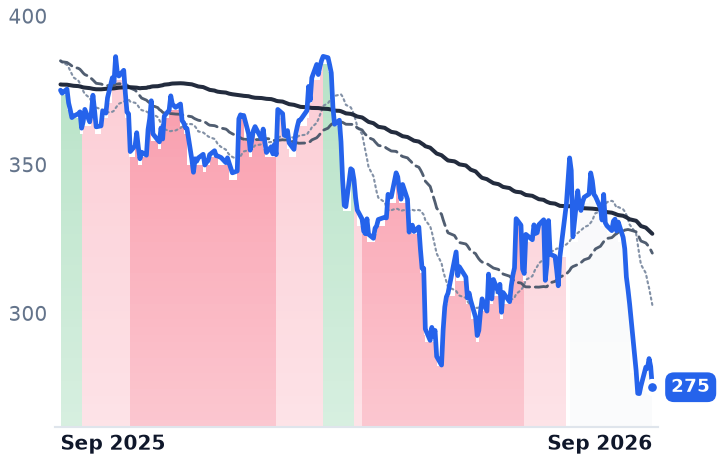
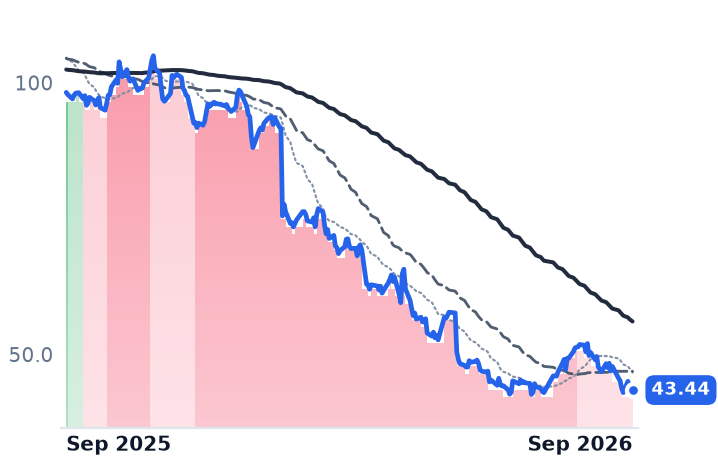
The market has spent a year marking down the orthopedic company whose reported numbers accelerated, and left alone the one whose knee franchise stopped growing. Stryker's June quarter put revenue up 9.4% to $6.59bn with gross margin six points wider at 68.3%, and management reaffirmed 8.3%-9.3% organic growth for 2026 — yet roughly seven turns of forward earnings have come out of the stock, from 25.1x on last September's price to 18.3x on the same consensus of $15.00 a share.
What is being repriced is not per-implant pricing. Zimmer Biomet's disclosed price headwind was 80 basis points last quarter against a full-year guide of up to 100, with 85% of its book already contracted, and it raised guidance in August. The discoverable causes are a March cyberattack Stryker is still working through, and elective orthopedic volumes that HCA says are weakest among under-65 patients losing coverage. Smith & Nephew cut its year on a product gap; Globus Medical's capital-equipment line fell 26%.
| Ticker | Company | Segment | Trend · 13mo | 30D | 1Y |
|---|---|---|---|---|---|
| The subject · what this brief is about | |||||
SYK | Stryker | Orthopedic Implants & Trauma | 🔴 Cont. Bear | −19.1% | −26.6% |
ZBH | Zimmer Biomet | Orthopedic Implants & Trauma | 🔴 Cont. Bear | −5.3% | −4.1% |
| Compared against · context, not the story | |||||
SNN | Smith & Nephew | Orthopedic Implants & Trauma | 🔴 Cont. Bear | −5.8% | −23.7% |
GMED | Globus Medical | Orthopedic Implants & Trauma | ⚠️ Emerging Bear | −14.6% | +33.0% |
BSX | Boston Scientific | Spinal Surgery & Neuromodulation | 🔴 Cont. Bear | −16.5% | −55.8% |
HCA | HCA Healthcare | Hospital Systems | ⚠️ Emerging Bear | +5.5% | +7.4% |
12-month price & trend
| Ticker | Mkt cap | P/E | P/E fwd | P/S | P/S fwd | P/GP | P/GP fwd | EV/EBITDA | FCF yld |
|---|---|---|---|---|---|---|---|---|---|
SYK | $105.5B | 28.3x | 18.3x | 4.1x | 3.9x | 6.3x | 5.9x | 18.7x | 4.5% |
ZBH | $18.4B | 23.1x | 11.2x | 2.2x | 2.1x | 3.1x | 3.1x | 13.0x | 9.9% |
SNN | $11.6B | 18.1x | 12.6x | 1.8x | 1.8x | 2.7x | 2.6x | 8.8x | 7.3% |
| Ticker | Mkt cap | P/E | P/E fwd | P/S | P/S fwd | P/GP | P/GP fwd | EV/EBITDA | FCF yld |
|---|---|---|---|---|---|---|---|---|---|
GMED | $10.0B | 18.7x | 14.8x | 3.2x | 3.1x | 4.6x | 4.6x | 10.9x | 7.5% |
BSX | $63.9B | 17.3x | 13.1x | 3.0x | 3.0x | 4.3x | 4.2x | 13.4x | 5.7% |
HCA | $93.8B | 14.1x | 14.0x | 1.2x | 1.2x | 3.5x | 3.4x | 9.1x | 8.4% |
Consensus projections
| Ticker | FY2026E | FY2027E | FY2028E | |
|---|---|---|---|---|
SYK | Revenue | +8.7% | +8.8% | +7.8% |
| EPS | +10.6% | +11.6% | +11.3% | |
ZBH | Revenue | +4.7% | +3.6% | +4.0% |
| EPS | +4.4% | +6.3% | +7.3% | |
SNN | Revenue | +5.4% | +5.3% | +5.5% |
| EPS | +10.5% | +9.0% | +11.9% | |
GMED | Revenue | +9.9% | +6.0% | +6.1% |
| EPS | +29.8% | +7.7% | +8.8% | |
BSX | Revenue | +6.2% | +4.4% | +7.0% |
| EPS | +8.3% | +3.9% | +10.8% | |
HCA | Revenue | +3.7% | +4.8% | +5.4% |
| EPS | +9.2% | +10.0% | +13.0% |
Forward fiscal years only. Blank means no analyst coverage for that year.
Stryker's chief financial officer spent part of September 8 explaining why a cyberattack that hit the company in March is still holding back sales. Recovery in peripheral vascular is taking longer than expected, Preston Wells told the Wells Fargo Healthcare Conference, costing 70 to 80 basis points of growth in the second and third quarters and probably the fourth as well, and hip sales had come in slower than planned — softer joint replacement in Europe, plus US summer seasonality. He did not cut guidance. Stryker's shares closed down 7.4% that day, alongside Boston Scientific, which said in a filing it would not meet third-quarter or full-year expectations after its own cyber incident.
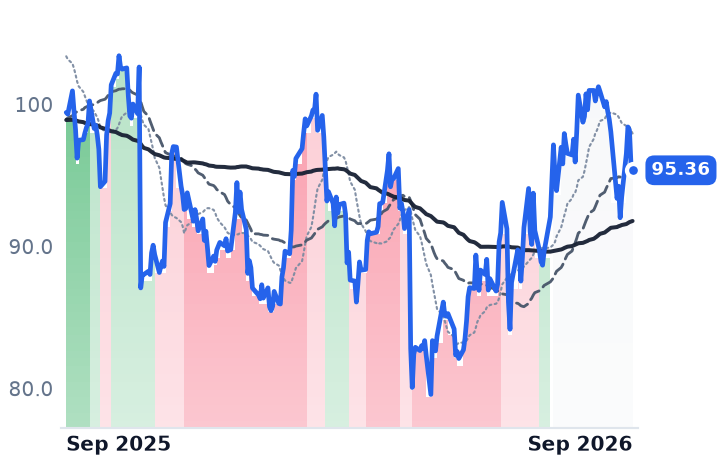
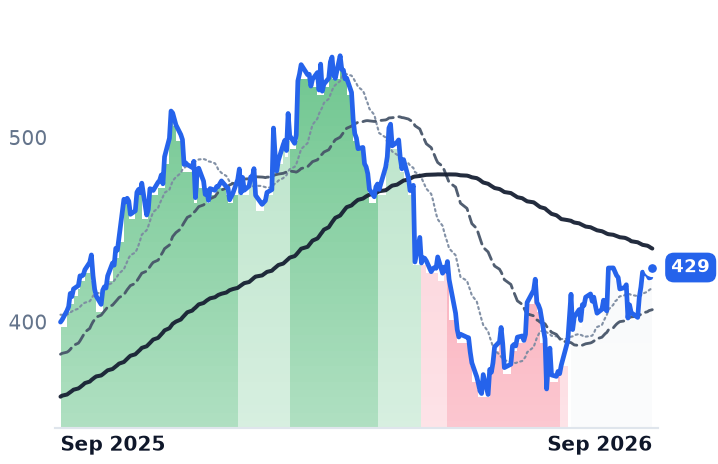
That session is the visible edge of something larger and stranger. Over the twelve months to September 17, Stryker — a Kalamazoo, Michigan maker of hip and knee implants, surgical robots, endoscopy and neurovascular devices — fell 25.2%, to $282.07. Zimmer Biomet, the Warsaw, Indiana implant house whose entire business is the thing supposedly being commoditized, fell 4.2%. Over three months the two moved in opposite directions: Zimmer up 8.8%, Stryker down 8.4%. The market has taken a quarter off the company whose reported numbers accelerated and left flat the company whose knee line stopped growing.
The numbers Stryker actually printed
Second-quarter revenue of $6.589bn was up 9.4% year on year. Gross margin widened to 68.3% from 62.3%, operating income rose 21.9% and net income 44.3%. The cyberattack damage sits in the first quarter, where revenue grew 2.6% and operating income fell 20.6%; the next quarter reaccelerated. Growth was not concentrated in implants — MedSurg and Neurotechnology sales of $3.6bn grew 9.2% organically against Orthopaedics' 8.6%, so more than half the company reprices on a cycle that has nothing to do with an artificial joint.
The machine underneath is placement, not price per part. Stryker's Mako installed base has passed 3,000 systems in 47 countries with more than 2.5 million cumulative procedures, and more than two-thirds of its US knee cases and about a third of US hips now run on a robot. "We can execute what depends on us, and that's what we're going to continue to do," Wells said on September 8. Canaccord trimmed its price target to $385 from $400 on the manufacturing problems — still about 40% above the current price, which is sell-side treating the move as an overshoot rather than a franchise mark-down.
On today's consensus of $15.00 for 2026, last September's Stryker price implied 25.1x forward earnings; it now trades at 18.3x, while consensus still has earnings growing 10.6% this year and 11.6% next. It is cheap against its own history and not cheap absolutely — 18.7x trailing enterprise value to earnings before interest, taxes, depreciation and amortization, and a 4.5% free-cash-flow yield.
What implant pricing actually costs
The price erosion that is supposed to define this business is disclosed, small and bounded. Zimmer's pricing headwind was 80 basis points last quarter against full-year guidance of up to 100, with 85% of the book already contracted. Mix can run the other way: "We get a 40% premium every time that we move from non-coated — non-iodine-coated hip to a coated hip," chief executive Ivan Tornos said on the August 5 call, describing a Japanese launch. China, the volume-tender risk, is declining about 20% and is 2% of revenue.
Units are the problem instead. Zimmer's knees grew 0.1% in constant currency last quarter, hips 5.1%, and revenue growth decelerated from 10.9% in the December quarter to 4.8% in June — yet the company raised its 2026 outlook to 2.25%-3.25% organic growth and $8.47-$8.59 of adjusted earnings, lifted the buyback to $1bn, and grew robotics 21.5% on record ROSA capital sales. At 11.2x forward earnings, 13.0x trailing EV/EBITDA and a 9.9% free-cash-flow yield, Zimmer's multiple is where last September's price implied it would be, near 11.7x. It carries roughly $6.9bn of net debt after the Paragon 28 and Monogram deals, and consensus has its EBITDA falling 3.7% this year.
The volume story has a named source. HCA Healthcare's preliminary second quarter flagged weak elective surgical volumes concentrated in under-65 orthopedic and spine patients losing exchange coverage, with management declining to assume a second-half rebound and full-year revenue guidance cut to $77.0-79.5bn. On that news the whole operating-room complex fell — GE HealthCare 7%, Intuitive Surgical 6%, Stryker 5.4% — and Zimmer fell least, at 3%.
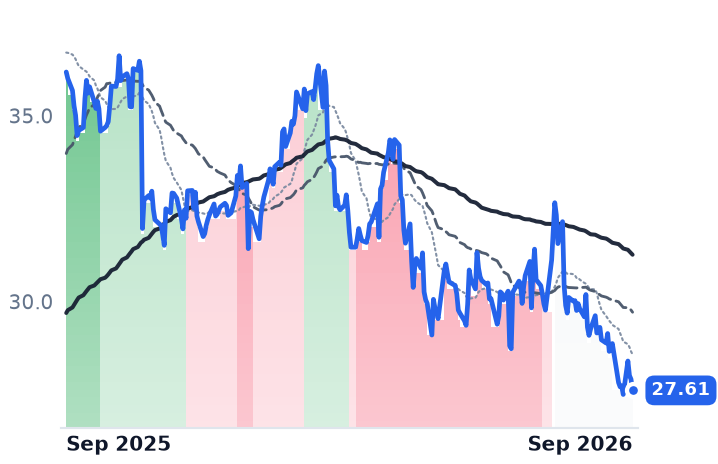
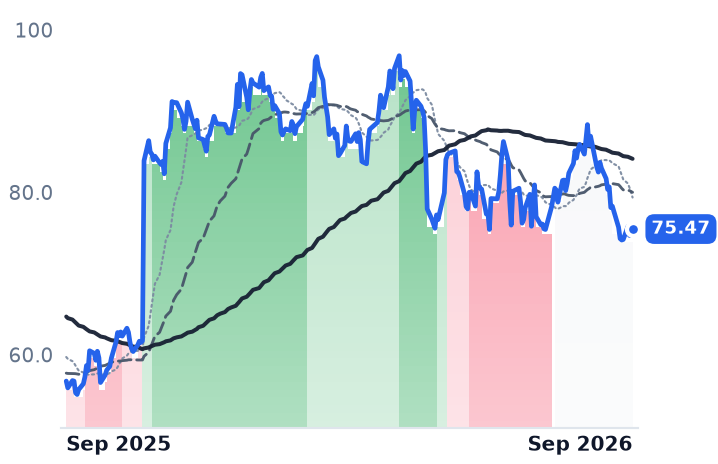
The two other names in this corner point the same way. Smith & Nephew, the UK group in orthopedics, sports medicine and wound care, cut full-year growth to about 4% with orthopedics down 1%, and chief executive Deepak Nath attributed the US shortfall mostly to itself: "Fundamentally, it's Knees. We're not able to participate in the fastest-growing part of Knees, which is Cementless." It trades at 12.6x forward earnings. Globus Medical, the spine and navigation maker, raised 2026 earnings guidance to $4.95-$5.05 at 14.8x forward earnings — and watched enabling-technology revenue fall 26% as hospitals shifted from buying capital equipment to leasing it, even as deployed units rose 25%.
The verdict
Part of Stryker's de-rating is earned: one wrecked quarter, a supply drag management now expects to run into the fourth quarter, and European hips that slowed. None of that explains seven turns of forward earnings against accelerating revenue, a six-point gross-margin gain and reaffirmed guidance. And the mechanism the price move is usually blamed on — contracted implant prices grinding down a point a year — is the one variable both companies quantified and bounded. What is being marked is the hospital's willingness to place capital and the under-65 patient's willingness to book an elective knee. Zimmer, on that reading, was never de-rated at all; its estimates are the flat part, and its shares have simply tracked them.
The risk nobody has priced is the one nobody has measured. A June study suggested sustained weight-loss drug use could prevent thousands of knee replacements a year; the trial testing those drugs in hip and knee arthroplasty patients only begins recruiting in October.