

Almost Half of Ultragenyx's Record $214m Quarter Is a Royalty on a Partner's Drug
Hypothesis Opus 5 · Research Opus 5 · Writing Opus 5 · Prompt v1.6
Ultragenyx won the first approval the Food and Drug Administration has ever granted for Sanfilippo syndrome Type A on 17 September, its second approval in a month — and the shares are worth barely half what they fetched three weeks ago. Rare-disease companies earn three different kinds of dollar, and the market prices them nothing alike.
A failed Phase 3 trial in Angelman syndrome on 3 September erased an asset analysts had modelled at $1.8bn in peak sales. What survived is an installed base that grew 28.5% year on year — but roughly half of it is a royalty on a drug Kyowa Kirin sells, and an extra quarter of that US and Canadian royalty was already sold to OMERS for $400m in November 2025.
Ascendis Pharma, doubling product revenue it books itself, is paid about five times as much per unit of gross profit.
| Ticker | Company | Segment | Trend · 13mo | 30D | 1Y |
|---|---|---|---|---|---|
| The subject · what this brief is about | |||||
RARE | Ultragenyx Pharmaceutical | Rare Genetic & Metabolic Diseases | 🌱 Emerging Bull | −47.4% | −53.3% |
ASND | Ascendis Pharma A/S | Rare Genetic & Metabolic Diseases | 🟢 Cont. Bull | −3.5% | +20.4% |
| Compared against · context, not the story | |||||
BMRN | BioMarin Pharmaceutical | Rare Genetic & Metabolic Diseases | 🌱 Emerging Bull | −1.7% | +21.2% |
12-month price & trend
| Ticker | Mkt cap | P/E | P/E fwd | P/S | P/S fwd | P/GP | P/GP fwd | EV/EBITDA | FCF yld |
|---|---|---|---|---|---|---|---|---|---|
RARE | $1.4B | n/m | — | 2.0x | 1.9x | 2.4x | 2.3x | n/m | -34.3% |
ASND | $14.8B | 17.2x | 16.7x | 12.3x | 10.9x | 13.6x | 12.0x | 160.9x | 2.6% |
BMRN | $12.6B | 171.3x | — | 3.7x | — | 4.9x | — | 41.2x | 5.8% |
Consensus projections
| Ticker | FY2026E | FY2027E | FY2028E | |
|---|---|---|---|---|
RARE | Revenue | +13.2% | +29.5% | +9.5% |
| EPS | −28.6% | −82.5% | −79.7% | |
ASND | Revenue | +93.2% | +46.1% | +26.7% |
| EPS | −527.2% | −36.5% | +59.5% |
Forward fiscal years only. Blank means no analyst coverage for that year.
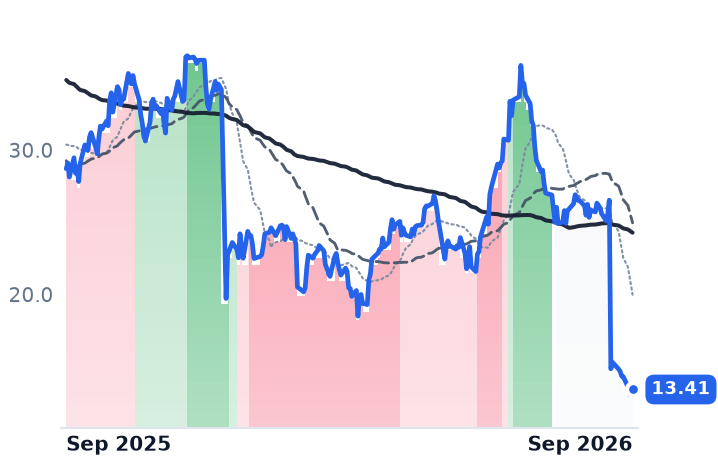
Ultragenyx Pharmaceutical, a Novato, California company that sells four rare-disease biologics and develops gene and antisense therapies, received full approval on 17 September for FAYUVI, the first treatment ever cleared for Sanfilippo syndrome Type A. It was the second approval in a month, after GENGLYCOS for glycogen storage disease type Ia on 19 August, the company's first gene therapy ever authorized. Across the same thirty days the stock fell 47.4%.
That is not a contradiction so much as an accounting lesson. An orphan-drug company earns money in three ways that look identical on a revenue line and are valued nothing alike: product it books itself, patient by patient; a royalty on a partner's sales; and pipeline assets that are worth a great deal until the day they are worth zero. The market pays roughly 12.0x forward gross profit for Ascendis Pharma, 4.9x trailing for BioMarin and 2.3x forward for Ultragenyx — a fivefold spread on gross margins of 91%, 80% and 84%, close enough that the comparison is fair.
What was marked to zero
On 3 September the Phase 3 Aspire trial of apazunersen missed both its primary cognitive endpoint and its key secondary responder index, with no difference between treated and control groups. Shares closed down 44.0%, from $26.53 to $14.85. "Based on everything we observed in the robust Phase 1/2 clinical development program and long-term extension study, we are disappointed by the Aspire result," chief executive Emil Kakkis said that day. Analysts had modelled peak sales above $1.8bn; Evercore ISI cut its target to $16 from $34. Management now plans "significant expense reductions" and a path to profitability in 2027.
The de-rating of that line item is earned. The base underneath it moved the other way. Second-quarter revenue of $214m grew 28.5% year on year, against a 2.4% decline in the first quarter. Crysvita, for X-linked hypophosphatemia, contributed $156m of it — and US and Canadian commercialization passed to Kyowa Kirin in April 2023, so $94m of North American revenue and $8m of European is royalty rather than sales Ultragenyx makes. First-half royalty revenue rose 11%, to $149m, on more patients treated. The owned franchises are genuinely ultra-orphan: about 675 reimbursed North American patients on Dojolvi against $27m in the quarter works out near $160,000 a patient a year.
The royalty also leaks. In November 2025 Ultragenyx took $400m from OMERS for an additional 25% interest in the same US and Canadian stream, with payments beginning January 2028 and capped at 1.55 times the purchase price. Reported royalty revenue therefore overstates what the company will keep.
The other kind of dollar
Ascendis Pharma, the Danish maker of long-acting hormone replacements built on its TransCon prodrug chemistry, is the clean version of the annuity. Product revenue reached €315m in the second quarter, up 105%, of which €252m was Yorvipath for hypoparathyroidism — 93% of the top line is drug sold to patients. Roughly 1,000 new US patients start each quarter and 95% remain on therapy after five years. Operating margin swung from −33.5% a year ago to +18.4%. "The majority of the drop-off is during that titration period," Jay Wu, president of Ascendis U.S., told investors on 13 August, naming the dosing ramp rather than payer rebates as the leak.
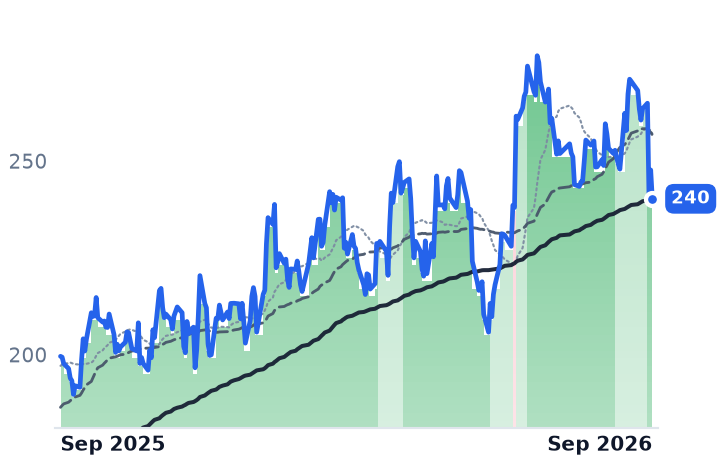
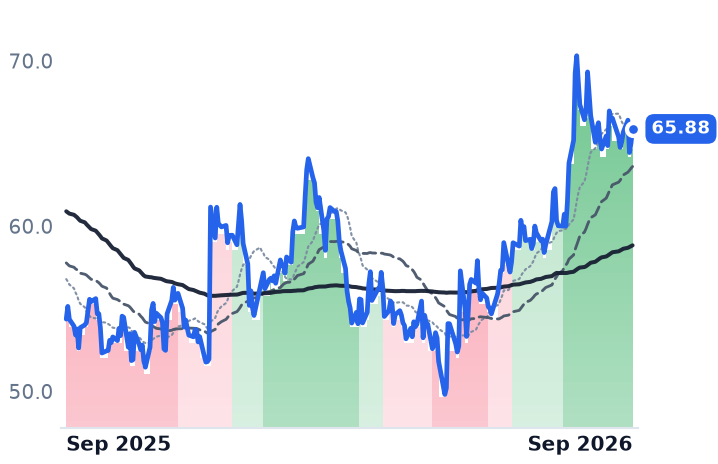
For that, the market pays 10.9x forward sales against 12.3x trailing — the forward figure sitting below the trailing one is the growth being bought, with consensus 2026 revenue of $1.37bn. Shares are up 20.4% over twelve months and 3.9% over three, a fraction of a doubling in revenue, and 9.5% of that was given back on 15 September after Novo Nordisk's metabolic rights reverted, leaving Ascendis to fund obesity programs itself. BioMarin, which sells seven rare-disease products on $3.22bn of 2025 revenue, grew 19.9% last quarter and sits between the two on price.
The verdict
Across the orphan names the three-month spread between best and worst runs about 70 points, and each of the largest moves traces to a dated single-company event rather than a shift in rates. The market got the direction right on Ultragenyx and has not yet re-examined what it left behind: 1.9x forward sales, $436m of cash, and a business whose fastest-growing line is a royalty it has partly pre-sold and does not control the selling of. Guidance of $730m–$760m for 2026 excludes both new launches entirely.
What it also left behind are two tradable priority review vouchers, awarded with the August and September approvals, in a market where single vouchers cleared at $180m and $205m this year — against a company the market now values at $1.4bn.