

Accenture's Outsourcing Half Grew Five Times Faster Than Consulting, and Booked Less Work
Hypothesis Opus 5 · Research Opus 5 · Writing Opus 5 · Prompt v1.6
Accenture closes its fiscal year on 1 October with its two halves pointing in opposite directions. Managed services — multi-year outsourcing run at a contracted price — grew 5% in local currency in the May quarter against consulting's 1%, which is what a world of cheaper software effort should look like. But consulting won $10.26bn of new signings against managed services' $9.06bn, and total new bookings fell 2%, so the growing half is not the half filling the order book.
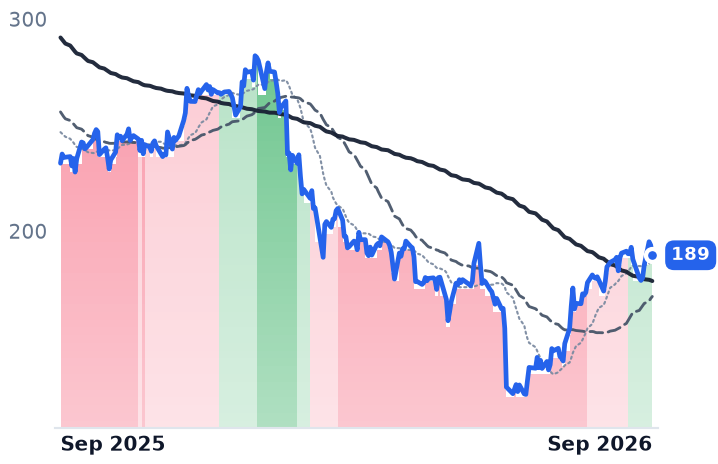
The shares have recovered 47% from their June post-guidance low while the disclosed numbers went the other way, including a full-year growth target trimmed to a 3.5% midpoint. At 15.0x trailing earnings against roughly 30x at the 2023 and 2024 fiscal year-ends, that is repair of a deep de-rating rather than proof of a turn. Infosys, paid per billed engineer, narrowed its guidance down and is the only name here whose forward multiple sits above its trailing one.
| Ticker | Company | Segment | Trend · 13mo | 30D | 1Y |
|---|---|---|---|---|---|
| The subject · what this brief is about | |||||
ACN | Accenture | Enterprise Consulting & Systems Integration | 🔴 Cont. Bear | +9.8% | −18.7% |
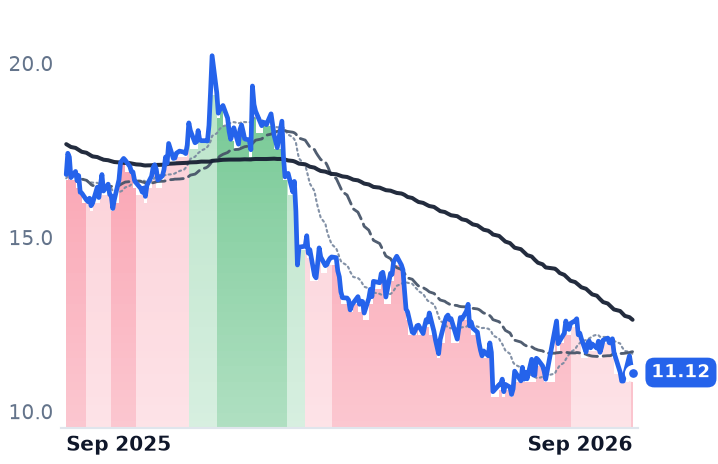
INFY | Infosys | Enterprise Consulting & Systems Integration | 🔴 Cont. Bear | −5.0% | −33.8% |
| Compared against · context, not the story | |||||
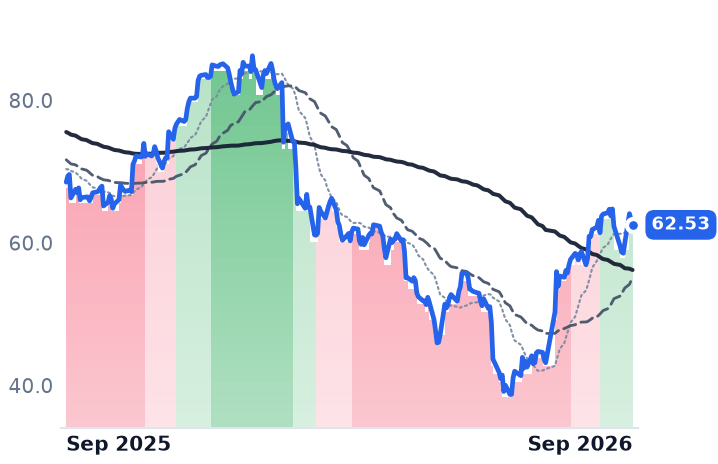
CTSH | Cognizant Technology Solutions | Enterprise Consulting & Systems Integration | 🔴 Cont. Bear | +9.8% | −8.7% |
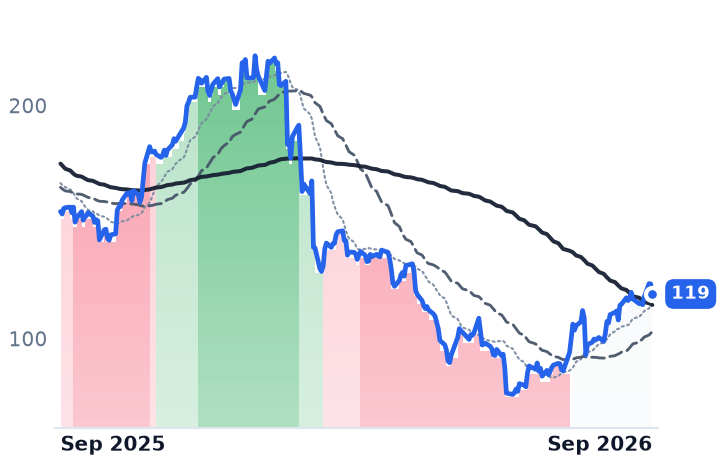
EPAM | EPAM Systems | Enterprise Consulting & Systems Integration | 🔴 Cont. Bear | +20.6% | −22.9% |
WIT | Wipro | Enterprise Consulting & Systems Integration | 🔴 Cont. Bear | −11.7% | −38.9% |
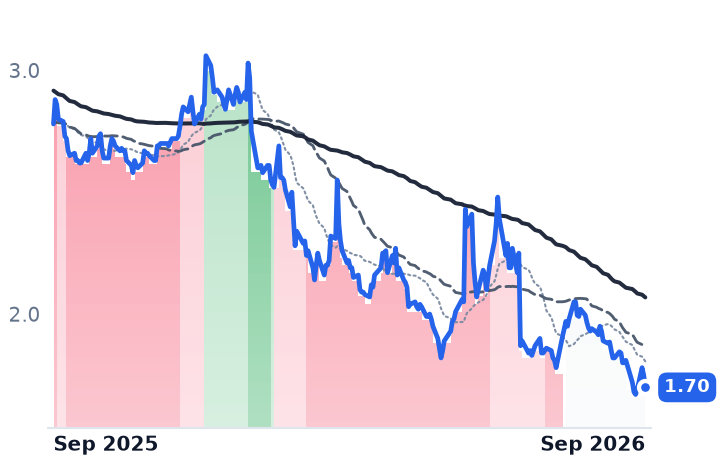
12-month price & trend
| Ticker | Mkt cap | P/E | P/E fwd | P/S | P/S fwd | P/GP | P/GP fwd | EV/EBITDA | FCF yld |
|---|---|---|---|---|---|---|---|---|---|
ACN | $116.0B | 15.0x | 12.9x | 1.6x | 1.5x | 5.0x | 4.7x | 9.0x | 10.8% |
INFY | $45.0B | 13.4x | 13.9x | 2.2x | 2.2x | 7.3x | 7.3x | 8.6x | 8.5% |
CTSH | $27.9B | 13.3x | 10.8x | 1.3x | 1.3x | 4.0x | 3.9x | 7.3x | 9.3% |
| Ticker | Mkt cap | P/E | P/E fwd | P/S | P/S fwd | P/GP | P/GP fwd | EV/EBITDA | FCF yld |
|---|---|---|---|---|---|---|---|---|---|
EPAM | $6.1B | 15.8x | 8.9x | 1.1x | 1.1x | 3.8x | 3.8x | 8.0x | 7.9% |
WIT | $16.6B | 13.2x | — | 1.7x | — | 6.0x | — | 8.8x | 8.6% |
Consensus projections
| Ticker | FY2026E | FY2027E | FY2028E | |
|---|---|---|---|---|
ACN | Revenue | +6.0% | +4.0% | +5.1% |
| EPS | +7.6% | +5.8% | +7.3% | |
INFY | Revenue | +1.6% | +4.2% | +3.6% |
| EPS | +2.3% | +4.5% | +4.4% | |
CTSH | Revenue | +5.2% | +4.7% | +5.2% |
| EPS | +10.8% | +9.8% | +10.5% | |
EPAM | Revenue | +3.9% | +3.5% | +4.9% |
| EPS | +15.1% | +7.3% | +7.6% | |
WIT | Revenue | +5.4% | +4.5% | +2.6% |
| EPS | +4.6% | +3.1% | +3.7% |
Forward fiscal years only. Blank means no analyst coverage for that year.
Accenture closes its fiscal year books on 1 October, and the line worth reading is not revenue but where new contracts are being signed. The Dublin-headquartered professional services firm — strategy, systems integration, cloud, security and outsourced operations sold to large corporates and governments — splits its business almost exactly in two: consulting, billed against people and days, and managed services, multi-year outsourcing run at a contracted price for an agreed outcome.
Those halves answer opposite questions about artificial intelligence. Where work is billed by the hour, effort removed by software is revenue removed. Where it is sold for a fixed price against an outcome, automating the delivery widens the spread. That is the whole argument over whether the integrators are AI's first white-collar casualty or its landlords, and Accenture is the only firm large enough to run both experiments at once.
The growing half is not the half winning work
In the quarter ended 31 May, managed services revenue grew 5% in local currency against consulting's 1%, on revenue bases of $9.4bn and $9.3bn. The outcome-priced half is the growing half. It is not the half stocking the order book: consulting booked $10.26bn of new work against managed services' $9.06bn, with overall book-to-bill of 1.0 and consulting at 1.1. Setting the managed services signings against that segment's own revenue implies roughly 0.96 — arithmetic on two disclosed lines, since Accenture does not publish book-to-bill by type, but it points the wrong way for the automation thesis.
Total new bookings of $19.32bn were down 2% in dollars and 3% in local currency. Accenture also cut the midpoint of its full-year local-currency growth target to 3.5% from 4%, a 3-4% range carrying an estimated one-point drag from federal work, and bought three cybersecurity businesses for a combined $4.18bn. "You cannot have an AI revolution without critical infrastructure, and you cannot have those without OT security, which is where today the world is most vulnerable," chair and chief executive Julie Sweet said on the 18 June call. The shares fell 18% that session, to $127.98.
What the recovery is made of
They have since risen 47%, to $188.61, closing as high as $195.00 on 14 September — a session on which a Morgan Stanley target raise to $175 lifted the stock about 5%, despite sitting below the price it closed at. The same day, money rotated back into enterprise software while the wider AI complex sold off. A moving-average measure of trend turned positive for Accenture on 1 September.
At 15.0x trailing and 12.9x forward earnings, with a trailing free-cash-flow yield near 11%, Accenture trades at about half the roughly 30x it carried at its 2023 and 2024 fiscal year-ends, and well below 21.4x at the 2025 close. The operating record supports part of it: revenue per employee is about $91,500 on a trailing basis, up roughly 5.5% year on year, with utilisation at 93% and voluntary attrition down to 14%. Headcount, though, rose to about 799,000 from 779,000 at year-end. The spread is widening with more people, not fewer.
The per-hour mirror
Infosys, the Bengaluru offshore delivery house whose revenue is ultimately a rate card times billed engineers, shows the other outcome. June-quarter revenue of $5,082m grew 2.4% in constant currency at a 21.1% operating margin, with large-deal signings of $3.6bn, and full-year guidance was narrowed to 1.5-3.0% from 1.5-3.5%. Chief executive Salil Parekh called AI momentum "rapidly converting into revenue"; he has also conceded that multi-year deals now price productivity gains in up front. Headcount fell by 532 and attrition rose to 13%. Revenue per employee, about $61,900, improved at half Accenture's rate. The American depositary shares trade at 13.4x trailing earnings and 13.9x forward — the rare case where the forward figure is the higher one, because consensus has dollar earnings shrinking. About six points of the shares' 35% twelve-month fall is the rupee, which weakened past 95 to the dollar; the local line still lagged the Nifty IT index by roughly eleven points.
The tidy reading — outcome pricing re-rated, hourly billing marked down — does not survive the neighbors. Cognizant raised full-year guidance on 4.5% revenue growth and rose with Accenture; EPAM cut its own full-year range to 3.2-4.2% growth and is the best performer of the group, while telling investors its agentic managed-services pipeline will not contribute meaningfully until the first half of 2027. The split runs along listing and delivery geography more than payment mechanism.
So: the business earns the improvement in revenue per employee and the operating leverage behind it, and earns nothing of the 47%. That part is a multiple climbing back off a de-rating that took it to half its 2023 level, on rotation and a target raise beneath the market price. The mechanism the bulls need — fixed-price work absorbing the automation gain — is visible in Accenture's revenue and absent from its signings.
Which makes 1 October narrower than a normal fourth quarter. One disclosure decides it: whether managed services starts booking as fast as it bills, or whether the half that grows keeps living off contracts signed in a cheaper year.