

Borr Drilling Locked In 9% Debt as Middle East Rig Bookings Hit a 25-Year Low
Hypothesis Opus 5 · Research Opus 5 · Writing Opus 5 · Prompt v1.6
An offshore driller whose rigs worked 98.4% of their scheduled hours in the June quarter earned an operating margin of 0.13% on $232.3m of revenue. Nothing broke in the fleet; the day rate and the cost per rig-day did the damage, and Borr Drilling refinanced substantially all its debt into that trough at coupons of 8.75% and 9.00%, with $101.75m of mandatory annual repayment starting July 2027.
Noble, the deepwater-weighted contractor, is in its own earnings trough but its book is growing: $6.8bn of backlog and leading-edge drillship rates in the mid-$400,000s a day. The two trade at almost the same trailing enterprise value to EBITDA, near 9.3x and 9.7x. On 2027 consensus, Noble turns roughly a third of EBITDA into net income and Borr turns 8%. Shallow water is being marked down for its cycle; deepwater only for its calendar.
| Ticker | Company | Segment | Trend · 13mo | 30D | 1Y |
|---|---|---|---|---|---|
| The subject · what this brief is about | |||||
BORR | Borr Drilling | Offshore Shallow-Water Jackups | ⚠️ Emerging Bear | −6.7% | +35.5% |
NE | Noble | Offshore Shallow-Water Jackups | ⚠️ Emerging Bear | −2.5% | +47.4% |
| Compared against · context, not the story | |||||
RIG | Transocean | Offshore Deepwater Floaters | ⚠️ Emerging Bear | −5.6% | +64.7% |
VAL | Valaris | Drilling & Rig Services | ⚠️ Emerging Bear | −5.4% | +57.0% |
SDRL | Seadrill | Offshore Deepwater Floaters | ⚠️ Emerging Bear | +0.6% | +42.0% |
HP | Helmerich & Payne | Onshore Land Drilling | 🟢 Cont. Bull | −4.7% | +107.3% |
SLB | Slb | Well Services & Stimulation | ⚠️ Emerging Bear | −0.1% | +55.5% |
TDW | Tidewater | Marine Support Services | ⚠️ Emerging Bear | −6.0% | +51.1% |
OII | Oceaneering International | Subsea & Offshore Equipment | 🟢 Cont. Bull | −11.4% | +92.7% |
WFRD | Weatherford International | Well Services & Stimulation | ⚠️ Emerging Bear | −9.3% | +38.8% |
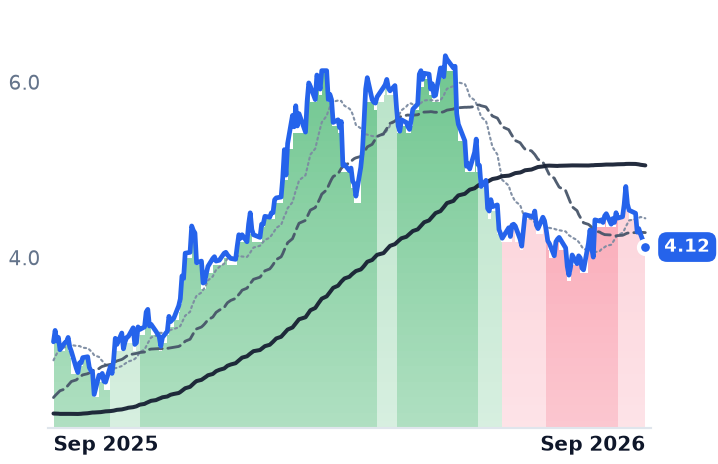
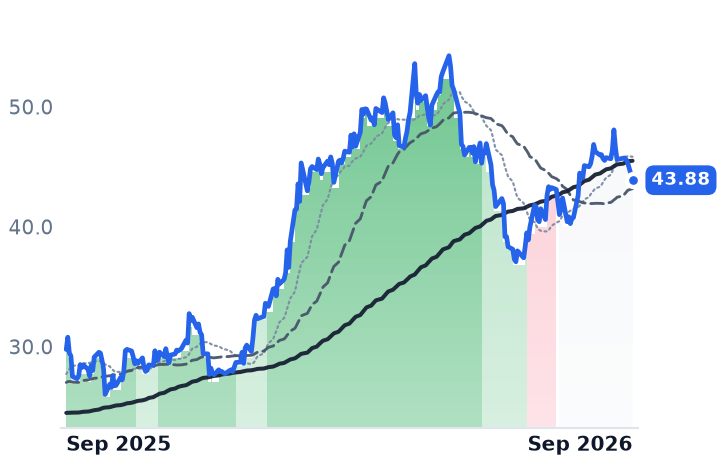
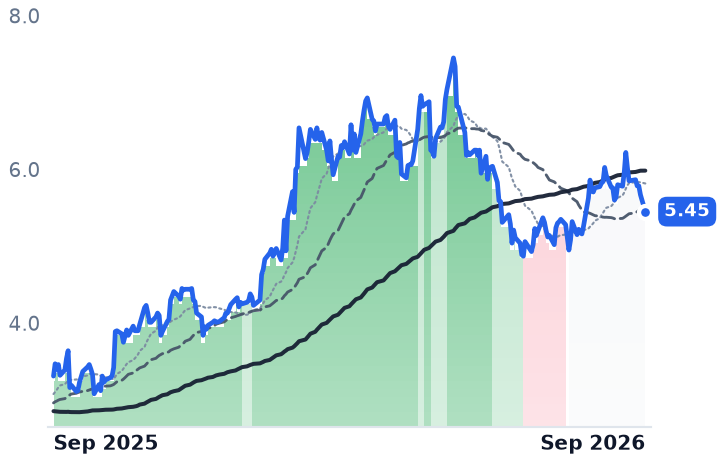
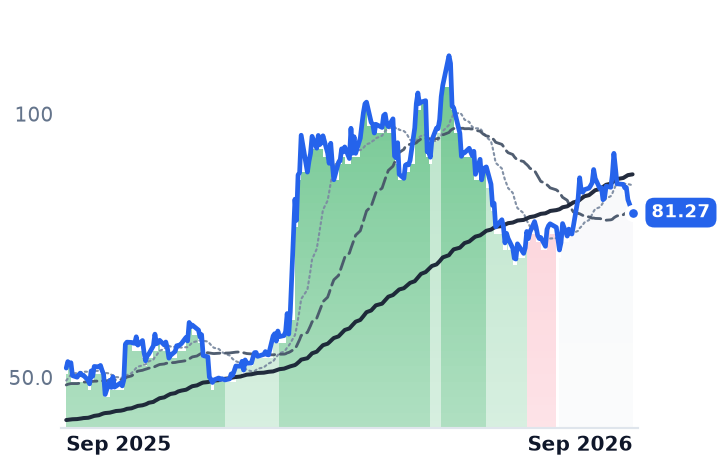
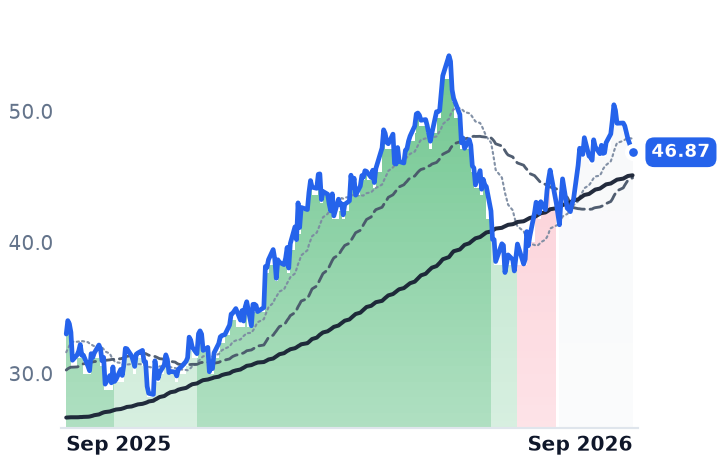
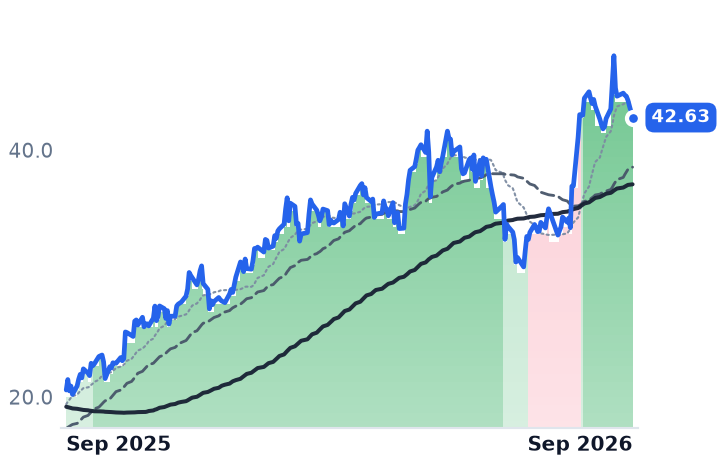
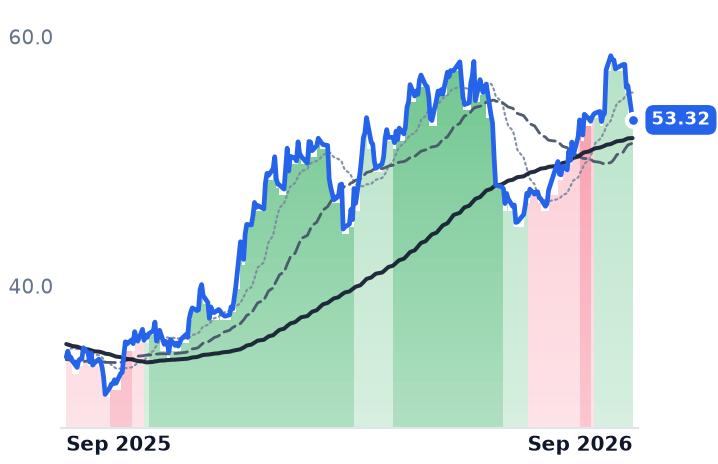
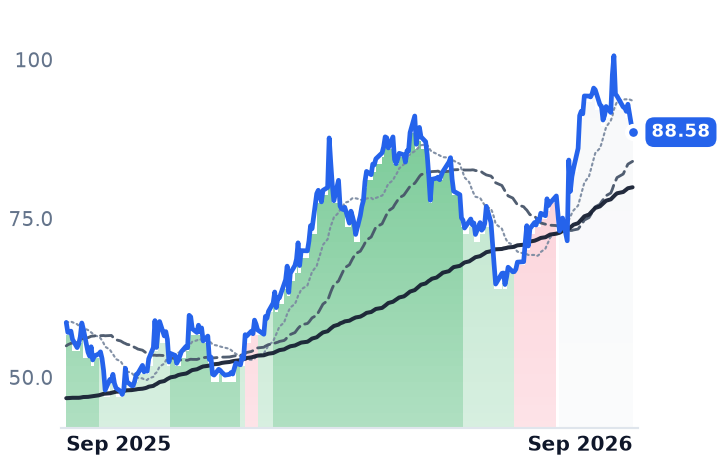
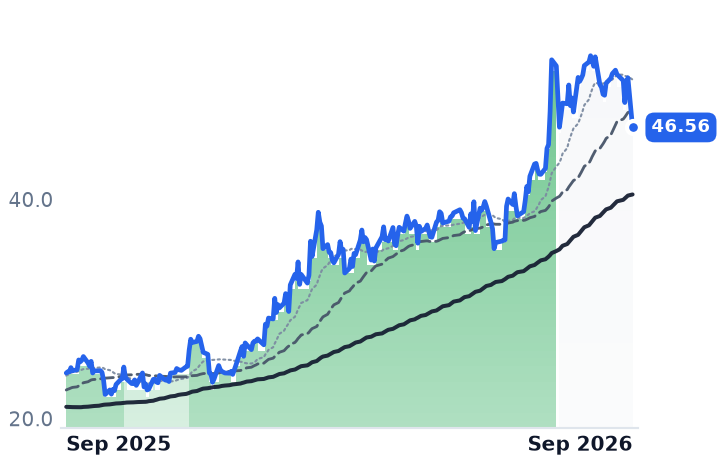
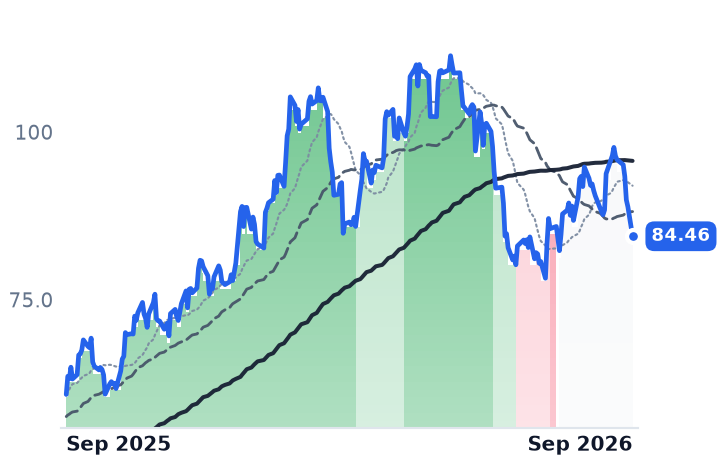
12-month price & trend
| Ticker | Mkt cap | P/E | P/E fwd | P/S | P/S fwd | P/GP | P/GP fwd | EV/EBITDA | FCF yld |
|---|---|---|---|---|---|---|---|---|---|
BORR | $1.3B | n/m | — | 1.2x | 1.3x | 4.1x | 4.2x | 9.7x | -11.6% |
NE | $7.0B | 46.2x | 71.0x | 2.3x | 2.4x | 8.6x | 9.1x | 9.3x | 4.1% |
RIG | $6.4B | n/m | 41.7x | 1.5x | 1.6x | 1.8x | 1.9x | n/m | 12.5% |
| Ticker | Mkt cap | P/E | P/E fwd | P/S | P/S fwd | P/GP | P/GP fwd | EV/EBITDA | FCF yld |
|---|---|---|---|---|---|---|---|---|---|
VAL | $7.3B | 7.3x | 30.7x | 3.3x | 3.4x | 13.5x | 13.9x | 12.2x | 1.6% |
SDRL | $3.3B | n/m | 89.7x | 2.3x | 2.2x | 13.7x | 13.5x | 12.7x | -1.7% |
HP | $4.4B | n/m | — | 1.1x | 1.1x | 10.5x | 10.6x | 7.6x | 7.1% |
| Ticker | Mkt cap | P/E | P/E fwd | P/S | P/S fwd | P/GP | P/GP fwd | EV/EBITDA | FCF yld |
|---|---|---|---|---|---|---|---|---|---|
SLB | $79.5B | 25.7x | 21.6x | 2.2x | 2.2x | 13.2x | 13.0x | 12.5x | 5.7% |
TDW | $4.1B | 13.7x | 23.8x | 3.0x | 2.8x | 10.4x | 9.6x | 9.0x | 6.9% |
OII | $5.1B | 14.7x | 26.3x | 1.8x | 1.7x | 8.9x | 8.8x | 12.5x | 4.4% |
| Ticker | Mkt cap | P/E | P/E fwd | P/S | P/S fwd | P/GP | P/GP fwd | EV/EBITDA | FCF yld |
|---|---|---|---|---|---|---|---|---|---|
WFRD | $7.8B | 16.9x | 18.5x | 1.6x | 1.6x | 3.5x | 3.6x | 8.6x | 6.0% |
Consensus projections
| Ticker | FY2026E | FY2027E | FY2028E | |
|---|---|---|---|---|
BORR | Revenue | −0.2% | +20.0% | +12.4% |
| EPS | −552.1% | −119.0% | +270.3% | |
NE | Revenue | −10.7% | +11.6% | +8.7% |
| EPS | −39.6% | +259.7% | +56.5% | |
RIG | Revenue | −2.4% | −0.1% | −0.4% |
| EPS | +37.7% | +51.0% | +7.1% | |
VAL | Revenue | −7.9% | +15.5% | +3.2% |
| EPS | −28.8% | +116.8% | +28.3% | |
SDRL | Revenue | +4.0% | +15.7% | −0.2% |
| EPS | −254.7% | +514.1% | +20.3% | |
HP | Revenue | +6.3% | +6.7% | +5.4% |
| EPS | −135.1% | −731.6% | +114.8% | |
SLB | Revenue | +4.0% | +7.6% | +6.1% |
| EPS | −13.9% | +29.2% | +16.0% | |
TDW | Revenue | +7.9% | +13.6% | +3.5% |
| EPS | +9.3% | +52.6% | +21.2% | |
OII | Revenue | +4.4% | +4.5% | +8.8% |
| EPS | +4.6% | +18.8% | +10.7% | |
WFRD | Revenue | −2.8% | +7.9% | +3.5% |
| EPS | +5.5% | +26.4% | +11.1% |
Forward fiscal years only. Blank means no analyst coverage for that year.
Borr Drilling, which owns a fleet of modern jack-up rigs and rents them with crews and equipment to national oil companies and independents from Mexico to Southeast Asia, kept those rigs running 98.4% of their scheduled time in the June quarter and still earned almost nothing. Revenue of $232.3m produced an operating margin of 0.13%, down from 18.6% in the March quarter.
That is the whole argument for owning or avoiding a jackup contractor, compressed into one line of an income statement. The revenue is arithmetic — rigs contracted, times day rate, times the share of days actually paid for — and the cost per rig-day barely falls when a rig idles. Utilization held; price and cost did the damage. And the damage now meets a fixed bill. Borr refinanced substantially all its debt during the quarter, issuing $1.1bn of senior secured notes at 8.75% due 2032, $935m at 9.00% due 2034 and $300m of 3.5% convertibles, while extending its revolver to $250m. Near-term maturity risk is gone; a hard cash schedule replaced it. "The new notes amortized at 5% per annum, equating to $101.75 million on a full year basis," chief financial officer Magnus Vaaler told investors on the August 12 call. That starts in July 2027, against $473.6m of cash and undrawn revolver today. The refinancing also carried a $176.3m debt extinguishment charge, the largest piece of the quarter's $241.4m net loss.
One buyer sets the price
The shallow-water price cycle has one author. When Saudi Aramco suspended rig contracts in 2024 it released supply into a market that could not absorb it, and global jackup day rates fell about 17% through 2025 as more rigs chased fewer jobs. The rebound that was supposed to arrive this year did not: Westwood's rig data shows working utilization of the marketed Middle East jackup fleet falling from 83% in early February to around 69% by late April as hostilities across the Arabian Gulf delayed contract starts. Borr told investors that first-half additions to Middle East backlog were the lowest in more than 25 years. Meanwhile 22 of the 37 suspended rigs have mobilized out of Saudi Arabia to West Africa, South America and Asia — the very markets Borr sells into. The overhang did not disappear; it moved next door.
The counterintuitive part is what a crude rally does to this business. The paper has treated the Hormuz disruption as a cost shock rather than a revenue event for oilfield equipment owners; Brent has since risen above $107 a barrel after Saudi Arabia shut its East-West pipeline following drone attacks, and the reading holds harder. Borr is not paid for oil. It is paid a fixed day rate, and $7.3m of the quarter's sequential EBITDA decline was higher conflict-related insurance and fuel. "The region still has substantial underlying demand, which was close to materializing prior to the onset of the conflict, and we believe this delayed activity should reenter the market once conditions stabilize," chief executive Bruno Morand said on the same call, guiding to roughly 23 active rigs in the third quarter and EBITDA improving significantly from the June quarter's $43.8m.
The deepwater mirror
Noble, the Texas-based contractor whose earnings come mostly from ultra-deepwater drillships, is also in a trough — June-quarter revenue of $719.7m was down 15.2% and produced a $36.7m net loss, and full-year EBITDA guidance was cut to $850–925m, largely on two rigs in Brazil. But its forward book is firming: backlog of $6.8bn, leading-edge Tier-1 drillship rates in the mid-$400,000s a day, and utilization of its five ultra-harsh-environment North Sea jackups up to 80% from 66%. Chief executive Robert Eifler told the July call that 77 rig-years of ultra-deepwater work were contracted industry-wide in the first half, the most in over a decade.
What the market is actually marking down
The two trade at nearly the same trailing enterprise value to EBITDA — about 9.3x for Noble, 9.7x for Borr — which makes them look like the same bet. They are not. Borr's multiple sits on an EBITDA base consensus expects to fall 57.7% next year, to $183.4m, on flat revenue; the collapse is entirely margin. Its trailing free cash flow yield is minus 11.6%, against a positive 4% at Noble. And in 2027, the recovery year, consensus turns $427.8m of Borr EBITDA into $34.5m of net income, 8%, because depreciation and that 9% coupon consume the rest. Noble converts a third of its EBITDA at the same point.
So the six-month split — Borr down about 19%, Noble down roughly 5% — is earned on the shallow-water side and provisional on the deep. Borr's de-rating is the market pricing a day-rate cycle plus a leveraged balance sheet, and the business supports it. Noble is being discounted for 2026 white space in front of a backlog that is still growing, which is a calendar problem if the 2027 inflection arrives and something worse if it does not.
Borr has 73% of this year's rig-days sold at an average of roughly $134,000. Aramco's next jackup tenders are due at the end of September, from a country that just lost its main route around the Strait of Hormuz.