

Planet Fitness Added No Members in the June Quarter While Life Time Raised Dues to $245
Hypothesis Opus 5 · Research Opus 5 · Writing Opus 5 · Prompt v1.6
Two companies filed under one fitness heading moved almost a hundred percentage points apart over twelve months, and the cheaper of the two is the one generating cash. Planet Fitness is paid a royalty on dues collected from a $15-a-month member; its membership finished June level with March and revenue growth slowed to 7.1%. Life Time, which builds and runs large-format athletic clubs itself, grew revenue 13.7% and has raised guidance twice this year.
The businesses explain most of both share prices. What they do not explain is the relative pricing: the decelerating royalty stream trades at roughly a quarter discount on enterprise value to EBITDA to the owner-operator, whose first-half free cash flow exists only because it sold $200.2m of its own real estate in the quarter and leased it back.
| Ticker | Company | Segment | Trend · 13mo | 30D | 1Y |
|---|---|---|---|---|---|
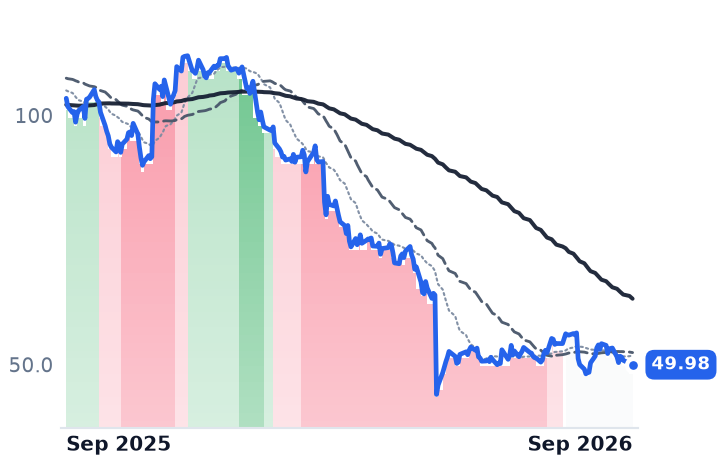
PLNT | Planet Fitness | Fitness & Wellness | 🔴 Cont. Bear | +3.2% | −51.7% |
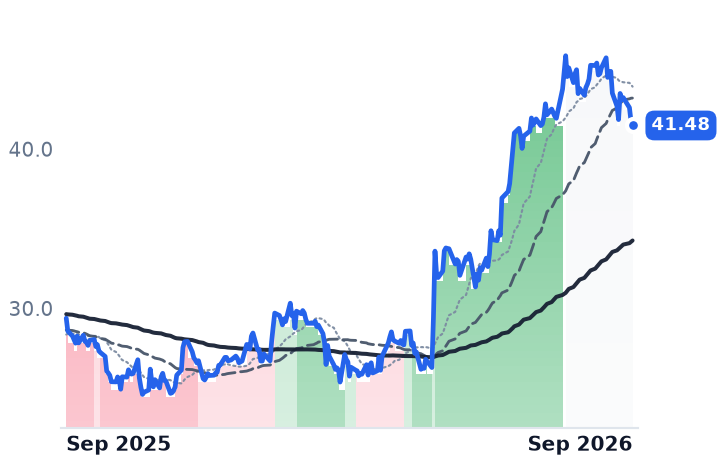
LTH | Life Time | Fitness & Wellness | 🌱 Emerging Bull | −5.9% | +41.2% |
12-month price & trend
| Ticker | Mkt cap | P/E | P/E fwd | P/S | P/S fwd | P/GP | P/GP fwd | EV/EBITDA | FCF yld |
|---|---|---|---|---|---|---|---|---|---|
PLNT | $4.0B | 16.9x | 15.4x | 2.8x | 2.8x | 5.6x | 5.5x | 10.8x | 6.6% |
LTH | $9.3B | 22.1x | 26.0x | 2.9x | 2.8x | 4.2x | 4.0x | 14.3x | -1.6% |
Consensus projections
| Ticker | FY2026E | FY2027E | FY2028E | |
|---|---|---|---|---|
PLNT | Revenue | +8.3% | +6.9% | +8.5% |
| EPS | +6.9% | +12.4% | +15.6% | |
LTH | Revenue | +12.6% | +11.9% | +11.0% |
| EPS | +17.6% | +14.3% | +9.8% |
Forward fiscal years only. Blank means no analyst coverage for that year.
Planet Fitness added no members between March and June. It closed the second quarter with 21.5m, level with the previous quarter and up 3.6% on the year, and the 1.7% increase in system-wide same-club sales came entirely from rate rather than bodies — against an 8.2% increase in the same quarter of 2025. A week earlier, Life Time had reported average monthly dues of $245, up 12.3%, and $993 of revenue per membership.
The two sit under one industry heading and are not in the same business. Planet Fitness owns fewer than one club in ten; it collects a 7% royalty on franchisee membership dues plus a national advertising levy, and sells franchisees their treadmills. Life Time designs, builds and operates large-format athletic clubs itself. Each grows on capital it does not fully control — franchisee balance sheets and the securitization market on one side, the sale-leaseback bid on the other — and this year that distinction has decided everything.
The guidance cut that reset the royalty
Planet Fitness shares fell more than 31% in one session on 7 May, the steepest drop since the 2015 listing, after net new member adds fell 36% and the company cut its full-year outlook: same-club sales to about 1% from 4–5%, adjusted EBITDA growth to roughly 6% from 10%. Management blamed messaging, competition in select markets, weather and the macro backdrop, and shelved a planned nationwide Black Card price increase. Consensus now models a 2.0% decline in this year's adjusted EBITDA — the first forecast earnings fall since 2021.
The June quarter shows where the reported growth came from. Franchise revenue rose 13.5% to $135.8m, but $10.1m of the $16.1m increase was a one-point rise in the advertising fund contribution rate, money the company collects and spends. Equipment revenue rose 4.1%, with 21 placements at new franchisee clubs against 19 a year earlier — modest re-engagement, though replacement sales were 85% of the mix. Operating margin still widened to 33.9% from 30.0%, helped by $200m of buybacks at an average $50.44 that cut the diluted share count to 77.1m from 84.2m. "The benefit of lower share count is being partially offset by higher interest expense following the drawdown of our $75 million VFN," chief financial officer Sudhanshu Priyadarshi told investors on 6 August. The remaining $250m of authorization competes with a dated wall: the 2022-1 Class A-2-I notes carry an anticipated repayment date of December 2026.
Attrition ran at 3.5%, the middle of its historical range, with no gap between card tiers. "We are concentrating our efforts this year on two priorities that are central to reigniting net member growth, driving acquisition and reinforcing affordability," chief executive Colleen Keating said on the same call. The problem is joins, not leavers.
The clubs Life Time sells and leases back
Life Time grew second-quarter revenue 13.7% to $866.0m, lifted operating margin by three percentage points to 17.3%, and cut net debt to 1.4 times EBITDA from 1.8 a year ago and 9.0 in mid-2022. Comparable-centre revenue rose 9.1%, with in-club spending — dynamic personal training, the spa — contributing as much as list pricing. Against a US gym industry growing about 1.3% this year, that is share and price gain rather than a rising tide.
The cash tells a second story. Capital expenditure was $263.3m in the quarter against $200.2m of sale-leaseback proceeds, with the full-year target raised to roughly $400m from $300m; first-half free cash flow of $85.3m is inseparable from those sales, and on a trailing twelve-month basis the free cash flow yield is still negative. "We have tremendous amount of real estate deals in the pipeline that I am more excited than I've ever been," founder and chief executive Bahram Akradi said on 30 July.
What each price is paying for
Planet Fitness trades at 10.8 times trailing enterprise value to EBITDA and 16.9 times trailing earnings, with a 6.6% trailing free cash flow yield. Life Time trades at 14.3 times and 22.1 times; its forward price/earnings of 26.0 sits above trailing because consensus 2026 net income of $361m is below the $415m earned in the last four quarters — a modelling artifact rather than a growth discount.
Both companies' moving averages converged into neutral territory on 28 July from opposite directions, Planet Fitness rising out of a months-long downtrend and Life Time falling out of an uptrend. Life Time's slip over the past thirty days looks like supply rather than operations: Leonard Green affiliates sold just over 5m shares at $43.16 on 10 August, cutting the group below 5% ownership.
The de-rating at Planet Fitness is earned: a company whose comps now run at industry rate deserves less than one compounding at nine percent. What the discount does not obviously price is that the cheaper company is the one throwing off cash, while the dearer one is funding its largest club class yet by selling the buildings into a market that has so far bid for them. The split is the K-shaped consumer written into two income statements — the $245 member absorbs increases, the $15 member is not joining — and it leaves each company hostage to a different counterparty: Life Time to the sale-leaseback bid, Planet Fitness to the December refinancing and to franchisee nerve.
Planet Fitness still says the United States will one day hold 5,000 of its clubs. Almost every one of them is somebody else's decision to build.