

NuScale Billed $75,000 Last Quarter; Oklo's Only Critical Reactor Makes Isotopes
Hypothesis Opus 5 · Research Opus 5 · Writing Opus 5 · Prompt v1.6
Two companies carry the listed claim on data-center nuclear demand, and neither is paid for electricity. NuScale sells a design and has handed the customer relationship to ENTRA1, its commercialisation partner, which it paid $495m last year; June-quarter revenue fell 99.1% when Fluor's Romanian engineering contract ended, and consensus has 2026 revenue dropping a further 54.8% to $18.9m before any binding module order exists.
Oklo intends never to sell a reactor at all — it wants to own plants and sell power — and booked its first revenue ever, $1.21m, from a test reactor built to make radioisotopes. Its licensing calendar has not slipped. What changed is the cost of funding it: second-quarter stock sales fetched about $62.55 a share against roughly $95.50 in the first quarter, and 2026 operating-cash guidance was raised to $120–150m.
| Ticker | Company | Segment | Trend · 13mo | 30D | 1Y |
|---|---|---|---|---|---|
| The subject · what this brief is about | |||||
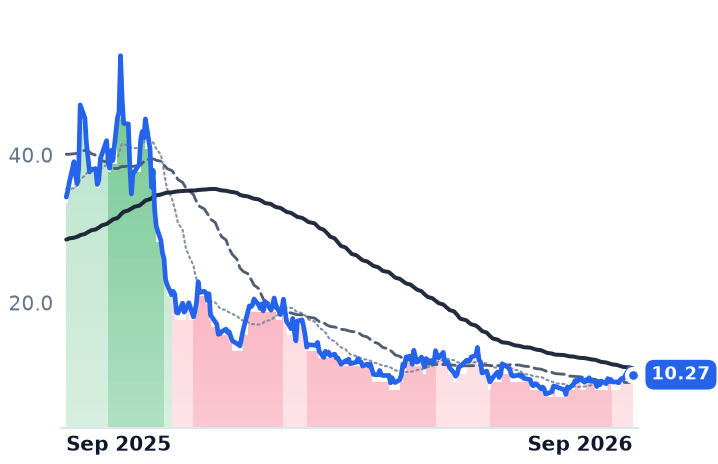
SMR | NuScale Power | Advanced Nuclear | 🔴 Cont. Bear | +7.2% | −70.1% |
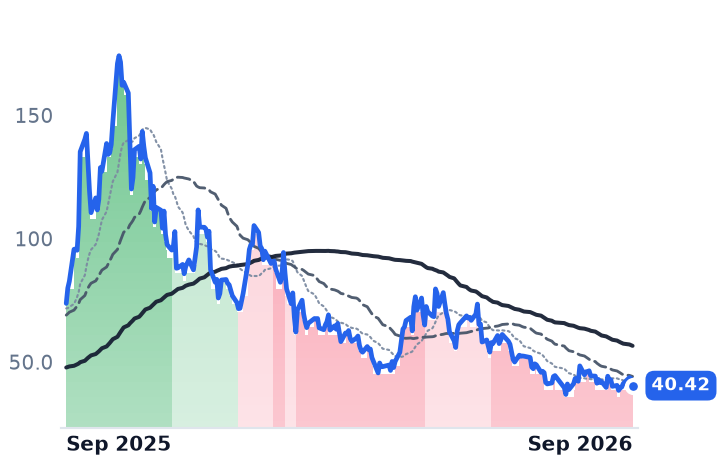
OKLO | Oklo | Emerging & Specialized Energy | 🔴 Cont. Bear | −12.3% | −45.2% |
| Compared against · context, not the story | |||||
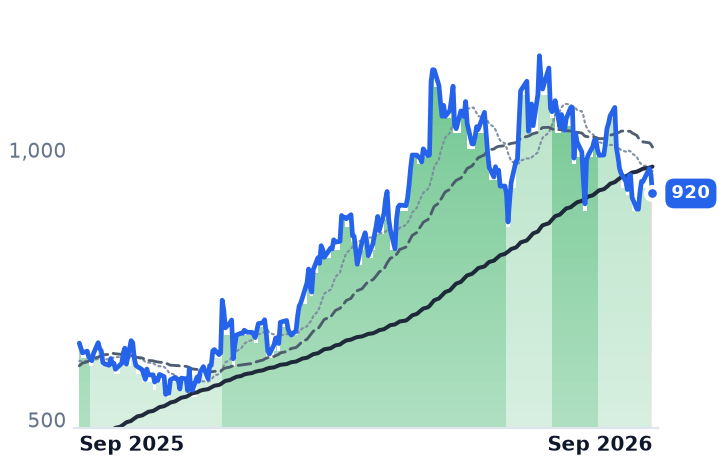
GEV | GE Vernova | GE Vernova Integrated | 🟢 Cont. Bull | −9.1% | +43.2% |
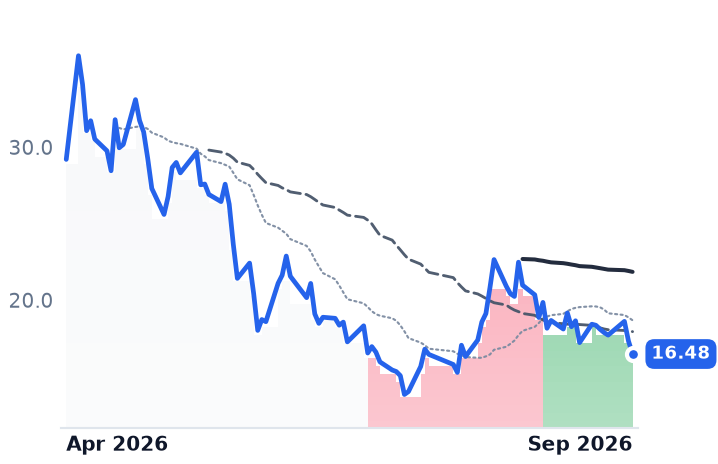
XE | X-Energy | Power & Propulsion Systems | 🔴 Cont. Bear | −19.3% | −43.6% |
NNE | Nano Nuclear Energy | Power & Propulsion Systems | 🔴 Cont. Bear | −7.3% | −44.2% |
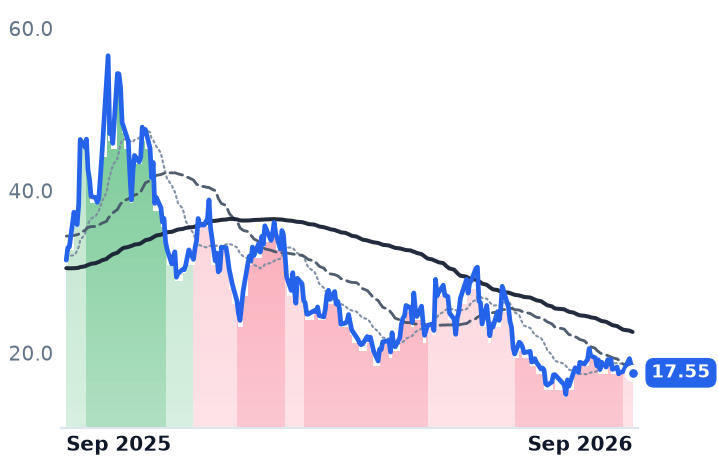
12-month price & trend
| Ticker | Mkt cap | P/E | P/E fwd | P/S | P/S fwd | P/GP | P/GP fwd | EV/EBITDA | FCF yld |
|---|---|---|---|---|---|---|---|---|---|
SMR | $3.0B | n/m | — | 284.6x | 160.7x | — | 762.7x | n/m | -25.5% |
OKLO | $6.9B | n/m | — | — | — | — | — | n/m | -4.0% |
GEV | $242.9B | 25.9x | 29.7x | 5.9x | 5.2x | 29.0x | 26.0x | 27.0x | 5.1% |
| Ticker | Mkt cap | P/E | P/E fwd | P/S | P/S fwd | P/GP | P/GP fwd | EV/EBITDA | FCF yld |
|---|---|---|---|---|---|---|---|---|---|
XE | $381.7M | n/m | — | 3.5x | 1.8x | — | — | 0.3x | -70.0% |
NNE | $1.1B | n/m | — | — | 887.7x | — | — | n/m | -3.7% |
Consensus projections
| Ticker | FY2026E | FY2027E | FY2028E | |
|---|---|---|---|---|
SMR | Revenue | −54.8% | +517.4% | +185.1% |
| EPS | −76.8% | +19.4% | −24.8% | |
OKLO | Revenue | — | +252.7% | +552.9% |
| EPS | +57.1% | +9.6% | +13.5% | |
GEV | Revenue | +23.9% | +14.8% | +15.0% |
| EPS | +321.7% | −19.5% | +40.7% | |
XE | Revenue | +83.1% | +253.8% | +46.2% |
| EPS | −98.0% | −1.4% | −33.6% | |
NNE | Revenue | +1684.0% | +356.5% | +39.0% |
| EPS | −23.4% | +55.2% | +34.3% |
Forward fiscal years only. Blank means no analyst coverage for that year.
NuScale Power's June-quarter revenue was $75,000. A year earlier it was $8.1m, and the entire difference is one contract ending: management attributed the drop to "completion of Fluor front-end engineering design Phase 2 work for RoPower in late 2025 with no comparable activity in current quarter." The company that owns the only small modular reactor design certified by the Nuclear Regulatory Commission was, for one quarter, billing less than a suburban dental practice.
This is the shape of the problem in listed nuclear. NuScale and Oklo are the two most-owned equity claims on data-center power demand, and neither company's income statement is a claim on electricity. The meters that matter are licensing dates, quarterly cash consumption and the share count — and over twelve months NuScale has lost 70.1% and Oklo 45.2% while the S&P 500 gained 16.2%.
NuScale sells the design and pays for the customer
NuScale supplies technology; someone else sells the power. Under a 50/50 joint venture, ENTRA1 Energy holds global exclusive rights to commercialise and deploy NuScale's 77-megawatt modules, developing, financing and owning the plants. Money flows toward the partner: NuScale paid ENTRA1 $495m as "Milestone Contribution 1" against the Tennessee Valley Authority framework for up to 6 gigawatts, with more than $3bn of further milestone payments possible. That single payment produced a $538.4m operating loss in the third quarter of 2025, against revenue of $8.2m in the same three months.
The TVA power purchase agreement is still unsigned; chief executive John Hopkins has said he expects it finalised by the end of 2026. Until then, the offsetting assets are real but static: two standard design approvals, conventional low-enriched uranium fuel rather than the high-assay fuel rivals need, forgings ordered from Doosan Enerbility, and $1.9bn of cash against operating expenses near $50m a quarter. Financing continued anyway. Class A shares rose from 318.5m at year-end to 410.4m by 30 June, and on 11 August the company launched a $750m at-the-market programme.
Oklo builds, owns and has not yet signed a price
Oklo's model is the mirror. It plans to own its Aurora powerhouses and sell electrons under long-dated contracts, which makes its forward case a licensing calendar and a fuel supply rather than an order book. The calendar has held: the NRC approved the Aurora principal design criteria in May on an accelerated schedule, the combined licence application is in review, and the Groves isotope test reactor in Lockhart, Texas reached first criticality on 5 August, which management called the fastest greenfield-to-criticality transition "for a full-scale, privately funded and privately sited reactor in history" on the 7 August results call.
What that reactor makes is radioisotopes. The roughly 14 gigawatts of announced demand — a 12-gigawatt Switch agreement plus letters of intent with Equinix, Diamondback Energy and Prometheus Hyperscale — remains, by Oklo's own filings, preliminary arrangements it is still negotiating into power purchase agreements. Fuel is similarly provisional: a Centrus letter of intent for up to five powerhouses with deliveries expected in 2029, plus a pending Department of Energy plutonium allocation. Meanwhile the bill grew — 2026 operating cash guidance was raised to $120–150m from $80–100m and capital spending to $400–500m — funded by $1.9bn of stock sales at a realised price that fell about 35% between the first and second quarters.
What the de-rating is actually pricing
The two have separated recently. NuScale is up 7.2% over thirty days, including a 15% session on 8 September when it and partner MillenniTEK produced first-of-a-kind boron-oxide pellets, a manufacturing demonstration rather than an order. Oklo is down 12.3%. On 10 September Piper Sandler initiated with a Buy on Oklo and a Sell on X-Energy, and the whole complex fell about 5%, selling the Sell rather than buying the Buy.
The year-long de-rating is not a milestone failure — Oklo's schedule is intact and NuScale's design approvals stand. It is a repricing of duration. With the 30-year Treasury yield near 5.27%, cash flows dated 2028 and beyond are worth less, and neither price is anchorable to earnings in any case. Oklo trades at about 2,337 times forward sales and 2.15 times book, with roughly $3.0bn of cash inside a $7.5bn market value. NuScale screens at 160.7 times forward sales only because the reported diluted share count is stale; on the fully exchanged Class A and Class B counts, the market value is nearer $4.4bn and forward sales roughly 233 times, with $1.9bn of that cash.
So the honest split: Oklo's fall is the cost of capital rising against an unchanged plan, and its equity is now partly a cash pile with a construction site attached. NuScale's is the plan itself going quiet — one signature away from a combined licence application, engineering contracts and OEM negotiations, and with no revenue worth the name until it arrives.
The fastest reactor to criticality in modern American history went critical last month to make medical isotopes. The one certified to make power for the grid is waiting on a piece of paper from a federal utility.