

Rambus Guided Royalties Down 14% and Chipset Sales Up 14% for the Same Quarter
Hypothesis Opus 5 · Research Opus 5 · Writing Opus 5 · Prompt v1.6
Rambus's patent annuity has stopped growing sequentially just as its chip business became the larger of its two books, and there is almost no deferred revenue left to smooth the difference. In the June quarter, chipset product revenue of $99.2m exceeded royalties of $84.2m for the first time, and licensing billings of $84.1m tracked recognized royalties within about a percent — so the licensing line now reads as demand rather than as a signing calendar.
The growth is real: revenue rose 20.4% to a record and gross margin widened to 79.8%. But Rambus is paid per module shipped, not per bit or per dollar of memory, and server module supply is forecast to grow 15-20% while contract prices do the rest. Everspin, filed under the same memory-pooling label, sells magnetoresistive memory into factories and satellites and books no revenue from pooling at all.
| Ticker | Company | Segment | Trend · 13mo | 30D | 1Y |
|---|---|---|---|---|---|
| The subject · what this brief is about | |||||
RMBS | Rambus | Interconnect & Storage IP | ⚠️ Emerging Bear | −9.2% | +16.8% |
MRAM | Everspin Technologies | Memory (DRAM/NAND) | ⚠️ Emerging Bear | +6.2% | +150.5% |
| Compared against · context, not the story | |||||
MU | Micron Technology | Memory (DRAM/NAND) | 🟢 Cont. Bull | +15.5% | +654.7% |
SNDK | Sandisk | Specialty Manufacturing & Components | 🟢 Cont. Bull | +43.3% | +2415.3% |
ALAB | Astera Labs | Specialty Semiconductors | 🟢 Cont. Bull | −7.3% | +41.7% |
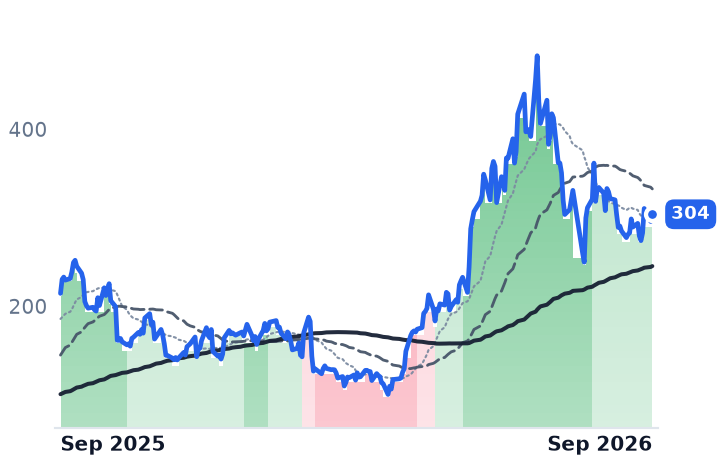
12-month price & trend
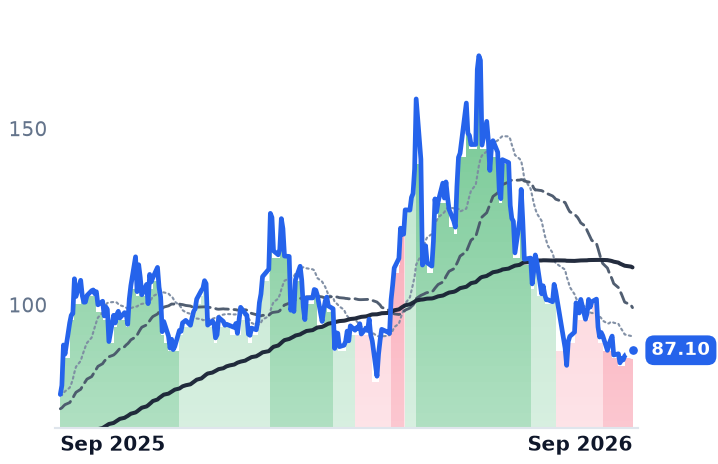
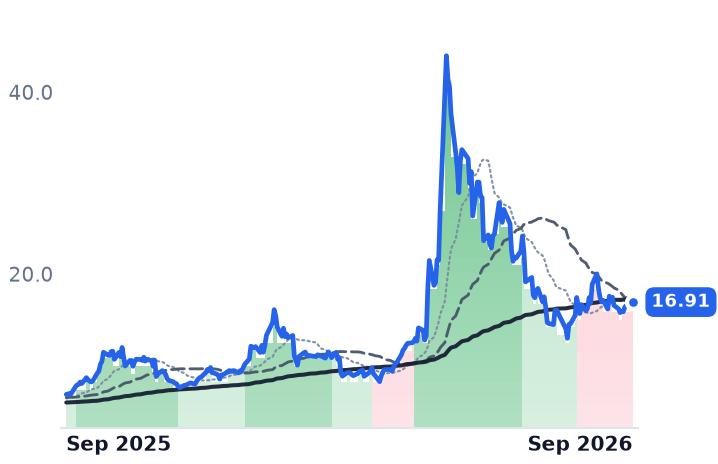
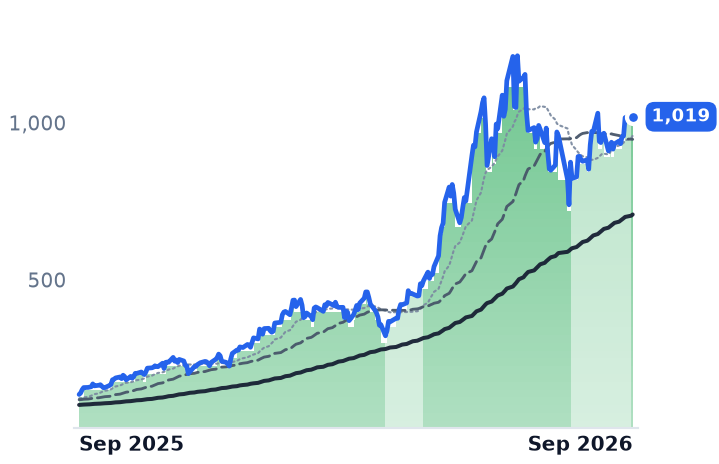
| Ticker | Mkt cap | P/E | P/E fwd | P/S | P/S fwd | P/GP | P/GP fwd | EV/EBITDA | FCF yld |
|---|---|---|---|---|---|---|---|---|---|
RMBS | $9.5B | 39.5x | 28.9x | 12.6x | 11.5x | 16.1x | 14.7x | 29.6x | 3.2% |
MRAM | $392.0M | n/m | — | 6.3x | 5.3x | 12.0x | 10.1x | 841.7x | -1.4% |
MU | $1.0T | 19.9x | 12.2x | 11.2x | 7.8x | 15.4x | 10.7x | 14.5x | 2.6% |
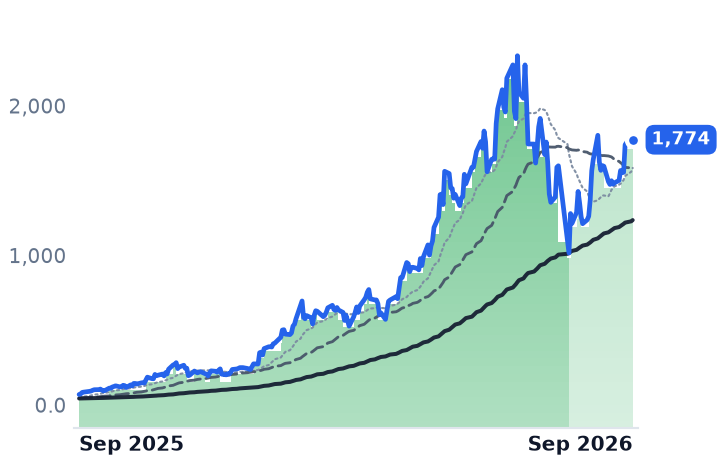
| Ticker | Mkt cap | P/E | P/E fwd | P/S | P/S fwd | P/GP | P/GP fwd | EV/EBITDA | FCF yld |
|---|---|---|---|---|---|---|---|---|---|
SNDK | $232.3B | 20.2x | 7.5x | 11.5x | 4.8x | 16.1x | 6.7x | 17.4x | 4.9% |
ALAB | $48.8B | 131.3x | 72.1x | 40.6x | 25.8x | 54.1x | 34.4x | 145.9x | 0.6% |
Consensus projections
| Ticker | FY2026E | FY2027E | FY2028E | |
|---|---|---|---|---|
RMBS | Revenue | +17.7% | +20.6% | +24.6% |
| EPS | +21.5% | +24.7% | +26.6% | |
MRAM | Revenue | +35.9% | +15.7% | +1.0% |
| EPS | +340.0% | −218.2% | +161.5% | |
MU | Revenue | +248.0% | +92.8% | +11.4% |
| EPS | +804.9% | +111.2% | +7.9% | |
SNDK | Revenue | +174.4% | +143.0% | +18.2% |
| EPS | +2369.0% | +214.5% | +22.1% | |
ALAB | Revenue | +127.6% | +60.7% | +29.5% |
| EPS | +122.0% | +61.8% | +27.1% |
Forward fiscal years only. Blank means no analyst coverage for that year.
Rambus pointed its own guidance in two directions for the September quarter. The San Jose company, which licenses memory patents and sells the register clock drivers and power-management chips that sit on server memory modules, told investors to expect product revenue of $110m to $116m, up roughly 14% from June, and royalties of $69m to $75m, down roughly the same.
Those two lines had just crossed for the first time. Chipset product revenue reached a record $99.2m in the June quarter against royalties of $84.2m, on total revenue of $207.4m — up 20.4% year over year, with gross margin widening nearly five points to 79.8%. And the licensing side carries very little accounting cushion to smooth what happens next. Rambus publishes licensing billings, the amount actually invoiced to licensees; those were $84.1m against $84.2m of recognized royalties, after $70.8m against $69.6m in the March quarter. Unbilled receivables stood at $27.8m and deferred revenue at $25.7m against a royalty run-rate near $290m a year, per the company's filings. The annuity is being billed roughly as fast as it is booked, which means the royalty line now reports demand, and demand there is flat.
Paid per module, in a market priced per bit
What carries growth instead is content on modules — and modules are counted, not weighed. Server memory contract prices are expected to rise 13-18% quarter over quarter in the third quarter; none of that reaches Rambus, whose management said on the July 27 call that it sees no pricing opportunity in the shortage and is holding share with standard products. Meanwhile high-bandwidth memory is absorbing a rising share of the top three suppliers' wafer input — roughly 18% at the end of 2025, 22% this year, 30% in 2027 — leaving registered module bit supply growing only 15-20%. Baird, downgrading the shares on precisely this, cut its registered-module unit growth estimate to 12-15% for 2027.
Rambus's answer is channels. Chief executive Luc Seraphin credited the migration from 12 to 16 memory channels per processor for the quarter's outperformance, and in the results release cited "the accelerating demands of data center and AI infrastructure." Sixth-generation chipsets were a low double-digit share of product revenue; the multiplexed-rank modules meant to lift dollar content per module are minimal until 2027.
The shares have taken the unit math to heart. Rambus has fallen 36.9% in three months and sits 49% below its June closing high of $170.66, leaving it up 16.8% over twelve months in which Micron rose 654% and SanDisk 2,415%. Price to trailing gross profit has compressed to 16.06x from 20.9x in early May, and the forward reading of 14.66x implies roughly 10% gross-profit growth against the 28% just delivered. Consensus still models revenue of $828.7m this year and $999.4m next.
The mis-filed mirror
Everspin, grouped with Rambus under a memory-pooling label, makes magnetoresistive memory — non-volatile chips that hold data without power. Its record June quarter, $18.7m and up 42%, was $15.3m of product sold into industrial automation, energy management and aerospace and defense, plus $3.4m of licensing, royalty and engineering revenue. Chief executive Sanjeev Aggarwal said on the August 5 call that results were "driven by strong product revenue coupled with initial non-product revenue under our recently signed $40 million contract with a US prime contractor" — a 30-month Navy microelectronics subcontract through Amentum. Its Compute Express Link work is a proof-of-concept and a memorandum of understanding with MaxLinear, both pre-revenue.
Everspin's own de-rating is earned elsewhere: litigation costs from Avalanche Technology's patent suit rose to $4.0m in the quarter, widening the operating margin to -23.4% from -14.9%, and at 6.28x trailing sales the stock remains more than twice its multiple of a year ago despite falling 26% in three months.
So the verdict splits. Rambus's business is growing faster than it was, and the market has taken a quarter of its valuation out anyway — but the de-rating has a mechanism, not just a mood: a company paid per module shipped meets a market where the growth is in price. What nothing yet explains is the width of the gap between 28% gross-profit growth delivered and roughly 10% implied. Everspin's decline needs no such explanation; its multiple is doing the falling from a much higher place.
Both companies now point at the same year for resolution, and neither points at memory pooling. Rambus needs a multiplexed-module ramp its own management calls immaterial before 2027; Everspin faces an import-ban proceeding at the International Trade Commission targeted for completion on July 6, 2027.