

Half of Corning's Sales Are Now Optical; Core Profit Exceeds Reported Profit by 22%
Hypothesis Opus 5 · Research Opus 5 · Writing Opus 5 · Prompt v1.6
Corning's fastest-growing business is now fiber and connectors sold into data centers, and its shares still sit nearly 40% below their June peak — a gap the order book does not explain. June-quarter operating income rose 21.8% on revenue up 16.6%, and the optical segment earned a record 21% net margin.
The figures management leads with, though, are struck on the company's own basis: core earnings of $0.78 a share against $0.64 reported, the difference principally an adjustment for hedged currency exposures adopted on April 1. Consensus 2027 earnings have not been cut. The business is compounding; what has come out of the stock is the premium it carried in June.
| Ticker | Company | Segment | Trend · 13mo | 30D | 1Y |
|---|---|---|---|---|---|
| The subject · what this brief is about | |||||
GLW | Corning | Display & Optical Materials | 🟢 Cont. Bull | −4.1% | +115.0% |
OLED | Universal Display | Display & Optical Materials | 🔴 Cont. Bear | −8.5% | −42.7% |
| Compared against · context, not the story | |||||
AVGO | Broadcom | Semiconductor Subsystems | 🟢 Cont. Bull | −15.6% | +4.1% |
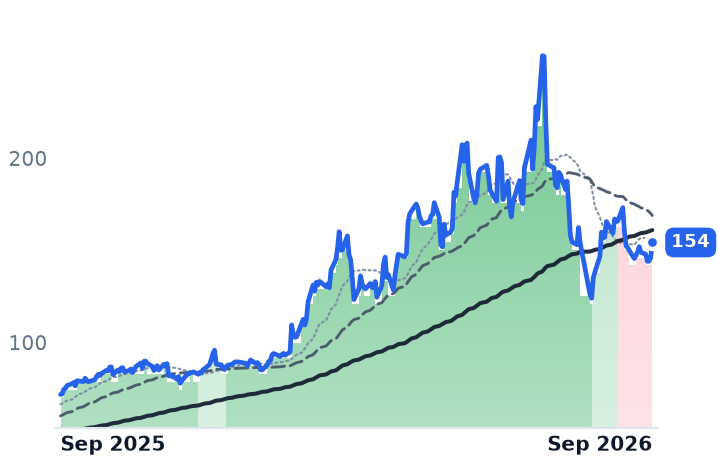
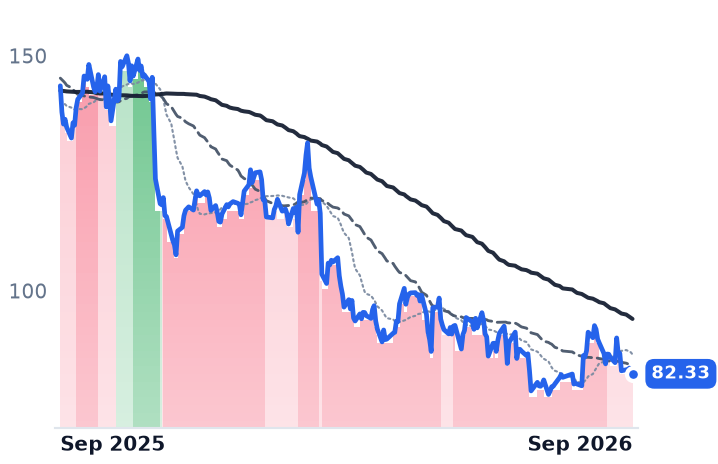
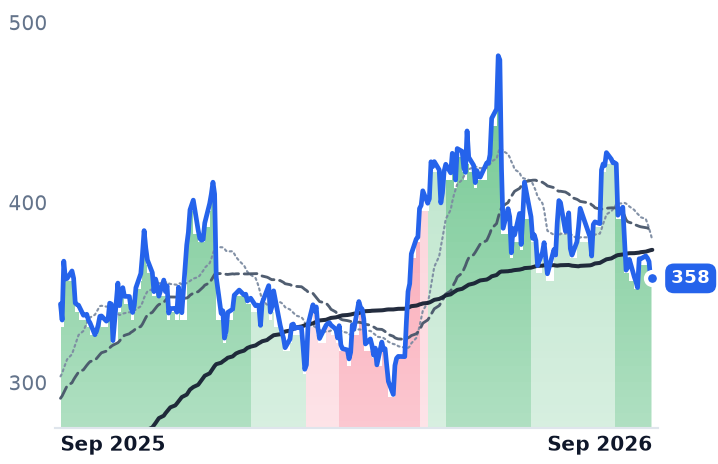
12-month price & trend
| Ticker | Mkt cap | P/E | P/E fwd | P/S | P/S fwd | P/GP | P/GP fwd | EV/EBITDA | FCF yld |
|---|---|---|---|---|---|---|---|---|---|
GLW | $132.9B | 69.8x | 47.1x | 7.8x | 6.9x | 21.6x | 19.1x | 35.8x | 1.8% |
OLED | $3.8B | 19.8x | 19.7x | 6.2x | 6.0x | 8.3x | 8.0x | 14.3x | 4.5% |
AVGO | $1.7T | 44.4x | 30.8x | 19.1x | 16.1x | 28.2x | 23.8x | 33.3x | 2.3% |
Consensus projections
| Ticker | FY2026E | FY2027E | FY2028E | |
|---|---|---|---|---|
GLW | Revenue | +17.4% | +18.7% | +21.5% |
| EPS | +29.9% | +31.8% | +37.3% | |
OLED | Revenue | −3.2% | +7.7% | +11.9% |
| EPS | −15.3% | +12.5% | +22.1% | |
AVGO | Revenue | +67.0% | +64.8% | +56.9% |
| EPS | +72.1% | +66.0% | +55.4% |
Forward fiscal years only. Blank means no analyst coverage for that year.
Corning sold $2.07bn of optical fiber, cable, connectors and hardware in the June quarter — 49% of company sales, and up 32% on a year earlier. The enterprise half of that business, the part that ships into data centers, grew 65%, and AI data-center sales nearly doubled. Segment net income rose 77% to $438m on a 21% net margin, the best the segment has recorded. Carrier sales were flat.
That is now the company. Corning, which also makes glass substrates for panels, Gorilla-type cover glass, ceramic emissions substrates for vehicles and lab consumables, has become a fiber manufacturer with side businesses, and it says demand for its high-density optical products still runs ahead of what it can produce. Multi-year capacity agreements signed this year with Meta — up to $6bn — with NVIDIA and with Amazon are turning long-term contracts into the majority of the optical book. Which makes the basis on which all of it gets reported worth reading closely.
Two sets of books, both legitimate
On reported figures, Corning's June quarter produced revenue of $4.505bn, up 16.6%, operating income of $698m, up 21.8%, and diluted earnings of $0.64 a share. The figures management leads with are core sales of $4.74bn and core earnings of $0.78 — 5.2% and 22% above the reported lines. The gap principally reflects an adjustment for hedged currency exposures that Corning adopted prospectively on April 1, 2026, replacing the constant-currency convention under which it had translated the yen at ¥120 for 2025 and 2026, plus non-cash tax and restructuring items, per the quarter's earnings exhibit. The market rate is nowhere near ¥120: spot traded between ¥160.38 on September 2 and ¥154.36 on September 7.
This is not cosmetic, because the plan investors are underwriting is stated in sales. "In the second quarter, we delivered outstanding results, and we upgraded our Springboard Plan to grow sales to an annualized run rate of $20 billion by the end of 2026, $30 billion by the end of 2028, and $40 billion by the end of 2030," chairman and chief executive Wendell Weeks said on the July results. June-quarter core sales annualize near $19bn; the reported ones near $18bn. Corning's own risk-adjusted version of Springboard is lower again — $27bn by end-2028 and $35bn by end-2030 — with the timing of optical scale-up adoption named as the largest single adjustment factor.
The AI build pays one segment and taxes the other
Glass Innovations — display substrates and cover glass, merged into a single segment in the first quarter of 2026 — grew 1% to $1.46bn, with net income of $354m. The reason is one price: Corning expects handset units down a mid-teens percentage this year because memory prices have inflated the cost of building a phone. The same data-center spending that fills the fiber order book is what shrinks the market for phone glass.
The shares closed at $154.29, 39.7% below the June 29 peak of $255.69 and down 13% over three months, though still up 117% over twelve; the 50-day average has sat below the 200-day since mid-August. Forward earnings are 47.1x against 69.8x trailing, and trailing stood near 88x in early May. Consensus has not moved against the company — $3.28 of earnings this year and $4.32 next — but the sell side has split on price, with JPMorgan cutting to $170 at neutral, Barclays to $129, and UBS reiterating a buy at $196. The 5.68% gain on September 4 came with no Corning-specific news and on the day Broadcom reported AI semiconductor revenue of $16.7bn; the likelier reading is a sector-wide bid for optics rather than anything from Corning.
What the business earns and what it does not
The fall from June is premium removal, not a markdown of the franchise: revenue growth has decelerated only gently, from 20% in the March quarter to 16.6% in June, and margins expanded rather than compressed. What the business does not yet earn is the gap between the two plans and the two profit lines. An investor buying Corning at 47x forward earnings is buying management's internal Springboard rather than its risk-adjusted one, and quoting a per-share number that sits 22% above the one in the filing. Both are defensible; neither is the same as the other.
The September quarter is guided to $4.9-5.0bn — the first full period reported entirely under the new hedged-exposure adjustment, and the first clean read on how wide that wedge stays.