

York Space Systems Cut 2026 Revenue a Third; Redwire and Intuitive Machines Reaffirmed
Hypothesis Opus 5 · Research Opus 5 · Writing Opus 5 · Prompt v1.6
Three listed spacecraft builders lost between 41% and 69% of their value over three months, and only one of them has a damaged forecast behind it.
York Space Systems' second-quarter revenue was $92.5m, down 12.9% from a year earlier after a first quarter up 52%, and its chief executive blamed a shift in how the U.S. government buys satellites rather than a lost competition. Intuitive Machines and Redwire did the opposite in the same weeks: record contracted backlogs of $1.8bn and $542.1m, full-year guidance held, and at Redwire a record 27.8% gross margin.
The complication is that Redwire is now more drone maker than satellite maker — its Defense Tech segment out-earned its Space segment last quarter — and it is still the most expensive of the three on forward sales.
| Ticker | Company | Segment | Trend · 13mo | 30D | 1Y |
|---|---|---|---|---|---|
| The subject · what this brief is about | |||||
LUNR | Intuitive Machines | Space Systems & Launch | ⚠️ Emerging Bear | −4.1% | +80.8% |
RDW | Redwire | Space Systems & Launch | 🌱 Emerging Bull | −17.2% | +31.3% |
| Compared against · context, not the story | |||||
YSS | York Space Systems | Aerospace & Defense | 🔴 Cont. Bear | −16.7% | −73.3% |
12-month price & trend
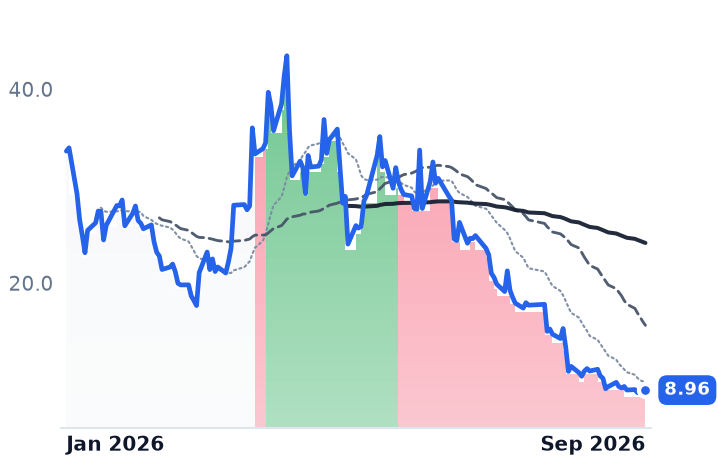
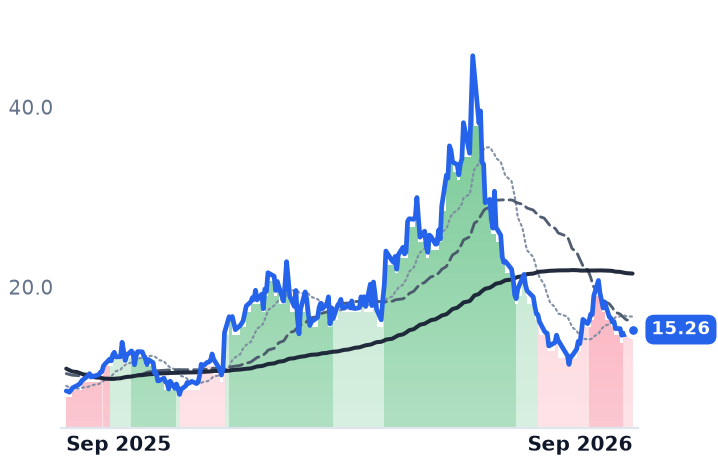
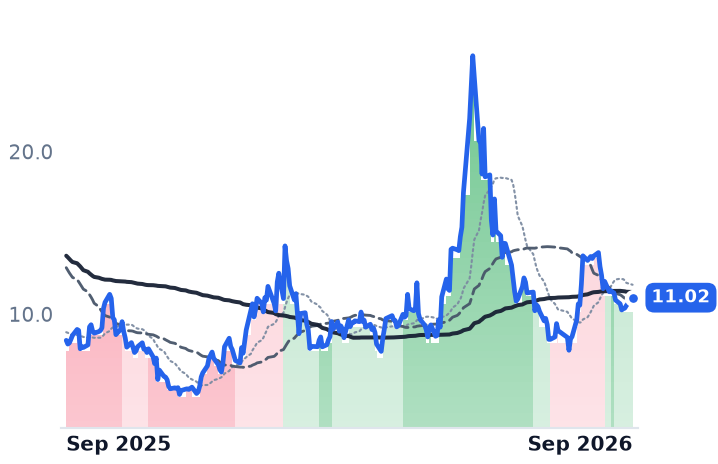
| Ticker | Mkt cap | P/E | P/E fwd | P/S | P/S fwd | P/GP | P/GP fwd | EV/EBITDA | FCF yld |
|---|---|---|---|---|---|---|---|---|---|
YSS | $1.2B | n/m | — | 2.9x | 2.8x | 13.5x | 13.3x | n/m | -15.7% |
LUNR | $2.4B | n/m | — | 5.0x | 2.6x | 18.2x | 9.6x | n/m | -7.8% |
RDW | $2.6B | n/m | — | 6.2x | 5.5x | 30.7x | 27.5x | n/m | -3.9% |
Consensus projections
| Ticker | FY2026E | FY2027E | FY2028E | |
|---|---|---|---|---|
YSS | Revenue | +6.7% | +29.0% | +33.6% |
| EPS | +163.7% | −78.2% | −167.0% | |
LUNR | Revenue | +322.6% | +23.3% | +21.2% |
| EPS | +69.3% | −67.8% | −152.9% | |
RDW | Revenue | +44.6% | +18.7% | +21.2% |
| EPS | −55.6% | −52.4% | −57.9% |
Forward fiscal years only. Blank means no analyst coverage for that year.
York Space Systems told investors on August 13 that it now expects $375-405m of revenue in 2026, against a prior range of $545-595m. The company did not lose a competition. Its chief executive, Dirk Wallinger, attributed the cut to a change in how the Pentagon issues work: awards are increasingly made as indefinite-delivery, indefinite-quantity vehicles — vendor pools that authorize spending but pay nothing until individual task orders are funded — instead of a run of discrete requests for proposals. Roughly 30% of York's planned new business for the year came out, with supply-chain delays pushing a similar amount into 2027.
"Through 2026 and increasingly in Q2, we've observed a meaningful shift in how the U.S. government is acquiring spacecraft systems, moving away from a rapid succession of larger RFPs to an IDIQ approach that is slow to start, but often faster to accelerate task orders later," Wallinger said on the August 13 call. That distinction matters well beyond York, because all three listed spacecraft builders sold off together this summer and only one of them has a forecast that broke.
The one that broke
York, a Colorado prime that builds S-CLASS, LX-CLASS and M-CLASS satellite buses for national-security customers, delivered an excellent quarter operationally: 21 satellites launched to finish its Space Development Agency Tranche 1 Transport Layer commitment at 42-for-42, gross margin up 13 percentage points to 24%, backlog up 9% to $592m. None of it stopped the revenue line from contracting. Adjusted losses before interest, tax, depreciation and amortization widened to $9.5m as selling and research costs rose 52%. The share damage arrived before the guidance cut, around the August 5 announcement that finance chief Kevin Messerle was leaving for a job outside the space industry: the stock fell 12.7% and then 18.5% on consecutive sessions. JPMorgan cut York to Neutral days later and dropped its target to $17 from $38.
The two that did not
Intuitive Machines, the Houston builder of lunar landers and, since acquiring the former Maxar satellite business now called Lanteris, of communications spacecraft, reported June-quarter revenue of $206.2m — more than four times the year-ago figure — with gross profit of $35.9m against a gross loss a year earlier. Contracted backlog reached a record $1.8bn, roughly double the $943m on the books in early May, and full-year guidance of $900m-$1bn was reaffirmed. Its largest booking of the quarter was a $600m order for three geostationary communications satellites built on the Lanteris bus. "This quarter demonstrates that Intuitive Machines is no longer dependent on a single market, customer or mission cadence for growth," finance chief Peter McGrath said on August 13.
The honest caveat is on the margin line and the share count. A $14.7m estimate-at-completion adjustment on the IM-4 lander helped drag gross margin from 39.0% in the March quarter to 17.4% in June, the company burned $60m of operating cash, and diluted shares rose 51% year over year. The at-the-market equity sold to date was priced at a volume-weighted average of $26.81 — well above where the shares now trade.
Redwire, which sells solar arrays, star trackers and deployable structures into space programs and, through its Edge Autonomy unit, uncrewed aircraft and surveillance payloads to defense ministries, posted record revenue of $117.1m, a record 27.8% gross margin and a record $542.1m backlog on a book-to-bill of 1.42. Estimate-at-completion adjustments were net neutral in the quarter, after years in which program charges held full-year 2025 gross margin to 5.2%. "We are reaffirming our full year 2026 revenue forecast in the range of $450 million to $500 million," finance chief Chris Edmunds said on August 6. Defense Tech revenue of $61.9m exceeded Space's $55.2m: the satellite-component company is now, by revenue, a drone company.
What the prices are actually saying
No company-specific bad news is discoverable at either name inside the last month; both peaked on August 17 and drifted. The likelier reading is that a scarcity premium drained out of the group after SpaceX's June 12 listing, the largest initial public offering on record, on whose debut day Redwire and Intuitive Machines each fell at least 10%. Redwire's own catalyst is datable: it established a $500m at-the-market equity program on June 9 and fell 15.2% that day, having already grown its diluted share count 146% in a year while cutting debt 75% to $48.9m.
The three now sit in different places. Intuitive Machines trades at 2.63x forward sales and 9.6x forward gross profit, against 18.7x sales in early May with no forecast cut in between — the clearest gap between what the order book did and what the price did. Redwire is the most expensive of the three on forward sales at 5.53x, and its trailing 6.17x is above the 5.36x it carried in May, so its slide is a retracement from a June peak rather than a de-rating. York, at 0.64x book value, is priced below the accounting value of its net assets by a market that has decided slow task-order conversion is permanent.
The grouping itself is the thing to discard. One of these companies had its revenue shrink; one quadrupled it; one now earns most of its money from drones. Whether York's IDIQ backlog converts in 2027 is a question about federal contracting speed, and it will be answered on a schedule no share price can pull forward.