

Collegium Cut 2026 Guidance to $825-855m as Its Own Nucynta Generic Undercut the Brand
Hypothesis Opus 5 · Research Opus 5 · Writing Opus 5 · Prompt v1.6
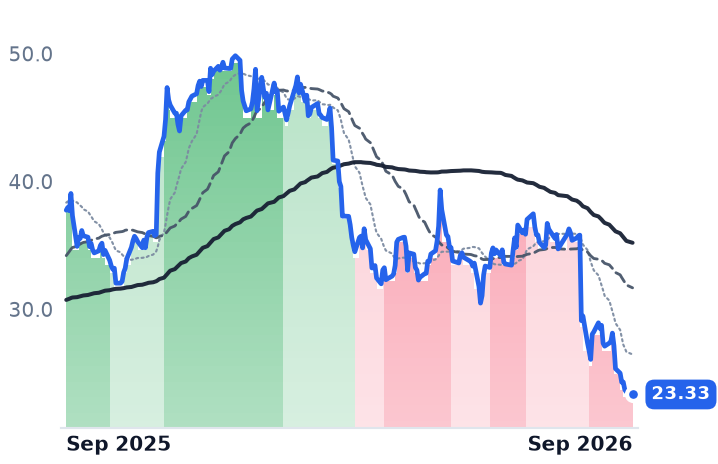
A company that buys approved drugs rather than discovering them can lose a quarter of a product's revenue without losing a single prescription. Collegium's Nucynta tapentadol franchise fell 24% year over year to $35.2m in the June quarter because Hikma's authorized generic — a copy Collegium itself licensed — clears at 10-15% of branded immediate-release price. Guidance came down on August 6 and the shares closed 18.7% lower that day, then kept sliding.
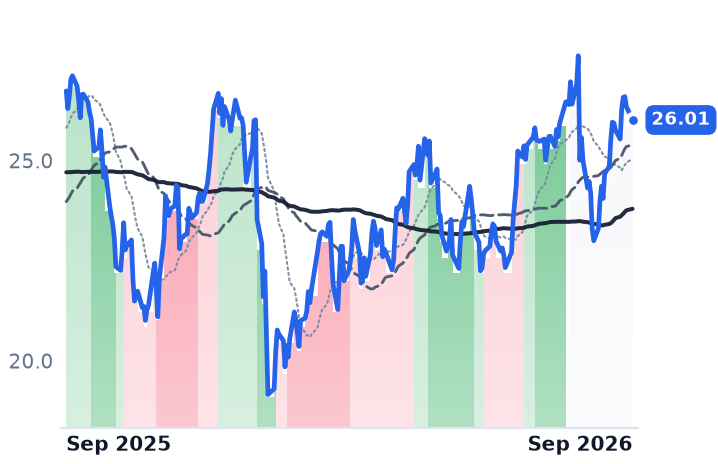
Pacira is the mirror image inside the same industry label: EXPAREL revenue grew 3% on roughly 4% procedure growth, so its net price is slipping too, but the number of Americans whose insurers pay for it separately is widening. Collegium at 2.5 times trailing enterprise value to earnings before interest, taxes, depreciation and amortization, against Indivior's 10.6, is less cheap than finite: Belbuca, about 28% of guided revenue, carries a contractual January 2027 generic date.
| Ticker | Company | Segment | Trend · 13mo | 30D | 1Y |
|---|---|---|---|---|---|
| The subject · what this brief is about | |||||
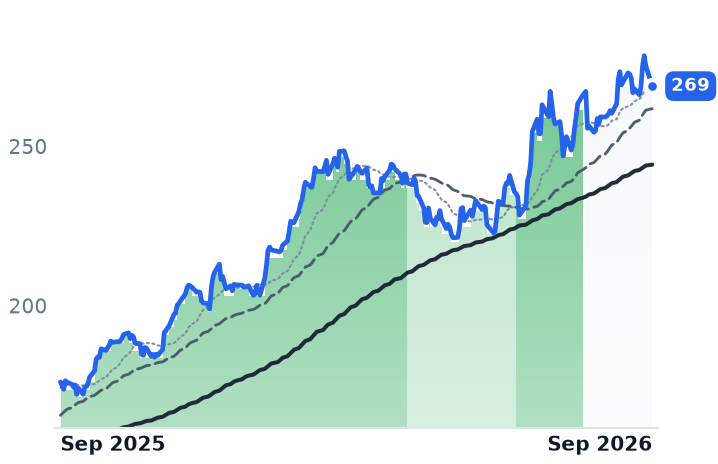
COLL | Collegium Pharmaceutical | Specialty Branded Pharma | ⚠️ Emerging Bear | −14.7% | −38.2% |
PCRX | Pacira BioSciences | Specialty Branded Pharma | 🌱 Emerging Bull | +7.0% | −2.7% |
| Compared against · context, not the story | |||||
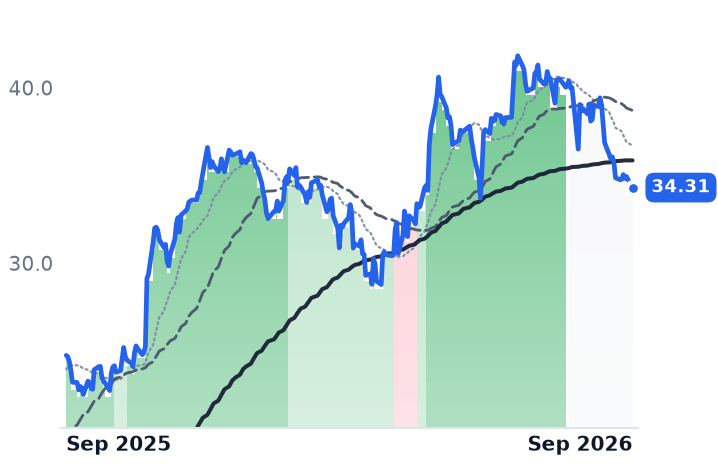
INDV | Indivior Pharmaceuticals | Specialty Branded Pharma | 🟢 Cont. Bull | −10.9% | +38.7% |
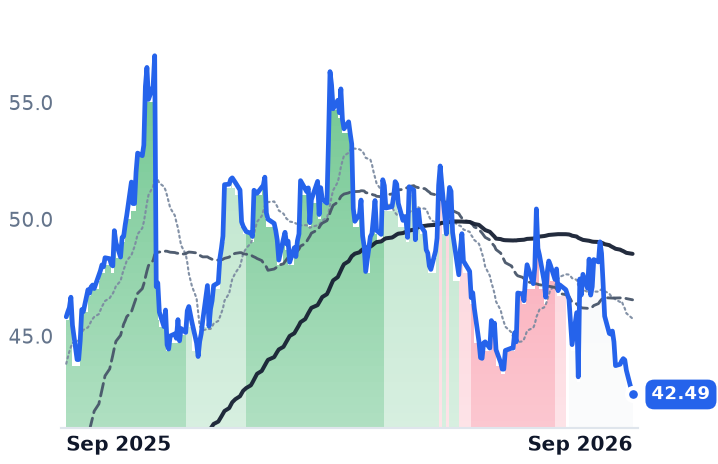
SUPN | Supernus Pharmaceuticals | Specialty Branded Pharma | ⚠️ Emerging Bear | −9.7% | −7.3% |
JNJ | Johnson & Johnson | Oncology | 🟢 Cont. Bull | +3.7% | +52.7% |
12-month price & trend
| Ticker | Mkt cap | P/E | P/E fwd | P/S | P/S fwd | P/GP | P/GP fwd | EV/EBITDA | FCF yld |
|---|---|---|---|---|---|---|---|---|---|
COLL | $758.0M | 15.3x | 3.1x | 0.9x | 0.9x | 1.6x | 1.5x | 2.5x | 43.3% |
PCRX | $1.0B | 73.5x | 9.0x | 1.4x | 1.4x | 1.7x | 1.7x | 10.7x | 17.6% |
INDV | $4.3B | 12.1x | 8.1x | 3.2x | 3.2x | 3.8x | 3.8x | 10.6x | -2.6% |
| Ticker | Mkt cap | P/E | P/E fwd | P/S | P/S fwd | P/GP | P/GP fwd | EV/EBITDA | FCF yld |
|---|---|---|---|---|---|---|---|---|---|
SUPN | $2.5B | n/m | 16.5x | 3.0x | 2.8x | 3.4x | 3.2x | n/m | 0.8% |
JNJ | $545.7B | 26.3x | 19.6x | 5.7x | 5.4x | 8.2x | 7.8x | 17.1x | 3.3% |
Consensus projections
| Ticker | FY2026E | FY2027E | FY2028E | |
|---|---|---|---|---|
COLL | Revenue | +7.1% | −1.0% | −1.0% |
| EPS | −0.1% | −9.4% | −13.9% | |
PCRX | Revenue | +3.2% | +4.7% | +13.1% |
| EPS | −2.4% | +19.6% | +37.1% | |
INDV | Revenue | +11.8% | +5.1% | +6.4% |
| EPS | +79.4% | +9.4% | +4.8% | |
SUPN | Revenue | +25.1% | +56.0% | +21.3% |
| EPS | −17.2% | +73.9% | +21.1% | |
JNJ | Revenue | +7.6% | +6.7% | +6.7% |
| EPS | +7.2% | +10.2% | +10.3% |
Forward fiscal years only. Blank means no analyst coverage for that year.
Collegium Pharmaceutical, a Stoughton, Massachusetts company that buys approved pain medicines rather than inventing them, told investors on August 6 that its full-year revenue would land between $825m and $855m, down from $865m to $895m. Almost none of the shortfall was patients or prescriptions. It was the price per unit the company collects after rebates, chargebacks and discounts — and the discount doing the damage was one Collegium arranged itself.
That distinction is the whole business model. A specialty branded pharma company of this kind has no laboratory; it has a balance sheet. It borrows to buy drugs that are already approved and already selling, and repays out of whatever exclusivity remains on them. Its reported revenue is therefore a wasting asset with dates attached, and the meter that matters is net revenue per script, not the growth rate on the top line.
The generic Collegium licensed to itself
Collegium signed an authorized generic agreement with Hikma Pharmaceuticals USA covering Nucynta and Nucynta ER, and Hikma has launched. Those copies clear at 10-15% of branded immediate-release price and 20-25% of the extended-release price, so the franchise cannibalizes itself: Nucynta revenue fell 24% to $35.2m in the June quarter, including $5.1m from the generics, while units largely held. Xtampza ER, the abuse-deterrent oxycodone, fell 14% to $45.0m — $2.4m of that gap was rebate timing in the prior-year quarter, an accounting artifact of the same gross-to-net machinery. "I would expect the net pricing to have stabilized at this point, and that is reflected in our full-year guidance," chief financial officer Colleen Tupper said on the August 6 call. Gross margin fell to 55.2% from 57.7%; operating margin went from 18.7% to 1.9%, with a $15.1m loss after $24.1m of acquisition costs.
The calendar behind the rest is public. Belbuca, at $57.7m the second-largest product, has a contractual January 2027 generic entry date under a Teva settlement; Xtampza's licensed generic cannot arrive before September 2033. The offset is attention-deficit medicine: Jornay PM grew 41% to $46.1m and holds 29.2% of the branded long-acting methylphenidate market, and Azstarys, bought from Corium for $650m cash partly on a $300m delayed-draw term loan, is protected into 2037. Net debt sits at 2.1 times adjusted EBITDA, with $210m of 2.875% convertible notes due February 2029. Consensus already models earnings per share falling from $7.47 this year to $5.83 in 2028.
The same mechanism, running the other way
Pacira BioSciences sells EXPAREL, a liposomal bupivacaine injected during surgery, and ZILRETTA for knee osteoarthritis. Its unit is a procedure, not a prescription. EXPAREL grew 3% to $147.8m on about 4% volume, so net price slipped there too, on vial mix and third-party group-purchasing discounts live since mid-2025; adjusted gross margin fell to 78% from 82%. But its price line is being widened by payers, not narrowed: UnitedHealthcare began reimbursing EXPAREL separately on July 1, taking covered lives with separate payment to roughly 150m. Pacira also sold the iovera cryoanalgesia device to Zimmer Biomet, closing July 31 for $73.6m, which is why its own revenue guidance came down. Its generics are contractually deferred to volume-limited quantities from early 2030. Consensus earnings rise, from $2.88 to $4.73 by 2028.
What the market is actually pricing
This is not a sector event. Indivior is up 39% over twelve months and agreed an all-stock merger of equals with Supernus on August 3, consolidation being the industry's standard answer to an exclusivity clock. Collegium fell into a rising market. At 2.5 times trailing EV/EBITDA against Indivior's 10.6 and Pacira's 10.7, and on a 43% trailing free-cash-flow yield, Collegium's shares are not priced as a bargain but as a terminal value: cash flows that are real, contracted, and dated. The business genuinely deteriorated, so the 38% twelve-month decline is earned; what nothing yet settles is whether the ADHD leg compounds faster than the pain portfolio decays.
Both companies sell relief they did not invent, and both now depend on paperwork more than promotion. Collegium's next test is a Teva launch window that opens in January 2027; Pacira's is the Medicare non-opioid payment provision that lapses on December 31, 2027 unless Congress extends it. Neither sales force can move either date.