

Expand Sold Two-Thirds of Its 2026 Gas Forward as EQT Left Next Year Mostly Open
Hypothesis Opus 5 · Research Opus 5 · Writing Opus 5 · Prompt v1.6
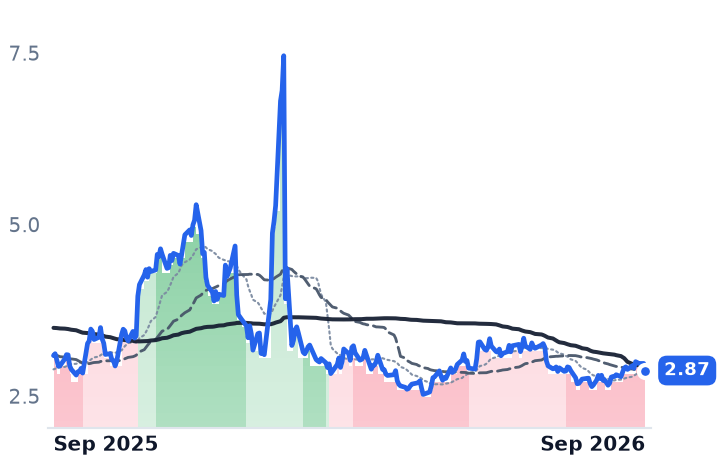
Appalachian gas producers spent the summer curtailing wells and are now turning them back on, and the reason is the forward curve rather than today's price: Henry Hub is still $2.87 per million British thermal units while gas flows to US export terminals climbed to 18.3 billion cubic feet a day in early September from 17.2 in August.
That sets up an uncomfortable split. Expand Energy, the cheapest of the three at 3.88 times trailing enterprise value to EBITDA, has already pre-sold 66% of its 2026 gas and 41% of 2027, and its June-quarter revenue fell 19.7%. EQT, essentially unhedged into the demand step-up, is the most expensive at 12.1 times trailing earnings on revenue down 29.2%. Only Range Resources grew, and it did so on liquids, not gas.
| Ticker | Company | Segment | Trend · 13mo | 30D | 1Y |
|---|---|---|---|---|---|
| The subject · what this brief is about | |||||
EXE | Expand Energy | Appalachian Shale Gas | 🔴 Cont. Bear | +4.1% | +6.2% |
EQT | EQT | Appalachian Shale Gas | ⚠️ Emerging Bear | +3.2% | +9.9% |
RRC | Range Resources | Appalachian Shale Gas | ⚠️ Emerging Bear | +6.5% | +24.9% |
| Compared against · context, not the story | |||||
CRK | Comstock Resources | Diversified Onshore & Conventional | 🔴 Cont. Bear | +6.9% | −0.8% |
AR | Antero Resources | Appalachian Shale Gas | 🔴 Cont. Bear | +7.5% | +23.5% |
NG=F | NG=F | — | 🔴 Cont. Bear | +5.1% | −7.1% |
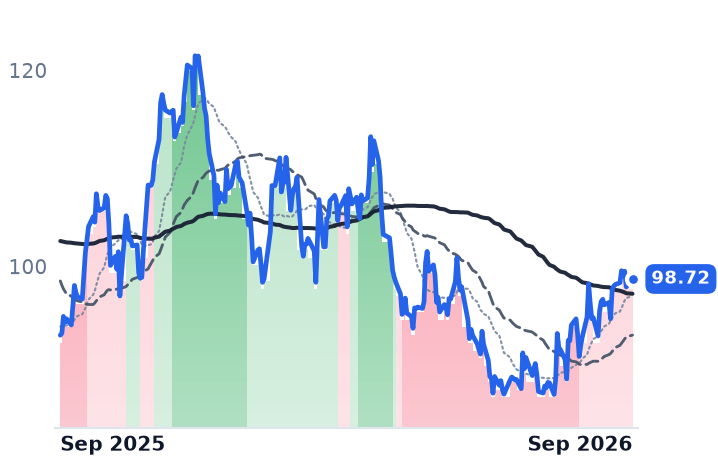
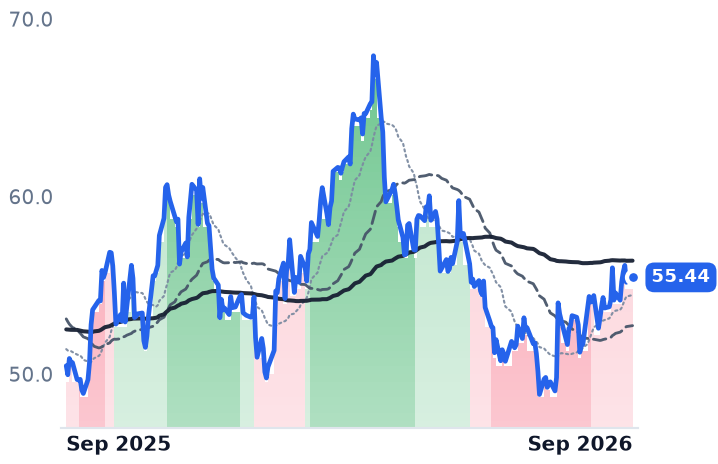
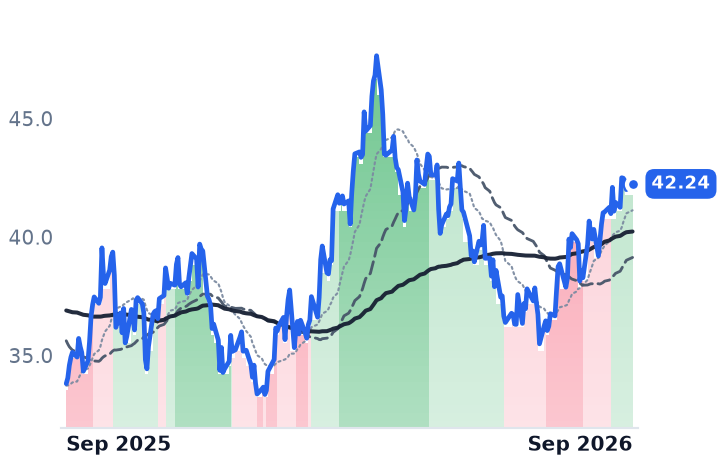
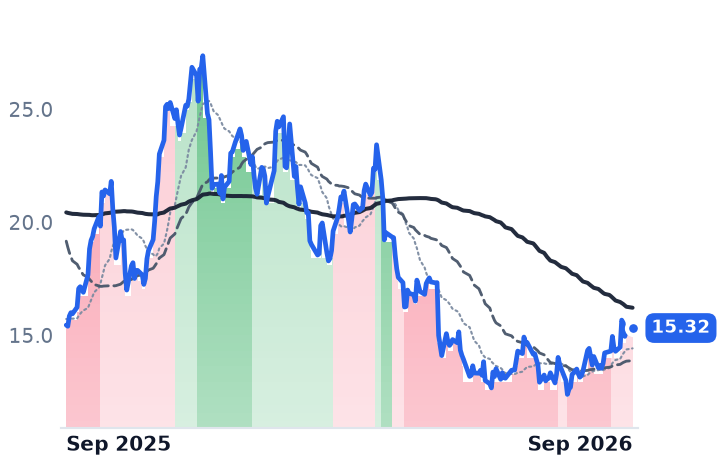
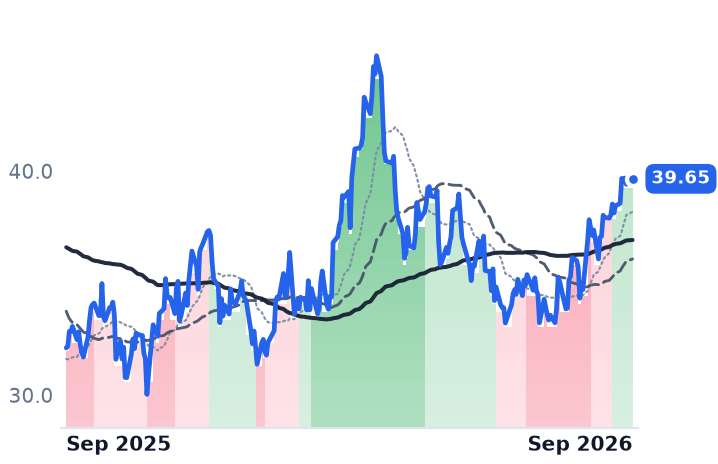
12-month price & trend
| Ticker | Mkt cap | P/E | P/E fwd | P/S | P/S fwd | P/GP | P/GP fwd | EV/EBITDA | FCF yld |
|---|---|---|---|---|---|---|---|---|---|
EXE | $22.7B | 8.4x | 10.9x | 1.7x | 1.7x | 2.7x | 2.7x | 3.9x | 11.2% |
EQT | $34.5B | 12.1x | 13.5x | 3.7x | 3.7x | 5.4x | 5.4x | 6.5x | 10.9% |
RRC | $9.8B | 11.5x | 10.3x | 3.0x | 2.8x | 6.2x | 5.8x | 7.6x | 12.0% |
| Ticker | Mkt cap | P/E | P/E fwd | P/S | P/S fwd | P/GP | P/GP fwd | EV/EBITDA | FCF yld |
|---|---|---|---|---|---|---|---|---|---|
CRK | $3.9B | 7.6x | 32.0x | 2.1x | 2.0x | 3.1x | 3.0x | 5.2x | -18.7% |
AR | $12.1B | 11.2x | 9.3x | 2.2x | 1.8x | 8.3x | 6.9x | 7.0x | 11.6% |
NG=F | — | — | — | — | — | — | — | — | — |
Consensus projections
| Ticker | FY2026E | FY2027E | FY2028E | |
|---|---|---|---|---|
EXE | Revenue | +15.4% | −4.0% | +6.1% |
| EPS | +50.0% | −5.1% | +22.8% | |
EQT | Revenue | +11.4% | −1.0% | +11.1% |
| EPS | +39.1% | −5.5% | +38.0% | |
RRC | Revenue | +17.7% | +2.5% | +8.1% |
| EPS | +40.2% | −4.7% | +21.6% | |
CRK | Revenue | +2.5% | +16.5% | +12.5% |
| EPS | −20.6% | +71.4% | +79.2% | |
AR | Revenue | +31.0% | −0.2% | +8.5% |
| EPS | +134.9% | +2.7% | +27.8% |
Forward fiscal years only. Blank means no analyst coverage for that year.
Appalachian producers who shut in wells this summer have started bringing them back. The winter forward price at the TETCO M-2 hub, the benchmark for gas leaving the northern Marcellus, has narrowed its discount to Henry Hub by about 45 cents over five months, and gas flowing to the nine large US liquefied natural gas export plants rose to 18.3 billion cubic feet a day in early September from 17.2 in August as Texas facilities came back from maintenance. The spot price did none of this work: Henry Hub settled at $2.872 per million British thermal units on September 8, and the Energy Information Administration cut its 2026 forecast to $3.44 from $3.67 while projecting a record 3,985 billion cubic feet in storage at the end of October.
So the question for the three largest listed Appalachian and Haynesville producers is not whether the export pull arrives. It is how much of each company's gas is still for sale when it does. A hedge book layered years in advance is the difference between owning that curve and having sold it.
The book that is already sold
Expand Energy, formed when Chesapeake renamed itself in 2024 and now North America's largest gas producer with roughly 5,000 wells across the Marcellus and the Haynesville, had hedged 66% of its 2026 volumes and 41% of 2027 as of late July, using swaps and collars. It realized $2.42 per thousand cubic feet of gas in the June quarter, down 17.4% year on year; revenue fell 19.7% to $2.96bn and operating margin compressed to 22.3% from 34.4%. Management put standalone breakeven near $2.70 per thousand cubic feet before dividends, told investors the market stays oversupplied through at least the first half of 2027, and let roughly ten Haynesville well completions slip — "happy to allow these to float into 2027," on the July 29 call. It also bought $1.25bn of gas marketer Twin Eagle. "We're already North America's largest natural gas producer, and now we'll be its leading gas marketer," interim chief executive Michael Wichterich said on July 27. Expand has had no permanent CEO since February.
The book that is open
EQT, the Pittsburgh producer with 25 trillion cubic feet of proved reserves and 1.7m Marcellus acres, is the opposite exposure. Its 2027 hedges amount to roughly 1.5 billion cubic feet a day of swaps at $3.16 plus collars — thin against a company that sold 634 billion cubic feet equivalent in the June quarter at a differential of minus $0.67 to the NYMEX benchmark, with unit operating costs of $1.03 and $330m of free cash flow. The reported profit is where the openness shows: revenue down 29.2%, diluted earnings of $0.44 against $1.30. EQT is selling demand instead, including 325,000 dekatherms a day for ten years to a two-gigawatt West Virginia power plant, priced off PJM electricity rather than in-basin gas. The agreement "provides EQT a substantial premium over in-basin pricing," chief executive Toby Rice said on July 21.
Range Resources, the Fort Worth-based Marcellus operator with about 794,000 net acres, was the only one of the three to grow: revenue up 19.1% to $834m, operating margin 39.1% against 26.8%. It realized $3.53 per thousand cubic feet equivalent including hedges, of which just $0.16 came from settled contracts. The rest was mix — natural gas liquids at $29.10 a barrel, and full-year guidance raised to a premium of $2.00 to $2.50 over the Mont Belvieu benchmark. Range also added roughly $1.1bn of firm midstream commitments and guides transport, gathering and processing at $1.55 to $1.60 per thousand cubic feet equivalent, a fixed cost that solves takeaway and does not go away in a weak quarter.
What the shares are paying for
All three regained an uptrend during August after a spring slide, and over the past month Expand rose 6.3%, EQT 7.3% and Range 10.3%; over six months Expand and EQT are still down 8.5% and 10.9%. Consensus models 2027 earnings per share lower at every one of them — roughly 5% down apiece — which encodes the curve rather than any operating stumble.
The verdict is that the rally is real and misallocated. The export pull is a mechanism, not sentiment, but it is dated to late 2027 and beyond by Expand's own market view, and the storage table says nothing is tight today. Range earns its move outright: it grew, and it grew on barrels priced off crude. Expand's move is earned by cash rather than the curve — an 11.2% trailing free-cash-flow yield and the cheapest cash-earnings multiple of the three, on a book whose next year is largely pre-sold and cannot rise with the strip. EQT's is the one nothing in the reported numbers explains: the most expensive of the three at 12.1 times trailing and 13.5 times forward earnings, on the steepest revenue decline. What the market is buying there is the open volume itself.
Storage will peak near a record in seven weeks, and every molecule of it is a reason the tightness stays a 2028 argument. Expand has sold most of that argument forward. EQT has kept it.